After my sermon last Sunday, a friend asked, “How many books do you read per week?”
Surprisingly, the answer is usually “less than one.” To be sure, I read daily: Scripture and academic works in the morning; and something outside my field at night—fiction, history, or biography. (I’m currently near the end of Simon Schama’s fantastic but entirely-too-long history of the French Revolution.)
Still, I suspect I read slower than most people.
My friend’s question emerged because I had referenced several books in the sermon (probably too many books, if I’m honest). These authors included A. J. Swoboda, Joshua Jipp, Will Guidara, Ingrid Faro, and Wendell Berry. And, you know, Luke’s Gospel.
I was able to draw on these books, not because I had read them last week. (Only one fell into that category, and I didn’t finish it.) Instead, I could retrieve them because of the way I read and annotate books. (And I do mean physical books—with pages, spines, and a total lack of pixels.)
I mark them up like a graffiti artist tagging a boxcar and I dog-ear pages with content I want to retrieve, usually with a one- or two-word annotation: “Blog post,” “Article,” “Micah 6:8 book,” “Sermon Illustration,” “Atonement doctrine,” “No!”
When it’s time to write a message, a lecture, or a book of my own, I’ll consider what previously-read works in my library might add something; then I’ll flip through the dog-eared pages quickly to see what fits. It might take 30 seconds per book.
The massive benefit, however, is that I’m able to retrieve things that I no longer remember.
Perhaps that habit can help you too.
Of course, some caveats apply:
You can’t dog-ear every page. If you highlight each word, you might as well not do it. I aim for less than ten dog-ears per book (four or five is best), otherwise you’re just doing entry-level origami.
Slow down. Reading is about growth, not “finishing.” Studies suggest slower readers—that is, those who read at the pace of speaking rather than the pace of word-recognition–retain and remember far better than others. Hear this: In a world of distracted digital rabbits, be the turtle.
Read broadly. No one wants to listen to someone who only reads business books (welcome to the late 90s and early 2000s in many evangelical denominations), or sports, or academic tomes, or jingoistic histories, or partisan political opinions disguised as “a Christian worldview.” The best writers, preachers, and thinkers read broadly. After all, I can only speak to all of life if I read intentionally in ways that touch upon the diversity of human experience. Otherwise, we become like the old man on the Simpsons who proclaims loudly that he hates everything but Matlock and Metamucil.
Man cannot live (or preach) on books alone. As much as I want to champion reading actual books over the brain-rot of cable news, TikTok, smartphones, and the temptation (even in academia…) to say “AI” over and over as if it’s a magic spell that substitutes for thought and work and expertise—the fact remains that we live increasingly in a post-literate age. Hence, I’ve been inspired by authors and preachers who can draw not only on books, but on other sources too. I recall several moving illustrations in Jake Meador’s recent work that came from the world of streaming television—since, let’s be real, his audience is more likely to recognize those illustrations than they are a reference to Charles Dickens. Thus, when Jesus preached, he told more stories about seeds than Stoic philosophers.
CONCLUSION
In the end, take this as an encouragement that slower readers can still be deeply formed by books—and then pass that blessing on to others. In fact, formation may be more substantial precisely because of its slowness. Likewise, one need not have a photographic memory to retrieve wisdom and beauty from texts that no longer occupy one’s short-term memory.
Reading is rereading.
And marking.
And dog-earing.
And pulling off the shelf when the time is right.
Hear then, the word of the Lord: Be the turtle. Make reading great again. Practice selective, recollective origami.
In fact, if you’re looking for some books to practice on, see here.
Hello friends, and thanks for reading. Please subscribe via the button on the home page to receive future posts by email. This is especially valuable to me since I’ve decided (mostly) to uncouple the blog from social media. I’m grateful for you. ~JM
“I’ve found it an effective rule of therapy to accept . . . that most people nowadays are possessed.”
So says the psychiatrist Dr. Thomas More in Walker Percy’s darkly funny dystopian novel, Love in the Ruins. The subtitle describes it as “The Adventures of a Bad Catholic at a time near the End of the World.”
I was carrying the novel through a Tulsa coffeeshop recently when a stranger stopped me to remark, “That book changed my life.” (What a gift it to hear such words in an age where many of us spend our free time staring into 3-inch screens that are the self-authorized equivalent of Fahrenheit 451.)
Percy was a Southern writer and a practicing Catholic whose works engage themes of alienation, faith, and the decline of American culture. Though written in 1971, Love in the Ruins reads as more relevant than ever in its focus on cultural unraveling, partisan factions descending toward violence, unchecked technological power, and, well . . . demonic possession.
After all, how else can you describe some of the mind viruses that have taken root in segments of American cultural and political life?
The book is also funny. All sides are skewered, but my favorite barb involves a group of (clearly) evangelicals who partner with an evangelistic organization to hold Pro Am golf tournament that includes a massive banner which reads, “Jesus Christ: Greatest Pro of them All!”
But back to Satan.
A WHIFF OF SULFUR
It can be a dangerous to speak of demons and possession loosely.
Richard Beck rightly observes that we too often smell “a whiff of sulfur” around our enemies. Hence, allegations of satanic interference have been (and still are) used to excuse acts of violence. (They were used that way against Jesus.) And in the words of a more recent writer, “They’re burning all the witches, even if you aren’t one.”
Still, I’ve been struck recently by passages like 1 John 5:19:
“…the whole world is under the control of the evil one.”
What does that sound like? (And believe me, I am not speaking only of non-religious folks when considering the afflicted.)
I was at an conference years ago where a roomful of academics (the technical term is a “balding of professors”) were debating the difference between being “filled with the Spirit” and being “possessed.” One of which we normally assume to be more common than the other.
At this point, the distinguished scholar Ephraim Radner spoke up to say something like the line from Percy: “Well, maybe the whole world is possessed.” It carried weight since he’s about the farthest thing imaginable from a wild-eyed witch-burner, or an exorcist for hire.
My goal here is not to exhaustively develop this idea.
Partly because I do not know what to make of it.
So let’s turn to two quotes from authors smarter than myself.
C. S. LEWIS
First, C. S. Lewis, in The Abolition of Man:
“We are born into a world where magic and miracles are seen as fairy tales, but in truth, we are under a spell ourselves—the spell of modernity. To break this enchantment, we need the strongest enchantment of all.”
He’s wrong to call it modernity.
Or at least that label no longer seems right. Perhaps Nietzsche was closer when writing of the “old strong gods” returning to the stage after mistakenly being assumed dead somewhere in a prior Act of the drama.
L. M. SACASAS
Second, here is L. M. Sacasas, in his argument (borrowed from Robin Sloan) on the need for “verbal amulets”—a metaphor for short quotations that have the power to guard our hearts and minds against the “spirits of our age.”
Such phrases or fragments [are] charged with a certain power. Like an amulet worn around the neck, these words might somehow shield or guide or console or sustain the one who [holds] them close to mind and heart.
In this way, these words may function like prayers of blessing and protection against a kind of “groupthink” that could almost be termed, corporate possession.
Sacasas suggests the following as examples holding exorcistic promise:
“Ideologies are never interested in the miracle of being.” ~Hannah Arendt
“We do not obtain the most precious gifts by going in search of them but by waiting for them.” ~Simone Weil
“We live the given life, and not the planned.” ~Wendell Berry
“Attention has moral implications.” ~L. M. Sacasas
AN AMULET OF MY OWN
I’ve been pondering all of this as I work on my next book, which offers what I hope will be a “spell breaking” look at a single verse of Scripture (a verbal amulet from the Old Testament). More on that some other time.
The working dedication reads as follows:
For Teddy Brian McNall
Here is an amulet. Put it on. It is made not of precious metal, gems, or bone— But of ancient words in foreign tongue. Keep it close to ward off the evil spirits of our age.
And here’s to you this week, dear reader:
May you receive the gift of exorcism.
Hello friends, thanks for reading. Please subscribe to receive future ones by email. This is especially valuable to me since I’ve decided not to promote the blog much on social media these days. I’m grateful for you. ~JM
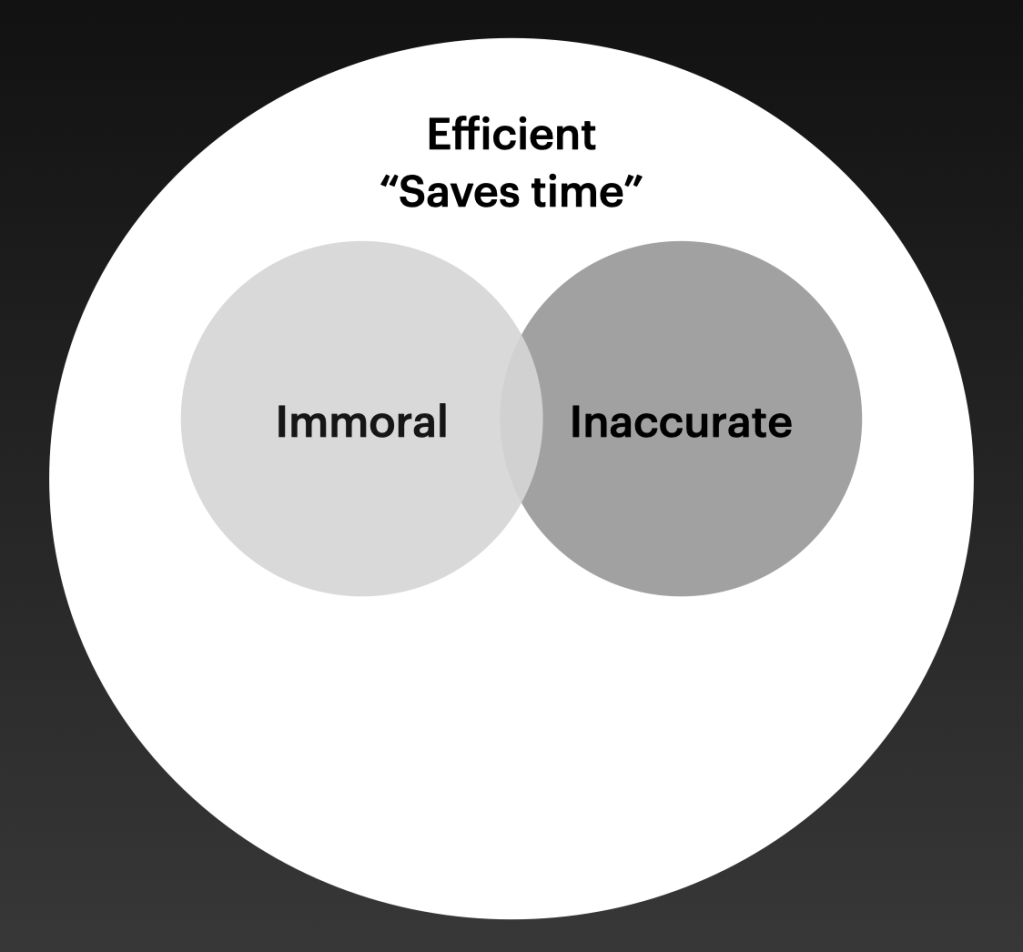
I created a Venn diagram recently to articulate when I think use of AI is ethical and when it’s not.
The smaller circles represent ways in which use of AI is problematic, while the remaining white space illustrates helpful ways in which one may utilize it to save time or accomplish meaningful tasks.
I want to be clear on two points: First, I do use programs like Chat GPT for some things. So I am not proposing a blanket rejection. And second, my focus here is almost exclusively on LLMs (Large Language Models) used to generate text and language. Thus, I am not interested in other ways that AI may be helpful, say, in coding, accounting, or other areas of life. My focus is on words.
My question is a simple one: When do programs like ChatGPT contribute to the good life, and when do they make me dumber, less personal, and less capable of being formed into a thoughtful and connected human being?
Let’s start with efficiency. As Jacques Ellul famously warned, the modern pull of “technique” tempts us to reduce every aspect of life—including relationships and spirituality—to a question of efficiency. In essence, if it saves time, do it.
Of course, efficiency may be a good thing. I do not ride a donkey to the office. I own a dishwasher. And I do not etch my writing on wax tablets. Broken, inefficient processes can be both frustrating and blameworthy. However, there are times when the modern idolatry of efficiency causes harm to others and ourselves.
Allow me to explain:
Circle #1: Efficient but Immoral: The most obvious way AI-use becomes unethical is when our drive to save time leads to immoral choices. Case in point: When I ask students not to use ChatGPT for a particular assignment (because I want them to think and grow by wrestling with ideas and words), to do it anyway is cheating. True, they may not get caught. But it is wrong nonetheless. Likewise, if my church expects me to write my own sermons (as they ought to… ), if I outsource an undo amount of that reflection to a robot, I am in the realm of immorality.
Frankly, many immoral decisions (whether robbing a bank or visiting a prostitute) are driven partly by our thirst for efficiency, which is to say, the drive to get something as fast as possible with the least amount of effort. And in these cases, the fact that it “saves time,” is hardly an excuse.
Circle #2: Efficient but inaccurate: A second problem with AI is the proliferation of falsehoods, inaccuracies, and other bogus depictions of reality. That’s because while programs like ChatGPT do a great job of producing grammatically correct sentences, they do not necessarily prioritize truth.
Hallucinations abound. And evidence is not hard to find: Sites like Google now prioritize bogus AI images of real animals, even when they look nothing like the actual creatures being searched.
LLMs invent sources that don’t exist, as attested by a friend of mine who was surprised to find his own name in footnotes, listed as the author of numerous academic works that don’t exist. And by some accounts, it’s going to get worse.
“Even OpenAI admits that users will notice ‘tasks where the performance gets worse’ in its latest generation chatbot. …
This isn’t a flaw in AI, but a limitation in the training materials. The highest quality training sources have already been exhausted—so AI is now learning from the worst possible inputs: Reddit posts, 4Chan, tweets, emails, and other garbage.
It’s going to get worse. Experts believe that AI will have used up all human-made training inputs by 2026. At that point, AI can learn from other bots, but this leads to a massive degradation in output quality.
In other words, AI will soon hit a brick wall—and face a dumbness crisis of epic proportions. That will happen around the same time that AI will have pervaded every sphere of society.
Are you worried? You should be.”
I can’t say whether all of this is accurate. But it further raises the specter of “the bogus” at a time when we are already drowning in it.
Circle #3: Efficient but impersonal: Now for the saddest (and weirdest) one.
As I watched the 2024 Olympics on Peacock with my kids, one of the commercials that ran on maddening repeat was the now infamous “Dear Sydney” ad for Google Gemini. The premise is bizarre. A dad asks AI to write a fan letter on behalf of his daughter to the American sprinter, Sydney McLaughlin-Levrone: “I’m pretty good with words,” he intones, “but this has to be just right.”
Responses to the ad were a mix of confusion coupled with a collective gag reflex. WHO IN THEIR RIGHT MIND WANTS AN AI-WRITTEN FAN LETTER!?? pretty much summed it up. Or in the words of Alexander Petri, that ad “makes me want to throw a sledgehammer into the television every time I see it.” After all, how do you possibly ruin the universally endearing act of a child authoring an imperfect but adorable note to her hero? Hey Gemini, can you help with that?
Google isn’t alone. I heard recently of a dad who asked ChatGPT to write the speech for his daughter’s wedding. And I personally received an 10-page email from a stranger, asking me to answer a list of questions about one of my books, The Mosaic of Atonement. For a small-time author, letters from readers can be encouraging (and sometimes not). But this one ended with an admission saying that it had been composed by AI. To be clear, the sender hadn’t bought the book. He hadn’t read the book. And he hadn’t even taken time to WRITE THE EMAIL he had sent me. Still, he wanted me to write a long response. (A friend suggested that I plug his 10-page email into ChatGPT and ask for a 10,000 word reply in Klingon.)
My claim for this third circle is simple: We should reject AI in instances where more genuine human interaction and personal attention is reasonably expected. That’s not every use of words (as when I asked ChatGPT to help me smooth out the legal jargon in an insurance claim after my car was totaled… [I repent of nothing!]), but it does require us to discern what parts of life cannot be delegated without a loss of love and human care. As L. M. Sacasas writes, “attention has moral implications.” (And that includes fan letters, sermons, and your daughter’s wedding speech.)
The potential cost is high: In addition to someone wanting to throw a sledgehammer at you, our epidemic of loneliness will continue to creep into domains normally immune to it. After all, as C. S. Lewis wrote, “We read to know that we are not alone.”
Circle #4: Efficient but infantilizing: For those who care about education and formation, this may be the most important circle. Admittedly, “infantilizing” is probably not the best word for it, but it speaks to the fact that education and discipleship are meant to move us toward maturity. And on that point, L. M. Sacasas seems right to note that the most important question to be asked of any technology is, “What kind of person will this make me?”
That is, how will this use of AI shape me?
In the humanities especially, to labor slowly over words, sources, and ideas is—without question—the best way to grow as a thinker and communicator. Believe me, the work is slow and often frustrating. But it changes you in ways that cannot be accomplished otherwise. Somewhere in his five million published words, Saint Augustine remarks that “people will never know how much I changed my mind by writing.” That sentiment resonates for me—in part, because I read and wrestled with it as I wrote a PhD on Augustine’s theology. That work changed me, tedious though it was.
In at least some cases, when we outsource the labor of thought and articulation, we move backward on the scale from Idiocracy to Augustine—which is a pretty fair diagnosis of many ills that currently afflict our cultural, political, and spiritual lives. (Let the reader understand.) The grammatically correct sentence is not the goal of writing. The goal is a well-formed and mature person.
In the words of Alan Noble, teachers must attempt to convey that
“the process of writing, when done well, is working magic in their minds, making them into better thinkers, better readers, better neighbors, better citizens. That writing will help them know themselves and others around them. But that writing will also take hard work, just as all good things take hard work. And to use AI to help with that hard work will rob their minds of all those good things. It would be like going to the gym to lift weights only to have someone come along and lift them for you. You’ll never grow stronger. You’ll never grow. You’ll only waste your time.”
Perhaps this case feels like a losing proposition. So be it. A final lie from the idol of efficiency is that only “successful” tasks are worth undertaking.
But for teachers and pastors especially, when it comes to the case for wisdom in our use of technology, the words of T. S. Eliot (in “East Coker”) still echo over the wasteland of soulless bureaucratic prose:
“For us, there is only the trying. The rest is not our business.”
For further reading on this topic, the folks cited in this post are excellent: Alan Noble, Ted Gioia, Alan Jacobs, and L. M. Sacasas.
Hello friends, thanks for reading. Please subscribe to receive future ones by email. This is especially valuable to me since I’ve decided not to promote the blog much on social media these days. I’m grateful for you. ~JM
My colleague, Dr. Brian Turner, is a master teacher. Last week he drew my attention to a line from Jonah 1:17 while covering a class for me:
“Now the LORD provided a huge fish to swallow Jonah….”
Translations vary for the underlined verb: designated, prepared, ordained. They are all about the same. Yet it was Brian’s next question that stuck with me.
“Was that fish a punishment or a gift?”
Well?
Of course, the two need not always be opposed. In Jonah’s story as we have it, the thing that kept him from drowning was the monster that swallowed him.
I use “monster” advisedly since it is the word Jesus chose when recounting Jonah’s story in Matthew 12. In Mosaic of Atonement, I noted how Christ likens his own time in the depths of the earth to Jonah’s sojourn in the belly of a ketous: monster, sea beast, or sea serpent. Why say it that way? (There is, of course, another Greek word for fish [ikthus].)The early church had a field day with allusions to Leviathan and Sheol—and they are not entirely unwarranted.
But for my class, Dr. T’s conclusion was as follows: “That fish rescued Jonah.”
I’ve been thinking about that line ever since, and it feels pregnant with applications:
First, perhaps we ought to exercise some caution before distinguishing what feel like punishments from gifts of saving grace. The DUI. The divorce. The downsizing. All hurt tremendously. But time is needed to know how they might be turned for good.
Second, the line from Jonah reminds us that divine sovereignty is a mysterious but ultimately benevolent doctrine. Don’t believe the press. Though God authors neither evil nor death—he does enlist unlikely incubators in the service of his grace. He’s still preparing fish. Hence even “monsters” and Sheol may turn out to be part of the “all things” that work together for our good. That’s the sign of Jonah of which Jesus spoke.
Third, a deciding factor between punishment or gift was what Jonah chose to do while in the belly of the beast. So too for us. To be merely swallowed by the fruit of foolish choices (or mere bad luck) is not enough. To be clobbered may not change us for the better.
Not every jail cell is rock bottom. Not every diagnosis grants a new lease on life. Not every firing becomes “the best thing that ever happened to me.” What we do next matters.
As Jonah recounts: “I called out of my trouble and distress to the LORD, And He answered me; Out of the belly of Sheol I cried for help, And You heard my voice” (Jonah 2:2).
Of course, it would be wrong to diminish every tragedy or consequence as somehow a sugar-coated blessing in disguise. Not so. Sometimes a fish is just a fish. And some occurrences are just evil, plain and simple. Hence, Isaiah was right to pronounce “Woe to those who call evil good, and good evil” (5:20).
Still… I think Dr. T. was right to seize upon the value of this verse: “The LORD provided a huge fish.”
I’ll end with a line from Walter Wink that has always stuck with me when questioning which “monsters” to curse and which to kiss.
“History belongs to the intercessors—those who believe and pray the future into being. But to see the future, it is necessary to kiss the dragon—to embrace the terrifying and the repulsive—only then does it transform.”
Hello friends, if you enjoy this blog, please subscribe on the homepage. Future posts will be sent directly via email.





 joshuamcnall.com