
While his characters were getting better (a cautionary tale)

While his characters were getting better (a cautionary tale)

A bombshell landed on the literary world last year after the death of Cormac McCarthy, the man who had been, arguably, America’s greatest living novelist.

The shock was not McCarthy’s passing (he was 89), but a Vanity Fair article by Vincenzo Barney that broke news of a nearly fifty-year relationship with a woman named Augusta Britt—the “secret muse” whose life and personality inspired many of McCarthy’s greatest characters, most of whom were male.

“I’m about to tell you the craziest love story in literary history,” the article began.

The short summary put it this way:

Augusta Britt would go on to become one of the most significant—and secret—inspirations in literary history, giving life to many of McCarthy’s most iconic characters across his celebrated novels and Hollywood films. For 47 years, Britt closely guarded her identity and her story. Until now.
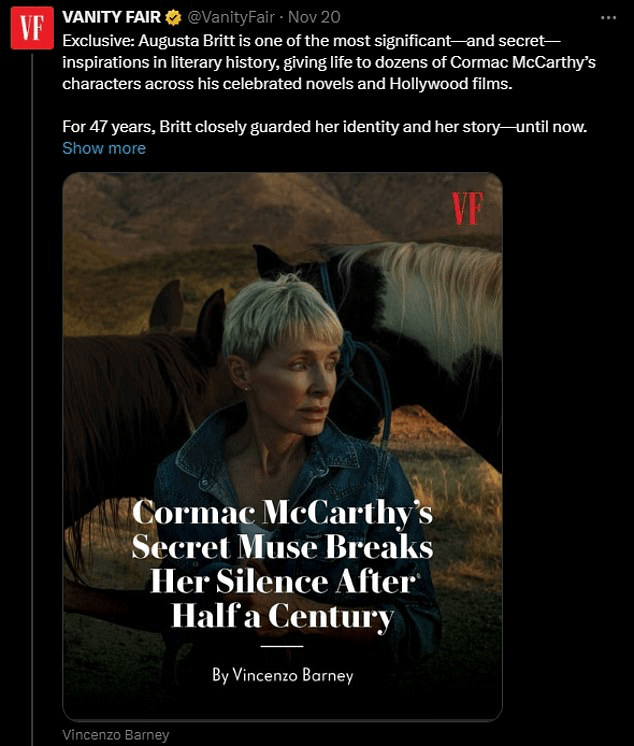
A firestorm ensued, in part, because the relationship began when Britt was just 16 and McCarthy 42. She met him by a hotel pool, while on the run from abuse within the foster system–a Colt revolver on her hip, his book in her hand. “Are you going to shoot me, little lady?” was allegedly McCarthy’s question.

Though Britt maintains that McCarthy saved her life, reactions to the article have understandably been mixed. “Let’s be honest with ourselves,” read a headline from The Guardian, “Cormac McCarthy groomed a teenage girl.”

I read the Vanity Fair piece back when it came out, which raises the question: Why write about it now, months later?

To be honest, a particular phrase sometimes gets lodged in my mind, long after I have read a book or article, and that’s essentially what happened here.

I’ve had a long relationship with McCarthy’s novels (see here and here), and he is undoubtedly one of the great writers of his generation. You can’t read books like The Road or Blood Meridian and not be struck by the power of his prose, the Christ-haunted characters, and the desert landscapes that seem to whirl and pulse in ways unmatched by any other author.

Unfortunately, great writers are not always great people. And in some cases, the relation seems to run the other way.

Here, then, is Augusta Britt’s assessment that stuck with me about McCarthy’s later years:

But as his characters started becoming better humans, in Britt’s view, McCarthy, whom she always thought of as a great man, did not. As he dined with celebrities and reinvented himself in Santa Fe as a formidable intellectual … he turned his back on his oldest friends. “He felt he’s wasted the last years of his life,” Britt says.

I can’t say if that’s true. (After all, running off to Mexico with a underage girl seems to work against the hypothesis that McCarthy’s moral compass became skewed primarily in his later years.)

Nonetheless, the potential divergence between one’s work and life strikes me as both interesting and relevant for all of us.

Why might one’s characters be getting better, while one’s character is either stalled or getting worse?

I’ve been struggling with a term to define the tendency, beyond mere hypocrisy. In the realm of spiritual formation, we might call this compartmentalization, rationalized regression, or a sort of moral transference. Psychologically speaking, transference involves the redirection to a substitute, often a therapist, of emotions or experiences that are (or ought to be) one’s own: in this case, from one’s character, to one’s characters.

Again, I don’t know if that happened with McCarthy, but I’m quite certain it’s a temptation for us.

Consider:

“While his sermons were getting better, his inner life was getting worse.”

“While her performance evaluations were getting better, her spiritual health was growing worse.”

“While his resume was getting better, his parenting was getting worse.”

If there’s a lesson here, perhaps it’s this: substitutionary sanctification is a dead end.

To amend one of my favorite verbal amulets from L. M. Sacasas, “[moral work] cannot be outsourced”–whether to AI agents or to characters between the pages of a book.


Hello friends. Please subscribe on the homepage to receive these posts by email. This is especially helpful since I’ve decided (mostly) to uncouple the blog from social media. Thanks for reading. ~JM

Against Corporate Word Vomit

Against Corporate Word Vomit

“Clutter is the official language used by corporations to hide their mistakes.”

William Zinsser penned that line in On Writing Well, but it resonates for anyone who’s had to endure a meeting or press release filled with what I affectionately call “corporate word vomit”—that is, recycled managerial euphemisms designed to mask bad news beneath a thin veneer of metaphor and sunny ambiguity.

For example: The branch isn’t closing. It’s going through a “strategic restructuring” to become more “nimble” so we can “pivot” toward “optimization” by “right-sizing” our “employee footprint” to “maximize efficiency” for the challenges and opportunities ahead. (Now box up your things.)

While I’m exaggerating, I’m convinced Christian leaders especially should reject this kind of talk as it tries to worm its way into churches, universities, and Christian non-profits. For one thing, there’s no precedent for it in the words of Christ, the prophets, or apostles. And there are many scriptural analogues to it in the language of false prophets, corrupt kings, and even Satan himself.

The trouble is not merely that such talk is inexact and weird (though it is); it’s that it verges on deception. Scripture frequently equates “smooth words” with deceit used to mislead the naïve. And for those who aren’t naïve, it can be both insulting and annoying.

Many years ago, I remember sitting through an update in which it was relayed that there would be substantial cutbacks because our numbers were “soft.” What is a soft number? I wondered. Is three more pillowy than four? Can you prick your finger on the sharp edge of a two? (Turns out, zero is softest; no edges at all.)

I was reminded of this frustration upon reading the official press release on the closing of Trinity Evangelical Divinity School’s Deerfield campus after years of financial difficulties. TEDS has long been a flagship evangelical seminary, and I’m sad for the loss of jobs and potential impact that will happen as the school is absorbed by Canada’s Trinity Western University. Yet upon reading the official announcement, there was so much verbal camouflage and clutter that the lede wasn’t so much buried as clothed in a ghillie suit and hidden in the bushes.

The lede

If there is a lesson here, it’s that Christian leaders (whether pastors, principals, CEOs, or university presidents) must find ways to marry truth with tact, rejecting evasive or deceptive corporate-speak in favor of calm but clear assessments of the reality at hand.

That’s difficult, and I suspect I’d fail at it on numerous occasions.

Still, the goals of clarity, simplicity, and truth-telling are worth pursuing. To steal a line to Habakkuk (2:2),

“Write down the revelation
and make it plain on tablets
so that a herald may run with it.”

If that fails, imagine that upon each use of evasive managerial jargon (nimbly pivoting to right-size optimal efficiency), a kitten dies.


Hello friends. Please subscribe on the home page to receive these posts by email. This is especially helpful since I’ve decided (mostly) to uncouple the blog from social media. I’m grateful for you. ~JM

A church for (and against) the world

A church for (and against) the world

What should be the church’s posture toward the world?

The challenge, as with bodily posture (hunched shoulders, rounded back, neck forward), is that posture solidifies at a subconscious level, without us noticing. (Did you just sit up straighter?)

To this point, I recently reread an excellent essay by the theologian, Natalie Carnes with the following subtitle: “Reconsidering the Church-World Divide” (here). She begins by drawing attention to other articles with titles like this: “World versus Church: Who Is Winning?” (…a line that could only be more cringeworthy if read by Howard Cosell).

I won’t rehash Carnes’ full argument, but it includes a helpful reminder that Scripture contains BOTH protagonistic and antagonistic passages on the church-world relationship. Both “for” and “against.”

Church Against World

For instance,

“You adulterous people, don’t you know that friendship with the world means enmity against God?

~James 4:4

Or even stronger,

Do not love the world or anything in the world. If anyone loves the world, love for the Father is not in them.”

~1 John 2:15

Church For the World

On the other hand, numerous passages reveal God’s radical heart for the world, which calls us to a similar “for-ness”: loving, serving, and practicing incarnate presence.

Most famously,

God so loved the world that he gave his one and only Son, that whoever believes in him shall not perish but have eternal life. For God did not send his Son into the world to condemn the world, but to save the world through him.”

~John 3:16

And this,

God was reconciling the world to himself in Christ, not counting people’s sins against them. And he has committed to us the message of reconciliation.”

~2 Corinthians 5:19

The following line from 1 John is even more interesting since it comes in the same book (above) that contains, arguably, the strongest anti-world prooftext:

“He [Jesus] is the atoning sacrifice for our sins, and not only for ours but also for the sins of the whole world.”

~1 John 2:2

Pro or Contra?

So… which is it?

Should the church be for or against the world?

It has long been acknowledged that different passages can mean different things while using the same word. Hence, “world” (cosmos) is a bit like “flesh” in its varied biblical meaning. In some cases, it means God’s good-but-fallen creation, loved and reconciled by Christ’s work. In others, it refers to a willingness to embrace ideologies and behaviors that set themselves in destructive opposition to goodness, beauty, and truth. Hence, as my former professor, David Wells, once wrote: “worldliness is anything that makes sin seem normal and righteousness seem strange.”

In the end, this much seems true: A Christ-like church must be both for and against “the world.” Yet the more important point is that this dual posture cannot take any form we wish: Our antagonism must always be housed within a larger protagonism.

Carnes puts it like this:

“the ‘versus’ of the church and world is enfolded into a larger for-ness. . . . There is a kind of against-ness: God did not leave the world to its own deterioration and destruction; God placed God’s own body against the forces of sin and death. And yet how could this story be told apart from the larger protagonism . . . which begins with a God who ‘so loved the world’?”

If you get nothing else, get this:

  1. A church bent primarily on defeating the world inevitably becomes more like it.

On the other hand…

  1. A church bent only affirming the world inevitably ceases to be “for it” since we have nothing to offer that the world does not already have.

The first point explains why rigid and partisan forms of religious fundamentalism often harbor and hide some of the darkest sins (see here)–whether sexual abuse, excusing and elevating authoritarian leaders, and even forms of violence. The second point explains why many exclusively pro-world (“affirming”) churches are basically empty. Why go? Especially when there’s golf and sleep and football.

We need both points, for as Carnes notes, “the world” is not merely something “out there” but “in here” with the dividing line running not only between groups, denominations, or political parties—but through every human heart, including mine.

Thus, Paul gives this crucial reminder not to pagans but to Corinthian Christ-followers who have lost the plot: “though we live in the world, we do not wage war as the world does”-i.e., with violent, snarky, flailing, win-at-all costs power plays (2 Corinthians 10:3).

Conclusion

If this were my classroom, I’d grab a marker and try to illustrate a better model for envisioning the church-world relation: beyond strict division or simplistic overlap (see below), and toward a complex and mysterious layering that sets aside combat metaphors in favor of more agricultural ones–since Jesus used those too. Something like this:

In one sense, I am borrowing from Saint Augustine, who says it this way:

She [that is, “the pilgrim City of Christ the King”] must bear in mind that among [her] very enemies are hidden her future citizens; and when confronted with them she must not think it a fruitless task to bear with their hostility until she finds them confessing the faith. […]

In truth, these two cities are interwoven and intermixed in this era, and await separation at the last judgment.

~De Civitate Dei, 1.35


Hello friends. Please subscribe on the home page to receive these posts by email. This is especially helpful since I’ve decided (mostly) to uncouple the blog from social media. I’m grateful for you. ~JM

[Indistinct chatter]

[Indistinct chatter]

“If I ever write a book about technology and modern life, that will be the title.”

I said that to my wife recently as we were watching Netflix. We were using closed captions since the kids had just been banished to their rooms. And during the course of the episode, I was struck by how one caption appeared more than any other, entombed in brackets: [Indistinct chatter].

And now that I’ve mentioned it, perhaps it will stand out to you as well.

It appears everywhere on the shows we consume: In crowded restaurants, on bustling streets, inside Dunder Mifflin, in Ted Lasso’s locker room, and virtually everywhere else.

You might “indistinct chatter” is the soundtrack of our lives.

In a literal sense, and especially for the hearing impaired, the caption alerts viewers to a constant buzz of unintelligible and unimportant speech, humming somewhere in the background. But the more you think about it, the more it starts to feel like a kind of oracle or prophetic diagnosis of what ails us in our age of noise and news and social media. Who’s speaking? We can’t say. What language? IDK. What makes this wave of jumbled words more consequential than, say, the noise made by my neighbor’s lawn mower? Nothing, really.

Still, the caption-generating gods of Netflix feel compelled to include them in a font that is just as large and bold as actual dialogue, lest we miss this apparently important detail. And in a weird way, that’s basically my goal here. Have you noticed how much of modern life can be summarized by what’s in those brackets?

You could take that observation in a dozen different directions.

But here are two quick attempts at showing why it matters.

When words become white noise

First, we become so accustomed to indistinct chatter—unintelligible and unimportant words that wash over us almost constantly—that we find it hard to function without it. The chatter soothes us. Silence is unsettling. And we cannot bear to be alone with our thoughts. Eventually, washing dishes, driving a car, or even using the restroom become unthinkable without a verbal (or visual) security blanket of incessant, often vacuous, noise. Air pods, tik tok, twitter. You hear it now.

I’ve seen the effects of this especially in college students who say they cannot read, focus, or do homework without various forms of media running constantly in the background. This too is indistinct chatter. Though “Background TV” is another for it. And despite some obvious benefits—dampening the noise across the hall, or making one feel less alone within an empty apartment—psychologists also caution that our addiction to such electronic noise carries costs: We use it to drown out inner monologues that need attention, and we may eventually find ourselves unable to follow more complex arguments, conversations, or plot-lines since our word-diet is now filled with empty calories. Reflection becomes difficult. And idiocracy encroaches further.

Only the shrillest are heard

Second, to be noticed in a world (or news cycle) of constant chatter requires one to shout–or perhaps to make a scene. Subtlety is lost. And eventually, poets, preachers, and reasonable politicians are replaced by demagogues and provocateurs.

Before we know it, our cultural Caps Lock remains constantly illumined like the faulty tire pressure light upon your dashboard. After awhile, you don’t even notice it. We are seeing the cost of this now in our shared political lives especially, where (to quote Yeats), “the worst are full of passionate intensity,” while the rest are just really, really tired.

So what’s the solution?

As usual, the way forward begins by noticing the way that caption has come (metaphorically) to dominate our lives. In the words of Andy Kennedy,

Every great solution starts with someone noticing a problem. Noticing is underrated. Notice more. Good things will follow.

But noticing is not enough. We must also make decisions, at least periodically, and for sustained intervals to unplug from machines and environments that threaten to drown us in indistinct chatter.

Here though is an irony. As I write this, I am seated outside by the fire while robins and bluejays and large group of black crows are performing their own bit of background noise. It too is unintelligible. Yet it hits differently than a steady stream social media alerts, breaking news, doom-scrolling, calendar reminders, and the targeted ads that constantly assault us. Is it chatter? Of a sort. And yet.

As the Psalmist writes:

There is no speech nor language, where their voice is not heard.
Their line is gone out through all the earth, and their words to the end of the world. In them hath he set a tabernacle for the sun,
Which is as a bridegroom coming out of his chamber, and rejoiceth as a strong man to run a race” (19:3-5 KJV).

Which is to say, go touch some grass. And for just an hour, disable captions.


Hello friends. Please subscribe to these posts via the button on the home page to receive future posts by email. This is helpful since I’ve decided (mostly) to uncouple the blog from social media. I’m grateful for you. ~JM