An Odor of Decay

An Odor of Decay

This is the final post in a three-part series on the mortal human body in two classic works of literature: Homer’s Iliad and Dostoyevsky’s The Brothers Karamazov. Though the topic may seem morbid, it grants an opportunity to reflect on God’s continued care for “this earthly tent” even after death, and to reclaim The Great Books as conduits for Christian formation.

Now… allow me to share something I don’t like about the handling of this subject in the Iliad, and how Dostoyevsky helps.

An Odor of Decay

One of the more brilliant and poignant moves by Dostoyevsky in The Brothers Karamazov involves what happens to the body of the saintly Elder Zosima.

Zosima is, in many ways, the voice of Christian love within the work. And as he nears death, many expect some great miracle to accompany his soul’s departure. Perhaps the corpse will smell of lavender and be miraculously preserved. Perhaps the heavens will portend some sign of triumph and approval. Perhaps (like Elisha) his remains will work great wonders to convert the scoffers and the skeptics.

But none of this transpires.

Dostoyevsky patterns this part of The Brothers Karamazov on the traditional Russian construction of a saint’s life (zhitie), where a holy person’s relics perform signs or withstand decomposition.

Yet shockingly, for Zosima, his corpse almost immediately emits a terrible stench of fleshly corruption: an odor of decay that sets in far faster than normal.

To quote the KJV in its description of Lazarus: “He stinketh.”

The scene was so scandalous Dostoyevsky had to beg his publisher not to censor it, and he implores his editor to leave in the more jarring Russian word for “stank.”

The expedited smell of rot causes some to declare Zosima a false teacher. And the combination of rumors and self-righteous gloating from his enemies drives the story’s hero, Alyosha Karamazov (Alexey), to question his faith, reach for a glass of vodka, and head off to visit a woman of ill repute (Grushenka) who has designs on debauching the young monk.

From Homer to Dostoyevsky

I bring up this strange happening because I find it to be a helpful counterbalance to a trend I spoke of previously (here and here) in Homer’s Iliad.

In Homer, the gods always dole out special treatment in who gets cared for both before and after death. Great warriors and the sons of deities get extra care and preservation, as when “Apollo pitied Hector, and kept his body free from taint.” Meanwhile, the rest of us rot.

When a spear is hurled at the mortal child of a god or goddess, it gets bumped off course by a nepotistic divinity. But it never clatters harmlessly to the sand. It always skewers some poor schmuck standing just behind the target.

Life still feels like that sometimes. The powerful and privileged get special treatment. And they have special resources to keep them “well preserved” despite the fact that death still comes.

But not with Zosima.

So why does Dostoyevsky tell his story this way?

Why does the saint emit an odor of decay in The Brothers Karamazov, whereas Homer keeps his main characters lemon fresh until the funeral pyre is lit?

The answer, I think, has to do with Dostoyevsky’s own wrestling match with faith and doubt in a world where God’s presence isn’t always discernible. And it hows his tenacity to cling to resurrection hope even when “the gods” don’t provide proof of their affections.

The Other Alexey

The epigraph for The Brothers Karamazov is a quote from John 12:24:

“Very truly I tell you, unless a kernel of wheat falls to the ground and dies, it remains only a single seed. But if it dies, it produces many seeds.”

It is, in many ways, the key that unlocks the entire novel.

Though Dostoyevsky names his hero Alexey Fyodorovich, the ghost of another Alexey hovers over the story’s most painful questions: the author’s three-year-old son (Alexey Fyodorovich), who died just before the book was written, of the epilepsy inherited from Dostoyevsky.

In many ways, The Brothers Karamazov is a father’s raw attempt to work through crushing grief and anger while refusing to relinquish gritty Christian hope. “Unless a seed falls into the ground…,” you can almost hear him reciting as he hammers out his tale of fathers and sons, faith and doubt, death and longed-for immortality.

If the problem in Homer is that the gods intervene too much (and too capriciously), the worry in Brothers is that God might not exist at all, or that he has much to answer for in creating a world where children suffer, die, and then decay.

There is a reason why Job was Dostoyevsky’s favorite book of Scripture.

Bow and Kiss

I’ll teach through Brothers this year in a special class on Christian worldview, offered in the OKWU Honors College.

The goal is to examine some of the biggest human questions through the lens of deeply Christian work of literature—which, when read slowly and discussed deeply (without smartphones or chatbots to give our brains “the odor of decay”), has the capability of forming us more fully in Christ’s image.

So back to the question: Why does Dostoyevsky make his saintly elder stink in excess of nature?

No answer is given.

But several clues are important.

First, Zosima’s last act before dying is to bow and kiss the earth (the place where seeds must fall and decompose in order to bear fruit).

Second, upon going to the alleged prostitute (Grushenka) in his bitter grief, Alexey and the woman do nothing unseemly. Instead, her compassion over Zosima’s death and Alexey’s lack of self-righteous judgment of her past end up transforming both characters—so that neither is ever the same. (Dostoyevsky clearly wants us to notice that this spiritual “fruit” would never have sprung forth except from soil fertilized by the “miracle” of Zosima’s premature decay.)

Third, when Alexey goes next to stand vigil by the Elder’s body, the passage being read over the casket is John 2: the wedding feast at Cana. Here, wine is miraculously made by Christ from water. And what is such wine? It is the product of expedited(!) fermentation that—in John 2—causes the disciples to put their faith in the Messiah.

Thus, even decomposing matter is transformed into fertilizer for an unexpected harvest that far exceeds the single seed.

Conclusion

What I love about Dostoyevsky’s treatment of the mortal human body is his gritty ability to hold together resurrection hope with a world that still smells with the odor of decay.

Whereas Homer’s vision is both formulaic and fatalistic (special people get “preserved” but none get resurrected), Dostoyevsky’s mind is open to surprises that are simultaneously more painful, mysterious, and hopeful.

“Bright sadness” is the paradoxical description that is often used.

Or to steal an oft-quoted line from the Nicaraguan poet Ernesto Cardenas, they tried to bury us, they didn’t realize we were seeds.


Hello friends. Please subscribe on the homepage to receive these posts by email. This is especially helpful since I’ve decided (mostly) to uncouple the blog from social media. Thanks for reading. ~JM
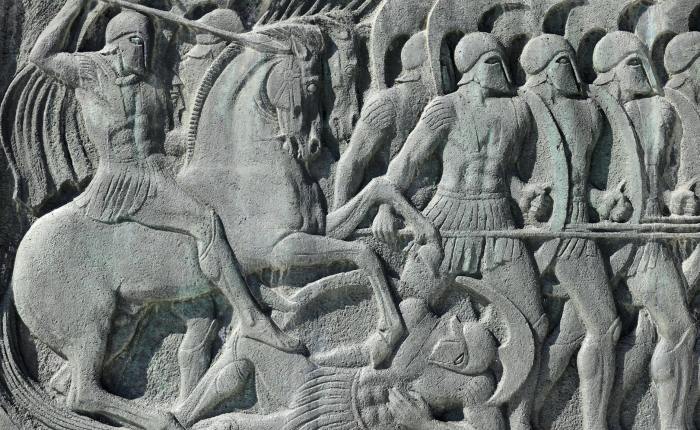
Battle for the dead (part 2)

Battle for the dead (part 2)

In the last post, I explored what might seem like an oddity in the greatest war story ever told: Homer’s Iliad.

In the epic, the most intense conflicts center not on killing enemies or conquering their land, but on securing corpses, for proper burial or vengeful desecration.

Why, though, should that matter still today?

Several insights follow, though I’ll leave them only partially developed, while admitting that I’m no expert in this area.

Despite occasional generalized claims that “Greek thought” cared little for the body (a shift that took place later), Homer reveals a deeply human impulse that what Paul calls “this earthly tent” (2 Cor. 5:1) is both precious and integral to personhood, both before death and after it.

It is right and good to feel this way, however painful it may be as we grieve those we have lost.

CHALLENGING A MISCONCEPTION

This is why it strikes me as obviously false when someone says something like this at a Christian funeral: “Now she is perfect and whole.”

To be sure, Christians believe that those who die in Christ are “with the Lord” (2 Cor. 5:8). Their suffering has ended. And they experience blessedness, rest, and even paradise (Luke 23:43). (It should be obvious from those claims that I do not hold to so-called soul sleep, since it doesn’t fit the experiential connotations of what Jesus calls “paradise,” when speaking to the thief upon the cross. Nor does it fit with Christ’s story of the Rich Man and Lazarus, however parabolic that is.)

To be spiritually with Christ is both beautiful and hope-giving. But it does not mean that we become perfect and whole upon death. The reason is simple: Bodies matter. To say otherwise would be to view God’s material creation as either irrelevant to human flourishing, or worse yet, a hindrance to it.

Such assumptions are often smeared as “Greek” or “pagan” errors (with some justification); yet even the Iliad challenges this point at one important level: In the Iliad, bodies matter, both before death and after it.

“WHAT WOULD JOSEPH DO?” (WWJD)

Second, the concern for corpse care after death, illuminates the bravery and importance of an oft-forgotten disciple in the Gospel narratives: Joseph of Arimathea.

We read this in Mark 15:42-46:

It was Preparation Day (that is, the day before the Sabbath). So as evening approached, Joseph of Arimathea, a prominent member of the Council, who was himself waiting for the kingdom of God, went boldly to Pilate and asked for Jesus’ body. […]

So Joseph bought some linen cloth, took down the body, wrapped it in the linen, and placed it in a tomb cut out of rock. Then he rolled a stone against the entrance of the tomb.

Scholars spill lots of ink debating whether (or how well) a given ancient philosopher or poet was known to biblical authors and their audiences. But one thing is clear: The Iliad was known. We have well-preserved wall paintings from Pompeii and Herculaneum, dating from the first-century AD, depicting its scenes. Just like kids hang movie posters of Marvel Comic characters, we find the ancient fresco of “Achilles and Briseis” (or “Briseis taken away from Achilles”) in the House of the Tragic Poet in Pompeii.

At the risk of pressing things too far, it might be like asking a modern American, “Have you heard of Superman?”

As another illustration, I’m currently in Vienna for a conference, where I visited the (incredible) Museum of Fine Arts. Below is a snap of an ancient Greek vessel, depicting scenes from the Iliad, including the arrival of Priam to plead for Hector’s body.

Priam pleads with Achilles for Hector’s body

Of course, there are big differences between Priam’s visit to Achilles, and that of Joseph to Pontius Pilate. Still, it seems reasonable that an early Christian—in a house church in Philippi, Rome, or Corinth—would have heard the echoes. Pilate also would have been shaped at some level by the story.

Here then is the point about the man from Arimathea: While other disciples fled on Good Friday, sinking in confusion and despair, Joseph put his reputation (and his life) on the line to go boldly before a man responsible for Christ’s death, and to plead for his friend’s body.

Because of Joseph, birds do not despoil the corpse, the sign of Jonah is preserved, the Sabbath rest is kept within the tomb, and the stage is set for Easter Sunday.

I don’t think Joseph did this because he was expecting resurrection three days later. That’s not why Priam did it either. They did it out of love and duty, even in the pit of hopelessness, which makes it even more powerful and relevant for us when all seems lost.

To await the Kingdom, for Joseph (and arguably for us), is to take up the shroud and not the sword. Because even when the kingly Son is dead—his body matters.

To cite Peter, on the Day of Pentecost:

Therefore my heart is glad and my tongue rejoices;
my body also will rest in hope,
because you will not abandon me to the realm of the dead,
you will not let your holy one see decay.

~Acts 2:26–27 (Psalm 16:8–11, LXX)

Now… in the next part of this series, I’ll share something I don’t like about the handling of this topic in the Iliad, and how Dostoyevsky helps.


Hello friends. Please subscribe on the homepage to receive these posts by email. This is especially helpful since I’ve decided (mostly) to uncouple the blog from social media. Thanks for reading. ~JM

Battle for the dead (part 1)

Battle for the dead (part 1)

One of my summer reads this year was a slow journey through Homer’s Iliad—the great archetype of our war stories, action movies, and (in a way) superhero universes.

Among other insights, I was struck by how much of the fighting is focused not on killing an enemy or conquering a bit of ground, but on the furious desire to protect or desecrate a corpse.

The Iliad is, in many ways, a struggle for the dead–whether for the corpse of Sarpedon (mortal son of Zeus), Patroclus (intimate of Achilles), or Hector (favored son of Priam and champion of Troy).

“Human mortality is at the center of it all,” writes Emily Wilson. “I know no other narrative that evokes with such unflinching truthfulness the vulnerability of the human body.”

Yet unlike modern action movies, that bodily vulnerability (in the Iliad) is just getting started when one’s final breath departs through “the fence of teeth” (Book 9.529).

Shame and honor lie at the root of such concerns, as do ancient pagan assumptions about the requirement of proper funeral rites for a departed shade to enter Hades.

Unfortunately, countless other deaths occur in the attempt to secure the body of an enemy or comrade.

I’m interested in the point for several reasons:

  1. N. T. Wright points out that Homer functioned somewhat like the “Old Testament” for ancient pagan audiences, in a way roughly analogous to how the Hebrew Scriptures remained foundational for Christians.
  2. I agree with C. S. Lewis about the value of old books to reveal our modern blind spots, not because they are infallible, but because they do not share our unexamined assumptions.
  3. I’m convinced many well-meaning Christians lack a proper view of the body both before and after death. Thus, reflecting on this subject in the Iliad (alongside Scripture) might actually make us more faithful Christians.

In Homer’s story, the struggle for the dead happens in at least three ways: (i.) corpse care, (ii.) desecration, (iii.) divine intervention to stave off decay.

CORPSE CARE

The importance of proper corpse care is demonstrated by Achilles, as he sets out to wash and rub with olive oil the body of his dear friend Patroclus, and to fill his wounds with ointment (18.438).

Though Achilles feels compelled to avenge his comrade, he cannot bear the thought of what may happen to the body in his absence:

I am still most terribly afraid for brave Patroclus

Whose body has been hacked with so much bronze.
Flies may get in his wounds and worms may grow there,
Dishonoring his corpse. His life is gone,
And now his flesh may rot (19.30-36).

The mirror of this heartrending concern is found in Priam, who ultimately sneaks behind Greek lines to plead with Achilles for the body of his beloved son, Hector.

In that meeting, “They both remembered those whom they had lost.” And “Curled in a ball beside Achilles’ feet, Priam sobbed desperately,” in a fatherly move that finally breaks the callous wrath of his adversary (24.631–35).

DESECRATION

The desire to care for the bodies of friends and family is matched by an unholy drive to desecrate the corpses of one’s enemies.

Achilles exceeds all others in this impiety, for which the deathless gods are furious with him (24.146), since he does not stop at merely killing foes or stripping their armor, but commits abominations on their corpses.

In the final battle between Achilles and Hector, the matter of who will win is never in doubt. The only question, even for Hector, is what Achilles will do to his corpse.

Despite pleas from his dying adversary, Achilles proclaims:

If only I had will and heart to do it
I would carve up your flesh and eat it raw […]

No one can save your body from the dogs,
not even if they bring me as a ransom
ten times or twenty times the usual rate (22.465-70).

True to his word, Achilles then commits “shameful atrocities on noble Hector,” piercing the tendons behind both his feet (#foreshadowing) and dragging him behind his chariot. Upon finishing his circuits ‘round the body of Patroclus, Achilles leaves Hector’s corpse face down in the dirt—unburied, unreturned, and yet (incredibly…) undecayed.

This brings us to the last point.

MIRACULOUS INTERVENTION

It would not be Homer if the gods did not intervene.

In each case (Sarpedon, Patroclus, Hector), divinities step in not to save or resurrect the warriors, but to preserve their corpses:

even now in death, Apollo pitied
Hector, and kept his body free from taint
He wrapped a golden cape, an aegis, round him,
To ensure the dragging never scratched his skin (24.24-27).

Though Hector’s body has been abused and left unburied for twelve days, still “dewy-fresh he lies”; and his many wounds “are quite closed up” (24.520).

Despite violent death outside the city gates, Apollo will not allow his holy one to see decay.

A father intervenes, a trip is made to the one responsible for his death, and a brave plea is made for the body.

Now what does that sound like?

In the next post I’ll unpack why this still matters.


Hello friends. Please subscribe on the homepage to receive these posts by email. This is especially helpful since I’ve decided (mostly) to uncouple the blog from social media. Thanks for reading. ~JM