That’s a sentence that no child of mine has uttered. Like, ever.
The fact is that human-beings are story-driven creatures—from our earliest memories to our final days. In the words of the novelist David Foster Wallace, “We need narrative as we need space-time.”
There’s a new post of mine up at Seedbed.com that talks about why it’s important to gain a basic grasp of the Biblical storyline. (Read here)
They’ve been releasing lots of resources this week for the official launch of Long Story Short: the Bible in Six Simple Movements.
Signup here to receive bonus content through my email Newsletter.
I will not clog your inbox, and I will not share your email address.
If you’ve read the book, please stop by either Amazon and Seedbed.com to leave a friendly review. It helps get the book in hands of folks who might not otherwise see it.
John Chau, Jim Elliot, and Joseph Conrad’s Heart of Darkness
As it happened, when news broke that John Allen Chau had been killed while trying to evangelize an isolated tribe far off the coast of India, I had been re-reading one of my favorite works of fiction: Joseph Conrad’s Heart of Darkness.
The story, written around 1899, is among the most famous critiques of colonialism in its ignorant and damaging forays into tribal cultures. Conrad wrote it from experience. He had gone to the Congo in 1890 to serve as a river pilot. Long before that, at the young age of nine, he had placed his finger on the blank space of a map that represented Africa, and proclaimed: “When I grow up I shall go there.”
The reality did not live up to his hopes.
Near the beginning of Heart of Darkness, the narrator (Marlow) recalls a scene that functions as a kind of allegory:
Once, I remember, we came upon a man-of-war anchored off the coast. There wasn’t even a shed there, and she was shelling the bush. It appears the French had one of their wars going on thereabouts. Her ensign dropped limp like a rag; the muzzles of the long six-inch guns stuck out all over the low hull; the greasy, slimy swell swung her up lazily and let her down, swaying her thin masts. In the empty immensity of earth, sky, and water, there she was, incomprehensible, firing into a continent.
Blindly firing into a continent.
For Conrad, this was a metaphor for western meddling in tribal cultures. It was a wasteful farce; a mix of ignorance and arrogance. And it resulted in unnecessary death.
But what does this have to do with John Allen Chau?
MUST MISSIONS BE COLONIAL?
For many, Chau’s decision to evangelize an unreached tribe on North Sentinel Island bears a resemblance to Conrad’s vessel. In Chau’s defense, his aim was not to pillage, colonize, or do violence. His goal was to minister or die trying.
Yet he did so with a frightful ignorance of the harm that he could bring—and not merely to himself. Even the slightest exposure to the germs Chau carried on his person or his gifts could wipe out the people that he sought to save. Yet “there [he] was, incomprehensible,” firing himself into an island.
JUST FATAL, FUTILE THEATER?
While many have been critical of Chau (and rightly so at points), it is the incomprehensibility of his act that interests me. That same word appeared in Conrad’s quote (above).
And in some ways, Chau’s thinking is as incomprehensible to the secular mind as is that of the islanders that killed him.
But it wasn’t always.
As Thomas S. Kidd notes, there is a striking difference in how journalists covered the death of Jim Elliot, the Christian missionary who was speared to death when he and others attempted to evangelize an unreached tribe of Ecuador in 1956. At that time, Life Magazineoffered almost fawning coverage of Elliot’s noble attempt to “civilize” the “Stone Age savages.” (Yes, they used those words.)
Jim Elliot, missionary.
What changed?
Are Chau and Elliot so different?
In some ways they were. It seems that Chau was more of a rogue actor. He was more naïve; more careless with the health of those he sought to help. And undoubtedly, there are differences between the Ecuadorian Huaorani and the tribe that Chau sought out.
Still, note how a recent column in The Wall Street Journalspoke of Chau’s death, and then contrast that with Life Magazine, 1956:
there will be those who ascribe nobility to Chau, and courage. . . But go easy on the romance of Chau and his messy, martyred end.
He broke Indian law by entering the country on a tourist visa while pursuing an evangelical mission. Chau’s application would have been refused if it so much as mentioned the words “North Sentinel Island.” . . . What we had in the end, was one man’s futile—and fatal—theater.
An adventure tourist. A theatrical fame-seeker who broke the law. Don’t cry for him.
But is that fair?
THREE TAKEAWAYS
Enough context. Now for my own imperfect takeaways from this odd mashup of
Conrad’s Heart of Darkness (1899)
Life Magazine (1956)
The Wall Street Journal (2018)
First, it seems quite clear to me that not all missionary efforts are praiseworthy. Despite good intentions, Chau was terribly naïve about the dangers that he brought to North Sentinel. When a couple of the islanders were kidnapped by a 19th c. British naval officer (Not Conrad), they died almost immediately for lack of an immune resistance. This matters; and especially given that far more indigenous people (in North America) were killed by germs from white conquerors, settlers, and missionaries than by anything else.
Would you go evangelize your neighbors and their children if you knew you carried the equivalent of Ebola?
If the apostle Paul was right that “Love does no harm to a neighbor” (Rom 13:10), then Chau was either terribly ignorant or terribly cavalier about the result of “firing” himself like a human bomb into a very vulnerable culture.
Second, thank God that many westerners are now more sensitive in the way they think of what Life Magazine called uncivilized “savages.” Not even Conrad’s Heart of Darkness is immune from these stereotypes (see Achebe’s famous, if overdone critique).
But neither Elliot nor Chau would have thought of indigenous communities in this way. Whatever other flaws they might have had, Chau and Elliot would have thought of such tribespersons as fellow image-bearers who deserve the gospel as much as anyone else. That’s not colonialism; it’s Christianity — even if Chau was wrong to go about it as he did.
Third, a final lesson from this whole sad tale is just how inscrutable it is for modern folks (e.g., the fairly conservative Wall Street Journal) to understand the historic Christian idea that neither “law” nor threat of “death” should stop one from sharing Jesus. Yes, this can be done badly (as it likely was in Chau’s case). But it can also be done with great care and bravery.
MY NEXT DOOR NEIGHBOR
Allow a final example: Right next-door to my office sits a PhD in Linguistics and Cultural Anthropology: “Dr. Mike.” He is a legend around campus for his open door, open ears, and oft-imitated-but-never-duplicated laugh. Students love him.
He also lived in the jungles of New Guinea for ten years as a missionary with a VERY isolated tribal culture. He learned their language, customs, and their names. He was sensitive to many things that white missionaries often take for granted, and he teaches this to students.
It was quite possible, of course, that Mike too could have been killed as were Chau and Elliot in a tribal region prone to violence.
Why then did he go? And why especially with a wife and two small children born during his decade in the jungles?
Was it all “futile, [nearly] fatal theater”?
I don’t think so.
But I don’t doubt that it seems incomprehensible – to all except the tribal people that he came to know and love.
UPDATE: The always-thoughtful Ed Stetzer has a piece out now at The Washington Post that debunks some of the early news reports on Chau (see here for that). While Chau may well have posed grave dangers to the tribe he sought to reach, it also appears that initial news reports were not working (or caring) with all the facts.
While the book has been available for a couple months now, this week marks the official launch of the project, along with all the video content we shot to help church small groups use the material in practical ways.
I’ve been blown away by the response so far and can’t wait to share new resources as they come out.
If your church is interested in the book and would like to have me come speak or preach on the content, you can reach me at Joshua.mark.mcnall@gmail.com
I’ve got several dates on the calendar already, but would love to add more.
Lastly, if you’ve read the book, please consider leaving a review on either Amazon or Seedbed.com. They really help with the digital voodoo (read: algorithms) that determine who sees the book online.
Separating boldness from shrillness in the age of outrage.
Thanks to The Wesleyan Church for asking me to be part of their new “Voices” blog.
Here is the first installment in a multi-part series I’ll be doing on how to differentiate “prophetic boldness” from “dogmatic shrillness” in the age of outrage.
I had a great time preaching this past weekend in Gillette, Wyoming.
Big shout-out to Mike Wilson and the folks at New Life Wesleyan for welcoming me!
They began a sermon series on Sunday entitled “What would Jesus undo? And as a part of that, I got to preach on some ideas I’ve been working through about what it looks like for Christians to reclaim the sacred ground between (1) crippling doubt, and (2) angry dogmatism.
I’ve written about that topic before (here), and I’m currently writing a book on the subject for IVP Academic. But until then, here’s the video.
We seem to be designed that way (see here); and it’s not necessarily a bad thing. We are hard-wired to find community, common cause, and a measure of identity within particular groups. There are:
Evangelicals, atheists, vegans, hunters, gamers, naturopaths, NRA members, Democrats, Republicans, Libertarians, Socialists, teamsters, doulas, environmentalists, and perhaps most cult-like of all: CrossFitters.
But if you stay in your tribe long enough, one thing is certain: It’s going to be wrong. And not just on some minor point. Given the fallibility of humans and the tendency of groups toward corruption, chaos, and dogmatism, your tribe is going to err on something important, and in a relatively widespread fashion.
Which raises the question: What do you do then?
As far as I can tell, there are three common responses:
Deny
Perhaps the most frequent human tactic when facing embarrassing or threatening data is to simply deny it. “Smoking can’t cause cancer! My uncle Ernie’s 97 and he’s a human chimney!” “And No! My knee injuries are not because of Crossfit; they’re probably genetic; or the work of Russian trolls!” “#FakeNews.”
Similarly, the choice to just stay silent on one’s tribal errors can also be denial.
But if one does this long enough, the result can be devastating. Before long, you forfeit credibility with all but the most Kool-Aid swilling faithful of your tribal kin. And for Christians, that’s Kryptonite for Kingdom building.
Now for number two.
Defect
When denial proves impossible, one might simply leave.
In some cases, this is warranted. Some tribes are inherently toxic, while others start good but have their mission so perverted that one must either defect or be forever tainted.
But there are dangers here as well.
As the saying goes: It’s hard to reform organizations that you leave. And if the tribe holds certain true or noble values, then defection can be deleterious. It can simply cede the field to the worst elements within the remaining group.
Likewise, the desire for defection sometimes stems from vengeful and unhealthy motives. “I’ll show them! They just made the wrong kind of enemy!”
Given the human tendency for knee-jerk reactions, we often swing from one form of tribal dogmatism to another. In disgust, we embrace wholesale the opposition, while immediately denying the deep flaws and contradictions in this newfound tribal home. “Anything is better than where I came from,” we say.
In a final twist: some attempt a total defection from mission-driven tribal homes. “I’m just a member of the ‘human tribe’ these days.” Nonsense. If we are hard-wired for these tribal groups, we will either find them or die of loneliness.
Distract
When denial or defection are rejected, a final option when confronted with one’s tribal “wrongness” is simply to shift the focus to the flaws of rival tribes. “Yes, yes, we have our problems, but when you look at the alternative… .”
Of course, some tribes are worse than others. The cartel is not the rotary. But when this “Lesser of two evils” logic is used as a distractor from the obvious corruption or error within one’s own tribe, the result is much the same as with denial: The “distractor” loses credibility with all but the most loyal partisans. Again: Kingdom Kryptonite.
One doesn’t put out a fire in the attic by pointing to the smoking ruins of a neighbor’s house; or by simply moving to the basement.
Distraction is denial’s evil twin.
CONCLUSION
What then is the right response to tribal wrongness?
It depends, of course, on a variety of factors. It doesn’t always mean a snarky airing of one’s public grievances (see here).
But it should probably begin with (1) an acknowledgment of the problem, (2) an awareness of these three coping mechanisms (above), and (3) a refusal to go from “tribe” to “tribalism.”
Now to mix the Kool-Aid for my CrossFit pre-workout. It helps with my genetic knee pain.
I’ve been on a blogging hiatus lately as I’m been under a deadline to get a book manuscript polished up and sent back to the editor (Yes, Katya, I am working on it!).
But I took time last week to type up what I thought was a pithy response to a particular hot-button cultural issue that had been nagging me.
I wrote it; I rewrote it; and I even had some friends weigh in.
Then, after all that work, I deleted the whole thing. (Which was really hard because it had a corny joke about a “salvation” that is seen as coming sola Twittera–by social media alone.)
I won’t go into the details, but suffice it to say I had an inkling of discernment (which is all I ever have…) that the last thing the world needed was one more pontification on something that I actually don’t know very much about.
On that note, I’ve found the following eight insights helpful for those times that I am tempted to think that I must always open my mouth/keyboard.
These come from the evangelical-Anglican and Baylor English professor, Alan Jacobs.
In his words:
Going off half-cocked is now widely perceived as a virtue, and the disinclination to do so as a vice.
What ‘s more:
that poorly informed and probably inflammatory statement of [My] Incontrovertibly Correct Position must be on the internet . . . or it doesn’t count towards your treasury of merit.
But must I always weigh in on every hot-button issue?
As Jacobs reminds himself:
I don’t have to say something just because everyone around me is.
I don’t have to speak about things I know little or nothing about.
I don’t have to speak about issues that will be totally forgotten in a few weeks or months by the people who at this moment are most strenuously demanding a response.
I don’t have to spend my time in environments that press me to speak without knowledge.
If I can bring to an issue heat, but no light, it is probably best that I remain silent.
Private communication can be more valuable than public.
Delayed communication, made when people have had time to think and to calm their emotions, is almost always more valuable than immediate reaction.
Some conversations are be more meaningful and effective in living rooms, or at dinner tables, than in the middle of Main Street.
None of this means, of course, that I will stop writing on issues that matter–even when they’re considered controversial. I come, after all, from a theological tradition (Wesleyanism) that refused to shut up on things like slavery and women’s rights, even they had been dubbed “too radical” for respectable Christians to weigh-in on.
So once I’m not buried under a book manuscript (which should be sometime in the next decade) I plan to keep thinking in public with what I hope is a mix of grace and truth–or at the least “grammar.”
And I hope other thoughtful people do too.
Still, it is freeing to recall occasionally that the world’s salvation does not come sola Twittera. Or in my more long-winded case: sola blogos.
I was happy to be a guest on the Wesley Seminary Podcast to discuss Jordan Peterson’s unique take on Scripture, culture, and meaning (here).
I’ve written previously on Peterson (here) and (here); and I was honored to share the mic with my good friend and colleague, Dr. Dalene Fisher, Professor of English at OKWU, and Dean of the School of Arts and Sciences.
Dr. Aaron Perry is a great host. Feel free to check out other episodes wherever you get podcasts.
Amongst other tings, I explain here why Peterson’s reading of Scripture tends to divorce the biblical narrative from history, while reading his own brand of Jungian psychology into the text.
I also talk about cilantro (but you’ll have to listen to get that one).
Here is a quick breakdown of the conversation in case you want to skip around.
0.00 – Intros
4.25 – Dr. Fisher on Archetypes in literature, psychology, and Jordan Peterson
12.05 – Me, talking about Peterson’s “(Not so) Strange” account of Christianity
16.40 -Me, on Jordan Peterson, cookbooks, and cilantro! (Could Peterson’s archetypal reading of Scripture get the same “truths” from a cookbook?)
20.40 – Dr. Fisher on how Peterson can be helpful for young adults.
24.27 – Me, on how Peterson can be helpful.
28.12 – Dr. Perry on Peterson on the danger (and the benefit) of comparison.
31.43 – Me, on Peterson’s overly tragic view of life.
34.12 – Dr. Perry on the lack of eschatology in Peterson’s dialectic of chaos and order.
36.05 – Me, on why Peterson’s self-help psychology is NOT enough.
I have almost zero interest in the age-old fights between Reformed and Wesleyan-Arminian theologians.
I was trained by some fantastic Reformed theologians in seminary, and my general view is that the various theological “tribes” need to be continually balanced by a dialogue (and a missional engagement!) with one another.
That said, one of the common critiques against my own tradition (Wesleyan-Armininianism) is that it represents a “human-centered theology.”
The idea here is that God’s grace is invariably minimized by any belief in a measure of human freedom to accept or reject the gospel–however enabled that freedom is by the work of the Spirit.
Is that true?
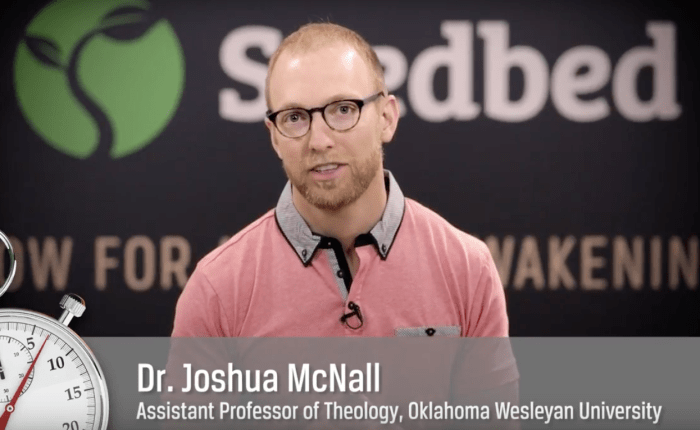
The fine folks at Seedbed just released this video in which I address the subject.









 joshuamcnall.com