A church for (and against) the world

A church for (and against) the world

What should be the church’s posture toward the world?

The challenge, as with bodily posture (hunched shoulders, rounded back, neck forward), is that posture solidifies at a subconscious level, without us noticing. (Did you just sit up straighter?)

To this point, I recently reread an excellent essay by the theologian, Natalie Carnes with the following subtitle: “Reconsidering the Church-World Divide” (here). She begins by drawing attention to other articles with titles like this: “World versus Church: Who Is Winning?” (…a line that could only be more cringeworthy if read by Howard Cosell).

I won’t rehash Carnes’ full argument, but it includes a helpful reminder that Scripture contains BOTH protagonistic and antagonistic passages on the church-world relationship. Both “for” and “against.”

Church Against World

For instance,

“You adulterous people, don’t you know that friendship with the world means enmity against God?

~James 4:4

Or even stronger,

Do not love the world or anything in the world. If anyone loves the world, love for the Father is not in them.”

~1 John 2:15

Church For the World

On the other hand, numerous passages reveal God’s radical heart for the world, which calls us to a similar “for-ness”: loving, serving, and practicing incarnate presence.

Most famously,

God so loved the world that he gave his one and only Son, that whoever believes in him shall not perish but have eternal life. For God did not send his Son into the world to condemn the world, but to save the world through him.”

~John 3:16

And this,

God was reconciling the world to himself in Christ, not counting people’s sins against them. And he has committed to us the message of reconciliation.”

~2 Corinthians 5:19

The following line from 1 John is even more interesting since it comes in the same book (above) that contains, arguably, the strongest anti-world prooftext:

“He [Jesus] is the atoning sacrifice for our sins, and not only for ours but also for the sins of the whole world.”

~1 John 2:2

Pro or Contra?

So… which is it?

Should the church be for or against the world?

It has long been acknowledged that different passages can mean different things while using the same word. Hence, “world” (cosmos) is a bit like “flesh” in its varied biblical meaning. In some cases, it means God’s good-but-fallen creation, loved and reconciled by Christ’s work. In others, it refers to a willingness to embrace ideologies and behaviors that set themselves in destructive opposition to goodness, beauty, and truth. Hence, as my former professor, David Wells, once wrote: “worldliness is anything that makes sin seem normal and righteousness seem strange.”

In the end, this much seems true: A Christ-like church must be both for and against “the world.” Yet the more important point is that this dual posture cannot take any form we wish: Our antagonism must always be housed within a larger protagonism.

Carnes puts it like this:

“the ‘versus’ of the church and world is enfolded into a larger for-ness. . . . There is a kind of against-ness: God did not leave the world to its own deterioration and destruction; God placed God’s own body against the forces of sin and death. And yet how could this story be told apart from the larger protagonism . . . which begins with a God who ‘so loved the world’?”

If you get nothing else, get this:

  1. A church bent primarily on defeating the world inevitably becomes more like it.

On the other hand…

  1. A church bent only affirming the world inevitably ceases to be “for it” since we have nothing to offer that the world does not already have.

The first point explains why rigid and partisan forms of religious fundamentalism often harbor and hide some of the darkest sins (see here)–whether sexual abuse, excusing and elevating authoritarian leaders, and even forms of violence. The second point explains why many exclusively pro-world (“affirming”) churches are basically empty. Why go? Especially when there’s golf and sleep and football.

We need both points, for as Carnes notes, “the world” is not merely something “out there” but “in here” with the dividing line running not only between groups, denominations, or political parties—but through every human heart, including mine.

Thus, Paul gives this crucial reminder not to pagans but to Corinthian Christ-followers who have lost the plot: “though we live in the world, we do not wage war as the world does”-i.e., with violent, snarky, flailing, win-at-all costs power plays (2 Corinthians 10:3).

Conclusion

If this were my classroom, I’d grab a marker and try to illustrate a better model for envisioning the church-world relation: beyond strict division or simplistic overlap (see below), and toward a complex and mysterious layering that sets aside combat metaphors in favor of more agricultural ones–since Jesus used those too. Something like this:

In one sense, I am borrowing from Saint Augustine, who says it this way:

She [that is, “the pilgrim City of Christ the King”] must bear in mind that among [her] very enemies are hidden her future citizens; and when confronted with them she must not think it a fruitless task to bear with their hostility until she finds them confessing the faith. […]

In truth, these two cities are interwoven and intermixed in this era, and await separation at the last judgment.

~De Civitate Dei, 1.35


Hello friends. Please subscribe on the home page to receive these posts by email. This is especially helpful since I’ve decided (mostly) to uncouple the blog from social media. I’m grateful for you. ~JM

[Indistinct chatter]

[Indistinct chatter]

“If I ever write a book about technology and modern life, that will be the title.”

I said that to my wife recently as we were watching Netflix. We were using closed captions since the kids had just been banished to their rooms. And during the course of the episode, I was struck by how one caption appeared more than any other, entombed in brackets: [Indistinct chatter].

And now that I’ve mentioned it, perhaps it will stand out to you as well.

It appears everywhere on the shows we consume: In crowded restaurants, on bustling streets, inside Dunder Mifflin, in Ted Lasso’s locker room, and virtually everywhere else.

You might “indistinct chatter” is the soundtrack of our lives.

In a literal sense, and especially for the hearing impaired, the caption alerts viewers to a constant buzz of unintelligible and unimportant speech, humming somewhere in the background. But the more you think about it, the more it starts to feel like a kind of oracle or prophetic diagnosis of what ails us in our age of noise and news and social media. Who’s speaking? We can’t say. What language? IDK. What makes this wave of jumbled words more consequential than, say, the noise made by my neighbor’s lawn mower? Nothing, really.

Still, the caption-generating gods of Netflix feel compelled to include them in a font that is just as large and bold as actual dialogue, lest we miss this apparently important detail. And in a weird way, that’s basically my goal here. Have you noticed how much of modern life can be summarized by what’s in those brackets?

You could take that observation in a dozen different directions.

But here are two quick attempts at showing why it matters.

When words become white noise

First, we become so accustomed to indistinct chatter—unintelligible and unimportant words that wash over us almost constantly—that we find it hard to function without it. The chatter soothes us. Silence is unsettling. And we cannot bear to be alone with our thoughts. Eventually, washing dishes, driving a car, or even using the restroom become unthinkable without a verbal (or visual) security blanket of incessant, often vacuous, noise. Air pods, tik tok, twitter. You hear it now.

I’ve seen the effects of this especially in college students who say they cannot read, focus, or do homework without various forms of media running constantly in the background. This too is indistinct chatter. Though “Background TV” is another for it. And despite some obvious benefits—dampening the noise across the hall, or making one feel less alone within an empty apartment—psychologists also caution that our addiction to such electronic noise carries costs: We use it to drown out inner monologues that need attention, and we may eventually find ourselves unable to follow more complex arguments, conversations, or plot-lines since our word-diet is now filled with empty calories. Reflection becomes difficult. And idiocracy encroaches further.

Only the shrillest are heard

Second, to be noticed in a world (or news cycle) of constant chatter requires one to shout–or perhaps to make a scene. Subtlety is lost. And eventually, poets, preachers, and reasonable politicians are replaced by demagogues and provocateurs.

Before we know it, our cultural Caps Lock remains constantly illumined like the faulty tire pressure light upon your dashboard. After awhile, you don’t even notice it. We are seeing the cost of this now in our shared political lives especially, where (to quote Yeats), “the worst are full of passionate intensity,” while the rest are just really, really tired.

So what’s the solution?

As usual, the way forward begins by noticing the way that caption has come (metaphorically) to dominate our lives. In the words of Andy Kennedy,

Every great solution starts with someone noticing a problem. Noticing is underrated. Notice more. Good things will follow.

But noticing is not enough. We must also make decisions, at least periodically, and for sustained intervals to unplug from machines and environments that threaten to drown us in indistinct chatter.

Here though is an irony. As I write this, I am seated outside by the fire while robins and bluejays and large group of black crows are performing their own bit of background noise. It too is unintelligible. Yet it hits differently than a steady stream social media alerts, breaking news, doom-scrolling, calendar reminders, and the targeted ads that constantly assault us. Is it chatter? Of a sort. And yet.

As the Psalmist writes:

There is no speech nor language, where their voice is not heard.
Their line is gone out through all the earth, and their words to the end of the world. In them hath he set a tabernacle for the sun,
Which is as a bridegroom coming out of his chamber, and rejoiceth as a strong man to run a race” (19:3-5 KJV).

Which is to say, go touch some grass. And for just an hour, disable captions.


Hello friends. Please subscribe to these posts via the button on the home page to receive future posts by email. This is helpful since I’ve decided (mostly) to uncouple the blog from social media. I’m grateful for you. ~JM

Something more than civilization

Something more than civilization

In-keeping with my claim that reading is rereading, I spent an evening recently flipping through Alan Jacobs’ excellent book, The Year of our Lord 1943: Christian Humanism in an age of Crisis.

He notes how, in a time of total war, an assortment of Christian poets, novelists, and philosophers produced some of the most remarkable and enduring work of the century. The players include Jacques Maritain, W. H. Auden, C. S. Lewis, Simone Weil, and T. S. Eliot.

More interesting still was that these folks were neither pastors nor theologians, and they did not focus explicitly on current events (i.e., the latest headlines), though the geopolitical world was quite literally on fire.

Instead, they turned to the humanities and education—poetry, novels, philosophy, and habits of prayerful contemplation—as ways of rebuilding the ruins of a fallen civilization on a more robust foundation than merely the desire to “save” civilization.

Perhaps civilization has been imperiled, wrote C. S. Lewis in 1942, “by the fact that we have all made civilization our summum bonum [highest good]. And “Perhaps civilization will never be safe until we care for something else more than we care for it.”

Many of them also identified a malignant common thread between the likes of Hitler, Stalin, and even many within the allied powers: a technocracy of domination, devoid of humane religious and moral underpinnings.

As Auden wrote, in a paragraph on “techinique” and “temporal power,”

“What fascinates and terrifies us about the Roman Empire is not that it finally went smash but that . . . it managed to last for four centuries without creativity, warmth, or hope.”

Or Jacques Maritain in Education at the Crossroads:

Technology is good, as a means for the human spirit and for human ends. But technocracy, that is to say, technology so understood and so worshipped as to exclude any superior wisdom and any other understanding than that of calculable phenomena, leaves in human life nothing but relationships of force, or at best those of pleasure, and necessarily ends up in a philosophy of domination. A technocratic society is but a totalitarian one.”

Or C. S. Lewis:

“What we call Man’s power over Nature turns out to be a power exercised by some men over other men with Nature as its instrument.”

LESSONS FROM THE RUBBLE

Jacobs’ point is that each of these writers (despite deep differences and numerous blind spots) strove with astonishing energy—at what might seem the least convenient time—to throw a lifeline to their readers in the form of deeply literate and thoughtful form of Christianity, which was neither a withdrawal from the public square, nor a breathless regurgitation of political talking points. “I see no hope for the Church,” wrote C. S. Lewis, “if it allows itself to become just an echo for the press” (or government).

Thus, if one wants to learn what a faithful form of cultural rebuilding looks like, we would do well to consider their examples.

Here then are Jacobs’ concluding lines—which seem more needed now than ever:

“If ever again there arises a body of thinkers eager to renew Christian humanism they should take great pains to learn from those we have studied here”

SIGNS OF LIFE

I revisited the book, in part, because Jacobs just announced his coming retirement from the Honors College at Baylor University. Still, as he heads off to (hopefully) write more books, there are signs that small pockets of this kind of thoughtful and historically-rooted Christian education are beginning to bear fruit.

The work isn’t sexy, and it won’t garner headlines, but it is happening in small corners even now.

Case in point: This Spring, twelve students signed up to take an Honors College class with me on Dostoevsky and discipleship, as witnessed in his brilliant but difficult novel, The Brothers Karamazov. The students come from a host of majors—accounting, biology, ministry. Most don’t need the course to graduate, but they’ve been convinced, partly by my soapbox evangelism, that the way through life’s toughest questions is more likely to run through the Great Books than by machine-gunning prompts into Chat GPT.

Evidence 2: Last week, I drove down to Oklahoma Baptist University to learn from one of their Honors seminars in which college students meet at 8am each morning (roughly 4am “CST” [College Student Time]) to discussGreat Books from a Christian perspective. The class was excellent. Not a smartphone in sight. Books and notebooks open. Insightful conversation. It was led by a church history professor, and the program is overseen by Oklahoma’s former poet laureate, Ben Myers.

Evidence 3: As I thumbed through a catalogue of books due to come out soon on the topics of theology, the arts, and culture, it was striking to see how many of those authors had been shaped and trained (in some way) by what might be called the “Baylor pipeline” in which Alan Jacobs has served for years within their Honors College. I am under no illusions (whatsoever!) that Baylor is a perfect place. Still, at least one pocket there has become quiet but consequential hub of deep and humane Christian learning, tucked within a Big 12 school.

All that to say, take heart.

For in the words of Auden, though “our world” seems “Defenceless under the night,” still, “Ironic points of light / Flash out whereever the Just / Exchange their messages.” And so,

May I, composed like them
Of Eros and of dust,
Beleaguered by the same
Negation and despair,
Show an affirming flame


Hello friends. Please subscribe to these posts via the button on the home page to receive future posts by email. This is helpful since I’ve decided (mostly) to uncouple the blog from social media. I’m grateful for you. ~JM

“The world is possessed”

“The world is possessed”

“I’ve found it an effective rule of therapy to accept . . . that most people nowadays are possessed.”

So says the psychiatrist Dr. Thomas More in Walker Percy’s darkly funny dystopian novel, Love in the Ruins. The subtitle describes it as “The Adventures of a Bad Catholic at a time near the End of the World.”

I was carrying the novel through a Tulsa coffeeshop recently when a stranger stopped me to remark, “That book changed my life.” (What a gift it to hear such words in an age where many of us spend our free time staring into 3-inch screens that are the self-authorized equivalent of Fahrenheit 451.)

Percy was a Southern writer and a practicing Catholic whose works engage themes of alienation, faith, and the decline of American culture. Though written in 1971, Love in the Ruins reads as more relevant than ever in its focus on cultural unraveling, partisan factions descending toward violence, unchecked technological power, and, well . . . demonic possession.

After all, how else can you describe some of the mind viruses that have taken root in segments of American cultural and political life?

The book is also funny. All sides are skewered, but my favorite barb involves a group of (clearly) evangelicals who partner with an evangelistic organization to hold Pro Am golf tournament that includes a massive banner which reads, “Jesus Christ: Greatest Pro of them All!”

But back to Satan.

A WHIFF OF SULFUR

It can be a dangerous to speak of demons and possession loosely.

Richard Beck rightly observes that we too often smell “a whiff of sulfur” around our enemies. Hence, allegations of satanic interference have been (and still are) used to excuse acts of violence. (They were used that way against Jesus.) And in the words of a more recent writer, “They’re burning all the witches, even if you aren’t one.”

Still, I’ve been struck recently by passages like 1 John 5:19:

“…the whole world is under the control of the evil one.”

What does that sound like? (And believe me, I am not speaking only of non-religious folks when considering the afflicted.)

I was at an conference years ago where a roomful of academics (the technical term is a “balding of professors”) were debating the difference between being “filled with the Spirit” and being “possessed.” One of which we normally assume to be more common than the other.

At this point, the distinguished scholar Ephraim Radner spoke up to say something like the line from Percy: “Well, maybe the whole world is possessed.” It carried weight since he’s about the farthest thing imaginable from a wild-eyed witch-burner, or an exorcist for hire.

My goal here is not to exhaustively develop this idea.

Partly because I do not know what to make of it.

So let’s turn to two quotes from authors smarter than myself.

C. S. LEWIS

First, C. S. Lewis, in The Abolition of Man:

“We are born into a world where magic and miracles are seen as fairy tales, but in truth, we are under a spell ourselves—the spell of modernity. To break this enchantment, we need the strongest enchantment of all.”

He’s wrong to call it modernity.

Or at least that label no longer seems right. Perhaps Nietzsche was closer when writing of the “old strong gods” returning to the stage after mistakenly being assumed dead somewhere in a prior Act of the drama.

L. M. SACASAS

Second, here is L. M. Sacasas, in his argument (borrowed from Robin Sloan) on the need for “verbal amulets”—a metaphor for short quotations that have the power to guard our hearts and minds against the “spirits of our age.”

Such phrases or fragments [are] charged with a certain power. Like an amulet worn around the neck, these words might somehow shield or guide or console or sustain the one who [holds] them close to mind and heart.

In this way, these words may function like prayers of blessing and protection against a kind of “groupthink” that could almost be termed, corporate possession.

Sacasas suggests the following as examples holding exorcistic promise:

“Ideologies are never interested in the miracle of being.” ~Hannah Arendt

“We do not obtain the most precious gifts by going in search of them but by waiting for them.” ~Simone Weil

“We live the given life, and not the planned.” ~Wendell Berry

“Attention has moral implications.” ~L. M. Sacasas

AN AMULET OF MY OWN

I’ve been pondering all of this as I work on my next book, which offers what I hope will be a “spell breaking” look at a single verse of Scripture (a verbal amulet from the Old Testament). More on that some other time.

The working dedication reads as follows:

For Teddy Brian McNall

Here is an amulet.
Put it on. It is made not of precious metal, gems, or bone—
But of ancient words in foreign tongue.
Keep it close to ward off the evil spirits of our age.

And here’s to you this week, dear reader:

May you receive the gift of exorcism.


Hello friends, thanks for reading. Please subscribe to receive future ones by email. This is especially valuable to me since I’ve decided not to promote the blog much on social media these days. I’m grateful for you. ~JM

When (not) to use AI: a Venn diagram

When (not) to use AI: a Venn diagram

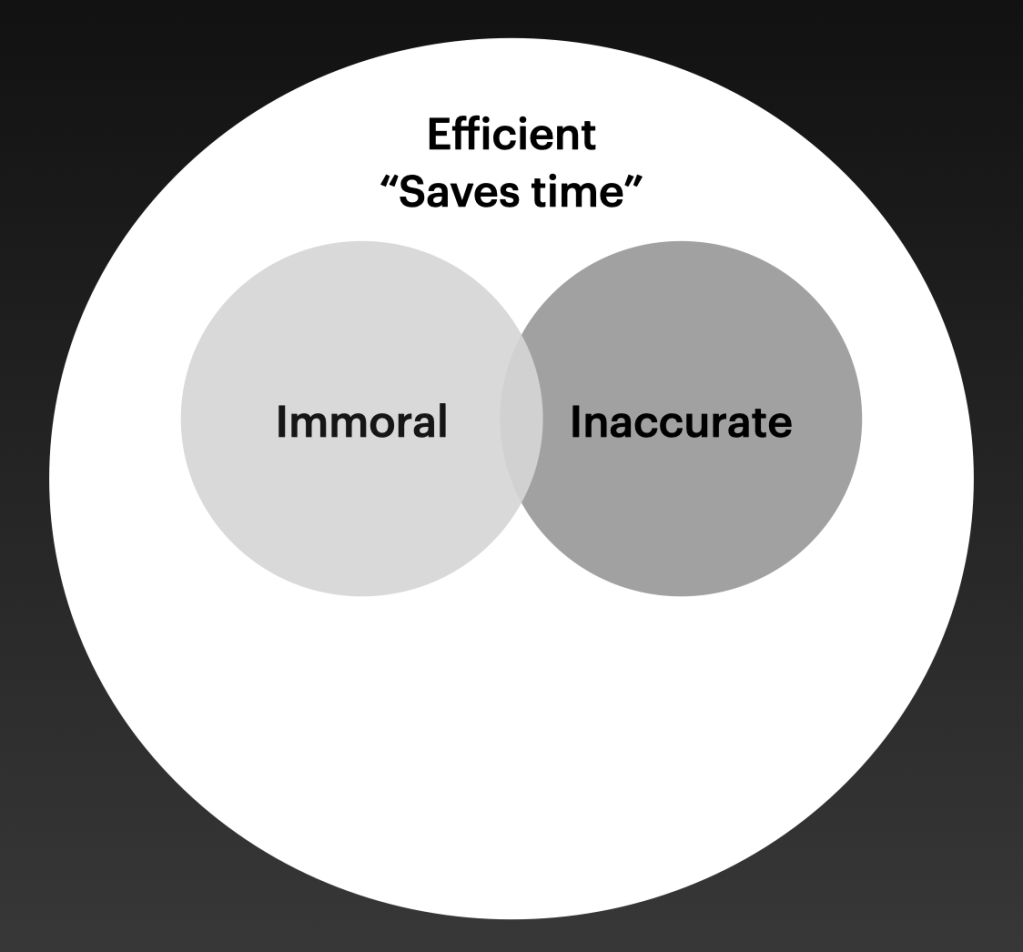
I created a Venn diagram recently to articulate when I think use of AI is ethical and when it’s not.

The smaller circles represent ways in which use of AI is problematic, while the remaining white space illustrates helpful ways in which one may utilize it to save time or accomplish meaningful tasks.

I want to be clear on two points: First, I do use programs like Chat GPT for some things. So I am not proposing a blanket rejection. And second, my focus here is almost exclusively on LLMs (Large Language Models) used to generate text and language. Thus, I am not interested in other ways that AI may be helpful, say, in coding, accounting, or other areas of life. My focus is on words.

My question is a simple one: When do programs like ChatGPT contribute to the good life, and when do they make me dumber, less personal, and less capable of being formed into a thoughtful and connected human being?

Let’s start with efficiency. As Jacques Ellul famously warned, the modern pull of “technique” tempts us to reduce every aspect of life—including relationships and spirituality—to a question of efficiency. In essence, if it saves time, do it.

Of course, efficiency may be a good thing. I do not ride a donkey to the office. I own a dishwasher. And I do not etch my writing on wax tablets. Broken, inefficient processes can be both frustrating and blameworthy. However, there are times when the modern idolatry of efficiency causes harm to others and ourselves.

Allow me to explain:

Circle #1: Efficient but Immoral: The most obvious way AI-use becomes unethical is when our drive to save time leads to immoral choices. Case in point: When I ask students not to use ChatGPT for a particular assignment (because I want them to think and grow by wrestling with ideas and words), to do it anyway is cheating. True, they may not get caught. But it is wrong nonetheless. Likewise, if my church expects me to write my own sermons (as they ought to… ), if I outsource an undo amount of that reflection to a robot, I am in the realm of immorality.

Frankly, many immoral decisions (whether robbing a bank or visiting a prostitute) are driven partly by our thirst for efficiency, which is to say, the drive to get something as fast as possible with the least amount of effort. And in these cases, the fact that it “saves time,” is hardly an excuse.

Circle #2: Efficient but inaccurate: A second problem with AI is the proliferation of falsehoods, inaccuracies, and other bogus depictions of reality. That’s because while programs like ChatGPT do a great job of producing grammatically correct sentences, they do not necessarily prioritize truth.

Hallucinations abound. And evidence is not hard to find: Sites like Google now prioritize bogus AI images of real animals, even when they look nothing like the actual creatures being searched.

LLMs invent sources that don’t exist, as attested by a friend of mine who was surprised to find his own name in footnotes, listed as the author of numerous academic works that don’t exist. And by some accounts, it’s going to get worse.

As Ted Gioia argues,

“Even OpenAI admits that users will notice ‘tasks where the performance gets worse’ in its latest generation chatbot. …

This isn’t a flaw in AI, but a limitation in the training materials. The highest quality training sources have already been exhausted—so AI is now learning from the worst possible inputs: Reddit posts, 4Chan, tweets, emails, and other garbage.

It’s going to get worse. Experts believe that AI will have used up all human-made training inputs by 2026. At that point, AI can learn from other bots, but this leads to a massive degradation in output quality.

In other words, AI will soon hit a brick wall—and face a dumbness crisis of epic proportions. That will happen around the same time that AI will have pervaded every sphere of society.

Are you worried? You should be.”

I can’t say whether all of this is accurate. But it further raises the specter of “the bogus” at a time when we are already drowning in it.

Circle #3: Efficient but impersonal: Now for the saddest (and weirdest) one.

As I watched the 2024 Olympics on Peacock with my kids, one of the commercials that ran on maddening repeat was the now infamous “Dear Sydney” ad for Google Gemini. The premise is bizarre. A dad asks AI to write a fan letter on behalf of his daughter to the American sprinter, Sydney McLaughlin-Levrone: “I’m pretty good with words,” he intones, “but this has to be just right.”

Responses to the ad were a mix of confusion coupled with a collective gag reflex. WHO IN THEIR RIGHT MIND WANTS AN AI-WRITTEN FAN LETTER!?? pretty much summed it up. Or in the words of Alexander Petri, that ad “makes me want to throw a sledgehammer into the television every time I see it.” After all, how do you possibly ruin the universally endearing act of a child authoring an imperfect but adorable note to her hero? Hey Gemini, can you help with that?

Google isn’t alone. I heard recently of a dad who asked ChatGPT to write the speech for his daughter’s wedding. And I personally received an 10-page email from a stranger, asking me to answer a list of questions about one of my books, The Mosaic of Atonement. For a small-time author, letters from readers can be encouraging (and sometimes not). But this one ended with an admission saying that it had been composed by AI. To be clear, the sender hadn’t bought the book. He hadn’t read the book. And he hadn’t even taken time to WRITE THE EMAIL he had sent me. Still, he wanted me to write a long response. (A friend suggested that I plug his 10-page email into ChatGPT and ask for a 10,000 word reply in Klingon.)

My claim for this third circle is simple: We should reject AI in instances where more genuine human interaction and personal attention is reasonably expected. That’s not every use of words (as when I asked ChatGPT to help me smooth out the legal jargon in an insurance claim after my car was totaled… [I repent of nothing!]), but it does require us to discern what parts of life cannot be delegated without a loss of love and human care. As L. M. Sacasas writes, “attention has moral implications.” (And that includes fan letters, sermons, and your daughter’s wedding speech.)

The potential cost is high: In addition to someone wanting to throw a sledgehammer at you, our epidemic of loneliness will continue to creep into domains normally immune to it. After all, as C. S. Lewis wrote, “We read to know that we are not alone.”

Circle #4: Efficient but infantilizing: For those who care about education and formation, this may be the most important circle. Admittedly, “infantilizing” is probably not the best word for it, but it speaks to the fact that education and discipleship are meant to move us toward maturity. And on that point, L. M. Sacasas seems right to note that the most important question to be asked of any technology is, “What kind of person will this make me?”

That is, how will this use of AI shape me?

In the humanities especially, to labor slowly over words, sources, and ideas is—without question—the best way to grow as a thinker and communicator. Believe me, the work is slow and often frustrating. But it changes you in ways that cannot be accomplished otherwise. Somewhere in his five million published words, Saint Augustine remarks that “people will never know how much I changed my mind by writing.” That sentiment resonates for me—in part, because I read and wrestled with it as I wrote a PhD on Augustine’s theology. That work changed me, tedious though it was.

In at least some cases, when we outsource the labor of thought and articulation, we move backward on the scale from Idiocracy to Augustine—which is a pretty fair diagnosis of many ills that currently afflict our cultural, political, and spiritual lives. (Let the reader understand.) The grammatically correct sentence is not the goal of writing. The goal is a well-formed and mature person.

In the words of Alan Noble, teachers must attempt to convey that

“the process of writing, when done well, is working magic in their minds, making them into better thinkers, better readers, better neighbors, better citizens. That writing will help them know themselves and others around them. But that writing will also take hard work, just as all good things take hard work. And to use AI to help with that hard work will rob their minds of all those good things. It would be like going to the gym to lift weights only to have someone come along and lift them for you. You’ll never grow stronger. You’ll never grow. You’ll only waste your time.”

Perhaps this case feels like a losing proposition. So be it. A final lie from the idol of efficiency is that only “successful” tasks are worth undertaking.

But for teachers and pastors especially, when it comes to the case for wisdom in our use of technology, the words of T. S. Eliot (in “East Coker”) still echo over the wasteland of soulless bureaucratic prose:

“For us, there is only the trying. The rest is not our business.”


For further reading on this topic, the folks cited in this post are excellent: Alan Noble, Ted Gioia, Alan Jacobs, and L. M. Sacasas.

Hello friends, thanks for reading. Please subscribe to receive future ones by email. This is especially valuable to me since I’ve decided not to promote the blog much on social media these days. I’m grateful for you. ~JM

The Death of Crazy Horse

The Death of Crazy Horse

This passage on the death of Crazy Horse from Ian Frazier’s book on the Great Plains is just fantastic.

It describes how, after being bayonetted in the back , the great Lakota warrior refused the U.S. Army cot toward which he had been led to die.

Ian Frazier:

“What I return to most often when I think of Crazy Horse is the fact that in the adjutant’s office he refused to lie on the cot. Mortally wounded, frothing at the mouth, grinding his teeth in pain, he chose the floor instead. What a distance there is between that cot and the floor! On the cot, he would have been, in some sense, “ours”: an object of pity, an accident victim, “the noble red man, the last of his race, etc. etc.”

But on the floor Crazy Horse was Crazy Horse still. On the floor, he began to hurt as the morphine wore off. On the floor, he remembered Agent Lee, summoned him, forgave him. On the floor, unable to rise, he was guarded by soldiers even then. On the floor, he said goodbye to his father […]. And on the floor, still as far from white men as the limitless continent they once dreamed of, he died.

With his body, he demonstrated that the floor of an Army office was part of the land, and that the land was still his.”

It’s a soaring passage.

And it’s made more moving by the fact that I listened to it while driving across the American plains as part an eleven-part series on Custer, Sitting Bull, and Crazy Horse—done masterfully by Tom Holland and Dominic Sandbrook.

THE LESSON

What I want to focus on is Frazier’s ability to condense the character of a lifetime into a single, pregnant image: the space between the cot and floor.

“On the cot, he would have been, in some sense, ‘ours’.”

“But on the floor Crazy Horse was Crazy Horse still.”

Some might say he reads too much into it. And, of course, there is a danger of imbuing tiny details with an excess of significance.

But I don’t care. I love it.

And there is a lesson here for those, like me, who want to use words well.

Now more than ever, our audience is drowning in a sea of white noise: emails, calendar invites, unbidden incursions of all kinds.

What they need is an arresting image on which to hang the point we want them to remember: “What a distance there is between that cot and the floor!” That’s it. That’s the brilliance of Frazier’s passage.

If we can give them that—in a way that elucidates rather than distorts the truth—then we will breathe life into the cold, dead words that often sit corpse-like and content upon the “cot” of our narration.


Click the green “Follow” button to never miss a post.

And see here for my own books.

What is walking?

What is walking?

“The world reveals itself to those who walk.” So said Werner Herzog.

I’m flying back now from Budapest, where I had the privilege to speak to a group of European church leaders. I was lucky enough to bring my eldest daughter with me. And we had two days prior to the conference to explore one of Europe’s great cities. (It’s been special and I’m grateful for the invitation.)

In Budapest, we walked a lot.

As always, I conceived of things while moving slowly on foot that would not have pressed themselves upon me otherwise. Like: Hmm…, Hungarians are thinner. I bet it’s partly the walking.

Then this gem from L. M. Sacasas hit my inbox (here).

Sacasas writes thoughtfully on the crossroads of technology and culture on his Substack, The Convivial Society. (You should subscribe to it.) In his words,

“To walk, then, is to inhabit a fitting scale and speed. It is the scale and speed at which our bodies are able to find their fit in the world, and the world rewards us by spurring our thinking and disclosing itself to us.”

I’m pondering that wisdom as I lament the fact that my next book (or rather, books) don’t seem to be revealing themselves as readily as prior ones. Reasons are numerous. I have more jobs and “hats” than five or ten years ago. More kids. More soccer games. More emails and calendar invites. But I wonder if it isn’t also that I’m just not walking and thinking enough to have worthwhile things to say. (I suspect most preachers and teachers can relate to that.)

Sacasas wonders if the reason walking and writing pair so well is that both require a kind of deliberate slowness. Because, “Past a certain speed, we simply cannot perceive the world in depth.”

Both writing and walking . . . seem to calibrate the tempo of our minds to the rhythm of thought.

Yes, cars and jets and computers and smartphones are useful—I’m boarding a transatlantic flight in a few minutes and typing on my MacBook. But as always with technology, there is a cost to our sedentary connectivity.

Namely, “the tool we think enhances our capacity may also diminish it” (…a note to all incautious evangelists for the gospel of AI).

To this end, Sacasas then quotes Rebecca Solnit, who observes,

The mind, like the feet, works at about three miles an hour. If this is so, then modern life is moving faster than the speed of thought.

Of course, not all sidewalks are created equal—the trash-strewn footpath by the Casey’s is not the Danube promenade by the Hungarian Parliament. Nor are all motives for our ambulation equally transformative. The tourist and the pilgrim differ in subtle and important ways. As Sacasas puts it,

The tourist bends the place to the shape of the self while the pilgrim is bent to the shape of the journey.

Those differences aside, mt overarching takeaway—and one I hope to embody more this summer—is as follows:

There is a scale of activity and experience appropriate to the human animal and things tend to go well for us when we mind it.

I’d say more, of course, but it’s time to strap myself to a metal tube that moves around 500 mph. No time for irony (or editing).

But here’s to more walking when the jet-lag wears off.


Click the green “Follow” button to never miss a post.

And see here for my own books.

Review of “The Anxious Generation” (part 2)

Review of “The Anxious Generation” (part 2)

Henry David Thoreau once wrote,

“The cost of a thing is the amount of LIFE … required to be exchanged for it, immediately or in the long run.”

He penned those words in 1854, but Jonathan Haidt argues they are even more important now in an age of digital distraction, and the bottomless scroll of social media.

In part 1 of this series, I offered a short overview of Haidt’s new book, The Anxious Generation: How the Great Rewiring of Childhood is Causing an Epidemic of Mental Illness. In part 2, I’ll move beyond summary to a short response from my admittedly limited perspective as a parent and professor.

In short, I find Haidt’s argument largely compelling: By swapping a play-based childhood for a phone-based one, “The Great Rewiring” has created a generation that is more anxious, scattered, and distracted than ever. And I also agree that one positive solution involves more free-play and independence—even if that’s hard for parents who, myself included, worry about our kids’ safety.

Despite this broad agreement, I’d like to focus on some additional factors that complicate Haidt’s book, even if they do not contradict it.

  1. #ParentsToo

A first challenge for parents (like me) is the charge of hypocrisy that easily attaches if we move to limit unhealthy digital behaviors in our children while we too are compulsively engaging in them.

Kids see us. They know our habits. And it’s tough to go all “Molly Hatchet” on your daughter’s screentime if you’re a raging digital addict too. (Picture a 1920s prohibitionist trying to close the local speakeasy by selflessly drinking all the liquor before it harms the kids.) Given this worry, a prerequisite for adopting Haidt’s advice may be to detox ourselves from screens and devices before preaching such an unpopular gospel to our children. That doesn’t mean throwing my phone in the lake, but it does mean making some important changes.

Preteens are attuned to hypocrisy. Thus, it seems insincere to act on the issue in the way Haidt suggests till we “first, remove the plank [read: phone] from our own eye.”

  1. Knowing isn’t Enough

While I hope Haidt’s book makes a difference, Alan Jacobs makes the point that “knowing” is NOT our problem when it comes to the dangers of smartphones, social media, and the zombie-fication of the American amygdala.

As Jacobs writes,

Everyone knows that living on screens is making children miserable in a dozen different ways, contributing to ever-increasing rates of mental illness and inhibiting or disabling children’s mental faculties.

Everyone knows that engaging creatively with the material world is better for children — is better for all of us.

Everyone knows that Meta and TikTok are predatory and parasitical, and that they impoverish the lives of the people addicted to them.

Everyone knows that social media breed bad actors: each platform does this in its own way, but they all do it, and the more often people engage on such platforms the more messed-up and unhappy they become. […]

Everyone knows all this. Some people, for their own reasons, choose to deny it, but even they know it — indeed, probably no one knows all that I’ve been saying better than Mark Zuckerberg and Shou Zi Chew and Sam Altman do.”

If that’s true, another book or blog post may not move the needle. Our problem is not a lack of knowledge. Our problem is a lack of will, fueled by compulsion and disordered loves.

  1. Already Dated

A third issue for Haidt’s research (and one he readily acknowledges) is that his book is already dated. This doesn’t change the overall thesis, but it does mean the situation is already substantially worse than his data suggests.

Because of how long it takes to publish peer reviewed studies, the The Anxious Generation barely touches on the new developments in the digital landscape: AI, VR, and TikTok. And for those of us in education, we can attest to how TikTok especially has abbreviated attention spans ever further.

To address that challenge, Haidt has a website that promises to add to the conversation as new data emerges (see here).

  1. Beyond Anxiety

Publishers (not authors) determine titles. And it’s no wonder why Penguin chose this one: Anxiety is front and center, especially in Gen Z.

Still, I think we shortchange the conversation by making it primarily about “anxiety.” To view fretful nervousness as the main cost of The Great Rewiring is already to prioritize the individual, therapeutic self as most important: “‘x’ is bad because ‘x’ makes me anxious.” Yes. Indeed. But there are moral, spiritual, and intellectual problems that go far beyond that.

The Great Rewiring is also troubling because it makes us more shallow, stupid, sleepless, sexually stunted, spiritually vacuous, and incapable of normal human interactions. That matters too. But we’ll need a rubric larger than anxiety to appreciate it. (To Haidt’s credit, he works to balance this trend with sections on porn, video games, and a need for real-world play.)

I witness this cost weekly in university chapel services where it sometimes feels like almost every student around me is staring blankly into smartphones, “forever elsewhere.” The same distraction afflicts classrooms, dinner tables, date-nights, Bible studies, and literally every waking moment.

To be fair, we shouldn’t blame Gen Z entirely. For the first time in history, a generation was captured by powerful tech companies before puberty, and captivated by digital stimuli for which they had no preparation. It happened when they were too young to know it. But the costs go far beyond anxiety.

  1. A God-shaped Hole

Since Haidt is an atheist, it was interesting to find him affirming Pascal’s famous line about a God-shaped hole in every human heart. In his words, “if [that hole] doesn’t get filled with something noble and elevated, modern society will quickly pump it full of garbage.” And with the rise of smartphones and social media, “that garbage pump got 100 times more powerful in the 2010s.”

Haidt thus joins a line of recent atheistic thinkers (most notably, Richard Dawkins) who want to extol the virtues of religion, but without the actual “God part.” (On this point, Dawkins created quite a stir recently by espousing what he calls cultural Christianity [see here].)

I appreciate Haidt’s respectful posture toward people of faith. Indeed, he seems like exactly the sort of measured, thoughtful, humble public intellectual we badly need. Still, I find Nietzsche’s critique of this brand of godless religion and post-Christian morality to be far more persuasive than the appeals of Haidt or Dawkins to “our elevated nature” and “cultural Christianity.” For all his terrifying faults, Nietzsche rightly saw that we have no basis for prioritizing (or even discerning) “our elevated nature” once God is dead and gone.

  1. Collective Action

Let’s end with application.

Haidt admits that his four action steps are hard to follow alone. If your kid is the only member in a friend group without a smartphone, then that isolation may be almost as bad as the negative effects of being on the platforms. (I can relate to this personally after hearing a child lament that “My friends already think I’m weird for not having one!”)

For that reason, Haidt hopes parents can act collectively. I must say, I’m not optimistic.

But perhaps he’s right to hope for incremental, voluntary change. After all, lots of harmful adolescent activities—from teen smoking, to drunk driving, to kids without seatbelts—used to be completely normal. Now they’re not. We changed in response to evidence. So while these problems still occur, they are not nearly as common.

Maybe in fifty years we’ll look at big tech companies capturing childhood much as we now view Big Tobacco using cartoon characters and product placement during kids’ programming.

Still, how we urge collective action matters. I’m wary of parental shaming that makes others (moms especially) feel like they’re failing because they don’t parent like the latest guru says. Hence, I don’t want Haidt’s work to become the latest bludgeon in the ongoing Suburban pastime of “parenting as competitive sport.”

We need to be clear that phones are harming kids. But we need to communicate that reality with humility and grace.

One of the best parts of The Anxious Generation comes in the form of practical, positive steps to get kids out in the real world, doing things that kids used to do for generations—playing, learning skills, and building confidence apart from screens. After all, the real cost of digital distraction is not just anxiety—it’s all the stuff we miss out on while staring vacuously into a phone. Again,

“The cost of a thing is the amount of LIFE … required to be exchanged for it, immediately or in the long run.”

Grace and peace, JM


Click the green “Follow” button to never miss a post.

And see here for my own books.

The Rise and Triumph of the Modern Self: A Review (pt. 2)

The Rise and Triumph of the Modern Self: A Review (pt. 2)

This post is part 2 of my review of Carl Trueman’s new book, The Rise and Triumph of the Modern Self. With the overview now complete, I’ll offer a few of my own thoughts on the book’s strengths and weaknesses.

To recall, Trueman’s goal is to trace the evolution of the self within the modern West—a transformation which culminates especially in novel views on identity and sexuality (e.g., “I am a woman trapped in a man’s body”).

IN PRAISE OF RISE AND TRIUMPH

From start to finish, the book is well written. And for readers who may be overwhelmed by its 400+ pages, Trueman has since released a slimmer version (Strange New World: How Thinkers and Activists Redefined Identity and Sparked Sexual Revolution). I was struck, however, by the sense that a bright undergrad student could still follow the original work without too much trouble.

Maybe the greatest pedagogical virtue of Trueman’s project is its easily-remembered three-part progression. How did we get here? Well, (1) the self was first psychologized (see Rousseau and the Romantic poets), (2) that psychology was then sexualized (see Freud), and finally (3) sexuality became highly politicized (see Nietzsche, Marx, and their postmodern heirs). When dealing with a long and complex history, the ability to simplify these shifts is a fantastic gift to students.

Of course, simplicity and memorability are not reliable guides to truth. Hence the famous quote from H. L. Mencken, “For every complex problem there is an answer that is clear, simple and wrong.” But in Trueman’s case, I think his three-part progression remains helpful.

Trueman also filled important gaps in my own reading. A danger of book reviews like this is that the reviewer sometimes feels driven to pretend like he or she already knew everything in the text—which then leaves space only for summary and smug critique (credit to Alan Jacobs for that point).

Not so here. Several sections in Trueman’s book filled key holes in my understanding. Specifically, my training in theology and philosophy did well in covering the rationalist underpinnings of the modern era, but it was often inadequate in detailing the Romantic counterbalance to the Enlightenment—which on these questions, is almost certainly the more important set of influences.

Hence, I had never deeply studied the writings of Rousseau in particular. Similarly, though I was familiar with the likes of Nietzsche, Freud, and Marx, I had not delved into later thinkers like Wilhelm Reich, Herbert Marcuse, and Simone de Beauvoir. In all of this, Trueman taught me much.

Lastly, I appreciated Trueman’s attempt to build bridges between intellectuals and other aspects of contemporary culture. He writes not merely of Freud and Marx, but of internet pornography, Supreme Court rulings, and (yes…) Taylor Swift and Ariana Grande.

Halfway through the book, I anticipated critiquing Trueman’s approach as a quintessential “Great Man History”—as if the world we inhabit was merely the product of some brilliant (if misguided) intellectuals writing treatises in university libraries. I still think the book veers in this direction, but the “bridge-building” sections help balance that tendency.

To further ameliorate this quasi-Great Man approach to modern identity, I suspect Trueman could have allotted more space to the influence of technology, consumerism, the attention economy, and free market capitalism. But of course, that would have made a long book even longer.

SOME QUIBBLES

There were also other aspects of Trueman’s narrative with which I’d want to quibble. None are damning, but each one might have added balance and context to the work.

First, much of the book is taken up with critiquing what Trueman dubs (but never defines) as “The New Left.” The move is not unwarranted since the sexual revolution and shifting views on identity have been driven by progressive ideology. Still, it seems unlikely that other segments of society contributed almost nothing to our modern view of selfhood.

I’ve written previously of the heresy of radical individualism—which (depending on the topic) is quite likely to flow from either Right or Left. Trueman is not completely silent on this point (p. 335), but his critiques sometimes seem one-sided, as if he—like so many others—has been watching only one Cable News network, and is writing to only one side of the aisle.

He speaks, therefore, of how the nation-state no longer provides people with a sense of identity, and how patriotism is assumed to be a bad thing (p. 404). Here, it seems quite odd to glide past the massive global upsurge in nationalism—now leveraged by strongmen of all stripes. In sum, one cannot tell the story of the modern self merely by attending to the progressive antecedents of the “New Left.”

Second, I suspect Trueman’s history could have benefitted from a bit more of what I’ll call “The Holland Principle.” In his popular book, Dominion, historian Tom Holland argues that many secular forces now arrayed against traditional Christian values actually have their roots in presuppositions that can be traced only to the Judeo-Christian tradition. (This is especially the case for the modern, secular concern for victims, minorities, and the marginalized.)

The same is true of what Trueman dubs the modern “inward turn”— the decision to look inward (i.e., inside the self) to encounter truth and meaning. My own PhD thesis explored the importance of Saint Augustine’s influence at this point—and despite Augustine’s brilliance, it was not an altogether positive inheritance. After all, it is no coincidence that Rousseau chose to name his own autobiography after Augustine’s introspective masterpiece, Confessions. Here too, Trueman is too good a historian to be completely blind to such influences (see p. 45), but I wonder if the book would have been more balanced–especially coming from a church historian–if he had noted the pre-modern origins of certain modern, secular impulses—bastardized though they may be.

Finally, since questions of sexuality and identity are so fraught within the current culture wars—I’d want to balance Trueman’s able dissection of the history with some pastoral sensitivity. Indeed, when approaching LGBT+ questions in particular, conservative Christians like myself must continually remind ourselves that we are dealing with people—not just issues, ideas, or partisan politics.

Perhaps this critique is unfair to direct at a work on intellectual history. Nonetheless, if I were assigning the book to my students (and I would assign it), I’d want to balance it with other readings that strike a more empathetic and pastoral tone—even while maintaining a biblical foundation that does not shrink from conclusions simply because someone labels them insensitive.

CONCLUSION

Despite these quibbles, I found much to appreciate in Trueman’s book. The ideas he tackles regarding identity and and the transformation of the modern self are among the most important facing the church today. And as he rightly notes, we can’t think through them without a sense of how we got here.


Click the green “Follow” button to never miss a post.

See here to purchase a copy of Perhaps: Reclaiming the Space between Doubt and Dogmatism.

Signup here to receive bonus content through my email Newsletter, “Serpents and Doves.”

The Rise and Triumph of the Modern Self: A Review (pt. 1)

The Rise and Triumph of the Modern Self: A Review (pt. 1)

How’d we get here?

That’s the question Carl Trueman tries to answer in his new book, The Rise and Triumph of the Modern Self: Cultural Amnesia, Expressive Individualism, and the Road to Sexual Revolution (Crossway, 2020).

The project’s origins involve Trueman’s curiosity over a now-common phrase which he claims would have baffled people like his late grandfather: “I am a woman trapped in a man’s body.” How did we arrive at a point where this statement now seems not only common but–in some settings–impervious to criticism at the risk of punishment?

Since I just finished Trueman’s book, I thought I’d craft a quick review of it, noting both what I appreciated and where I might differ. (See guys, I do still have a blog! All it took was me catching COVID to write a new post!) This first installment is merely an overview of Trueman’s work. If you want my “hot takes” you’ll have to wait till part two.

THE BIG IDEA

The key claim of Rise and Triumph is that one cannot understand the modern revolution regarding sexuality without going deeper—to talk about the transformation of the modern view of “selfhood.”

While sex used to be something one did, it is now considered constitutive of identity in a way that is novel throughout human history. It is about who you are at your most primal level. Thus, the evolution of selfhood, not sexuality, is at the heart of Trueman’s historical survey.

Helpfully, Trueman simplifies his entire historical narrative with a three-step progression.

“The self must first be psychologized; psychology must then be sexualized; and sex must [finally] be politicized” (221).

The first move is traced through Rousseau and the Romantic poets. The second involves Freud with an assist from the authority of scientific verbiage after Darwin. And the third involves a look at Nietzsche, Marx, and their (post)modern inheritors.

I’m obviously skipping rather quickly past several hundred pages, but before I turn to my own takeaways (part two), a bit more context is in order.

TRUEMAN’S HELPERS

Trueman credits three philosophers for helping him to diagnose the pathologies inherent in the modern view of selfhood: Philip Rieff, Charles Taylor, and Alasdair MacIntyre. The contributions of these thinkers are too complex to summarize in a brief post, but others are certainly correct to note that one of Trueman’s accomplishments is to distil and simplify key facets from these thinkers for an audience that may not have read them.

One of his central takeaways involves the triumph of the therapeutic impulse. This includes the mentality that inner psychological well-being (i.e., how a person feels) is every bit as important as damage done to a person’s physical body or property. Thus, Trueman:

“While earlier generations might have seen damage to body or property as the most serious categories of crime, a highly psychologized era will accord increasing importance to words as a means of oppression. And this represents a serious challenge to one of the foundations of liberal democracy: freedom of speech.”

“Once harm and oppression are regarded as being primarily psychological categories, freedom of speech then becomes part of the problem, not the solution, because words become potential weapons.”

This is just one insight that Trueman draws from his three philosophical helpers.

CONTEMPORARY CASE STUDIES

Lastly, Trueman seeks to root his history of ideas in some contemporary case studies that include the world of art (surrealism), the Supreme Court, pornography, pop music, and the addition of the “T” into the fragile alliance between feminism the LGBT+ movement. All this serves to keep the book from becoming too focused on key thinkers without any “bridges” (Trueman’s word) to popular culture.

CONCLUSION

It’s all too much to summarize here, but one last point now bears repeating: Trueman’s stated aim (regardless of whether he actually achieves it) is that the book be neither a lament nor a polemic—though it is abundantly clear that he has much to criticize. As he writes in the Introduction,

” … giving an accurate account of one’s opponents’ views, however obnoxious one may consider them to be, is vital, and never more so than in our age of cheap Twitter insults and casual slanders” (31).

His goal and tone are therefore somewhat different from the many popular level treatments of these subjects from so-called evangelical thought-leaders. (Most of those texts have some version of the word “woke” in the title.) As Trueman notes, a necessary precursor to engaging in these increasingly-polarized discussions is to understand a bit about the question that began this post:

How’d we get here?

(In part two I’ll share my own thoughts on the strengths and weaknesses of Trueman’s history.)


Click the green “Follow” button to never miss a post.

See here to purchase a copy of Perhaps: Reclaiming the Space between Doubt and Dogmatism.

Signup here to receive bonus content through my email Newsletter, “Serpents and Doves.”