It’s NOT just a heart issue: On mass shootings and false choices

It’s NOT just a heart issue: On mass shootings and false choices

Imagine a particular township in which literally hundreds of people were dying every year from heart attacks.

In this one municipality (unlike others), cardiac fatalities had become so common that they now went largely unnoticed, except for the extreme exceptions—or when the paramedics came to your front door.

In response, some citizens began to study the situation to form solutions that would involve a variety of factors: diet, exercise, smoking, family history, and better medical testing.

This wouldn’t end all heart attacks, of course, but it might stop some.

“Finally… one citizen began to think. Perhaps we could do something to reduce this blight that strikes only here with this kind of stupid frequency.”

But then imagine if a well-meaning Christian offered this:

“Stop bringing up all this stuff about diet, exercise, and smoking! Clogged arteries are a heart issueand only Jesus can heal hearts.”

How would we respond?

THE TROUBLE WITH FALSE CHOICES

While I can think of several less charitable phrases, let’s pretend that we are in a mood to be compassionate (since I wrote about that recently). After all, the well-meaning Christian is not entirely wrong.

We might point out that “Yes, heart attacks are ‘a heart issue’—but they are not just that.” And because they are not just that, it would be foolish to go about preventing them with only prayer and preaching.

The reason, however, has nothing to do with prayer and preaching being weak.

Even “heart issues” require a variety of responses.

They have many causes and, thus, are not reducible to bumper-stickers. They require nuanced, both/and thinking, and they are not solved by false dichotomies: trans fats vs. lack of exercise; family history vs. sugary sodas; stress vs. smoking.

It’s not either/or—it’s both/and.  And yes, it is also “a heart issue.”

Unfortunately, in our current climate, both/and thinking seems almost anathema, and especially in the land of social media–where nuance goes to die.

It’s either “a heart issue” or “a gun issue.”

It’s either “a failure of parenting” or “a failure of the mental health system.”

It’s either “what happens when we turn away from God,” or “what happens when even self-advertising psychopaths can easily access their own private arsenal.”

Never have I seen so many false choices.

In response, one is tempted to scream: “IT’S ‘ALL OF THE ABOVE’!!!”

Behold the challenge of discussing mass shootings in America.

JESUS AND FALSE CHOICES

Which brings me to Jesus.

One day after a horrific massacre in Florida, a student in my Bible class asked this:

“In the Gospels, why does Jesus almost never give people a straight answer to their questions?”

It’s a great question, and I was about to answer it. Then I remembered Jesus. So I proceeded to ask questions and tell stories.

“Do you remember what was written on the whiteboard today when you came in?”

Some nodded.

Upon entering the room, I had noticed that another professor had apparently given his or her students a choice of essays. The topic was school shootings. OPTION ONE was to craft an essay entitled “Take away all guns,” while OPTION TWO was to “Give them to the good guys.”

(I have since learned that this was not the professor’s own view; but it does serve to make a needed point.)

So I asked this: “Is it possible that those might NOT be the only two solutions?”

What if framing the debate in such simplistic and false-dichotomizing terms actually prevents someone from answering the question intelligently?

What if that’s why Jesus rarely accepted the premises of his partisan questioners?

“Who sinned, this man or his parents?” (John 9:2)

“Whose wife will she be in the Age to Come?” (Matt 22:28)

As someone mentioned recently, it’s as if the binary codes that run our social media (all ones and zeros) have infected us. We have been conformed to their electronic image. And now we too must be all “ones” or “zeros” on every complex issue.

Brothers and sisters, this should not be.

ASH WEDNESDAY

It was a cruel twist that one of the latest in a long line of school massacres took place on Ash Wednesday—a fact painfully pressed home by the gray cross smudged across the forehead of a grieving mother.

Parkland Mother
Joel Auerbach, AP

In such moments, “Eloi, Eloi” comes to mind.

And as with Jesus’ cry upon the cross, the question hangs unanswered.

In the end, I don’t know how to solve all school shootings. They have many causes, and I suspect they will require many nuanced solutions—all of which will cost us something.

But I do know this: We’ll continue getting nowhere so long as we fall into our partisan talking-points of “gun issue” vs. “sin issue.”

It’s time to stop being “ones” and “zeros” and start being people.


Interested in understanding the Big Story of the Bible? Check out my new book: “Long Story Short: the Bible in Six Simple Movements,” available with Video teachings to help church small groups.

Signup here to receive bonus content through my email Newsletter (“Serpents and Doves”).

I will not clog your inbox, and I will not share your email address.

A tribute to the life Micah Flick: On the nature of “excruciating” sacrifice

A tribute to the life Micah Flick: On the nature of “excruciating” sacrifice

One never expects to see a picture announcing the death of a long-time family friend while casually perusing the national headlines.

Still, that’s what happened last week as I nonchalantly “clicked” on a world-wide news source only to see a picture of Deputy Micah Flick, killed in the line of duty while trying to protect and serve the citizens of Colorado Springs.

MIcah

I hadn’t seen Micah since we were kids.

His parents and mine were dear friends. We were nearly the same age. And if memory serves, not one but two of my sisters lived with the Flicks for a season there in Colorado.

In such ways, his family has been an immense blessing to my own.

Sadly, I never knew Micah as a man. I never met his wife Rachael. And my kids never played with the 7-year-old twins he left behind. Hence, I have no claim to the kind of grief borne by those who really knew him.

Still, as I watched the live-stream of his funeral Saturday, I couldn’t help but find the scene both hopeful and “excruciating.”

His wife talked of his faith and fatherhood. A fellow officer told how Micah sacrificed his life for others. He was serious about the things that mattered, and a self-professed “goofball” about the other stuff.

Excruciating.

EX CRUCIS

It was only later that I realized that this is precisely the right word.

For a story to be “excruciating” is literally for it to be “of” or “like” the Cross (or crucis)—the form of execution Christ experienced.

This was a form of torture.

And that’s how we usually mean the term.

The “excruciating” describes agony and sadness. It describes gut-wrenching grief and unimaginable travail.

A DEEPER MEANING 

Yet it struck me after watching Micah’s funeral that we also need a second—deeper—definition.

            Excruciating (adjective)

  1. Intensely painful, agonizing

  2. More truly “of the cross”– to give one’s life for others.

Because while all tragic deaths are “excruciating” in the first sense, almost none are like the second.

Micah’s was.

In saying that, Micah would be the first to note that his own sacrifice could not hold a candle to the work of Jesus. His death was not salvific in that sense.

Still, the two “excruciating” stories do have this in common: a willingness to lay down everything for others.

And as Christ said: “Greater love hath no man than this.”

That kind of work deserves respect from people like myself.

So while I am not one who automatically sides with the police in every single use of force (I’ve even written on that topic elsewhere), I do have an abiding gratitude for the impossible and important job they do on a daily basis.

A job, it should be said, done on behalf of people like me, who often live in blissful ignorance of the worries and the risks that accompany both they and their loved ones.

To Micah’s friends and family, I am so sorry for your loss.

And I join with you in the hope that he will be like Christ not merely in his death, but in his resurrection.


For any interested in donating to Micah’s widow and children, see here for a fund established by the El Paso Co. Sheriff’s Office.

What Seven Thunders Spoke: Why some revelations ought to go unpublished

What Seven Thunders Spoke: Why some revelations ought to go unpublished

The most anxious moment for a blogger is the second just before one hits the button labeled “Publish.”

It is a point of no return.

And it can raise nervous questions:

Will someone try to get me fired for saying this?

Will it be misunderstood?

Could I have phrased this better?

Come to think of it: Is the very exercise of “blogging” only slightly less narcissistic than a suggestive teenage selfie, emblazoned with an out-of-context Bible verse?

(Shut up inner voice! I rebuke you in the name of #Jeremiah_29.11!)

ON PRIVACY SETTINGS

Of course, such questions are not entirely unique to bloggers.

We all wrestle with our “privacy settings.”

And we all hit “Publish” in one way or another.

Hast thou a mouth that thou canst speak?

Hast thou a camera on thy smartphone?

Despite the mild anxiety, the wrestling match can be helpful. Because strange as it may sound in our age of TMI, some “revelations” ought to go unpublished.

Here’s what I mean:

THE SEVEN THUNDERS

In the trippy tell-all book of Revelation, John of Patmos says this about the so-called Seven Thunders:

And when the seven thunders spoke, I was about to write; but I heard a voice from heaven say, “Seal up what the seven thunders have said and do not write it down” (Revelation 10.4).

The command seems somewhat odd, since John is elsewhere ordered to “Write” what he has seen, regardless of its strange or controversial content. Yet in this one instance, just as he is about to click the button labeled “Publish,” the voice of God chimes in–“Don’t do it!!!”

“Do not write this thing that is simultaneously TRUE and NOT FOR PUBLIC CONSUMPTION.”

Did John bristle at the prohibition?

After all, he is not even told the reason for the divine censorship.  He simply gets a very pressing prompt: “Do not write it down.”

Whatever could this have to do with us?

WHY THUNDERS SPEAK TODAY

As most people acknowledge, we badly need a better ethic when it comes to use of social media these days—whether in The White House or the hands of certain mal-adjusted Junior-Highers (*tries hard to ignore the irony in that sentence).

None of us do this perfectly, including me.

Yet as I’ve thought about the button labeled “Publish” in my own life, there are some obvious reasons why certain “Thunders” might deserve to go unpublished.

Here are just a few:

  1. When the point is expressed in a way that is un-necessarily hurtful or sensational. 

In Romans 14, Paul delivers an interesting command with regard to a first-century squabble over food and drink. While agreeing with those (“the strong”) who saw nothing wrong with eating meat and drinking wine in moderation, he also gave this warning to those who were theologically correct:

20 Do not destroy the work of God for the sake of food. All food is clean, but … 21 It is better not to eat meat or drink wine or to do anything else that will cause your brother or sister to fall.

In essence, it’s possible to be “Right” in your view, and yet “Wrong” as you press them to the point of harm.

And while this is not a blanket condemnation of all sharp rhetoric (see Jesus, Paul, and pretty much any other biblical prophet), it is a caution against words that are intended merely to get a rise out of others.

  1. When the motive for the telling has been twisted.

Another danger of the Internet is our ability to track how much attention we receive for any given action.

It is the pathology of analytics, and it breeds “tricks for clicks.”

There is thus a constant pressure to say things that will maximize “exposure.” And in some cases, exposure is precisely the right word: as in a cause of death for mountain climbers, and a misdemeanor involving the “indecent.”

In truth, our motives are almost always mixed.

And our aims are often hidden from us.

Is there not a certain irony in this very blog post!? (Inner voice, I warned you!)

As a one of my old professors used to say: “We are a bundle of contradictions”—wanting simultaneously to be seen and to stay hidden. Thus we lock ourselves in the Panopticons of Instagram and Facebook, while grasping feverishly for fig leaves.

Come to think of it: How do I turn off notifications for the Seven Thunders…?

  1. When the “Publishing” may do more harm than good.

I joked in a prior post that the Hebrew word blogger translates roughly to “Not helping.”

And like all humor, it’s only funny if there is truth to it.

On that point, I often wonder if some Christian attempts (including my own…) to “speak prophetically” do not actually make the situation worse (See here for more along those lines).

In such moments, we end up as the theological equivalent of those trying to ban books. The result is always a bestseller, even when the book is lame.

On the other hand, this so-called “Hippocratic worry” can lead to dangers of its own. It may mean cowardly silence in the face of injustice or a dangerous equation of positions that are actually quite different (See here on how this happened with white pastors in the Civil Rights era).

The fear of offending may also lead to a weak-kneed, boring style of writing that lacks punch, humor, and engagement with issues that actually matter.

“I never discuss anything but politics and religion,” remarked Chesterton, “There is nothing else to discuss.”

While that’s not quite true, it is certainly true enough to discourage the politico-religious equivalent of spaying or neutering our public discourse.

Sometimes we should speak up (as the saying goes) even if our voice shakes.

CONCLUSION

Despite such qualifiers, the reminder of Revelation 10 is both simple and profound: Some points are not (yet) meant for public consumption, despite their honesty or truth-value.

And so we end as we began: in that moment just before the “Publish.”

Listening for revelation, and for the quiet voice that might say “Do not write it.”

Ferdinand and bull____.

Ferdinand and bull____.

OH HOW PERILOUS TO GET YOUR HEART’S DESIRE

Recently, while others flocked to see the latest Star Wars movie, I got to take our three oldest kids to see the film that we’ve been waiting for: Ferdinand.

Ferdinand, the bull.

(Dear Jedi groupies, I hear the Klingons were fantastic!)

Sadly, I had to leave Ferdinand early because our 2-year-old suddenly proclaimed that he felt sick.  And last I checked, it’s still illegal to yell “vomit!” in a crowded theater.

But I was there for the sad part.

Here it comes.

“THE BIG SHOW”

As the film opens, little Ferdinand grows up on a ranch called Casa del Toro.  He is there with his father (Naf), who is not only the biggest and toughest bull on the block, but also kind and loving toward his sensitive son.

Unfortunately, like all the other bulls, Ferdinand’s father wants nothing more than to make it to “the show” (the bullfights in Madrid).

And eventually, he does.

One day, a matador shows up to choose the fiercest bull to take to the arena. And as young Ferdinand looks on, they load his father on a trailer.

Unfortunately (of course), the trailer returns empty.

As a ranch-hand sprays it out with water, Ferdinand begins to realize: Daddy isn’t coming home.

“I’m not crying; you’re crying!” (*whisper-shouted to a 4-year-old).

THE TRAGEDY OF GETTING WHAT YOU WANT

While it’s risky to extract deep thoughts from children’s movies (See my prior post on the post-colonial undercurrent in last week’s episode of Paw Patrol), I couldn’t help but note the truth at work here.

For many of us, getting our heart’s desire can be disastrous.

The Bible shows this truth repeatedly.

In Romans 1, the evidence of God’s “wrath” against sinners is not a future-focused fire and brimstone, but a present-tense allowance of the heart’s own longing:

            God gave them over to the desires of their hearts… (vs. 24).

Likewise, in Proverbs (14.12) we are told that

            There is a way that seems right to a man / but in the end, it leads to death.

Still, my favorite example of the “bullfight principle” comes from Numbers 14.

After spying out the Promised Land, only Joshua and Caleb declare their wish to enter in to it. Everyone else proclaims that they would rather perish in the desert than have to face such fearsome enemies.

If only we had died … in this wilderness! (vs. 2)

In the end, God gives everyone their wish.

Joshua and Caleb enter in; the others die in the desert.

O how perilous to get your heart’s desire.

WE ARE NO DIFFERENT

Unfortunately, the reality behind our foolish wants usually seems less obvious in our own lives than in the Bible, or in Casa del Toro.

Be honest:

How many times have you gotten the very thing you longed for, only to be left with an acute case of buyer’s remorse?

If only I could marry him…

If only I could get that fancy house…

If only I could be deployed and see “real action”…

If only I could write a blogpost that would be read by thousands…

CHASING MAILMEN

In such ways, we become like the old dog (“Bear”) that my family used to own.

Every day he chased the mail truck.

Then, one day, he caught it.

Miraculously, he lived (only because my dad couldn’t find the .22 cartridge that he needed to put him out of his misery). But he never chased the mailman after that.

A NICE PLACE TO VISIT

Another illustration can be seen in an old episode of The Twilight Zone.

In “A Nice Place to Visit,” a thief named Valentine dies in a robbery and then finds himself in “heaven.”

Here, he gets whatever he wants, instantly and endlessly. He visits a casino and wins every bet; he eats his favorite food for every meal.  But he eventually finds this “paradise” monotonous and smothering.

“I’m tired of heaven, take me to ‘the other place,’” he screams.

To which his guardian demon responds:

“Whatever gave you the idea you were in Heaven, Mr. Valentine? This is the other place!”

The Twilight Zone is bad theology.  Even so, one view of final separation from God is to see it as the ultimate example of “getting what you want”—that is, if your wants have been eternally corrupted (See C.S. Lewis, The Great Divorce).

“Hell” is when corrupt desire finally achieves its object.

In this state, divine love might feel like a torture—like plunging frost-bitten fingers into an otherwise refreshing bath.

REDEEMING OUR DESIRES

What then is the solution?

As folks like Jonathan Edwards and Augustine knew well, the answer is not “tamping down” of human longings, but rather redirecting them toward more worthy ends.

Enter grace.

Enter The Holy Spirit.

Enter discipleship.

In such ways, God enflames and redirects our loves, so that they may point toward the One who is actually capable of satisfying them.

When this happens, we become like Ferdinand.

We learn to love the smell of “flowers” over bullfights, and more importantly, bull____.

Don’t speak “your truth”

Don’t speak “your truth”

A spirited defense of the word “The”

Have you ever heard a phrase that seemed innocuous, until it didn’t?

Me too.

Like many non-sexual predators, I’ve been cheering as the #Metoo movement gained momentum in the recent months.

And I’ve been grieving as I’ve heard the stories of real-life harassment, sexual assault, and gender discrimination–some from women I know personally.

Time is up.

And with two young daughters, I hope the movement does some good.

But that doesn’t change the curmudgeonly frustration I’ve felt as a particular phrase has emerged as the “solution” to our #Metoo moment.

SPEAK YOUR TRUTH

What’s needed, we are told, is for women to speak “their truth” about such matters.  Because only when you speak “your truth” will society begin to change.

We heard it yet again, from Oprah, at the Golden Globes:

What I know for sure is that speaking your truth is the most powerful tool we all have.

Then again, just seconds later:

Their time is up. And I just hope that Recy Taylor died knowing that her truth, like the truth of so many other women who were tormented in those years, and even now tormented, goes marching on.

Oddly, we heard it also from Senator Al Franken, in his farewell address to the U.S. Senate.

While denying that he had done “anything” that would warrant dismissal, Franken said that he was resigning, in part,

Because all women deserve to be heard and their experiences taken seriously.

Huh?

In other words, “their truth” is one thing, “my truth” is quite another. But who am I to question their experiences?

THE DEFINITE ARTIC(O)DECTOMY

The oddity here is how “truth” seems to have been permanently detached from its definite article.

It’s as if the concept has undergone a surgical procedure to remove the “the”—perhaps because it posed a previously unknown health risk.

It is no longer “the” truth, but rather her truth, my truth, their experience—all quite valuable, even if mutually contradictory.

But why talk like this?

AN OBJECTION

At this point, some will claim that I am making too much of mere semantic differences.

Perhaps when Oprah says “speak your truth” she simply means to “tell your story.”  After all, she spoke also of “the absolute truth that keeps us from turning a blind eye to corruption and to injustice.”

What’s more, no wise person would want to confuse their perspective on reality with an infallible and absolutist “God’s-eye view.”  Last month I forgot my own address. So to say that truth exists is not to say that I always know it.

Fair enough.

(For the record, I have no beef with Oprah. The speech was moving; she seems nice; and I hear her hugs cure cancer.)

But I still think this “your truth” way of speaking is, like, stupid.

ASK RECY TAYLOR

After all, If you had you asked Recy Taylor what happened to her in 1944, my guess is that she would have said nothing of “her truth.”

97-year-old women have no time for postmodern perspectivalism.

They’re about to die.

Recy would have simply told “the truth” – because it really happened.  As Oprah noted, she was raped and left for dead by six armed white men while walking home from church.  The men were never punished.

That’s the truth.

And Recy would never sequester such events merely to the murky realm of her “experience.”

They happened.

So there’s no need to neuter facts by adding nonsense qualifiers (i.e., “my” and “their”).

WHY IT MATTERS

The subtle move to “my truth” also has real dangers.

The fallout from Nietzsche’s Will to Power comes to mind here:

there are many sorts of “truths,” and consequently there is no truth.

In this case, “my truth” does not necessarily depend on corresponding evidence to elicit the destruction of another person.

These days, the allegation alone may be enough to mobilize the mob.

One wonders, after all, how many of those men and women wearing black and clapping feverishly were actually complicit in the decades-spanning Weinstein cover-up?  It’s said that after the Terror of the French Revolution, it was Robespierre’s enablers who were quickest to renounce him as a demon. Did they wear black?

ON HUNTING WARLOCKS

On the perils of the #Metoo moment , Claire Berlinski worries that the movement may have crossed a line and “morphed into a moral panic that poses as much danger to women as it does to men” (see here: “The Warlock Hunt“).

While championing the need to prosecute abusers and believe victims, she also issues a stern warning:

Revolutions against real injustice have a tendency […] to descend into paroxysms of vengeance that descend upon guilty and innocent alike. We’re getting too close. Hysteria is in the air. The over-broad definition of “sexual harassment” is a well-known warning sign. The over-broad language of the Law of Suspects portended the descent of the French Revolution into the Terror. This revolution risks going the way revolutions so often do, and the consequences will not just be awful for men. They will be awful for women.

Specifically, Berlinski worries that women will be passed over even more for hiring as corporate bean-counters fear the liability of accusations that may require no substantiation.

After all, “your truth” is true, and “all experiences must be taken seriously.”

As Berlinski asks:

Do you think only the men who have done something truly foul are at risk? Don’t kid yourself. Once this starts, it doesn’t stop. The Perp Walk awaits us all.

We should certainly realize by now that a moral panic mixed with an internet mob is a menace. When the mob descends on a target of prominence, it’s as good as a death sentence, socially and professionally. […] “Show me the man, and I’ll show you the crime.”

I hope that’s an exaggeration.

CONCLUSION

Regardless, my argument is far narrower than Ms. Berlinski’s.

My hope is merely that we might champion both the cause of women (#Metoo) and the reality that “your truth” is only valuable insofar as it corresponds to “the truth.”

Don’t speak “your truth,” be truthful—and let the chips fall where they may.

Flee Roy Moore’s evangelicalism

Flee Roy Moore’s evangelicalism

But take the real “evangel” with you.

When I typed up a quick blog post yesterday, I did so assuming that Roy Moore was about to win the Alabama Senate seat.

I was wrong.

Thank God.

To some, that may sound rather strange.  After all, I am precisely the sort of person that was supposed to carry Judge Roy to victory: I am Pro-Life, white, and evangelical in my theology.

According to the media, I am supposed to belong to that very “base” that was going to make the difference–despite no fewer than nine allegations of sexually predatory behavior toward children.

And despite Moore’s claim that “many problems would be solved” if we scrapped all constitutional amendments after the 10th one (Just so we’re clear: the 13th ended slavery; the 15th gave all races the vote; and the 19th gave votes to women).

Well, I do not belong to that “evangelical base”–because, in some cases, there’s nothing evangelical about it.


REQUIUM FOR “EVANGELICAL”

As some news outlets have been quick to trumpet, Moore’s strongest support came from the self-styled “evangelical” voter.

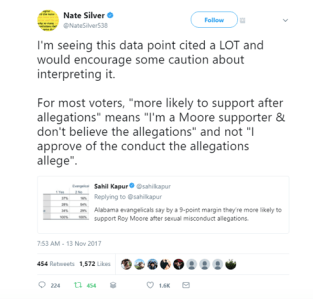
The most vexing evidence for such logic, came in a poll showing that a plurality of Alabama “evangelicals” reported being “more likely” to support him after numerous allegations of child sexual misconduct than before.

This left many of us scratching our heads.

Who could possibly be “more likely” to support someone “after” reports that he repeatedly stalked underage girls at the local mall while dressed like the cartoon sheriff from the movie Toy Story?

NOT SO FAST…

As many have pointed out, however, such polls should be viewed with suspicion (see here).

Screen Shot 2017-12-12 at 9.09.07 AM

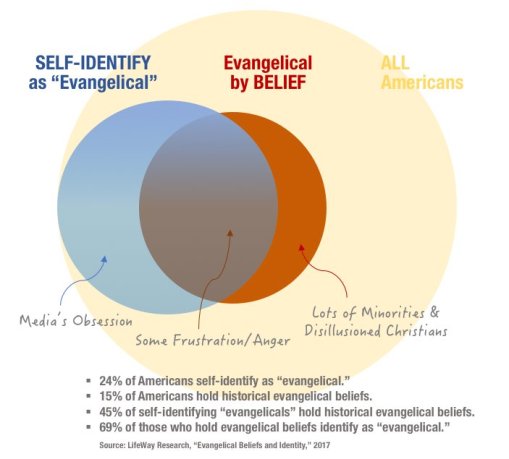
According the Wheaton professor Alan Jacobs: In parts of the country, “evangelical” has become synonymous with “whites who watch Fox News and consider themselves [vaguely] religious”–regardless of church attendance, Bible reading, or basic theological beliefs.

And while I love those people, that is not what the word means.

Evang. venn diagram

In short, the label has been corrupted.

In Roy Moore’s case, it was equated with the worst elements of partisan politics—hence it hangs like an albatross around the neck of many faithful and devoted Christ-followers.

(For what it’s worth, it also hurts the Pro-Life movement in the long run–like making Bull Connor the face of your anti-human trafficking campaign.)

Yet while many of us grieve the (earned) destruction of the “evangelical” label, we also worry that to look back longingly at the smoking ruins is to risk being turned into a pillar of insipid salt.

What, then, should one do with this beautiful but now corrupted label?

THE YEAR IS 1955

It bears noting that in 1955, Billy Graham faced a similar decision.

He had once been a self-identifying “fundamentalist,” back when that word was not synonymous with backwardness and bigotry. In its origin, the term had stood for the fundamentals of the faith. As did Graham.

Yet in 1955, he decided to drop the albatross for reasons that sound eerily familiar: it had been irrevocably tainted by un-Christlike beliefs and behaviors.

Even good words can be turned it seems—like raw oysters in the Alabama sun.

So Graham followed Jesus – out of “fundamentalism” in order to stay true to Scripture and the gospel (the “evangel”).

Or as cowboy Roy might say: “When your horse dies, get off.”

HOPPING OFF THE PENDULUM

What one does next, however, is important.

The temptation for many is simply to flee one rival kingdom for another.

If Roy Moore’s “evangelicalism” has turned a blind eye to egregious sexual and racial sins, one simply runs hard in the opposite direction.  After all, as Justice Ruth Bader Ginsberg once remarked:

            The true symbol of the United States is not the bald eagle. It is the pendulum.

But what if…?

What if it is partly our love of pendulums that caused this very mess?

NOW FOR THE GOOD NEWS 

My suggestion, then, is rather different: flee Roy Moore’s evangelicalism, but take the real “evangel” (i.e., gospel) with you

Because the real “evangel” is alive and well.

Just don’t look for it primarily in the halls of power.

That’s the same mistake we’ve been making for two thousand years: we long for thrones and forget to check the manger.

“I sent you prophets,” says Christ, “but you wanted lobbyists.”

“I sent you shepherds, but you wanted merchants of outrage.”

If you want the real evangel, here is some advice:

Look to the local homeless shelter, where Christ’s hands and feet are serving dinner to the other (equally valuable) members of his body.

Look to the recovery ministry meeting nightly in the church basement, sans cufflinks and news coverage.

Look to the crisis pregnancy center, where women who’ve been there reach out to women who are there.

Look to the high school football star (John) who takes my college Bible class even though it won’t count for credit at his eventual State school–he takes it because he loves Jesus.

Look to the college women (that I know) who spend their Spring Break fighting human trafficking in a Southeast Asia, rather than partying on some sandy beach in Destin.

Look to the group of older Christian women (the godly grandmas) who gather to encourage my young wife with wisdom gained from generations of parenting.

Look to the African-American couple serving faithfully in a predominantly white church, because they believe that the journey toward multi-ethnic community is worth it, even if it’s difficult.

And look to the Catholic nun, kneeling peacefully in the cold rain outside an abortion clinic, praying for the souls inside (doctors, mothers, and babies).

This is the REAL “evangel.”

It’s alive and well.

And in that sense, I don’t give a flying flip what happens to the Roy Moore version.

“The lower classes smell”

“The lower classes smell”

Why our ideas matter less than we think.

Back in 1937, George Orwell claimed this about the divisions within British society:

The real secret of class distinctions in the West can be summed up in four frightful words: The lower classes smell (~Road to Wigan Pier).

The statement sounds offensive and reductionistic. Perhaps it is.

Yet Orwell’s goal was actually to challenge his fellow highbrow socialists on whether their ideas about dismantling the class structure were actually strong enough to work in the field—where people live, and sniff.

In the words of James K. A. Smith (citing Wigan Pier):

Orwell’s point is that the root of class distinctions in England is not intellectual but olfactory.  The habits and rhythms of the system are not so much cerebral as visceral; they are rooted in a bodily orientation to the world that eludes theoretical articulation, which is why theoretical tirades also fail to displace it. … “For no feeling of like or dislike is quite so fundamental as a physical feeling.”

In other words, you cannot solve a gut-level problem with a philosophy.

The visceral trumps the voluntary; fundamental dispositions are more caught than taught; and the “nose” (now speaking metaphorically) is mightier than the brain.

Now the kicker:

Almost every other kind of discrimination could be countered theoretically, with the weapons of facts, ideas, and information, “But physical repulsion cannot.”

What does this have to do with us?

Just this:

In America, we seem to have entered a cultural-political climate in which both sides are “physically repulsed” by one another. Sickened, even.

And sometimes for good reason.

Yet if this is so, then one should strongly question our ability to bridge the gap with education, rational discourse, or (gasp) blog posts. Orwell’s point is this: revulsion trumps reason every time—try as we might to overcome it.

In short, our “ideas” are not nearly as important for the way we engage the world as we would like to think.

As Smith argues, we are not primarily “thinking things” as Descartes posited. Nor even “believing things” as much of Christian culture claims. Even demons believe (Jms. 2.19).

For Smith, both of these mistaken anthropologies place too much emphasis upon the cognitive realm (“ideas”), whereas the Bible focuses more upon reforming the heart, the gut, or even “the bowels.”  (Even the biblical references to renewal of the “mind” are not given in a Cartesian sense.)

We are primarily loving-desiring beings.

And as such, much of our behavior is the product of pre-cognitive, affective, gut-level, and visceral reactions.

“The lower classes smell.”

But how does one disciple the olfactory senses?

How do “the bowels” get redeemed?

Next time.


See James K. A. Smith, Desiring the Kingdom: Worship, Worldview, and Cultural Formation (here). For a less academic version of Smith’s argument, see You are what you love: The Spiritual Power of Habit (here).

Thou shalt not Cable News?

Thou shalt not Cable News?

Over at The Gospel Coalition, Trevin Wax is asking whether Christians should consider “pulling the plug” on an increasingly unsanctified form of television entertainment.

No, it’s not the racy or gratuitously violent scenes on “Skinamax” or other channels— it’s cable news.

Cable News

Here’s the money quote:

In a culture that has lost its appetite for truth and has developed an appetite for coarseness and sensationalism, cable news plays to our worst tendencies.

(Read the full thing here.)


Like me, Wax admits to having once been a bit of a “political junkie.” But as he puts it, “Election 2016 changed that.”

It wasn’t because, this time around, I was unable to enthusiastically support either candidate. It was a growing concern with the toxic atmosphere of the cable news channels and the worrisome trends they reveal about our society.

He then gives three reasons why the rise of niche-market news channels–tailor made to heighten our existing biases–have had cancerous effects.

Here they are:

  1. The Disappearing Aim of Journalism

While absolutely no one is unbiased, the claim here is that today’s cable news outlets (whether Fox News, CNN, or MSBC) aren’t even trying.

The aim is no longer truth or journalism; it’s ratings via sensationalized pandering to a specific demographic. For proof, one need only recall the admission of a CNN producer that the Russia scandal was “great for ratings.”

  1. The Disappearing Desire for Truth

Worse yet, many viewers do not seem to care.  We tune in for validation, not objectivity, and the media on both sides plays the music to our band.

  1. The Rise of News as Show

Wax’s third claim is that the line between news and entertainment has all but vanished.  What we have now are “shows,” or rather: “food fight journalism,” dished out by the likes of Hannity, Maddow, and (formerly) O’Reilly.

On this point, Wax gives a telling example from the life of Roger Ailes, Fox News founder and longtime Harvey Weinstein impersonator:

Ailes knew what types he wanted on that show: the “bombshell blonde,” the middle-of-the-road guy, the renegade, the brunette, and the token liberal (white or black) to round out the panel. When casting the show, he made it clear to the panelists that they were replaceable precisely because they were typecast.

In the end, such typecast replicability also led, by all accounts, to a newsroom that made Ron Burgundy’s look like a paragon of gender equality and female respect. The non-disclosure agreements were stacked like papal indulgences.

WAIT A MINUTE

But wait a minute… is all this an exageration?

Despite such strong indictments, Wax doesn’t want to go too far.

As he notes, moments of real journalism do sneak through on the cable channels.  And in moments of crisis, like the recent hurricanes, we are thankful to be “inspired by the stories of individual families, of daring rescues, and the ongoing relief efforts.”

Cable news is not all bad; not all options are equally biased; and simply tuning out to world events does not seem like a great alternative.

Perhaps one possibility then is to step away from cable–millennials like myself have long since done this (what are channels?)–and get our news from a variety of other sources.

The best of these may even involve (wait for it…) reading. While this would hardly free us from the grip of bias, the choice to read our news from more reputable sources would eliminate the endless food fights (read: panel discussions), engineered by Ailes and others. It would also prevent the binge-newsing that fuels an obsessive and over-politicized paranoia.

In the recent words of David Brooks:

[Our] public conversation is over-politicised and under-moralised … we analyse every single movement in the polls, but the big subjects about relationships and mercy and how to be a friend – these are the big subjects of life and we don’t talk about them enough. Or we have our moral arguments through political means, which is a nasty way to do it because then you make politics into a culture war.

A PROBLEM ON BOTH SIDES

As Wax makes clear, the problem exists on both the Right and Left.

In this, we have yet another example of how both extremes within our current culture wars are locked in a symbiotic existence that is simultaneously a carnal embrace.

They need each other; they are producing offspring (“As even your own poets claim”); and they ought to be in each other’s Christmas cards.

In the end, the greatest danger is what such WWE-inspired journalism does to us.

It changes us in subtle ways.  And it leaves us drawn (perhaps subconsciously) toward leaders with these qualities.

We form our media; then our media form us.

Before we know it, one might even feel “strangely warmed” toward a figure whose philosophical and rhetorical inspirations seem like an odd amalgam of Gordon Gecko and Ric Flair.  Hypothetically.

BEYOND LEGALISM

After reading Wax, my own takeaway was not a legalistic command along the lines of “Thou shalt not cable news.”

In all honesty, my own tradition has sometimes erred in this direction. My grandparents tell an old story of unloading the family moving van at a new church parsonage, only to be asked brusquely by a church elder:

“Do you own a television?”

“No,” replied my grandfather.

“Good; we throw those in the river!”

Neither Wax nor I are advocating this.

Even so, perhaps evangelicals would do well to recognize that “sex and cussing” are not the only forms of television viewing that can malform us when it comes to holiness.

Oh be careful little eyes…

We are Seven: On counting miscarriage

We are Seven: On counting miscarriage

“How many children do you have?”

That was the seemingly innocuous question that I asked my new acquaintance as we sat around the chips and salsa at our local Chili’s.

Like most parents, he answered with a number. Then he said the part that I had not expected:

“We had two miscarriages. And we always count those.”

While I responded with empathy, I recall thinking that most of us (myself included) do not publically number our children to include the little lives that never made it to delivery.

And on many levels, that is understandable.

We all deal with grief differently.  And it would be wrong to force one way of processing a failed pregnancy on others.

OUR MISCARRIAGE

About a year and a half ago Brianna and I walked through our own experience of miscarriage. And while it was sad for me, at the time, I was primarily concerned for her well-being.

After hearing a noise in our house, I came into our bedroom to find Brianna unconsciousness from blood loss.  I panicked.  Then I phoned my mom to watch our kids; I carried Brianna’s (now) semi-conscious body to the car, did my best to place her inside, and then drove us to the hospital.

Thankfully, she was soon okay.

But the baby had been deceased for several days.

Later, as some readers can relate, there was the awkward reality of having already told some folks that we were pregnant, and now having to explain.  Partly because of this, Brianna chose to share publically that she had lost a pregnancy.  And soon after, she was overwhelmed by the many friends and family who then confided their own stories–some far more traumatic than our own.

It happens often.  But that doesn’t make it nothing.

CONSISTENTLY PRO-LIFE

In Christian circles, one hears much about the need to be “Pro-Life,” and rightly so.

While the issue of abortion is polarizing, my own view leans on both Scripture and science to conclude that an unborn child is indeed a sacred human life, however small.

Even so, the consistent application of my “Pro-Life” stance involves much more than just abortion. It is a virtue that spans from womb to tomb, and sweeps up everything from welfare to warfare within its complicated wake.

I aim to be consistently Pro-Life.

Yet this too raises questions as to how I “count” our miscarriage.

WORDSWORTH OVER CHIPS AND SALSA

In a slightly different vein, something like my Chili’s conversation also happens in a classic poem by William Wordsworth (“We Are Seven”; pub. 1798).

Its verses recount an exchange between a traveler and a simple peasant girl.

The traveler asks:

“Sisters and brothers, little Maid, / How many may you be?”

“How many? Seven in all,” she said, / And wondering looked at me.

“And where are they? I pray you tell.” / She answered, “Seven are we; / And two of us at Conway dwell, / And two are gone to sea.

“Two of us in the church-yard lie, / My sister and my brother; / And, in the church-yard cottage, I / Dwell near them with my mother.”

Yet this statement brings confusion to the traveler: “I thought that you said seven.”

“You say that two at Conway dwell, / And two are gone to sea, / Yet ye are seven! I pray you tell, / Sweet Maid, how this may be.”

The misunderstanding, of course, involves the girl’s counting of her two dead siblings (“who in the church-yard lie”) as present members of her family.

Unfortunately, the mathematical modern adult doesn’t get it:

“You run about, my little Maid, / Your limbs they are alive; / If two are in the church-yard laid, / Then ye are only five.”

WE ARE SEVEN

As I read the poem recently (outside, on a nice morning, as is legally required of Wordsworth), it struck me that perhaps the number “seven” reflects our family too.

For if I were to begin consciously “counting” the child that we lost to miscarriage, then we would indeed be Seven. –(1) Brianna, (2) Josh, (3) Lucy, (4) Penny, (5) Ewan, (6) Baby unnamed, (7) Teddy.

And while I have no plans to begin saying this whenever someone asks about my children, perhaps it is a more consistent conclusion for those of us who consider ourselves “Pro-Life.”

After all, the weight of Wordsworth’s poem lies in the child’s stubborn insistence that death does not erase a child from the family roll.

To live at all is to be woven forever into the fabric of “present personhood.” We are eternal.

For to use Donne’s metaphor, “all mankind is of one author, and is one volume.” And while death is powerful and grievous, it cannot tear out words and pages from this book.  It can only translate them–if they be written in Christ’s blood–“into a better language.”

The trouble, however—as my two-year-old reminds me daily—is that children learn new “languages” far easier than grown-ups.

Thus even our ostensibly “Christian” thinking about miscarriage can often leave us thinking as only slightly more cordial versions of Wordsworth’s adult traveler, in need of child-like wisdom:

“How many are you, then,” said I, / “If they two are in heaven?” / Quick was the little Maid’s reply, / “O Master! we are seven.”

“But they are dead; those two are dead! / Their spirits are in heaven!” / ’Twas throwing words away; for still / The little Maid would have her will, / And said, “Nay, we are seven!


Coyote America

Coyote America

In the Latino communities of the American southwest, there is a saying:

            The only thing smarter than a coyote is God.

And while we car-driving, blog-writing humans may take issue with this claim, just ask yourself this question:

How many coyotes have you seen holding fidget spinners?

I sat rapt recently as I listened to the nature historian Dan Flores talk about his recent book: Coyote America. 

It is essentially a biography of America’s most adaptive underdog.

And it is also a strange topic for a blog on faith and culture.

So we should probably address that weirdness.

A DEFICIT OF AWE

You may not know it, but coyotes are not exactly “click-generators” in the world of social media. They do not wear bikinis; they have no thoughts on Donald Trump; and (unlike cats) they do not appear on Youtube playing the piano. (I checked.)

So why write about them?

Two words: unexpected awe.

While there are many problems in the modern world, among the least acknowledged may be our loss of wonder.  Despite all our technological marvels, most of us are far too rarely dazzled.

So while we are awash with entertainment, we have a deficit of awe.

And from this evil Amazon.com cannot deliver us.

This state of disenchantment presents a problem for the church, because a capacity for wonder may be a prerequisite for what Calvin called the sensus divinitatis—our sense of the divine.

INTO THE WILD

In the Bible, such awe comes often out-of-doors–though not exclusively.

It presents itself in burning bushes; in stars that mark descendants; and in a grappling angel by a brook.

In such wild places, our sense of wonder is refreshed.

And this brings us back to the coyote.

ETERNAL UNDERDOG

While Flores’ book starts in prehistoric times, its most interesting parts reveal how the coyote flourished while other species were decimated by the settling of the American West–a period that brought perhaps the swiftest destruction of wildlife in world history.

Yet despite an all-out war on coyotes starting around 1915, the only noticeable result has been that they continue to spread like wildfire.

While first inhabiting only a portion of North America, the animals now stretch from beyond the arctic circle down into South America.  And what’s more, they now inhabit every major city in the United States.

The reason for their flourishing has something to do with what the apostle Paul identified as “power perfected in weakness” (2 Cor. 12.9).

Because coyotes adapted as the smaller, frailer cousin of the wolf, they could not rely on brute force to stay alive.  Instead, they had to lean into their wits and learn to leverage weakness.

Case in point: their use of howls and hormones.

COYOTE TINDER

According to Flores, when the female coyote howls (or yips) each night, one purpose is to take the roll of the respective mates within her group.

If a male does not respond—say, because he was trapped or shot or mauled—it triggers a chemical reaction within the alpha female that does two things, both of which are awe-inducing:

First, it sends her prematurely into heat; and second, it causes the ensuing litter to be larger than normal.

You might want to read that again. The mere absence of an answering “yip” both triggers heat and makes the litter larger than they would be otherwise.

Most likely, this adaptation emerged from a history of weakness and inferiority in the face of larger predators. Yet somehow, this tendency to get killed-off by bigger animals coincided with a freakish adaptation that gave coyotes an advantage.

Example number two:

FRAGILE PACKS 

While wolves tend to stay almost perpetually in tight-knit groups, coyotes are what Flores calls a “fragile pack” animal. This means that when they face pressure from their enemies, they tend to splinter into smaller groups and then cast about in search of new territory.

Because grey wolves group more rigidly, the killing of a single wolf often leads to the killing of the entire pack—sometimes aided by the use of the original hide as a way to lure others to an ambush. For such reasons, wolves were almost eliminated from the American West, while coyotes spread rapidly in all directions.

“They tried to scatter us,” you can almost hear them howling, “They didn’t realize we were seeds” (cf. D. Christianopoulos).

RESISTING APPLICATION

Okay, okay… so coyotes have some crazy adaptations that have led to flourishing – but what do we do with this?

The tendency, for preachers like myself, would be a move to application: something like, The Coyote Principle (Now available for $12.99!).

After all, the book of Proverbs tells us to “Consider the ant” in order to be wise. And if Solomon were relocated to the Sierra Madres, perhaps the text would read “Consider the coyote.”

To be sure, there are lessons to be gained from such creaturely longevity.

For instance:

  1. Weakness does not have to be a weakness. And:
  2. Scattering can be a form of conquest.

Yet the too-quick drive to application can be a fault of teachers like myself. And in some cases it borders on a sacrilege–what Kierkegaard called “pillaging the holy.”

Because while we may benefit from life-lessons, sometimes we have a deeper need to marvel merely at the wonders made by the Creator.

As Donald Miller writes in Through Painted Deserts:

I sometimes look into the endless heavens, the cosmos of which we can’t find the edge, and ask God what it means. Did You really do all this to dazzle us? 

In sum: application is no substitute for awe.

THAT SUCH THINGS SHOULD BE

A related point is made beautifully in John Steinbeck’s classic novel, The Grapes of Wrath.

In one scene, two ragged “okie” boys slide into a roadside gas station as their family migrates west in search of food and better fortunes. In patched overalls and dirt-streaked faces, the children halt suddenly before the candy case. There they stared

not with craving or with hope or even with desire but just with a kind of wonder that such things should be.

Perhaps this tells us something of how Christians ought to look at nature, at coyotes, at oceans, at eclipses, and even at our fellow man—not with craving or with quests for application, but with naked wonder that such things should be.