Jesus picks the music: why love trumps “safety” on the Christian soundtrack

Jesus picks the music: why love trumps “safety” on the Christian soundtrack

When I was just a poor college student, I did things I’m not proud of.

Things – for money.

In a local apartment complex (dubbed “smurf village” for the bright blue paint), there was one particular residence that looked like all the others. Yet on the inside it was filled with recording equipment.

And there, on numerous occasions, I sang radio jingles for money.

Out of shame, I told no one. Thus my friends (if they noticed) probably thought that I had come into a very small inheritance – perhaps the life insurance policy for a departed hamster.

But eventually the truth came out.

One evening, as the college basketball team drove through a lonely stretch of rural Kansas, across the radio airwaves, came my voice – singing the praises of a “Christian lifestyle store” in a tiny town called McPherson.

Somewhere a rooster crowed.

All kidding aside, the jingles were easy to produce because whatever the merchant—a Bible bookstore in Kansas, a tanning salon in Illinois—the music and the melody remained exactly the same. Only the lyrics were different. This allowed the jingle producer (“Chuck”) to save both time and money when it came to composing and recording.

And most importantly, it ensured that I never had to learn new music.

THE GOSPEL IS NEW MUSIC

And that’s the trouble for Christians too.

All of us have a set of cultural assumptions that seem right and reasonable to us. These assumptions form the “soundtrack” of our lives, and they color everything from our politics to our parenting. Depending where you were born, your soundtrack may be different.

So while Scripture gives WORDS that are meant to tell us how to view the world, those words are easily lost amid the MUSIC of our tribe and our tradition.

It’s like trying to discern the lyrics to a “screamo” song when you’re used to Kenny Rogers.

The result, as one scholar observed, is that we look down the long well of history in search of Jesus, and in the water at the bottom we see a reflection of our own face. “That’s him!” we shout; “He looks and thinks a lot like me!”

Hence, we assume that Christ’s view on something is pretty much the same as whatever seems most “practical” or “reasonable” to us. Thank God. Or rather, thank us.

JESUS, THE IMPRACTICAL

But a quick read through the Gospels (with our music turned down even slightly) shows that Jesus is far from “practical” and “prudent” as we usually define those terms.

In fact, he says many things that don’t seem reasonable or “safe” at all.

A few examples, just from Matthew’s Sermon on the Mount:

  • “You have heard that it was said, ‘Eye for eye, and tooth for tooth.’ But I tell you, do not resist an evil person.”
  • “If anyone slaps you on the right cheek, turn to them the other cheek also.”
  • If anyone wants to sue you and take your shirt, hand over your coat as well.”
  • “Love your enemies and pray for those who persecute you, that you may be children of your Father in heaven.”
  • “If you love those who love you, what reward will you get?”

Elsewhere, in an even more radical passage (Mt. 25), Jesus claims that hellfire—yes, hellfire (see verse 41)—hinges upon whether or not one welcomes “him” in the form of poor and marginalized:

  • “I was a stranger and you invited me in,I needed clothes and you clothed me, I was sick and you looked after me, I was in prison and you came to visit me… Truly I tell you, whatever you did for one of the least, you did for me (vss. 35–36).”

Despite interpretive nuances, all this demands an ethic of radical love that seems impractical in many cases. And to be honest, I don’t always like it.

I WAS A STRANGER

I thought about this recently as I read a predictable comment thread on Facebook.

A pastor friend (and former student) had written a heartfelt post lamenting the recent Presidential edict summarily banning refugees and Green Card holders from certain countries, even when they pass the current vetting process.

My friend’s post was not partisan or angry, but the first comment was invariably a rebuke from a fellow churchgoer.

The respondent appreciated the compassion, but just wanted to share that it really isn’t “safe” or “responsible” to allow in Muslim refugees. After all, they’re Muslims.

So just as we “lock our doors at night,” so too we should lock our borders to such refugees—it’s just safer that way.

In response to this “locked door” analogy, the Scriptures tend to tell stories of people opening them (even late at night) to help the vulnerable (Gen. 19; Luke 11). And on the two occasions that a door remains locked, we discover that the church has shut out Jesus himself (Rev. 3.20; Mt. 25.43). The analogy is flawless, except for the Bible.

IN FAIRNESS…

To be fair, I’m all for safety and secure borders. And I’m all for improving the vetting process (when possible) for the folks that we allow to immigrate. A concern for safety isn’t bad, and it can even be a way of “loving thy neighbor.”

But what many fail to see is how radical the WORDS of Scripture actually are on such matters. And I suspect the reason is that while we’re happy to let Jesus say some things, we’ve never let him change our MUSIC.

Hence, the background noise (whether liberal or conservative; Fox News or MSNBC), drowns out the gospel call to a different set of values.

To disagree with the radio station that aired one of my jingles, Jesus has never been “safe and fun for the whole family.” He got tortured to death. And so did his followers.

Radical love, not safety, has always been the mark of Christian character.

This may sound risky, and that’s because it is.

But to sign on to the Jesus movement means that Jesus picks the music.

And in this soundtrack, sacrificial love trumps “safety” as the highest virtue.


For one organization helping refugees, see here.

For one book that has shaped my thinking on this issue, see here.

The trouble with millennial bashing (A response to Simon Sinek)

The trouble with millennial bashing (A response to Simon Sinek)

Recently, my social media feed was practically glutted with recommendations to watch the latest viral rant about “millennials”—that amorphous population blob between age fourteen and thirty-four.

This group is supposedly recognized by their armloads of participation trophies, their entitlement, and their helicopter parents.

This particular installment comes from Simon Sinek, and it has received around four million views.

Because I am eager to encounter insights that have been described as “Yes!” and “Boom!” I watched the video.

It’s easy to see why it caught fire.

Sinek is witty, well-spoken, and has smart-guy glasses.

But while he makes a couple of fairly obvious points (like: social media can be addicting <Now share this in-no-way ironic insight from a viral video>), I had a different reaction than did “Yes!” and “Boom!”

Apparently, I was not the only one (see here; NSFC).

THE CLAIMS

For Sinek (pun intended?), the problem with people born between 1982 and 2002 is that they were given lots of participation medals, and as a result, this self-esteem parenting has given them an insatiable desire for—in Sinek’s words—“beanbags” and “free food.”

In short, millennials are lazy and entitled.

And when the world doesn’t match their “Lo-Fi” Instagram filter, they become impatient and depressed–which makes them difficult to manage.

But don’t worry, Sinek sells books and courses that can teach you how to get more out of such lazy, narcissistic, and developmentally “Lo-Fi” people.

RESPONSE

To be fair, not all of Sinek’s claims are baseless.

So it would be wrong to follow the “crowd-pounding” of millennials with the crowd-pounding of Simon Sinek.

Some millennials are lazy, entitled, and surgically attached to smartphones.

I know: I’m a college professor.

In the words of a colleague:

“You are entitled to your opinion, but your opinion is a C minus.”

Some are even so surrounded by viral videos that they think success comes by becoming a YouTube sensation who plays fast and loose with data. It’s weird; I don’t know where they get it.

In sum, the trouble is not that the allegations against millennials are totally wrong, it’s that they are exaggerated and oversimplified.

In Sinek’s case, the flaws are masked by wit and supported by completely unsubstantiated appeals to things like “science” and “research.” And the glasses.

In my view, the problems are threefold:

  1. Wild generalizations,
  2. A bogus boogieman in the form of “participation trophies,”
  3. And a not-so-subtle marketing approach that succeeds by validating attitudes of superiority that are (ironically) similar to the faults discerned within millennials.

I’ll tackle these in order.

  1. THE TROUBLE WITH “GENERA(TIONA)LIZING”

            “All generalizations are false; including this one” (~Mark Twain).

Imagine if someone started a sentence with “You know what’s wrong with black people… [or Asians, or Jews, or the elderly].”

Then imagine that they proceeded to give a ridiculously reductionist answer like “they all want X.”

The trouble with such sweeping stereotypes is not just that they’re offensive, it’s that they’re wrong in many cases. You need actual data to make claims like this.

One cannot speak of millions of people, born in different regions, in different decades, under different economic conditions, to different parents with the tagline that “they want beanbags and free food.”

When dealing with runaway generalizations, one useful exercise is to look at what is being assumed. What face is Sinek putting on millennials?

Based on the description, his portrait is a child of privilege, showered with parental compliments (i.e. continually told that she was special), and ferried about to numerous after-school activities in which medals were awarded for participation.

Picture a Chevy Tahoe, orange slices, and a nice house in the suburbs.

And while this certainly describes some millennials, I’ve known just as many who struggled for nearly OPPOSITE reasons (And some who don’t struggle at all).

Some millennials were born poor, rarely heard words of affirmation, never knew a loving dad, and were rarely able to participate in activities that didn’t involve a television or the struggling schools tasked with fixing all manner of parental and societal shortcomings.

In fact, Sinek’s “millennial” looks strangely like himself: a reasonably affluent white kid with cool glasses and a bizarre beanbag fixation.

It is as if he looks into the deep well of culture, sees a distorted reflection of his own face, and calls it “millennials.”

I’d say look again; and this time leave the suburbs.

Now for the bogus boogieman:

  1. THE DREADED TROPHIES 

Participation medals are silly.

Lots of people think so.

So decrying them takes about as much courage as yelling “Yankees suck!” at a Red Sox home game. “That’s right Hahvey; Derak Jetah’s a bum!!!” 

It’s red meat.

But while the golden knick-knacks may be silly, they are not the major reason why some millennials are struggling to find jobs and pay off student loan debt.

The millennials I know (myself included) don’t even recall receiving the dreaded trophies. And if we did, they were likely lost beneath the minivan seats before we got home.

To explode the absurdity, Mark Hill recalls his reaction to one of these shiny little WMDs:

My response was not “Well, clearly I’m going to be handed a six-figure job as an adult.” It was “Neat, a trophy! Now I’m going to go back to thinking about Pokemon or farts, because I am a child.” [As] I got older, eventually only the teams that won were rewarded. This did not shock and sadden us — it was what we expected, and wanted, because we were actually capable of observing adult society, and we noticed that pro sports teams weren’t handed many trophies for constantly losing.

To blame a plastic trinket for the loss of a generation is like blaming the 2008 financial collapse on an ill-chosen Happy Meal toy (probably the Hamburgler; he totally normalized greed).

Participation medals are like Vin Diesel movies, Jar-Jar Binks, and men with bangs: they’re absurd, but they are not among our biggest evils.

The trouble is that we crave simplistic answers to complex problems. So along comes a pitchman, or a demagogue, to say:

  • “It’s the Jews!”
  • “It’s the rich people!”
  • “It’s the ab-roller for five minutes!”

It’s not. It’s really not.

And while Sinek bases his case on vague appeals to “science” and “clear research” Hill refutes this also:

It took me five seconds to find science that says the exact opposite. [So] maybe, just maybe, giving a kid a plastic knickknack when they’re eight doesn’t forever shape their psyche.

Now for the biggest problem:

  1. “FIRST, REMOVE THE [TROPHY] FROM YOUR OWN EYE” 

The most insidious issue with millennial-bashing has to do with a not-so-subtle marketing technique: the validation of self-righteous attitudes in the land of “Yes!” and “Boom!”

“God thank you that I am not like those people” (Lk. 18.11), I don’t even like beanbags.

Ironically, this sense of “special-ness” is quite similar to the fault decried within millennials. Funny how that works.

It is as if we all have a satisfied smirk while failing to notice that there’s a trophy sticking out of our own eye.

This happens in two ways:

First, there is the reaction of an older generation that sees the rant as validation: “I walked to school uphill both ways, and these spoiled brats get trophies.” This is nothing new. Every generation sees the next as upending everything. But the accusation is especially rich when coming from the children of the 1960s.

Second, it’s worth noting that many people laughing with Sinek are millennials themselves (see video). And for us (since, again, I technically am one), the pride comes from knowing that we are not like our peers. We’re better. “I sit on a real chair; I pay for my food; I drive a Dodge Stratus!”

Either way, such rants inculcate a sense of self-righteous superiority over a population that is not exactly what Sinek makes it out to be.

CONCLUSION

So yes, entitlement does need to be quashed.

And we can thank Sinek for reminding us.

But it doesn’t happen best by caricature and mockery devoid of data.

Believe me; I’ve tried.

When Billy met Richard: A cautionary tale

When Billy met Richard: A cautionary tale

It was the only whiff of scandal in the remarkable ministry of Billy Graham.

The year was 1972, and the evangelist was talking candidly with President Richard Nixon in the Oval Office. Unbeknownst to Graham, the now-infamous White House taping system was recording every word.

After an innocuous comment from Billy, the President launched into an anti-Semitic tirade. Such racist rants were not altogether unusual for Nixon.

But this one gained notoriety for the way Billy Graham joined in.

“They’re the ones putting out the pornographic stuff,”

Graham said of Jews.

“Their stranglehold [on the media] has got to be broken or the country’s going down the drain.”

While saying such things, Graham also acknowledged that the Jewish community didn’t know his true feelings about them:

A lot of the Jews are great friends of mine, they swarm around me and are friendly to me because they know that I’m friendly with Israel. But they don’t know how I really feel about what they are doing to this country.

After denying the rumored remarks about “satanic Jews” in the diary of H.L. Haldeman (Nixon’s aid), Graham issued a heartfelt apology when the audio came out in 2002.

It was a great embarrassment.

THE AFTERMATH

In the aftermath, both friends and biographers tried to make sense of statements that seemed so out of character.

After all, Graham had been a longtime foe of anti-Semitism and racism of all stripes. During the civil rights movement, he had invited Martin Luther King Jr. to share the stage with him. And he had even gone publicly to bail the civil rights icon out of jail as a show of solidarity.

“There is not an anti-Semitic bone in his body,”

said Graham’s longtime friend Lewis Drummond.

Perhaps, some said, he was just speaking of a few unscrupulous Jews in the media.

Yet another view came forth from Charles Colson. As he suggested, such lapses in character were not uncommon in Nixon’s Oval Office. The President was a commanding personality–especially in that room–and it didn’t take long for his “advisors” to be conformed to his conspiratorial image.

Colson knew this all too well.

He was imprisoned for his own involvement in Watergate; he became a Christian in incarceration; and he would remain close to Graham for the rest of his life.

Colson knew how the audio haunted him.

WHY TALK ABOUT THIS?

But why dredge up this story?

Contrary to what some might think, the reason is NOT to tarnish the reputation of Billy Graham. While the comments were ugly, Nixon’s were worse, and we might ask how many of us would want our most confidential conversations broadcast for the world to hear?

Not I said the cow. Not I said this blogger.

On the whole, Graham’s marathon ministry remains a paragon of humility, integrity, and grace. He’s not Jesus, but along with names like J.I. Packer and John Stott, he gave credibility to the label “evangelical.”

We could only wish to have him as the custodian of that label today.

A LESSON

So, again, why bring this up?  The reason is that it provides a much-needed lesson for all Christian leaders, and now more than ever.

All of us have a tendency to become chameleons in the presence of the powerful—not just overlooking their vices (which may sometimes be required) but sanctifying them in the name of “access” and “the greater good.”

In such cases, we play the flattering court chaplain rather than the truth-telling prophet. And in so doing, we become agents of propaganda rather than ambassadors of the gospel.

For his own part, Graham came to recognize this danger.

In 1991, he told an interviewer that he regretted “the politics part” of his relationship with Nixon—and this was long before the infamous audio came out. After Watergate especially, he vowed never again to be a pawn for partisanship.

In these days—and regardless of who occupies the Oval Office—many would do well to remember this advice.

GRACE BATS LAST 

This doesn’t mean, however, that Christians must always adopt the posture of indignant prophets. Somehow, there must be a middle ground between the sycophantic sellout and the “clanging cymbal” (1 Cor. 13).

And most cases, Graham found it.

Imperfect leaders need spiritual support as well. And even after the embarrassment of Watergate, Graham showed grace to Nixon.

When Nixon died, in 1994, I remember watching Graham deliver the funeral sermon.

He began with a gentle reference to another gifted though unscrupulous leader: (ironically) a Jew, named Saul.

The great king of ancient Israel, David, said on the death of Saul, who had been a bitter enemy: “Know ye not that there is a prince and a great man fallen this day in Israel.”

Somehow this managed (simultaneously) to pay respect and to acknowledge that there were things that needed forgiving.

As with Saul, there were faults that ought not be glossed over in the name of “access,” much less be baptized through emulation.

Thankfully, however, within the landscape of the gospel, such faults don’t get the final say. As Anne Lamott remarked recently, “Grace bats last,” and “Love is sovereign here.”

So Graham’s funeral sermon ended as it always did, with grace.

Nevertheless, as we now near the centennial of Graham’s birth, and the inauguration of yet another (by all accounts, conspiratorial) President, such cautionary tales seem worth remembering.


For a biography that situates Graham’s ministry in its socio-political context, see here.

For Graham’s own–more spiritually enriching–autobiography, see here.

My favorite bio of the Nixon presidency is that of Reeves, see here.

Hillbilly Elegy

Hillbilly Elegy

An elegy is a lament for the dead.

And as J.D. Vance describes it, his is a memoir of a family and a culture that is (at best) on life support.

Hillbilly Elegy chronicles the plight of America’s working class whites through the saga of his own family, which was transplanted from Appalachia to a dying factory town in the Ohio Rust Belt.

vance
P: Naomi Mcculloch

The book skyrocketed to #1 on bestseller lists as it became apparent that Donald Trump had somehow swept these so-called Blue states. And while there are many reasons for this unexpected victory, much credit (or blame) went to the demographic Vance describes.

His memoir shines a light on Rust Belt poverty from the inside—and from the perspective of one who has both deep affection and scathing criticism for the culture of his youth.

I encourage you to buy it here.

FROM THE “HOLLER” TO THE FACTORY 

Like many hill people, Vance’s family left the “holler” to take well-paid factory work up north. Yet as times changed, the steel communities like Middletown, Ohio began hemorrhaging both jobs and hope. And with the addition now of rampant opioid addiction, the hemorrhaging continues.

As a boy, Vance never knew his father, and his mother was a prescription drug addict who rotated boyfriends and husbands more frequently than others rotate tires.

He was raised by “Mamaw”—a foul-mouthed, pistol-packing grandmother who got pregnant at age thirteen, and who had a soft spot for F-bombs and Jesus Christ (both the Savior and the curse word).

Despite her faults, Mamaw saved J.D., and he eventually went on to the Marine Corps, to college, and then to Yale Law School.

AN INDIGTMENT OF ENTITLEMENT

What I expected from the work was more an indictment of the Rust Belt’s failed economy: factories shuttered, jobs outsourced, pensions lost.

I anticipated stories about hard-working men and women who fell afoul of a changing world.

And there was some of this.

But more frequently, Vance pulled no punches in acknowledging the crippling laziness and entitlement that has besieged his friends and family. As he states:

This book is about reacting to bad circumstances in the worst way possible. It’s about a culture that increasingly encourages social decay instead of counteracting it (p. 7).

People talk about hard work all the time in places like Middletown. You can walk through a town where 30 percent of the young men work fewer than twenty hours a week and find not a single person aware of his own laziness … the rhetoric of hard work conflicts with the reality on the ground (pp. 57–58).

To many analysts, terms like “welfare queen” conjure unfair images of the lazy black mom living on the dole. Readers of this book will realize quickly that there is little relationship between that specter and my argument: I have known many welfare queens; some were my neighbors, and all were white (p.8).

We talk about the value of hard work but tell ourselves that the reason we’re not working is some perceived unfairness: Obama shut down the coal mines, or all the jobs went to the Chinese. These are the lies we tell ourselves to solve the cognitive dissonance—the broken connection between the world we see and the values we preach (p. 147).

FAMILY MATTERS

At the root of this problem were not just economic forces, but the wholesale breakdown of the family.

Our men suffer from a peculiar crisis of masculinity in which some of the very traits that our culture inculcates make it difficult to succeed in a changing world. … Virtuous fathers are in short supply in Jackson [KY], but they are equally scarce in the lives of my grandparents’ grandchildren.

When it came to motherly influence, Vance says things were not much better:

“I was nine months old the first time Mamah saw my mother put Pepsi in my bottle.”

As a teacher at my old high school told me recently, “They want us to be shepherds to these kids. But no one wants to talk about the fact that many of them are raised by wolves.”

In this environment, Vance claims that a stigma is often attached to those who try to better themselves. Thus they are “too big for their britches” and are ridiculed by friends and relatives.

HILLBILLY CHRISTIANITY

Another takeaway was the role that religion plays within this culture.

As Vance describes it: “[Here] in the middle of the Bible Belt, active church attendance is actually quite low.” And in the steel mill town that he grew up in, it was “about the same as ultra-liberal San Francisco.”

Most folks are nominally “Christian,” yet the faith is full of contradictions:

Mamah always had two gods: Jesus Christ and the United States of America. I was no different, and neither was anyone else I knew (p. 189).

For Vance personally, his own faith was ignited (momentarily) when he went to live briefly with his adopted father. This man had been divorced by Vance’s mother, and had now found God with a new family.

I devoured books about young-earth creationism, and joined online chat rooms to challenge scientists on the theory of evolution. I learned about millennialist prophecy and convinced myself that the world would end in 2007. I even threw away my Black Sabbath CDs (p. 95).

In my new church … I heard more about he gay lobby and the war on Christmas than about any character trait that a Christian should aspire to have. … Dad’s church required so little of me (p. 98).

As Vance describes it, this was “evangelical” theology. Yet for those of us who study such things, it is frustrating to note the way in which mindless fundamentalism has become synonymous with “evangelical.” Perhaps, as many now argue, the label is beyond repair.

Likewise, the result is easily predictable:

[I didn’t] realize that the religious views I developed during my early years with Dad were sowing the seeds for an outright rejection of the Christian faith (p. 99).

CONCLUSION

In the end, Hillbilly Elegy is an eye-opening look into a culture that (till recently) had gone mostly unseen by those of use who don’t live in it.

It is both love song and lament, both thank-you and Dear John.

Yet for those who want to understand what’s happening across the Rust Belt of this country, it is a required read.

Buy here.

See also, Strangers in Their Own Land (here)

Missionaries, not Inquisitors: Columbus, Russell Moore, and Generational Mind Change

Missionaries, not Inquisitors: Columbus, Russell Moore, and Generational Mind Change

In flipping through some old books in my office, I came across this from David Bayles and Ted Orland (Art and Fear):

When Columbus returned from the New World and proclaimed the earth was round, almost everyone went right on believing [it] was flat. Then they died—and the next generation grew up believing the world was round. That’s how people change their minds.

Historically, the Columbus part is rubbish. The explorer did not prove that the world was round. People already knew that. What Columbus proved was that he was wrong about the earth’s circumference, and—more importantly—about Christian ethics.

My interest, however, is in the END of the quotation.

The idea here is that people mostly do not change their minds, even when confronted with new arguments. Instead, we tend to keep believing what we thought before—and then we die. Later on, our kids think differently.

We might call this the principle of GENERATIONAL MIND CHANGE.

For some, the recognition of this tendency leads to a narrative of PROGRESS in which the backward thinking of the past is slowly replaced with enlightenment and freedom. For others, it is tale of LOSS in which the wisdom of the ‘ol days gives way to cultural rot and muddled thinking.

Both are true in certain cases (see here).

My own generation, for instance, is far less likely to excuse, say, racism. But we are also far more likely to follow the Kardashians, or to confuse “tolerance” with full agreement.

Generational tendencies are a mixed bag. And every generation is diverse.

Given this, the point is not that such shifts are usually good or bad, but that (at some broad level) they do exist.

Now for an example:

RUSSELL MOORE

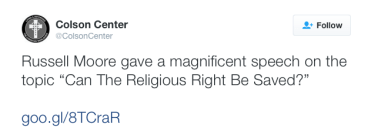
This week, I watched Russell Moore’s much hailed Erasmus Lecture. entitled: “Can the Religious Right be Saved?” It was a eulogy of sorts for a failed segment of the movement. And it was—in the view of many—brilliant (watch here; overview here).

My new theory is that Moore gives prophetic voice to what many younger evangelicals are feeling on this topic. But because he has the appearance of a 1950s Bible salesman (KJV only!), it is more difficult to dismiss him as “just another millennial” with hemp shoes and a secret love of socialism.

Like Samson, the secret’s in the haircut.

russell-moore

While the whole talk is instructive, Moore addresses a form of generational mind change that has taken place amongst many folks like myself—theologically conservative younger evangelicals (I’m still young, right?).

As he states:

There are no 22 year-old John Hagees. This is not because of liberalization. The next generation of these evangelicals pack orthodox confessional universities and seminaries, are planting orthodox confessional churches with astounding velocity. The evangelicals who are at the center of evangelical vitality are also the least likely to be concerned with politics. Again, this is not because they are liberal but because they keep a priority on the gospel and the mission that they do not wish to lose. The leaders they read and listen to are also often fairly indifferent to politics. … Those who do care about politics, and who lead populist movements, tend to be theologically vacuous, tied to populist ‘God and Country’ appeals that seem simultaneously idolatrous and angry to younger Christians, and often form a kind of “protection racket” seeking to silence Christian voices as “liberal” who wish to speak about such matters as racial justice.

While I might quibble with one or two things here,[1] my overall response is a hearty “Amen!”

As Moore continues:

We must remind ourselves that we are not inquisitors but missionaries [and] that we can be Americans best when we are not Americans first.

The problem, as he argues, is that segments of the Religious Right were never deeply formed by the gospel (the euangelion). Therefore:

One of the assumptions [was] that the church is formed well enough theologically and simply needs to be mobilized politically.

As Moore notes, this is simply wrong. Because when a gospel-formed theology is assumed (even when absent), what rushes in to fill the void is something more pernicious—often the pursuit of money, fame, and power:

As he argues:

The fundraising structure of political activism, left and right, means that often the most extreme and buffoonish characters are put forward. For the Religious Right, the strangeness to the world is not where the New Testament places it—in the scandal of the gospel—but in the willingness to say outrageous things on television. Some would suggest that even broaching this topic is “intellectual snobbery.” And yet, imagine a 1960s civil rights movement led not by Martin Luther King Jr. and John Lewis, but by Al Sharpton and Jeremiah Wright.  King did not simply speak to the passions of his followers but to the consciences of his detractors and to the consciences of those on the sidelines, overhearing it all. Behind that was a coherent set of ideas, grounded in the Bible and the Declaration of Independence.

In the end, Moore holds out hope that Religious Right may be saved, by an overhaul of leadership and by an encounter with more gospel-centered theology.

As he makes clear, his answer is not a withdrawal from the public square. Nor is he suggesting that Christians simply surrender to liberal shibboleths. From his perspective, both quietism and capitulation are copouts. Thus it was interesting to see ringing endorsements of the speech even from segments of the Religious Right itself.

colson-center
Tweet from the Colson Center

In this way, Moore’s conclusion was all the more jarring because it came from inside the camp of biblical and cultural conservatism. As he argued:

[The current political climate] did not give us this. This is a preexisting condition. The Religious Right turns out to be the people the Religious Right warned us about.

In response to all this, Rod Dreher addressed the question of whether Moore’s speech will change many minds within the old guard.

His answer—with which I agree—is a resounding “No.” That’s just not how these things work.

But in one sense, that point is irrelevant.

Because if Moore is right, the tectonic shift has already happened.

Time does not run backwards.

And for younger evangelicals, attempts to turn back the clock are likely to be about as effective as a robust argument that the world is flat.


[1] To modify Moore’s quote slightly, I would say, first, that many younger evangelicals do care about politics. They simply reject the preaching of partisanship  in place of Christ’s gospel. Likewise, many are frustrated that the old Religious Right has cared about some biblical values while ignoring others (See Moore’s comment about the voter guides which proclaimed a “biblical” position on term limits and the line item veto, but said nothing about racism and the abiding legacy of Jim Crow). Secondly, it may also be that Moore’s claims on the orthodoxy of younger evangelicals are a bit too rosy. My assumption on this point, however, is that his definition of what constitutes an “evangelical” means to exclude herterodoxy from the outset. Thus, he is not technically wrong here, despite the failure to mention the other side of the statistics.

Why I’d rather lose my religious liberty than vote for Donald Trump

Why I’d rather lose my religious liberty than vote for Donald Trump

“When you’re a star, they let you do it. You can do anything.”

And while Donald Trump said this of women, it’s been more true of his relationship with the Religious Right.

In short, Donald Trump has treated the bride of Christ just like the other married women in that disgusting audio recording. Yet unlike more honorable brides, some evangelical leaders have done nothing to resist his self-serving advances.

This, indeed, is a profound mystery. But I am talking about Trump and the church.

prolifememe

To be honest, I thought I’d written my last post on this subject.

Then came the audio of Trump bragging about his sexual assaults. And yes, that is the proper word for it (You just “Grab them by the p—y; you can do anything!”).

So here we are. Once more unto the breach.

In past posts (for newcomers):

  • I lamented the fact that democracy gives you the candidates you deserve (here);
  • I predicted that despite playing coy initially, evangelicals would ultimately flock to Trump (here) like moths to an orange and hairspray-fueled flame.
  • And I argued that choosing the “lesser of two evils” is not always a rule to live by (here).
  • I’ve also made it clear, that I am no fan of Trump’s main opponent.
  • And I suggested (here) that, for me personally, focusing my voting energy on local and statewide issues is a solution to the high-stakes game of “Would you rather…?” that is the Presidential race.

Along slightly different lines, I also appreciated my pastor’s wise advice to think for yourself, to think biblically, and to vote accordingly.

This post, however, is about a different topic.

THE “RELIGIOUS LIBERTY” ARGUMENT

As many of my Christian friends more-or-less concede, Donald Trump is a lecherous braggart with no serious proposals, the temperament of a toddler, and a penchant for racism and misogyny.

But… they say… We still must vote for him, because if we don’t, we’ll lose our religious liberties. And that “trumps” everything.

I respect people who say this.

And indeed, one of the things I like about academics is that we often disagree (even in print), not because we dislike one another, but because critique brings clarity, and that helps us all.

In fact, amongst esteemed professors, the way you honor someone is to gather their friends from around the globe, and publically critique their work. 🙂

And while that may seem strange, there is something beautiful about it too, because it says that even severe disagreement need not sever friendship.

(Now back to the issue.)

THE GRAIN OF TRUTH

As best I can tell, the logic of the “religious liberty” argument runs as follows:

Christianity is under attack. And if we don’t elect this admittedly horrible person, we will face further marginalization in the future.

(Note: I toned down the prior sentence in the editing process. Originally, it read: “orange-tinted sexual predator,” but I will not say that. Many others are saying it. I will not.)

And to be honest, there are bits of the religious liberty narrative to which I’m somewhat sympathetic.

It concerns me that our culture has confused “tolerance” with “agreement” (see here). And there are some areas in which liberty has been eroded.

The problem, however, is not just that the threat is sometimes exaggerated.

The deeper issue is the assumption that Christians should publicly join themselves with truly horrible individuals (and ideas) in exchange for promised “favors.”

That’s not prophetic witness. It’s closer to prostitution.

THE EVANGELICAL FUTURE

And my fear, which is rapidly materializing, is that American evangelicalism will suffer permanent damage for its shameful part in Trump’s doomed and degenerate campaign.

Here are just a few:

  • We will increasingly be seen as a “White’s only” movement – and if you don’t believe that, just ask my black and Latino students.
  • We will increasingly be known as a misogynistic movement, which has been a concern already, given the way certain evangelicals have tried to keep women from serving in leadership roles.
  • And we will increasingly be an “over sixty” movement, because one needs only to look at the Stats to see that my own generation has little stomach for Trump, or for those who try to force us into supporting him in the name of Jesus.

White guys. Over sixty.

That is not the kingdom of God.

But it is in danger of becoming “American evangelicalism.”

MY PERSONAL OPINION

So what’s my personal answer to the religious liberty argument?

Here it is:

As a Christian, and a father of two girls, I would rather lose every shred of my religious freedom than align myself with this truly vile human being.

In fact, I would rather have Christianity assailed from without (by liberalism) than corrupted from within.

As history shows, we can survive being marginalized. We can even survive persecution (though the “p-word” is sometimes overused by the Religious Right).

But we cannot so easily survive brazen complicity with the worst elements of human behavior. Nor do we deserve to.

So, yes, I still care deeply about abortion, the supreme court, religious liberty, and everything else.

But as Christ’s bride, I will not be treated like that married woman who Trump took “furniture shopping” in an effort to buy her body.

I did try and f— her. She was married. And I moved on her very heavily.

Some things are more important than “furniture.”

And some things are more important than political favors.

That’s my opinion, and I’m sticking to it.


Now a brief addition to the original post to address a common critique:

I should probably clarify at this point, what I am NOT saying.  I am not saying (as some seem to think) that we, as Christians should simply “give away” our liberties or treat them lightly (Thus, the intentional use of the word “lose” instead of “give” in my admittedly hyperbolic title).

Since true liberties are given by God, they should not be encroached upon by anyone.  Period.  Nor should they be “given up” without right resistance. I’m not proposing that we stop caring about religious liberty–in fact, I explicitly state that I do care about it, and that there are areas of concern.

What I am saying is that the church should stay true to Christ and his values (which, for me, means saying “No” to both candidates). And if that means having to face further marginalization in the future, then we must face that also by staying true to Christ.

Nothing is gained by linking arms with a truly destructive and dangerous candidate simply because he promises certain favors to one particular group. In sum, I do not think this is a particularly controversial idea and there is ample precedent for it in the Scriptures.


I’m proud of Tulsa

I’m proud of Tulsa

Charlotte erupted; Tulsa prayed.

That was the  headline, not from a Christian news source, but from CNN (here).

I live near Tulsa. And like many, my emotions swung wildly this week between gut-wrenching sadness and seething rage. Both are justified.

Yet another unarmed black man killed, a damning video, and the predictable flood of shameful justifications for why “it’s not what it looks like.”

Let’s be clear: it is what it looks like.

And the possibility of drugs in Terence Crutcher’s system doesn’t justify homicide.

Meanwhile, in Charlotte, there was another shooting: a black cop, a black man killed, and the allegation that the deceased was pointing a gun at officers. Buildings were burned, stores were looted, and many were injured–including innocent police officers and civilians.

Two cities.

Two very different scenarios.

Two very different reactions.

Charlotte burned; Tulsa prayed.

To be clear, this is not an attempt to bash Charlotte. And I fully admit that there are things about the broader situation there of which I am unaware.

Nor is it an attempt to “tamp down” protests or anger.

In the Bible, prayer itself can be an act of protest–a revolt against the status quo–and it is sometimes very angry.

Thus my point is only about Tulsa.

WHY I’M PROUD

Because while I am deeply ashamed that this shooting took place, I am proud of how many Tulsans reacted.

A few examples:

  • There were peaceful protests, with many looking more like prayer vigils made up of persons of all races.
  • Churches led the way, inviting the community to channel anger and grief in constructive ways, rather than giving the prejudiced deniers of injustice more cause to dismiss the unsettling reality of racism.
  • The police released the videos almost immediately, in a step toward transparency. This didn’t happen in Charlotte, and many have connected this to prolonged distrust between citizens and the authorities.
  • The police chief stated immediately and unequivocally that Terence Crutcher was unarmed, because it was true.
  • The DA’s office investigated promptly, and filed charges against the officer involved. She was arrested and will have a chance to defend herself.
  • And through all of this, no buildings burned, no stores were looted, and no police officers or civilians were injured by angry mobs.

This is an answered prayer, because one reason for taking police misconduct seriously is a desire to protect and honor brave and honest cops who do a thankless and impossible job.

Sadly, none of this brings Terence Crutcher back to his four kids. And none of it means that the problem of racial injustice has gone away—even (or perhaps especially) in Tulsa.

Still, amid the sadness and anger, I am proud of how Tulsa’s people have responded.

Now let’s work to ensure that such occasions for pride (and shame) happen far less frequently.


Comment policy: While comments are welcome, be sure to follow two guidelines in order to have your comment approved: (1) Use your actual name, and (2) Be respectful of all readers. Thanks for reading!

Why you should be more excited about your local school bond than about Trump vs. Clinton

Why you should be more excited about your local school bond than about Trump vs. Clinton

This week, my fellow citizens in small-town (Bartlesville) Oklahoma, go to vote.

Yet the choice is not about Republicans or Democrats.

It is a bond issue that will attempt to shield our local schools from crippling budget cuts.

asvcwp66

Turnout is expected to be very low.

And that’s a shame, because there are lots of reasons to be FAR more excited about a local school bond, than there are to be excited about either Donald Trump or Hillary Clinton.

Here are five:

  1. BECAUSE TRUMP IS GOING LOSE, NO MATTER HOW MANY FACEBOOK POSTS YOU WRITE.

He just is—and for lots of reasons. But mostly because we haven’t seen this kind of mind-numbing self-sabotage since Ryan Lochte called his mom from Rio. Given this, it would make more sense to direct your political passion to other votes at the state and local levels.

  1. BECAUSE UNLIKE THE PRESIDENTIAL RACE, THE MAIN OPTIONS DON’T FEEL LIKE A REQUEST TO CHOOSE YOUR FAVORITE CANCER.

Unlike Trump v. Clinton, your local school bond is far less likely to feel like a lose/lose choice. It’s a simple decision either up or down. And as a colleague of mine put it, it is different from the presidential ballot because it feels much less like you’ve been asked to pick your favorite Menendez brother.

  1. BECAUSE YOUR LOCAL SCHOOL BOND IS NOT DECIDED BY PEOPLE IN FLORIDA AND OHIO (*UNLESS YOU LIVE IN FLORIDA OR OHIO).

In small elections, at the state and local level, your vote carries much more weight in determining the outcome. Yet our passions are often illogically focused on races in which your vote will make no difference at all. To be clear, that’s not an invitation to skip the Presidential ballot, but it is a request to Google “electoral college” if you think I’m wrong.

Sadly, it’s the races that we often ignore that give us the biggest opportunity to make a difference.

  1. BECAUSE NO MATTER WHO IS PRESIDENT, PUBLIC SCHOOLS ARE HEAVILY INFLUENCED BY FOLKS AT THE STATE AND LOCAL LEVELS.

In my home state of Oklahoma, our public schools are woefully underfunded. We pay teachers terribly. And we pay a heavy price for it. In the end, there are lots of reasons for this, but none of them have much to do with who is President. Our teachers were paid poorly under Bush, Clinton, Bush, Obama, etc. And the solution to that problem will not come by way of the Presidential ballot.

  1. BECAUSE THE SCHOOL BOND IS NEITHER A REPUBLICAN NOR A DEMOCRAT.

These days, almost everything boiled down to the awkward binaries of Republican or Democrat, liberal or conservative.

Thus it is refreshing to vote on something that is simply an important issue, and not a purely partisan one. This week, many of my Republican friends will join me in voting “Yes” on our school bond, as will many of my Democratic ones.

(If you disagree, that’s okay too.)

But in this vote, the mud slinging of Trump vs. Clinton won’t matter.

Because the choice is about our kids, like my kindergarten daughter.


I Changed My Mind

I Changed My Mind

As someone once said:

“The only way to prove that you still have a mind is to change it occasionally.”

While the statement is meant to be humorous, I want to ask about the potential truth within it.

The question is this: Is there a link between wise and winsome people—the people we would like to emulate—and the ability to change one’s thinking on important issues over time?

In some cases, the answer would seem to be “No.”

After all, it is quite possible to change one’s mind for the worse. No one is born a racist, a proponent of “all natural deodorant,” or an Oakland Raiders fan. So there is nothing inherently good in simply reaching a new conclusion. Sometimes it’s bad.

Likewise, it is possible to “flip-flop” to a fault, changing majors fifteen times within a college career, or being like the wafflers in the lowest level of Dante’s Paradiso, who are “inconstant in their vows.” (The kids love Dante!)

349px-15th-century_painters_-_portrait_of_dante_alighieri_-_wga15992
Dante Alighieri. Divine Comedian. Wearer of awesome bedtime hats.

Despite this, I think most would say that the willingness to change one’s mind, and to admit publically that one was wrong, is a rare virtue in a world of ossified opinions and stick-to-your-guns stubbornness.

After all, there are no points for going down with your ideological ship once it hits the iceberg of Reality.

META-NOIA

And for Christians, the ability to change one’s thinking is actually a command.

In the New Testament, the Greek compound for “repentance” (metanoia) can be translated literally as a “change of mind.” Yet while Martin Luther once claimed that the whole of life should be characterized by this humble action (see his 95 theses), few would claim that Christians are particularly known for this.

More commonly, we are known for close-mindedness. And while the label can be unfair (note: the intolerance of the “tolerant”; see here), sometimes we earn it.

So how do we change that?

AN UNUSUAL CHAPEL SERIES

When I was in seminary, the director of the chapel program dedicated an entire semester of Friday sermons to a series called: “I Changed my Mind.”

Then, he invited respected professors to give messages on how they came to think differently about an important theological or social issue. As far as I remember, some of the offerings included:

  • “Women in ministry leadership.”
    • i.e., I used to think the Bible forbade it; now I don’t.
  • “Politics.”
    • i.e., I used to think that Republicans were basically “God’s party”; now I don’t.
  • “War and Peace.”
    • i.e., I used to believe that the New Testament required pacifism; now I espouse a cautious version of Just War theory.

In the end, the purpose of the series was not to get everyone to agree, but to show how serious  believers had wrestled with a particular issue, and then come to the conclusion that they had been wrong.

So they changed their minds.

In no case did this happen because they lost an argument. And in zero instances did it happen in the post apocalyptic world of internet comment boxes–where civil discourse goes to die.

Yet the series was meant (I suppose) to show students that even smart people need to continually re-examine their assumptions, entertain opposing views, and be willing to change if evidence demands it.

None of us have “arrived.”

All facts are friendly.

And as Luther argued, meta-noia ought to characterize the whole of life.

In terms of education, I love the words of Rosaria Butterfield:

“Good teachers make it possible for students to change their minds without shame.”

I hope to embody that this semester.

HOW I’VE CHANGED

But what about my own views?  Despite remaining relatively constant in core commitments, I’ve also experienced mind change. And not just “way back then.”

In my discipline, I started a doctoral dissertation with the intent of blaming Augustine of Hippo for any number of deficiencies within the western intellectual tradition. I ended up with a rather different conclusion.

In politics, my once predictable midwestern/evangelical views have become much more complex. Thus I now find myself as a faculty sponsor for a student group called the College Independents. (Because picking between Donald Trump and Hillary Clinton sounds like being asked to choose your favorite cancer (See here and here for more on that).)

In parenting, I was once adamant that my kids would go to public school “just like I did.” And while our daughter will start public kindergarten this week, our current philosophy is more fluid: As in, we’ll see how it goes and reevaluate based on the “situation on the ground.” No more dogmatism. Do what works for you. (But seriously, let’s pay public school teachers more; my home state of Oklahoma should be ashamed.)

CONCLUSION

So in some cases, the humorous quote has merit: The only way to prove that you still have a mind is to change it occasionally.

Now two questions:

On what important issue have you changed your mind?

And how did that happen?

Is G.P.A. Destructive? A Response to David Brooks and a Rant on Education

Is G.P.A. Destructive? A Response to David Brooks and a Rant on Education

“[The] grade-point average is one of the more destructive elements in American education.”

So says David Brooks in a recent Op-Ed for the New York Times (here).

In his view:

“Success is about being passionately good at one or two things, but students who want to get close to that 4.0 have to be prudentially balanced about every subject. In life we want independent thinking and risk-taking, but the GPA system encourages students to be deferential and risk averse, giving their teachers what they want.”

David Brooks
David Brooks

For the record, I like Brooks. Yet my question now is whether he’s right in this particular contention. As a teacher, I’ve thought about the matter a bit, and I’ve even had my own frustrations with the American elevation of broad-spectrum academic standards (like GPA).

Here’s a personal example:

ON MATH AND HERESY

After grad school, I wanted to do a PhD in theology. Yet in America, a key part of the application process is one’s GRE score. The GRE is something like the ACT on steroids, and it includes a written composition portion along with verbal and quantitative elements (aka “math”).

Sadly, I am terrible at math. Actually, I don’t “math,” which is one reason I specialized in trinitarian theology. In the Trinity, One = Three and Three = One. And if you object to that with “math,” you’re a heretic.

The GRE is a heretic (*sarcasm).

So while I achieved the highest possible mark on my written composition, my overall score was torpedoed by important theological skills like Long Division. I was not accepted.[1]

Then I applied to a great school in the UK (Manchester). Oddly, their entrance requirements had to do with (wait for it…) theology.

I got in, and finished ahead of schedule.

This brings me back to Brooks’ claim:

“Success is about being passionately good at one or two things, [not] prudentially balanced about every subject.”

I agree.

But here’s a complicating factor.

SPECIALIZED MORONS

At the same time that Brooks is critiquing the kind of broad-spectrum acumen that the GPA rewards, others are decrying the technical specialization that is rapidly replacing a liberal arts education.

The argument here is that while the migration to specialized STEM majors (Science, Technology, Engineering, or Math) may lead to a bigger paycheck initially, it can also fail to form the person broadly. And in some cases (not all), this results in highly specialized morons.

To back this up, many recent articles have highlighted the benefits of a broad-spectrum liberal arts education, even for those who eventually go into fields like business, science, and technology.

One of these articles comes from a Wheaton College grad, Alex Soholt. As he argues (here), broad training in the liberal arts has major benefits over exclusive specialization. Here are a few:

  • Liberal (i.e. “broad”) education teaches students how to think and learn for a lifetime. It does so by emphasizing a variety of skills, especially critical thinking and analysis that go far beyond the execution of a particular task.
  • Liberal education helps students to see things whole. As Soholt notes, the industries of the world are connected, like systems in a human body. If one fails, others are affected. Think, for instance, about the housing crisis of 2008, and the ensuing domino effect.
  • Liberal education enhances wisdom and faith. This is crucial. Education is meant to form the person, not just enable the acquisition of a paycheck. Think again of the housing crisis, and ponder what even the barest amount of morality and wisdom from the big banks would have done to change things. Just because something is lucrative and legal, that doesn’t mean it’s wise.
  • Liberal education contributes to joy. This last point is among the most important, but I’d like to address it through another personal example/rant.

WHY SHAKESPEARE DIDN’T MAKE: A RANT

For this semester, I was looking forward to auditing our college Shakespeare class. I have always wanted to do this, and the course only happens every couple years. (see here for why I decided to start doing this.) I talked with the professor, and got permission.

Then a problem emerged. Shakespeare didn’t “make.” In essence, no one else signed up to take it. More precisely, out of an undergraduate population of around six hundred students, two people enrolled in Shakespeare. Two!!!

“How is that possible!?” I asked. How is it that in a liberal arts university, only two people out of six hundred signed up to study the single most important writer in the English language? How can that be!?

I’ll tell you how. Or rather, I’ll tell you one reason. In large measure, we have forgotten that education is not just about checking off  requirements so that you can graduate. It’s not just about staying (barely) eligible so that you can play your sport. Nor is it merely about maximizing your “earning potential.” Education is also about maximizing JOY. And I don’t care what your major is, learning to appreciate great literature, great art, and great thinkers will make YOU better, no matter what field you settle in.

Increasingly, this reality is being noticed even in business and technology sectors, which have begun hiring more English and humanities majors in search of people who can write well, think broadly, and draw upon a number of disciplines (see here).

A POSSIBLE COMPROMISE 

So which is it?

Should we stress being “passionately good at one or two things” (Brooks)—and perhaps deemphasize the GPA? Or should we encourage students to study broadly as in a true liberal arts environment?

The answer is “Yes.”

At some point, one must drill deeply into an area of specialization. This is good. And at this stage, a poor score in an unrelated field (in my case, math) should not impede one as much as it sometimes does in the American model. Brooks is right about this. And too much focus on the GPA is a problem.

Yet at the same time, we must encourage undergraduate students especially to use electives to dabble widely, especially in the liberal arts. This way, they are more likely to be shaped as whole people and not just as narrowly knowledgeable one-trick ponies.

This need not mean abolishing the GPA, but it does mean changing how we use it.

Along these lines, one option might be to remove the threat of a GPA-crushing score in electives (like Shakespeare) so that non-specialists might be more apt to take such courses. A further step would be to ensure that students actually have said electives—as some majors, even in liberal arts environments, leave no room for them.

Finally, both students and parents must change the way they think about education in general. We must get beyond the soulless notion that the only classes that matter are those that teach me to do the immediate skill that I desire to do upon graduation.

Let’s be honest, that skill may not even exist fifteen years from now, but the ability to analyze, write, speak, think, and create is timeless.

That’s my two cents.

Now, what did I leave out?

And what do you think of Brooks’ claim?


[1] Of course, it is equally possible that I was denied for completely different and reasons. But this likelihood is more damaging to my self-esteem. Better to blame math.