An Odor of Decay

An Odor of Decay

This is the final post in a three-part series on the mortal human body in two classic works of literature: Homer’s Iliad and Dostoyevsky’s The Brothers Karamazov. Though the topic may seem morbid, it grants an opportunity to reflect on God’s continued care for “this earthly tent” even after death, and to reclaim The Great Books as conduits for Christian formation.

Now… allow me to share something I don’t like about the handling of this subject in the Iliad, and how Dostoyevsky helps.

An Odor of Decay

One of the more brilliant and poignant moves by Dostoyevsky in The Brothers Karamazov involves what happens to the body of the saintly Elder Zosima.

Zosima is, in many ways, the voice of Christian love within the work. And as he nears death, many expect some great miracle to accompany his soul’s departure. Perhaps the corpse will smell of lavender and be miraculously preserved. Perhaps the heavens will portend some sign of triumph and approval. Perhaps (like Elisha) his remains will work great wonders to convert the scoffers and the skeptics.

But none of this transpires.

Dostoyevsky patterns this part of The Brothers Karamazov on the traditional Russian construction of a saint’s life (zhitie), where a holy person’s relics perform signs or withstand decomposition.

Yet shockingly, for Zosima, his corpse almost immediately emits a terrible stench of fleshly corruption: an odor of decay that sets in far faster than normal.

To quote the KJV in its description of Lazarus: “He stinketh.”

The scene was so scandalous Dostoyevsky had to beg his publisher not to censor it, and he implores his editor to leave in the more jarring Russian word for “stank.”

The expedited smell of rot causes some to declare Zosima a false teacher. And the combination of rumors and self-righteous gloating from his enemies drives the story’s hero, Alyosha Karamazov (Alexey), to question his faith, reach for a glass of vodka, and head off to visit a woman of ill repute (Grushenka) who has designs on debauching the young monk.

From Homer to Dostoyevsky

I bring up this strange happening because I find it to be a helpful counterbalance to a trend I spoke of previously (here and here) in Homer’s Iliad.

In Homer, the gods always dole out special treatment in who gets cared for both before and after death. Great warriors and the sons of deities get extra care and preservation, as when “Apollo pitied Hector, and kept his body free from taint.” Meanwhile, the rest of us rot.

When a spear is hurled at the mortal child of a god or goddess, it gets bumped off course by a nepotistic divinity. But it never clatters harmlessly to the sand. It always skewers some poor schmuck standing just behind the target.

Life still feels like that sometimes. The powerful and privileged get special treatment. And they have special resources to keep them “well preserved” despite the fact that death still comes.

But not with Zosima.

So why does Dostoyevsky tell his story this way?

Why does the saint emit an odor of decay in The Brothers Karamazov, whereas Homer keeps his main characters lemon fresh until the funeral pyre is lit?

The answer, I think, has to do with Dostoyevsky’s own wrestling match with faith and doubt in a world where God’s presence isn’t always discernible. And it hows his tenacity to cling to resurrection hope even when “the gods” don’t provide proof of their affections.

The Other Alexey

The epigraph for The Brothers Karamazov is a quote from John 12:24:

“Very truly I tell you, unless a kernel of wheat falls to the ground and dies, it remains only a single seed. But if it dies, it produces many seeds.”

It is, in many ways, the key that unlocks the entire novel.

Though Dostoyevsky names his hero Alexey Fyodorovich, the ghost of another Alexey hovers over the story’s most painful questions: the author’s three-year-old son (Alexey Fyodorovich), who died just before the book was written, of the epilepsy inherited from Dostoyevsky.

In many ways, The Brothers Karamazov is a father’s raw attempt to work through crushing grief and anger while refusing to relinquish gritty Christian hope. “Unless a seed falls into the ground…,” you can almost hear him reciting as he hammers out his tale of fathers and sons, faith and doubt, death and longed-for immortality.

If the problem in Homer is that the gods intervene too much (and too capriciously), the worry in Brothers is that God might not exist at all, or that he has much to answer for in creating a world where children suffer, die, and then decay.

There is a reason why Job was Dostoyevsky’s favorite book of Scripture.

Bow and Kiss

I’ll teach through Brothers this year in a special class on Christian worldview, offered in the OKWU Honors College.

The goal is to examine some of the biggest human questions through the lens of deeply Christian work of literature—which, when read slowly and discussed deeply (without smartphones or chatbots to give our brains “the odor of decay”), has the capability of forming us more fully in Christ’s image.

So back to the question: Why does Dostoyevsky make his saintly elder stink in excess of nature?

No answer is given.

But several clues are important.

First, Zosima’s last act before dying is to bow and kiss the earth (the place where seeds must fall and decompose in order to bear fruit).

Second, upon going to the alleged prostitute (Grushenka) in his bitter grief, Alexey and the woman do nothing unseemly. Instead, her compassion over Zosima’s death and Alexey’s lack of self-righteous judgment of her past end up transforming both characters—so that neither is ever the same. (Dostoyevsky clearly wants us to notice that this spiritual “fruit” would never have sprung forth except from soil fertilized by the “miracle” of Zosima’s premature decay.)

Third, when Alexey goes next to stand vigil by the Elder’s body, the passage being read over the casket is John 2: the wedding feast at Cana. Here, wine is miraculously made by Christ from water. And what is such wine? It is the product of expedited(!) fermentation that—in John 2—causes the disciples to put their faith in the Messiah.

Thus, even decomposing matter is transformed into fertilizer for an unexpected harvest that far exceeds the single seed.

Conclusion

What I love about Dostoyevsky’s treatment of the mortal human body is his gritty ability to hold together resurrection hope with a world that still smells with the odor of decay.

Whereas Homer’s vision is both formulaic and fatalistic (special people get “preserved” but none get resurrected), Dostoyevsky’s mind is open to surprises that are simultaneously more painful, mysterious, and hopeful.

“Bright sadness” is the paradoxical description that is often used.

Or to steal an oft-quoted line from the Nicaraguan poet Ernesto Cardenas, they tried to bury us, they didn’t realize we were seeds.


Hello friends. Please subscribe on the homepage to receive these posts by email. This is especially helpful since I’ve decided (mostly) to uncouple the blog from social media. Thanks for reading. ~JM
Battle for the dead (part 1)

Battle for the dead (part 1)

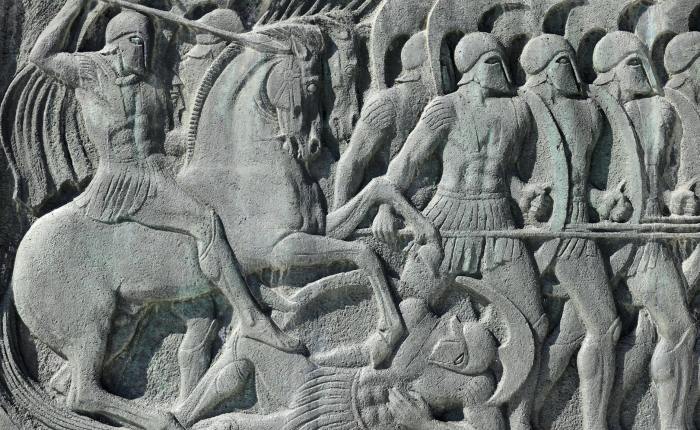
One of my summer reads this year was a slow journey through Homer’s Iliad—the great archetype of our war stories, action movies, and (in a way) superhero universes.

Among other insights, I was struck by how much of the fighting is focused not on killing an enemy or conquering a bit of ground, but on the furious desire to protect or desecrate a corpse.

The Iliad is, in many ways, a struggle for the dead–whether for the corpse of Sarpedon (mortal son of Zeus), Patroclus (intimate of Achilles), or Hector (favored son of Priam and champion of Troy).

“Human mortality is at the center of it all,” writes Emily Wilson. “I know no other narrative that evokes with such unflinching truthfulness the vulnerability of the human body.”

Yet unlike modern action movies, that bodily vulnerability (in the Iliad) is just getting started when one’s final breath departs through “the fence of teeth” (Book 9.529).

Shame and honor lie at the root of such concerns, as do ancient pagan assumptions about the requirement of proper funeral rites for a departed shade to enter Hades.

Unfortunately, countless other deaths occur in the attempt to secure the body of an enemy or comrade.

I’m interested in the point for several reasons:

  1. N. T. Wright points out that Homer functioned somewhat like the “Old Testament” for ancient pagan audiences, in a way roughly analogous to how the Hebrew Scriptures remained foundational for Christians.
  2. I agree with C. S. Lewis about the value of old books to reveal our modern blind spots, not because they are infallible, but because they do not share our unexamined assumptions.
  3. I’m convinced many well-meaning Christians lack a proper view of the body both before and after death. Thus, reflecting on this subject in the Iliad (alongside Scripture) might actually make us more faithful Christians.

In Homer’s story, the struggle for the dead happens in at least three ways: (i.) corpse care, (ii.) desecration, (iii.) divine intervention to stave off decay.

CORPSE CARE

The importance of proper corpse care is demonstrated by Achilles, as he sets out to wash and rub with olive oil the body of his dear friend Patroclus, and to fill his wounds with ointment (18.438).

Though Achilles feels compelled to avenge his comrade, he cannot bear the thought of what may happen to the body in his absence:

I am still most terribly afraid for brave Patroclus

Whose body has been hacked with so much bronze.
Flies may get in his wounds and worms may grow there,
Dishonoring his corpse. His life is gone,
And now his flesh may rot (19.30-36).

The mirror of this heartrending concern is found in Priam, who ultimately sneaks behind Greek lines to plead with Achilles for the body of his beloved son, Hector.

In that meeting, “They both remembered those whom they had lost.” And “Curled in a ball beside Achilles’ feet, Priam sobbed desperately,” in a fatherly move that finally breaks the callous wrath of his adversary (24.631–35).

DESECRATION

The desire to care for the bodies of friends and family is matched by an unholy drive to desecrate the corpses of one’s enemies.

Achilles exceeds all others in this impiety, for which the deathless gods are furious with him (24.146), since he does not stop at merely killing foes or stripping their armor, but commits abominations on their corpses.

In the final battle between Achilles and Hector, the matter of who will win is never in doubt. The only question, even for Hector, is what Achilles will do to his corpse.

Despite pleas from his dying adversary, Achilles proclaims:

If only I had will and heart to do it
I would carve up your flesh and eat it raw […]

No one can save your body from the dogs,
not even if they bring me as a ransom
ten times or twenty times the usual rate (22.465-70).

True to his word, Achilles then commits “shameful atrocities on noble Hector,” piercing the tendons behind both his feet (#foreshadowing) and dragging him behind his chariot. Upon finishing his circuits ‘round the body of Patroclus, Achilles leaves Hector’s corpse face down in the dirt—unburied, unreturned, and yet (incredibly…) undecayed.

This brings us to the last point.

MIRACULOUS INTERVENTION

It would not be Homer if the gods did not intervene.

In each case (Sarpedon, Patroclus, Hector), divinities step in not to save or resurrect the warriors, but to preserve their corpses:

even now in death, Apollo pitied
Hector, and kept his body free from taint
He wrapped a golden cape, an aegis, round him,
To ensure the dragging never scratched his skin (24.24-27).

Though Hector’s body has been abused and left unburied for twelve days, still “dewy-fresh he lies”; and his many wounds “are quite closed up” (24.520).

Despite violent death outside the city gates, Apollo will not allow his holy one to see decay.

A father intervenes, a trip is made to the one responsible for his death, and a brave plea is made for the body.

Now what does that sound like?

In the next post I’ll unpack why this still matters.


Hello friends. Please subscribe on the homepage to receive these posts by email. This is especially helpful since I’ve decided (mostly) to uncouple the blog from social media. Thanks for reading. ~JM
While his characters were getting better (a cautionary tale)

While his characters were getting better (a cautionary tale)

A bombshell landed on the literary world last year after the death of Cormac McCarthy, the man who had been, arguably, America’s greatest living novelist.

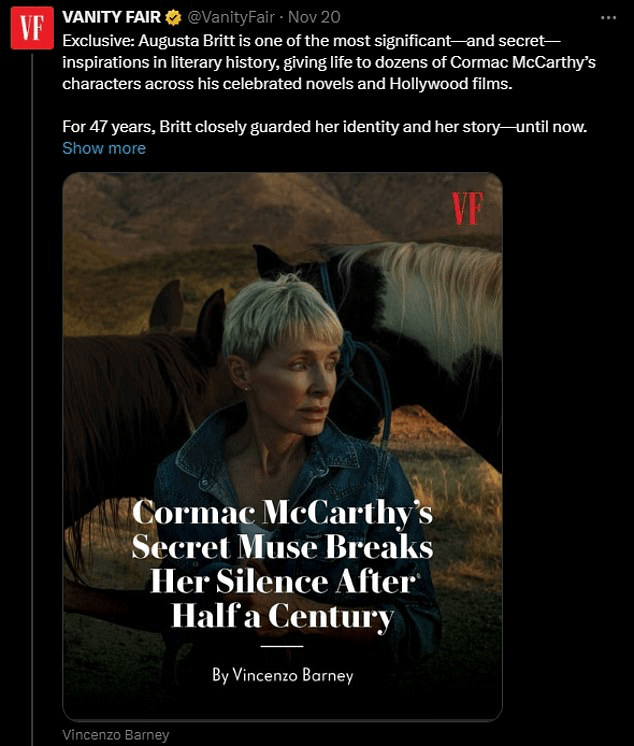
The shock was not McCarthy’s passing (he was 89), but a Vanity Fair article by Vincenzo Barney that broke news of a nearly fifty-year relationship with a woman named Augusta Britt—the “secret muse” whose life and personality inspired many of McCarthy’s greatest characters, most of whom were male.

“I’m about to tell you the craziest love story in literary history,” the article began.

The short summary put it this way:

Augusta Britt would go on to become one of the most significant—and secret—inspirations in literary history, giving life to many of McCarthy’s most iconic characters across his celebrated novels and Hollywood films. For 47 years, Britt closely guarded her identity and her story. Until now.

A firestorm ensued, in part, because the relationship began when Britt was just 16 and McCarthy 42. She met him by a hotel pool, while on the run from abuse within the foster system–a Colt revolver on her hip, his book in her hand. “Are you going to shoot me, little lady?” was allegedly McCarthy’s question.

Though Britt maintains that McCarthy saved her life, reactions to the article have understandably been mixed. “Let’s be honest with ourselves,” read a headline from The Guardian, “Cormac McCarthy groomed a teenage girl.”

I read the Vanity Fair piece back when it came out, which raises the question: Why write about it now, months later?

To be honest, a particular phrase sometimes gets lodged in my mind, long after I have read a book or article, and that’s essentially what happened here.

I’ve had a long relationship with McCarthy’s novels (see here and here), and he is undoubtedly one of the great writers of his generation. You can’t read books like The Road or Blood Meridian and not be struck by the power of his prose, the Christ-haunted characters, and the desert landscapes that seem to whirl and pulse in ways unmatched by any other author.

Unfortunately, great writers are not always great people. And in some cases, the relation seems to run the other way.

Here, then, is Augusta Britt’s assessment that stuck with me about McCarthy’s later years:

But as his characters started becoming better humans, in Britt’s view, McCarthy, whom she always thought of as a great man, did not. As he dined with celebrities and reinvented himself in Santa Fe as a formidable intellectual … he turned his back on his oldest friends. “He felt he’s wasted the last years of his life,” Britt says.

I can’t say if that’s true. (After all, running off to Mexico with a underage girl seems to work against the hypothesis that McCarthy’s moral compass became skewed primarily in his later years.)

Nonetheless, the potential divergence between one’s work and life strikes me as both interesting and relevant for all of us.

Why might one’s characters be getting better, while one’s character is either stalled or getting worse?

I’ve been struggling with a term to define the tendency, beyond mere hypocrisy. In the realm of spiritual formation, we might call this compartmentalization, rationalized regression, or a sort of moral transference. Psychologically speaking, transference involves the redirection to a substitute, often a therapist, of emotions or experiences that are (or ought to be) one’s own: in this case, from one’s character, to one’s characters.

Again, I don’t know if that happened with McCarthy, but I’m quite certain it’s a temptation for us.

Consider:

“While his sermons were getting better, his inner life was getting worse.”

“While her performance evaluations were getting better, her spiritual health was growing worse.”

“While his resume was getting better, his parenting was getting worse.”

If there’s a lesson here, perhaps it’s this: substitutionary sanctification is a dead end.

To amend one of my favorite verbal amulets from L. M. Sacasas, “[moral work] cannot be outsourced”–whether to AI agents or to characters between the pages of a book.


Hello friends. Please subscribe on the homepage to receive these posts by email. This is especially helpful since I’ve decided (mostly) to uncouple the blog from social media. Thanks for reading. ~JM
Something more than civilization

Something more than civilization

In-keeping with my claim that reading is rereading, I spent an evening recently flipping through Alan Jacobs’ excellent book, The Year of our Lord 1943: Christian Humanism in an age of Crisis.

He notes how, in a time of total war, an assortment of Christian poets, novelists, and philosophers produced some of the most remarkable and enduring work of the century. The players include Jacques Maritain, W. H. Auden, C. S. Lewis, Simone Weil, and T. S. Eliot.

More interesting still was that these folks were neither pastors nor theologians, and they did not focus explicitly on current events (i.e., the latest headlines), though the geopolitical world was quite literally on fire.

Instead, they turned to the humanities and education—poetry, novels, philosophy, and habits of prayerful contemplation—as ways of rebuilding the ruins of a fallen civilization on a more robust foundation than merely the desire to “save” civilization.

Perhaps civilization has been imperiled, wrote C. S. Lewis in 1942, “by the fact that we have all made civilization our summum bonum [highest good]. And “Perhaps civilization will never be safe until we care for something else more than we care for it.”

Many of them also identified a malignant common thread between the likes of Hitler, Stalin, and even many within the allied powers: a technocracy of domination, devoid of humane religious and moral underpinnings.

As Auden wrote, in a paragraph on “techinique” and “temporal power,”

“What fascinates and terrifies us about the Roman Empire is not that it finally went smash but that . . . it managed to last for four centuries without creativity, warmth, or hope.”

Or Jacques Maritain in Education at the Crossroads:

Technology is good, as a means for the human spirit and for human ends. But technocracy, that is to say, technology so understood and so worshipped as to exclude any superior wisdom and any other understanding than that of calculable phenomena, leaves in human life nothing but relationships of force, or at best those of pleasure, and necessarily ends up in a philosophy of domination. A technocratic society is but a totalitarian one.”

Or C. S. Lewis:

“What we call Man’s power over Nature turns out to be a power exercised by some men over other men with Nature as its instrument.”

LESSONS FROM THE RUBBLE

Jacobs’ point is that each of these writers (despite deep differences and numerous blind spots) strove with astonishing energy—at what might seem the least convenient time—to throw a lifeline to their readers in the form of deeply literate and thoughtful form of Christianity, which was neither a withdrawal from the public square, nor a breathless regurgitation of political talking points. “I see no hope for the Church,” wrote C. S. Lewis, “if it allows itself to become just an echo for the press” (or government).

Thus, if one wants to learn what a faithful form of cultural rebuilding looks like, we would do well to consider their examples.

Here then are Jacobs’ concluding lines—which seem more needed now than ever:

“If ever again there arises a body of thinkers eager to renew Christian humanism they should take great pains to learn from those we have studied here”

SIGNS OF LIFE

I revisited the book, in part, because Jacobs just announced his coming retirement from the Honors College at Baylor University. Still, as he heads off to (hopefully) write more books, there are signs that small pockets of this kind of thoughtful and historically-rooted Christian education are beginning to bear fruit.

The work isn’t sexy, and it won’t garner headlines, but it is happening in small corners even now.

Case in point: This Spring, twelve students signed up to take an Honors College class with me on Dostoevsky and discipleship, as witnessed in his brilliant but difficult novel, The Brothers Karamazov. The students come from a host of majors—accounting, biology, ministry. Most don’t need the course to graduate, but they’ve been convinced, partly by my soapbox evangelism, that the way through life’s toughest questions is more likely to run through the Great Books than by machine-gunning prompts into Chat GPT.

Evidence 2: Last week, I drove down to Oklahoma Baptist University to learn from one of their Honors seminars in which college students meet at 8am each morning (roughly 4am “CST” [College Student Time]) to discussGreat Books from a Christian perspective. The class was excellent. Not a smartphone in sight. Books and notebooks open. Insightful conversation. It was led by a church history professor, and the program is overseen by Oklahoma’s former poet laureate, Ben Myers.

Evidence 3: As I thumbed through a catalogue of books due to come out soon on the topics of theology, the arts, and culture, it was striking to see how many of those authors had been shaped and trained (in some way) by what might be called the “Baylor pipeline” in which Alan Jacobs has served for years within their Honors College. I am under no illusions (whatsoever!) that Baylor is a perfect place. Still, at least one pocket there has become quiet but consequential hub of deep and humane Christian learning, tucked within a Big 12 school.

All that to say, take heart.

For in the words of Auden, though “our world” seems “Defenceless under the night,” still, “Ironic points of light / Flash out whereever the Just / Exchange their messages.” And so,

May I, composed like them
Of Eros and of dust,
Beleaguered by the same
Negation and despair,
Show an affirming flame


Hello friends. Please subscribe to these posts via the button on the home page to receive future posts by email. This is helpful since I’ve decided (mostly) to uncouple the blog from social media. I’m grateful for you. ~JM

Reading is Rereading

Reading is Rereading

After my sermon last Sunday, a friend asked, “How many books do you read per week?”

Surprisingly, the answer is usually “less than one.” To be sure, I read daily: Scripture and academic works in the morning; and something outside my field at night—fiction, history, or biography. (I’m currently near the end of Simon Schama’s fantastic but entirely-too-long history of the French Revolution.)

Still, I suspect I read slower than most people.

My friend’s question emerged because I had referenced several books in the sermon (probably too many books, if I’m honest). These authors included A. J. Swoboda, Joshua Jipp, Will Guidara, Ingrid Faro, and Wendell Berry. And, you know, Luke’s Gospel.

I was able to draw on these books, not because I had read them last week. (Only one fell into that category, and I didn’t finish it.) Instead, I could retrieve them because of the way I read and annotate books. (And I do mean physical books—with pages, spines, and a total lack of pixels.)

I mark them up like a graffiti artist tagging a boxcar and I dog-ear pages with content I want to retrieve, usually with a one- or two-word annotation: “Blog post,” “Article,” “Micah 6:8 book,” “Sermon Illustration,” “Atonement doctrine,” “No!”

When it’s time to write a message, a lecture, or a book of my own, I’ll consider what previously-read works in my library might add something; then I’ll flip through the dog-eared pages quickly to see what fits. It might take 30 seconds per book.

The massive benefit, however, is that I’m able to retrieve things that I no longer remember.

Perhaps that habit can help you too.

Of course, some caveats apply:

  1. You can’t dog-ear every page. If you highlight each word, you might as well not do it. I aim for less than ten dog-ears per book (four or five is best), otherwise you’re just doing entry-level origami.
  2. Slow down. Reading is about growth, not “finishing.” Studies suggest slower readers—that is, those who read at the pace of speaking rather than the pace of word-recognition–retain and remember far better than others. Hear this: In a world of distracted digital rabbits, be the turtle.
  3. Read broadly. No one wants to listen to someone who only reads business books (welcome to the late 90s and early 2000s in many evangelical denominations), or sports, or academic tomes, or jingoistic histories, or partisan political opinions disguised as “a Christian worldview.” The best writers, preachers, and thinkers read broadly. After all, I can only speak to all of life if I read intentionally in ways that touch upon the diversity of human experience. Otherwise, we become like the old man on the Simpsons who proclaims loudly that he hates everything but Matlock and Metamucil.
  4. Man cannot live (or preach) on books alone. As much as I want to champion reading actual books over the brain-rot of cable news, TikTok, smartphones, and the temptation (even in academia…) to say “AI” over and over as if it’s a magic spell that substitutes for thought and work and expertise—the fact remains that we live increasingly in a post-literate age. Hence, I’ve been inspired by authors and preachers who can draw not only on books, but on other sources too. I recall several moving illustrations in Jake Meador’s recent work that came from the world of streaming television—since, let’s be real, his audience is more likely to recognize those illustrations than they are a reference to Charles Dickens. Thus, when Jesus preached, he told more stories about seeds than Stoic philosophers.

CONCLUSION

In the end, take this as an encouragement that slower readers can still be deeply formed by books—and then pass that blessing on to others. In fact, formation may be more substantial precisely because of its slowness. Likewise, one need not have a photographic memory to retrieve wisdom and beauty from texts that no longer occupy one’s short-term memory.

Reading is rereading.

And marking.

And dog-earing.

And pulling off the shelf when the time is right.

Hear then, the word of the Lord: Be the turtle. Make reading great again. Practice selective, recollective origami.


In fact, if you’re looking for some books to practice on, see here.


Hello friends, and thanks for reading. Please subscribe via the button on the home page to receive future posts by email. This is especially valuable to me since I’ve decided (mostly) to uncouple the blog from social media. I’m grateful for you. ~JM

Life in a “case”

Life in a “case”

I’ve just finished Anton Chekhov’s excellent short story, “The Man in a Case” (1898).

It chronicles the life of a rigid and anxious man named Belikov, who teaches Greek in a provincial Russian town. As Chekhov describes him,

“the man displayed a constant and insurmountable impulse to wrap himself in a covering, to make himself, so to speak, a case which would isolate and protect him from external influences.”

For Chekhov, a “case” is a way to insulate ourselves from the world’s messiness, but also from its grandeur, pathos, and joy. Cases prevent discomfort, but they also wall us off from life and from transformative experience.

Through a series of unexpected twists, Belikov nearly gets married (driven partly by the townspeople who hope to rid themselves of him), but he pulls back at the last minute, refusing now to even leave his bed, until his final encasement: death.

Then comes Chekhov’s most memorable line:

“Now when he was lying in his coffin his expression was mild, agreeable, even cheerful, as though he were glad that he had at last been put into a case which he would never leave again. Yes, he had attained his ideal!”

In our day, we might say that Belikov lives with a form of OCD. And that likely makes him a more sympathetic character.

Chekhov’s genius, however, is to show how there is a bit of Belikov in all of us. After the narrator (whose thoughts are not necessarily Chekhov’s) has smeared Belikov for the entirety of the story, another character experiences a moment of apparent revelation, staring up at a moonlit and melancholy sky. After reflecting on his safe but stuffy life, filled with frivolous pursuits, ” he remarks: “isn’t that all a sort of case for us, too?”

And the question hangs unanswered.

CASE STUDIES

Chekhov’s encasement sounds a bit like what Jonathan Haidt calls “safety-ism”— the worship of safety above all else, which leads to an attempt to “nerf” the world to prevent all possibility for distress, anxiety, or risk.

But safety-ism has ironic consequences: It serves as an “experience blocker,” which fuels anxiety, instead of quelling it. It also often leads to an enforced adherence from others. “You know, he crushed us all,” a townsperson remarks of Belikov, “and we gave way.”

Case-dwellers become case-enforcers.

And case-enforcers rob not only themselves, but also their loved ones of life.

MY CASE

I’ve thought about my own tendencies to be a bit like Belikov.

Like anyone, I have reasons: A few years back we almost lost our eldest son to a freakish rip current while on a family vacation in Florida. It happened on my watch, and ever since I’ve turned into much less of a “fun dad” at the beach (but also elsewhere)—causing my children to complain as I hover nearby telling them to “stay close!”

Is my safety-ism bad?

Not always. Sometimes it’s needed. But it can go too far so that I find myself saying “Be careful” when what I really mean is “I love you, and I’m scared you’ll die.” The thing is, both ends of that sentence are inalterable. So the only question is, what now?

A theme in Chekhov’s masterpiece is the need to examine how we insulate ourselves not merely from danger or discomfort—but from life. This happens not just in anxious attempts to avoid suffering or death, but more frequently through the malaise of distraction, productivity, and the tyranny of tiny tasks which confuses “getting things done” with actually living.

In other words, as Chekhov might say, don’t crawl into a casket because it’s “safe.”


Click the green “Follow” button to never miss a post.

And see here for my own books.

The beautiful book

The beautiful book

I’ve been on the family farm the past few days, with my wife’s folks in central Kansas. On Tuesday, we woke before dawn to watch a nearby “little house” of lesser prairie chickens (that’s what they’re called, apparently) do their colorful springtime dance, which takes place in the same plot of ground each year.

The kids have been riding dirt bikes, checking baby calves with grandpa, and playing in their palatial tree house. I’ve been cutting firewood and generally enjoying some outdoor time away from the indoor office since it’s Spring Break at the university.

Considering all that, I was struck by these lines that I read yesterday from the Belgic Confession of 1561. (I always save my 16th century Calvinists confessions for Spring Break; or as I call it, Presbyterians Gone Wild.)

In a lovely passage, the confession celebrates that we know God not only by Scripture but also

“. . . by the creation, preservation, and government of the universe, since that universe is before our eyes like a beautiful book, in which all creatures, great and small, are like letters to make us ponder the invisible things of God . . .”

The chief author of the statement was Guido de Bres, who was later martyred for his faith. The language of the “two books” (nature and Scripture) is familiar to many Christians. Yet I was struck less by what the Confession affirms than by how it illustrates it.

Creation is God’s beautiful book.

And all creatures, great and small, are like letters that pour forth from his pen.

In the 16th century, with the invention of the printing press not long ago in recent memory, the accessibility of books was skyrocketing. Thus, the confession locates us in a world that is no longer ancient or medieval; yet not quite modern, mechanized, and disenchanted. In that space between antiquity and the modernity (papyri and iPhones) sits the book—now in our own day increasingly a dusty museum relic in the age of Tik toc, Tinder, and attention spans approaching the breadth of a sneeze, even as anxiety tracks in the opposite direction (see here).

To liken creation to a book is, in a roundabout way, to venerate the act of writing, and the need for careful reading. The Reformers knew this more than most. Their movement would have floundered without Gutenberg’s invention. And they had seen their favorite texts—including the New Testament—banned in common tongue. In the end, their message depended partly on a public that could comprehend (and would want to comprehend) the written works that folks like Luther, Calvin, and Arminius were churning out with a rapidity to make even a chat bot green with envy.

In the analogy of the Belgic Confession, books matter—as does God’s creation.

Yet it is not just any book to which the world is likened by de Bres. After all, a text may be accurate, informative, useful, or just plain dull. Yet the confession calls creation God’s “beautiful book.” To be fair, this beauty is more apparent in some instances than others. (I wrote a whole chapter in Perhaps on Darwin’s haunting question on what he called “the suffering of millions of lower creatures,” and how he came to think that formed an argument against an all-loving and all-powerful creator. I beg to differ. But one can’t deny the force of Darwin’s “reading.”)

Yet amidst the dancing house of prairie chickens, and the smell of storm-felled and time-seasoned elm, one has a sense that Guido de Bres got that part exactly right, even if Hopkins said it more poetically.

“And for all this, nature is never spent;
There lives the dearest freshness deep down things;
And though the last lights off the black West went
Oh, morning, at the brown brink eastward, springs—
Because the Holy Ghost over the bent
World broods with warm breast and with ah! bright wings.”


Click the green “Follow” button to never miss a post.

And see here for my own books.

and still it is not full: on epigraphs

and still it is not full: on epigraphs

As a reader, I’m a sucker for intruiging epigraphs.

These are the short quotations, usually from another writer, placed at the start of a book or chapter. Since I’m working on a new writing project now, I’ve already started a Word doc with a list of possibilities.

For my last book, the overarching epigraph was a single line from N. T. Wright:

“Sometimes, believing in providence means learning to say perhaps.”

N. T. Wright

Here are a few of my favorites from books other than mine.

EAST OF EDEN

Though it’s more a dedication than an epigraph, I’ve always loved the inscription that precedes my all-time favorite novel, East of Eden. According to legend, when John Steinbeck finished the 250,000-word manuscript, he placed it into a mahogany box that he had carved. Then he sent it to his friend, Pascal “Pat” Covici. When you open East of Eden, these words greet you:

Dear Pat,

You came upon me carving some kind of little figure out of wood and you said, “Why don’t you make something for me?”
I asked you what you wanted, and you said, “A box.”
“What for?”
“To put things in.”
“What things?”
“Whatever you have,” you said.
Well, here’s your box. Nearly everything I have is in it, and it is not full. Pain and excitement are in it, and feeling good or bad and evil thoughts and good thoughts—the pleasure of design and some despair and the indescribable joy of creation.
And on top of these are all the gratitude and love I have for you.

And still, the box is not full.
~John

East of Eden

OF BOLDNESS AND REQUESTED BODIES
Then there is this thought-provoking verse from Mark’s Gospel that James K. A. Smith chose as the epigraph for his book on Christian public witness and political philosophy (Awaiting the King):

“Joseph of Arimathea, a prominent member of the Council, who was himself waiting for the kingdom of God, went boldly to Pilate and asked for Jesus’ body”

Mark 15:43

I love it because it seems so purposeful and yet so unexpected. It made me stop and ask, Now why the heck did he choose that!? Is this a Christian attitude toward cynical leaders and corrupt governments? …to ask not for prayer in public schools or Ten Commandments on a courthouse lawn, but for a corpse to bury in strange anticipation of a kingdom still to come? …and to do so “boldly”?

It’s perfect—precisely because it raises questions more than answers them. You’ve got to keep read on. And in this case, you should.

CUTTING POPPIES
Then there’s this from Søren Kierkegaard’s masterpiece Fear and Trembling—a book that probes the nature of faith in the frightening story of Abraham being willing to sacrifice his son. Kierkegaard chooses this:

“What Tarquinius Superbus said in the garden by means of the poppies, the son understood but the messenger did not.”

Fear and Trembling

Who’s Tarquinius? And why the cryptic message sent by way of flowers? Once again, the quotation is just strange enough to make me care. It plays upon the universal human impulse that drives attention to ancient oracles, true crime podcasts, and ridiculous Q-drops—a mystery to be figured out.

THE PAST AS PROLOGUE
Finally, I’ve long loved the epigraph that opens Zadie Smith’s debut novel, White Teeth:

“What is past is prologue”
–Inscription in Washington, D.C., museum

The phrase is a well-worn line from Shakespeare’s The Tempest. Yet Smith messes with it. Shakespeare’s “What’s” is changed to the rather clunky “What is”; and the origin of the phrase is deliberately mis-cited: “–Inscription in Washington, D.C., museum.”

For careful readers—and it took me auditing a college Brit Lit class to have it pointed out—these small but deliberate changes illustrate the theme of Smith’s sprawling, multi-generational epic on what it’s like to be an immigrant, or the child of one, in modern Britain. Her novel plays upon the complex ways in which the past influences the present, even while the present tweaks and misremembers the received tradition. It’s brilliant. And on the novel’s final page, Smith gives one last nod to the lesson from her epigraph:

“To tell these tall tales and others like them would be to speed the myth, the wicked lie, that the past is always tense and the future, perfect. … It’s never been like that.”

Zadie Smith, White Teeth

LESSONS LEARNED

Over time, I’ve formed opinions on what makes for an arresting epigraph: (1) Short beats long; (2) one beats many; (3) cryptic beats obvious or preachy. But like most writing rules, these may be broken under the right circumstances.

The true constant, and the real magic of a perfect epigraph is that it functions exactly like Steinbeck’s little hand-carved box: As the writer, all you have is there—the whole book–though the words are not your own:

—the pleasure of design and some despair and the indescribable joy of creation.

and still it is not full.

***If you have a favorite epigraph, post it in the comments. I’d love to see it.


Click the green “Follow” button to never miss a post.

See here to purchase a copy of Perhaps: Reclaiming the Space between Doubt and Dogmatism.

Signup here to receive bonus content through my email Newsletter, “Serpents and Doves.”

prophets and scribes

prophets and scribes

Here’s a delightful passage from Marilynne Robinson’s novel, Gilead:

“How do you tell a scribe from a prophet…? The prophets love the people they chastise, a thing this writer does not appear to me to do.”

I wrote a fair bit on the distinction between prophets and demagogues in Perhaps; but I don’t think I included this insightful snippet.


Click the green “Follow” button to never miss a post.