Battle for the dead (part 1)

Battle for the dead (part 1)

One of my summer reads this year was a slow journey through Homer’s Iliad—the great archetype of our war stories, action movies, and (in a way) superhero universes.

Among other insights, I was struck by how much of the fighting is focused not on killing an enemy or conquering a bit of ground, but on the furious desire to protect or desecrate a corpse.

The Iliad is, in many ways, a struggle for the dead–whether for the corpse of Sarpedon (mortal son of Zeus), Patroclus (intimate of Achilles), or Hector (favored son of Priam and champion of Troy).

“Human mortality is at the center of it all,” writes Emily Wilson. “I know no other narrative that evokes with such unflinching truthfulness the vulnerability of the human body.”

Yet unlike modern action movies, that bodily vulnerability (in the Iliad) is just getting started when one’s final breath departs through “the fence of teeth” (Book 9.529).

Shame and honor lie at the root of such concerns, as do ancient pagan assumptions about the requirement of proper funeral rites for a departed shade to enter Hades.

Unfortunately, countless other deaths occur in the attempt to secure the body of an enemy or comrade.

I’m interested in the point for several reasons:

  1. N. T. Wright points out that Homer functioned somewhat like the “Old Testament” for ancient pagan audiences, in a way roughly analogous to how the Hebrew Scriptures remained foundational for Christians.
  2. I agree with C. S. Lewis about the value of old books to reveal our modern blind spots, not because they are infallible, but because they do not share our unexamined assumptions.
  3. I’m convinced many well-meaning Christians lack a proper view of the body both before and after death. Thus, reflecting on this subject in the Iliad (alongside Scripture) might actually make us more faithful Christians.

In Homer’s story, the struggle for the dead happens in at least three ways: (i.) corpse care, (ii.) desecration, (iii.) divine intervention to stave off decay.

CORPSE CARE

The importance of proper corpse care is demonstrated by Achilles, as he sets out to wash and rub with olive oil the body of his dear friend Patroclus, and to fill his wounds with ointment (18.438).

Though Achilles feels compelled to avenge his comrade, he cannot bear the thought of what may happen to the body in his absence:

I am still most terribly afraid for brave Patroclus

Whose body has been hacked with so much bronze.
Flies may get in his wounds and worms may grow there,
Dishonoring his corpse. His life is gone,
And now his flesh may rot (19.30-36).

The mirror of this heartrending concern is found in Priam, who ultimately sneaks behind Greek lines to plead with Achilles for the body of his beloved son, Hector.

In that meeting, “They both remembered those whom they had lost.” And “Curled in a ball beside Achilles’ feet, Priam sobbed desperately,” in a fatherly move that finally breaks the callous wrath of his adversary (24.631–35).

DESECRATION

The desire to care for the bodies of friends and family is matched by an unholy drive to desecrate the corpses of one’s enemies.

Achilles exceeds all others in this impiety, for which the deathless gods are furious with him (24.146), since he does not stop at merely killing foes or stripping their armor, but commits abominations on their corpses.

In the final battle between Achilles and Hector, the matter of who will win is never in doubt. The only question, even for Hector, is what Achilles will do to his corpse.

Despite pleas from his dying adversary, Achilles proclaims:

If only I had will and heart to do it
I would carve up your flesh and eat it raw […]

No one can save your body from the dogs,
not even if they bring me as a ransom
ten times or twenty times the usual rate (22.465-70).

True to his word, Achilles then commits “shameful atrocities on noble Hector,” piercing the tendons behind both his feet (#foreshadowing) and dragging him behind his chariot. Upon finishing his circuits ‘round the body of Patroclus, Achilles leaves Hector’s corpse face down in the dirt—unburied, unreturned, and yet (incredibly…) undecayed.

This brings us to the last point.

MIRACULOUS INTERVENTION

It would not be Homer if the gods did not intervene.

In each case (Sarpedon, Patroclus, Hector), divinities step in not to save or resurrect the warriors, but to preserve their corpses:

even now in death, Apollo pitied
Hector, and kept his body free from taint
He wrapped a golden cape, an aegis, round him,
To ensure the dragging never scratched his skin (24.24-27).

Though Hector’s body has been abused and left unburied for twelve days, still “dewy-fresh he lies”; and his many wounds “are quite closed up” (24.520).

Despite violent death outside the city gates, Apollo will not allow his holy one to see decay.

A father intervenes, a trip is made to the one responsible for his death, and a brave plea is made for the body.

Now what does that sound like?

In the next post I’ll unpack why this still matters.


Hello friends. Please subscribe on the homepage to receive these posts by email. This is especially helpful since I’ve decided (mostly) to uncouple the blog from social media. Thanks for reading. ~JM

You can’t think your way out

You can’t think your way out

All summer, I’ve been chipping away at my next book, which is a practical exploration of a single pregnant verse of Scripture: Micah 6:8.

He has told you, O mortal, what is good;
and what does the LORD require of you
but to do justice, and to love kindness,
and to walk humbly with your God?

After mulling various possible projects, I landed on this one, in part, because it seems like the one that can best serve both spiritual seekers and the church in our current cultural moment.

I’m now drafting the last full chapter, which is on humility.

Or rather, that’s what I thought it would be on.

It still is, but it strikes me as important that the lone action verb at the end of Micah 6:8 is not “Humble thyself” or “Be humble”—but rather: “walk.”

“Walk humbly with your God.”

The Hebrew word is halak, which has a long history in the Scriptures.

God’s Law is described as halakha: “the way of walking.”

The imagery goes back to Genesis. We read there that Enoch walked with God (Genesis 5:24). Noah walked with God (Genesis 6:9). And even earlier, the LORD’s first mention after Adam and Eve eat the fruit is of God “walking in the garden in the cool of the day” (Genesis 3:8)—searching for his walking partners.

WALKING > THINKING

The call to “walk” is helpful to me personally because I have a tendency to get stuck in my own head. Analyzing. Ruminating. Evaluating. Replaying. Comparing. Worrying. Constructing the perfect response to the imagined slight that happened yesterday.

And while thinking is fine and good (says the college professor), it is precisely this “stuck-ness” in our own heads that is the deadly enemy of both humility and joy.

In fact, I’ve come to question the common assumption that we should speak of humility merely in opposition to the sin of pride. Yes, pride is real and deadly, but in my experience I see problem more like this:

Thus, the beauty of the call to “walk”—and walk humbly.

A wise colleague suggested to me that the use of “humbly” in the verse connects not just to our need to “walk” (in general, or alone), but to walking “with” a certain kind of Partner. That is: it takes humility to walk with a greater Other, to let him set the pace, neither running ahead (in pride) nor ghosting him to hide behind fig leaves (in shame and self-loathing).

While restless, self-conscious comparison is a loop that takes place in our heads, walking is a slow, embodied practice. One foot, then the other.

As such, it moves the focus out of our heads, where, in the famous line from David Foster Wallace,

“Everything in my own immediate experience supports my deep belief that I am the absolute center of the universe, the realest, most vivid and important person in existence.”

This reminds me of a story.

“WE’LL THINK OUR WAY OUT”

When I was new to ministry, and serving as an intern at a local church, I was blessed to attend a teaching conference at a massive megachurch in the Chicago area.

For a kid from rural Kansas, I had seen nothing like it. The sanctuary could have housed a minor league hockey club, the music was pitch-perfect (U2-inspired, obviously); and while every speaker could have hosted a TED Talk followed by a comedy special, my favorite preacher brought a live goat on stage to illustrate a point about the high priesthood of Jesus.

To be honest, I loved the conference. And I still believe God uses different types of churches to reach different types of people. Looking back, however, it isn’t hard to see the interplay of hubris, inferiority, and comparison that thrives in such settings—not just in the organizers, but in attendees like me.

One line stuck with me so much that I remember it verbatim.

In a breakout session, one of the church’s executive pastors explained one of their internal mottos: “We will think our way out of any problem.” It was meant as a calming encouragement in the face of future challenges. As in: Yes, we will invariably encounter setbacks and surprises, but if we think clearly, creatively, and objectively, we can always engineer a way out. I remember scribbling down the quote within my conference notebook.

Alas, I no longer agree.

Years later, when this same megachurch imploded in scandal and the inevitable coverup, it became clear just how wrong the maxim was. Some the most destructive fallout—overlooking impropriety, silencing victims, subbing NDAs for repentance—came from leaders trying desperately to “think their way out” of sin rather than coming clean, holding accountable, and taking the next difficult but faithful step.

The logic of PR firm won out over the ethos of the Kingdom. Gnosis (“knowledge”) over halakha. Cunning over wisdom.

Here then is the way I see it now: You can think your way into sin, but you can’t think your way out of it.

As the saying from AA goes, “Remember, your best thinking landed you here.”

Israel doesn’t think her way out of slavery. Lazarus doesn’t think his way from the tomb. And Paul most certainly doesn’t think his way out of persecuting Christians and into apostleship. In all cases, God intervened; then his people had the choice of whether they’d start walking or stay put.

None of that diminishes the importance of clear, well-ordered, rigorous thought, which can be the midwife and the handmaid to obedience.

But it does mean this: You can reason well or poorly, but neither is sufficient for the “good” that God requires: To do justice, love kindness, and walk humbly with your God.


Hello friends. Please subscribe on the homepage to receive these posts by email. This is especially helpful since I’ve decided (mostly) to uncouple the blog from social media. Thanks for reading. ~JM

Are all sins equal before God? (part 2)

Are all sins equal before God? (part 2)

In the last post, I examined what I take to be a common false assumption in some Christian circles: namely, that all sins are equal in the sight of God.

While acknowledging the gravity and pervasiveness of sin, my reasons for rejecting the myth were fourfold:

  1. Scripture never says it.
  2. Scripture teaches the opposite.
  3. Common sense and church tradition corroborate the Bible.
  4. There’s a hidden danger in the myth, especially for victims.

Since the prior post focused on points 1 and 2, this one will move (eventually) to points 3 and 4.

But before that, let me aim for a bit more charity in understanding why the false assumption might arise.

TOWARD CHARITY

First, I suspect some folks gravitate to the myth partly because they have a rightful aversion to the religious impulse to create a “ranked” list of sins that (conveniently) focus on the faults of others while ignoring our own. That worry is understandable. Jesus takes aim at this hypocrisy in his parable about the Pharisee who is confident in his own righteousness while loudly condemning the sins of others, “God, I thank you that I am not like other people—robbers, evildoers, adulterers—or even like this tax collector” (Luke 18:11).

Thankfully, to accept the biblical position that some sins are more serious in God’s sight than others (see part 1), need not lead to this self-righteous posture—in part, because (if anything) it is the sin of callous and exploitative self-righteousness that falls most under Christ’s condemnation. Nor should it lead to the fearful false assumption that God can’t forgive me because I have committed a particularly heinous or unpardonable sin. Though that’s a topic for another post, the worry of blaspheming of the Holy Spirit likely has more to do with a human unwillingness to repent rather than a divine unwillingness to save and forgive. As Charles Wesley put it, “His blood can make the foulest clean,” and “His blood availed for me.”

Second, I suspect another reason for the “all sins are equal” assumption involves passages like James 2 (mentioned last time), or Galatians 3:10, which claim the following:

“For whoever keeps the whole law but fails in one point has become guilty of all of it. For he who said, ‘Do not commit adultery,’ also said, ‘Do not murder.’ If you do not commit adultery but do murder, you have become a transgressor of the law.” ~James 2:10-11

“For all who rely on works of the law are under a curse; for it is written, ‘Cursed be everyone who does not abide by all things written in the Book of the Law, and do them.'”
~Galatians 3:10 (citing Deuteronomy 27:26)

(As a side note: I love how these texts counteract the false assumption [set forth by Luther] that James and Paul stand in blatant contradiction with one another, especially in James 2 and Galatians. While that’s a conversation for another day, here we see two deeply Jewish Christ-followers making quite similar points with respect to Torah.)

But does that mean all sins are equal in severity before God?

No. Neither passage says that.

Rather, both teach that breaking any of God’s laws makes one a lawbreaker, which makes one liable to judgment. Hence, we cannot be saved by works of Law (Paul), nor should we fail to love our impoverished neighbors while showing favoritism to the rich and powerful (James). Both points are important. But both fit in the “all sin is sin,” “all sin is serious,” and “all sin is liable to judgment” bucket, not the “all sins are equal” one.

By analogy, if I boast in my perfect driving record because I have not been involved in a vehicular homicide; yet I conveniently forget that I have a DUI and thirteen speeding tickets, three truths follow: (1) My boasting is hypocritical, (2) I am a lawbreaker, and (3) I am liable to judgment. But these facts do not imply that the tickets, the DUI, and the vehicular homicide are equal in severity. All break the law. All are serious. And all make one liable to judgement apart from grace or mercy. But not all are equal before a judge who is just.

On these points, both common sense and church tradition concur with Scripture.

COMMON SENSE AND CHURCH TRADITION

It’s important to note that the false assumption we’ve been addressing is primarily a “pop-Christian saying,” not an official doctrinal position across most faith traditions.

As proof, it is rejected outright by Catholics, Calvinists, and Wesleyans alike.

Catholicism:

Catechism of the Catholic Church, 1992

CCC 1854: Sins are rightly evaluated according to their gravity. The distinction between mortal and venial sin, already evident in Scripture, became part of the tradition of the Church. It is corroborated by human experience.

CCC 1855: Mortal sin destroys charity in the heart of man by a grave violation of God’s law… Venial sin allows charity to subsist, even though it offends and wounds it.

CCC 1856: Mortal sin, by attacking the vital principle within us—that is, charity—necessitates a new initiative of God’s mercy and a conversion of heart which is normally accomplished within the setting of the sacrament of reconciliation.

The Reformed/Presbyterian Tradition:

The Westminster Larger Catechism (1648)
The Westminster Larger Catechism clearly teaches that some sins are more grievous than others:

Q. 150. Are all transgressions of the law of God equally heinous in themselves, and in the sight of God?

A. All transgressions of the law of God are not equally heinous; but some sins in themselves, and by reason of several aggravations, are more heinous in the sight of God than others (Jn 19:11; Ezk 8:6, 13, 15; 1 Jn 5:16; Ps 78:17, 32, 56).

Wesley:

For his own part, when John Wesley revised the Westminster Standards, he left the above Q/A unchanged to demonstrate his agreement.

Yet his position (as revealed by other statements on the topic) relied not only on Scripture or tradition, but also upon what he calls “reason” (or just plain common sense).

In other words, a God who weighs all sins as equally heinous would be manifestly unjust. He would stand in blatant contradiction to the LORD revealed within the Law of Israel (a problem that I never broached within the prior post, but which points in the same direction).

In sum, these examples (Catholic, Reformed, and Wesleyan) reveal that the assumption about all sins being equal in severity is just that: a “pop assumption,” and not a view that enjoys broad support across the centuries.

Now for a more practical concern.

ABUSE AND ANTINOMIANISM

One last reason to reject the myth has to do with the way it has been weaponized to do great harm, especially to victims of abuse.

You’d have to live under rock to miss that scandals, exploitation, and their coverup have plagued American evangelicalism in recent years.

To choose one example, just down the road from me in rural Oklahoma, the pastor of a Texas megachurch (one of the largest in the country) was just indicted on five counts of lewd or indecent acts to a child for offenses that took place decades earlier. To make matters worse, we now know numerous Christian leaders (in his own church and in others) knew of these heinous acts. Not only did they fail to report them, but they also continued to protect and elevate the pastor in his own church and in other churches all around the country.

Of course, it would be wrong to blame such acts of cowardice and injustice on a misguided assumption about all sins being equal. (I have no idea if that line was used in this particular case.)

Still, we need not look far to see how that saying has been used to silence victims, sweep abuse under rug, and move quickly to “restore” offenders to places of leadership without justice or accountability.

After all, if all sins are equal in God’s eyes, who are we to disagree?

More commonly, however, the myth leads to a form of antinomianism. Here, the logic runs as follows: “I’m going to sin no matter what, and all sins are equal, [insert whatever destructive tendency I’d like to excuse].”

In a weird way, the fact that the misguided view is not enshrined in Christian doctrine or affirmed in most church traditions may actually add to its power.

It’s a “pop-assumption,” which makes it more prevalent at a popular level.

CONCLUSION

Thankfully, the confluence of Scripture, tradition, and common sense give ample grounds to retire this false assumption.

In the end: God is just. Sin is serious. All are sinners. But not all sins are equal in their heinousness or consequences.

That said, it feels wrong to end there. Better to close with Charles Wesley on the good news of a grace that extends to any sin you have committed, regardless of its nature.

He breaks the power of cancelled sin,
he sets the prisoner free;
his blood can make the foulest clean;
his blood availed for me.


Hello friends. Please subscribe on the homepage to receive these posts by email. This is especially helpful since I’ve decided (mostly) to uncouple the blog from social media. Thanks for reading. ~JM

Are all sins equal before God? (part 1)

Are all sins equal before God? (part 1)

About once a year in my theology or Bible classes, a student will say something like the following: “But as we know, all sins are equal in God’s sight.”

In response, I’ll often ask: “How do we know that? Can you think of any passages that support the claim?” In what follows, we usually discover that the phrase “As we know” is substituting for any solid evidence from Scripture or tradition.

This realization need not be belittling. In fact, the chance to rethink our unexamined assumptions can be one of the great joys of learning, even for professors.

The Bible never states that all sins are equal in God’s sight. Several passages teach the opposite. And in the end, both common sense and church tradition corroborate the biblical witness. More importantly, the sooner we acknowledge this, the sooner we can avoid a subsequent move that sometimes does great harm, especially to victims of abuse.

Grace is real. God is just. Sin is serious. All are sinners. But none of those facts leads to anything like the equalizing of, say, child abuse and coveting thy neighbor’s goat.

Theologian Beth Felker Jones has written well on this subject over at her Substack (here), where she traces the unfortunate myth to a Protestant desire to avoid certain medieval Catholic assumptions about mortal and venial sins, penance, and a web of other questions. It’s a great post, though I can’t seem to review it now behind the Substack paywall.

My focus is slightly different.

I’d like to work quickly through the points I laid out above to show why it’s time to retire this evangelical cliché:

  1. Scripture never says it.
  2. Scripture frequently teaches the opposite.
  3. Common sense and church tradition corroborate the Bible.
  4. There’s a hidden danger in the myth, especially for victims of abuse.

To keep things short, this post deals only with points 1 and 2.

JESUS CONTRA EVANGELICALS

In the interest of being fair, I’ve tried to wrack my brain for any passages that might challenge what I’ve said above. But upon inspection, none pass muster.

Case in point: What about Jesus, when he links inner attitudes (of, say, lust or hatred) to outward actions (like adultery or murder)?

“You have heard that it was said, ‘You shall not commit adultery.’ But I tell you that anyone who looks at a woman lustfully has already committed adultery with her in his heart” (Matthew 5:27–28).

From this passage, we learn that outward acts flow forth from internal ruminations. Both lust and adultery are serious and sinful. And indeed, one springs from the other like a plant from a seed, or a birth from conception (see also James 1:14-15).

Hence, we should care not just about our external actions, but about the inner habits of the heart that birth them. (In fact, this isn’t new: the Ten Commandments warn not only against theft but coveting—which arguably is what leads to theft, adultery, and sometimes murder.) What Jesus says is crucially important. But he never says, “All sins are equal.”

Elsewhere, he teaches quite the opposite.

In the texts below, Jesus links the seriousness of certain sins (and the level of their accompanying consequences) to the amount of knowledge or opportunity possessed by those who reject the way of truth and obedience.

  1. Matthew 10:15: When sending disciples to preach and minister to some of their own people, who know God’s word and yet rebel against it, he proclaims that “it will be more bearable for Sodom and Gomorrah on the day of judgment than for that town” (Matthew 10:15).
  2. Matthew 11:22: He then says something similar when decrying the lack of repentance in the Jewish towns of Chorazin and Bethsaida, where many miracles were performed: “But I tell you, it will be more bearable for Tyre and Sidon on the day of judgment than for you.”
  3. Luke 12:47-48: More starkly, Christ tells a parable about some unwatchful servants whose punishments are proportionate to the knowledge they had of their master’s will. Their unwatchfulness is the same, but their culpability and consequences differ:

“The servant who knows the master’s will and does not get ready or does not do what the master wants will be beaten with many blows. But the one who does not know and does things deserving punishment will be beaten with few blows. From everyone who has been given much, much will be demanded; and from the one who has been entrusted with much, much more will be asked.”

  1. John 19:11: Finally, when standing before Pontius Pilate, Jesus again demonstrates that while the Roman Governor is guilty of rejecting truth and (indeed) murdering an innocent man, he does so with more ignorance and less premeditation than do others. That’s no plea for Pontius Pilate, but it does mean, “the one who handed me over to you is guilty of a greater sin.”

In short, Jesus is clear that while repentance is required from everyone, not all sins are equal in culpability or accompanying consequences.

What’s shocking, then, is not that Jesus sees some offenses as more egregious in God’s sight than others (that’s just common sense if God is just), but that he focuses on the sins of callous self-righteousness coming from religious insiders (scribes and Pharisees), who while having ample exposure to the word of God, still reject their Messiah and his way of peace and justice, even while they exploit the vulnerable.

Thus, prostitutes and tax-collectors flock to him, and theologians plot his murder.

Once again, Christ calls all to repentance, which is the only right response to any sin. But his talk of “millstones” is reserved for those who prey upon the “little ones” (Luke 17:2). And his most famous fire and brimstone parable is about a rich man who ignores a beggar underneath his table (Luke 16:19–31).

This makes me wonder: Is the evangelical myth about all sins being equal less about Protestant vs. medieval Catholic minutiae, and more about Christ’s way of weighing our offenses?

BEYOND JESUS

The same goes for the rest of the New Testament.

Paul is perhaps clearest of all that all people (except Jesus) are sinners (Romans 3:23), and that sin’s wages are ultimately death (Romans 6:23).

James likewise argues that to break one part of the law makes one a lawbreaker. Hence, there is no place for boasting in anything apart from Christ, in whom “Mercy triumphs over judgment” (James 2:10,13).

But as Miroslav Volf points out:

From “All are sinners” it does not follow that “All sins are equal.” [. . .] The aggressors’ destruction of a village and the refugees’ looting of a truck and thereby hurting their fellow refugees are equally sin, but they are not equal sins; the rapist’s violation and the woman’s hatred are equally sin, but they are manifestly not equal sins.

The world of equal sins is a world designed by the perpetrators.

~Exclusion and Embrace, p.82

In this last line, we begin to see the hinge-point between the biblical truth and why it matters in our daily lives.

More on that next time.


Hello friends. Please subscribe on the homepage to receive these posts by email. This is especially helpful since I’ve decided (mostly) to uncouple the blog from social media. Thanks for reading. ~JM

A church for (and against) the world

A church for (and against) the world

What should be the church’s posture toward the world?

The challenge, as with bodily posture (hunched shoulders, rounded back, neck forward), is that posture solidifies at a subconscious level, without us noticing. (Did you just sit up straighter?)

To this point, I recently reread an excellent essay by the theologian, Natalie Carnes with the following subtitle: “Reconsidering the Church-World Divide” (here). She begins by drawing attention to other articles with titles like this: “World versus Church: Who Is Winning?” (…a line that could only be more cringeworthy if read by Howard Cosell).

I won’t rehash Carnes’ full argument, but it includes a helpful reminder that Scripture contains BOTH protagonistic and antagonistic passages on the church-world relationship. Both “for” and “against.”

Church Against World

For instance,

“You adulterous people, don’t you know that friendship with the world means enmity against God?

~James 4:4

Or even stronger,

Do not love the world or anything in the world. If anyone loves the world, love for the Father is not in them.”

~1 John 2:15

Church For the World

On the other hand, numerous passages reveal God’s radical heart for the world, which calls us to a similar “for-ness”: loving, serving, and practicing incarnate presence.

Most famously,

God so loved the world that he gave his one and only Son, that whoever believes in him shall not perish but have eternal life. For God did not send his Son into the world to condemn the world, but to save the world through him.”

~John 3:16

And this,

God was reconciling the world to himself in Christ, not counting people’s sins against them. And he has committed to us the message of reconciliation.”

~2 Corinthians 5:19

The following line from 1 John is even more interesting since it comes in the same book (above) that contains, arguably, the strongest anti-world prooftext:

“He [Jesus] is the atoning sacrifice for our sins, and not only for ours but also for the sins of the whole world.”

~1 John 2:2

Pro or Contra?

So… which is it?

Should the church be for or against the world?

It has long been acknowledged that different passages can mean different things while using the same word. Hence, “world” (cosmos) is a bit like “flesh” in its varied biblical meaning. In some cases, it means God’s good-but-fallen creation, loved and reconciled by Christ’s work. In others, it refers to a willingness to embrace ideologies and behaviors that set themselves in destructive opposition to goodness, beauty, and truth. Hence, as my former professor, David Wells, once wrote: “worldliness is anything that makes sin seem normal and righteousness seem strange.”

In the end, this much seems true: A Christ-like church must be both for and against “the world.” Yet the more important point is that this dual posture cannot take any form we wish: Our antagonism must always be housed within a larger protagonism.

Carnes puts it like this:

“the ‘versus’ of the church and world is enfolded into a larger for-ness. . . . There is a kind of against-ness: God did not leave the world to its own deterioration and destruction; God placed God’s own body against the forces of sin and death. And yet how could this story be told apart from the larger protagonism . . . which begins with a God who ‘so loved the world’?”

If you get nothing else, get this:

  1. A church bent primarily on defeating the world inevitably becomes more like it.

On the other hand…

  1. A church bent only affirming the world inevitably ceases to be “for it” since we have nothing to offer that the world does not already have.

The first point explains why rigid and partisan forms of religious fundamentalism often harbor and hide some of the darkest sins (see here)–whether sexual abuse, excusing and elevating authoritarian leaders, and even forms of violence. The second point explains why many exclusively pro-world (“affirming”) churches are basically empty. Why go? Especially when there’s golf and sleep and football.

We need both points, for as Carnes notes, “the world” is not merely something “out there” but “in here” with the dividing line running not only between groups, denominations, or political parties—but through every human heart, including mine.

Thus, Paul gives this crucial reminder not to pagans but to Corinthian Christ-followers who have lost the plot: “though we live in the world, we do not wage war as the world does”-i.e., with violent, snarky, flailing, win-at-all costs power plays (2 Corinthians 10:3).

Conclusion

If this were my classroom, I’d grab a marker and try to illustrate a better model for envisioning the church-world relation: beyond strict division or simplistic overlap (see below), and toward a complex and mysterious layering that sets aside combat metaphors in favor of more agricultural ones–since Jesus used those too. Something like this:

In one sense, I am borrowing from Saint Augustine, who says it this way:

She [that is, “the pilgrim City of Christ the King”] must bear in mind that among [her] very enemies are hidden her future citizens; and when confronted with them she must not think it a fruitless task to bear with their hostility until she finds them confessing the faith. […]

In truth, these two cities are interwoven and intermixed in this era, and await separation at the last judgment.

~De Civitate Dei, 1.35


Hello friends. Please subscribe on the home page to receive these posts by email. This is especially helpful since I’ve decided (mostly) to uncouple the blog from social media. I’m grateful for you. ~JM

“The world is possessed”

“The world is possessed”

“I’ve found it an effective rule of therapy to accept . . . that most people nowadays are possessed.”

So says the psychiatrist Dr. Thomas More in Walker Percy’s darkly funny dystopian novel, Love in the Ruins. The subtitle describes it as “The Adventures of a Bad Catholic at a time near the End of the World.”

I was carrying the novel through a Tulsa coffeeshop recently when a stranger stopped me to remark, “That book changed my life.” (What a gift it to hear such words in an age where many of us spend our free time staring into 3-inch screens that are the self-authorized equivalent of Fahrenheit 451.)

Percy was a Southern writer and a practicing Catholic whose works engage themes of alienation, faith, and the decline of American culture. Though written in 1971, Love in the Ruins reads as more relevant than ever in its focus on cultural unraveling, partisan factions descending toward violence, unchecked technological power, and, well . . . demonic possession.

After all, how else can you describe some of the mind viruses that have taken root in segments of American cultural and political life?

The book is also funny. All sides are skewered, but my favorite barb involves a group of (clearly) evangelicals who partner with an evangelistic organization to hold Pro Am golf tournament that includes a massive banner which reads, “Jesus Christ: Greatest Pro of them All!”

But back to Satan.

A WHIFF OF SULFUR

It can be a dangerous to speak of demons and possession loosely.

Richard Beck rightly observes that we too often smell “a whiff of sulfur” around our enemies. Hence, allegations of satanic interference have been (and still are) used to excuse acts of violence. (They were used that way against Jesus.) And in the words of a more recent writer, “They’re burning all the witches, even if you aren’t one.”

Still, I’ve been struck recently by passages like 1 John 5:19:

“…the whole world is under the control of the evil one.”

What does that sound like? (And believe me, I am not speaking only of non-religious folks when considering the afflicted.)

I was at an conference years ago where a roomful of academics (the technical term is a “balding of professors”) were debating the difference between being “filled with the Spirit” and being “possessed.” One of which we normally assume to be more common than the other.

At this point, the distinguished scholar Ephraim Radner spoke up to say something like the line from Percy: “Well, maybe the whole world is possessed.” It carried weight since he’s about the farthest thing imaginable from a wild-eyed witch-burner, or an exorcist for hire.

My goal here is not to exhaustively develop this idea.

Partly because I do not know what to make of it.

So let’s turn to two quotes from authors smarter than myself.

C. S. LEWIS

First, C. S. Lewis, in The Abolition of Man:

“We are born into a world where magic and miracles are seen as fairy tales, but in truth, we are under a spell ourselves—the spell of modernity. To break this enchantment, we need the strongest enchantment of all.”

He’s wrong to call it modernity.

Or at least that label no longer seems right. Perhaps Nietzsche was closer when writing of the “old strong gods” returning to the stage after mistakenly being assumed dead somewhere in a prior Act of the drama.

L. M. SACASAS

Second, here is L. M. Sacasas, in his argument (borrowed from Robin Sloan) on the need for “verbal amulets”—a metaphor for short quotations that have the power to guard our hearts and minds against the “spirits of our age.”

Such phrases or fragments [are] charged with a certain power. Like an amulet worn around the neck, these words might somehow shield or guide or console or sustain the one who [holds] them close to mind and heart.

In this way, these words may function like prayers of blessing and protection against a kind of “groupthink” that could almost be termed, corporate possession.

Sacasas suggests the following as examples holding exorcistic promise:

“Ideologies are never interested in the miracle of being.” ~Hannah Arendt

“We do not obtain the most precious gifts by going in search of them but by waiting for them.” ~Simone Weil

“We live the given life, and not the planned.” ~Wendell Berry

“Attention has moral implications.” ~L. M. Sacasas

AN AMULET OF MY OWN

I’ve been pondering all of this as I work on my next book, which offers what I hope will be a “spell breaking” look at a single verse of Scripture (a verbal amulet from the Old Testament). More on that some other time.

The working dedication reads as follows:

For Teddy Brian McNall

Here is an amulet.
Put it on. It is made not of precious metal, gems, or bone—
But of ancient words in foreign tongue.
Keep it close to ward off the evil spirits of our age.

And here’s to you this week, dear reader:

May you receive the gift of exorcism.


Hello friends, thanks for reading. Please subscribe to receive future ones by email. This is especially valuable to me since I’ve decided not to promote the blog much on social media these days. I’m grateful for you. ~JM

The LORD prepared a fish

The LORD prepared a fish

My colleague, Dr. Brian Turner, is a master teacher. Last week he drew my attention to a line from Jonah 1:17 while covering a class for me:

Now the LORD provided a huge fish to swallow Jonah….

Translations vary for the underlined verb: designated, prepared, ordained. They are all about the same. Yet it was Brian’s next question that stuck with me.

“Was that fish a punishment or a gift?”

Well?

Of course, the two need not always be opposed. In Jonah’s story as we have it, the thing that kept him from drowning was the monster that swallowed him.

I use “monster” advisedly since it is the word Jesus chose when recounting Jonah’s story in Matthew 12. In Mosaic of Atonement, I noted how Christ likens his own time in the depths of the earth to Jonah’s sojourn in the belly of a ketous: monster, sea beast, or sea serpent. Why say it that way? (There is, of course, another Greek word for fish [ikthus].)The early church had a field day with allusions to Leviathan and Sheol—and they are not entirely unwarranted.

But for my class, Dr. T’s conclusion was as follows: “That fish rescued Jonah.”

I’ve been thinking about that line ever since, and it feels pregnant with applications:

First, perhaps we ought to exercise some caution before distinguishing what feel like punishments from gifts of saving grace. The DUI. The divorce. The downsizing. All hurt tremendously. But time is needed to know how they might be turned for good.

Second, the line from Jonah reminds us that divine sovereignty is a mysterious but ultimately benevolent doctrine. Don’t believe the press. Though God authors neither evil nor death—he does enlist unlikely incubators in the service of his grace. He’s still preparing fish. Hence even “monsters” and Sheol may turn out to be part of the “all things” that work together for our good. That’s the sign of Jonah of which Jesus spoke.

Third, a deciding factor between punishment or gift was what Jonah chose to do while in the belly of the beast. So too for us. To be merely swallowed by the fruit of foolish choices (or mere bad luck) is not enough. To be clobbered may not change us for the better.

Not every jail cell is rock bottom. Not every diagnosis grants a new lease on life. Not every firing becomes “the best thing that ever happened to me.” What we do next matters.

As Jonah recounts: “I called out of my trouble and distress to the LORD, And He answered me; Out of the belly of Sheol I cried for help, And You heard my voice” (Jonah 2:2).

Of course, it would be wrong to diminish every tragedy or consequence as somehow a sugar-coated blessing in disguise. Not so. Sometimes a fish is just a fish. And some occurrences are just evil, plain and simple. Hence, Isaiah was right to pronounce “Woe to those who call evil good, and good evil” (5:20).

Still… I think Dr. T. was right to seize upon the value of this verse: “The LORD provided a huge fish.”

I’ll end with a line from Walter Wink that has always stuck with me when questioning which “monsters” to curse and which to kiss.

“History belongs to the intercessors—those who believe and pray the future into being. But to see the future, it is necessary to kiss the dragon—to embrace the terrifying and the repulsive—only then does it transform.”


Hello friends, if you enjoy this blog, please subscribe on the homepage. Future posts will be sent directly via email.

The beautiful book

The beautiful book

I’ve been on the family farm the past few days, with my wife’s folks in central Kansas. On Tuesday, we woke before dawn to watch a nearby “little house” of lesser prairie chickens (that’s what they’re called, apparently) do their colorful springtime dance, which takes place in the same plot of ground each year.

The kids have been riding dirt bikes, checking baby calves with grandpa, and playing in their palatial tree house. I’ve been cutting firewood and generally enjoying some outdoor time away from the indoor office since it’s Spring Break at the university.

Considering all that, I was struck by these lines that I read yesterday from the Belgic Confession of 1561. (I always save my 16th century Calvinists confessions for Spring Break; or as I call it, Presbyterians Gone Wild.)

In a lovely passage, the confession celebrates that we know God not only by Scripture but also

“. . . by the creation, preservation, and government of the universe, since that universe is before our eyes like a beautiful book, in which all creatures, great and small, are like letters to make us ponder the invisible things of God . . .”

The chief author of the statement was Guido de Bres, who was later martyred for his faith. The language of the “two books” (nature and Scripture) is familiar to many Christians. Yet I was struck less by what the Confession affirms than by how it illustrates it.

Creation is God’s beautiful book.

And all creatures, great and small, are like letters that pour forth from his pen.

In the 16th century, with the invention of the printing press not long ago in recent memory, the accessibility of books was skyrocketing. Thus, the confession locates us in a world that is no longer ancient or medieval; yet not quite modern, mechanized, and disenchanted. In that space between antiquity and the modernity (papyri and iPhones) sits the book—now in our own day increasingly a dusty museum relic in the age of Tik toc, Tinder, and attention spans approaching the breadth of a sneeze, even as anxiety tracks in the opposite direction (see here).

To liken creation to a book is, in a roundabout way, to venerate the act of writing, and the need for careful reading. The Reformers knew this more than most. Their movement would have floundered without Gutenberg’s invention. And they had seen their favorite texts—including the New Testament—banned in common tongue. In the end, their message depended partly on a public that could comprehend (and would want to comprehend) the written works that folks like Luther, Calvin, and Arminius were churning out with a rapidity to make even a chat bot green with envy.

In the analogy of the Belgic Confession, books matter—as does God’s creation.

Yet it is not just any book to which the world is likened by de Bres. After all, a text may be accurate, informative, useful, or just plain dull. Yet the confession calls creation God’s “beautiful book.” To be fair, this beauty is more apparent in some instances than others. (I wrote a whole chapter in Perhaps on Darwin’s haunting question on what he called “the suffering of millions of lower creatures,” and how he came to think that formed an argument against an all-loving and all-powerful creator. I beg to differ. But one can’t deny the force of Darwin’s “reading.”)

Yet amidst the dancing house of prairie chickens, and the smell of storm-felled and time-seasoned elm, one has a sense that Guido de Bres got that part exactly right, even if Hopkins said it more poetically.

“And for all this, nature is never spent;
There lives the dearest freshness deep down things;
And though the last lights off the black West went
Oh, morning, at the brown brink eastward, springs—
Because the Holy Ghost over the bent
World broods with warm breast and with ah! bright wings.”


Click the green “Follow” button to never miss a post.

And see here for my own books.

Why didn’t God simply declare sinners forgiven?

Why didn’t God simply declare sinners forgiven?

As we consider the cross this Good Friday, here’s a blog post I wrote over at the Seedbed on a frequently asked question.

“Jesus’ saving work is about more than simply uttering a fatherly “I forgive you” over disobedient children.”

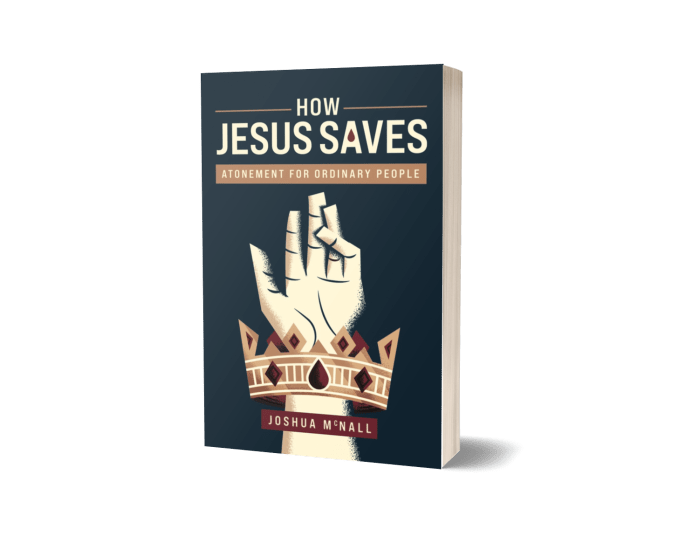
If you’re hoping to explore the meaning of Christ’s saving work this Holy Week, I’d be honored if you’d check out my latest book, How Jesus Saves: Atonement for Ordinary People.

If you’ve already read or listened to it, would you consider writing a short review on Amazon–or wherever you purchased it.

Grace+Peace this Holy Week,

~Josh

“This is my body, commodified and mass-produced for you”: On Communion and Campbell’s Soup

“This is my body, commodified and mass-produced for you”: On Communion and Campbell’s Soup

When Andy Warhol unveiled his Campbell’s Soup Cans art exhibit in 1962, reactions were closer to befuddlement than praise.

Was this art? Where was the beauty, drama, grandeur, sacredness, or seduction that had previously marked great paintings? And who would pay the exorbitant sticker price of $100 for something that could be purchased at the grocery for ten cents?

Of course, Warhol’s cans now fetch massive sums. One reason was that they offered an ironic critique of modern life. For good and ill, we are now drowning in cheap, mass-produced, pre-packaged, disposable, easily accessible, low quality but quickly replaceable “stuff.” (I originally opted for a different word to end that sentence.)

It’s Campbell’s soup—brought to us by Chinese sweatshops and two-day shipping.

I’ve thought about those Warhol paintings several times of late as I have received Holy Communion.

Out of noble health concerns starting with the COVID-19 pandemic, many churches moved away from traditional Communion methods in favor of individually packaged, disposable, mass-produced, plastic “blister packs” (actual description) like the one seen here.

I agreed with this move and gave thanks for it.

The tiny packages encase a single crumb of bread on one side, and—when you flip them over to remove another “blister” coating—approximately the same amount of liquid as contained within a single teardrop.

In evangelical congregations, I am used to Communion being spoken of as a mere symbol that helps us remember Christ’s sacrifice. “It’s not about the elements,” the pastor may be heard to say. So instead of the Gospel line, “This is my body”—many a minister feels compelled to amend the text to avoid misunderstanding: “This bread represents my body,” etc., etc. “This wine—I mean grape juice…—represents my blood.” I’ve grown accustomed to these things. And truth be told, I am not a believer in something like Catholic transubstantiation.

But I’ve also tired of Communion “blister packs.”

Despite understandable concerns for germs (with which I sympathize), I’ve begun to wonder what the “Oscar Mayer lunchable” approach to the Eucharist says about the modern church—not just on the Lord’s Supper, but on how we value symbols, sacraments, and physicality.

At the risk of overreaction, it sometimes feels as if we have set out to take the most beautiful and sensory-laden sacrament and turn it into something that has the aesthetic value of a roll of bubble wrap.

Even if it doesn’t burst like a juice box in my kid’s backpack, one looks around the sanctuary to see some churchgoers struggling with their teeth and fingernails—like racoons trying to unlock iPhones. By the end of the process, the elements usually find their way into digestive tracts—but something is lost from the meal that Jesus gave us. It has been commodified, sanitized, mass-produced, and individually packaged—like much of modern life.

What, then, is the solution?

My goal is not to add one more curmudgeonly complaint to the endless pile that pastors face. (It has not been easy to lead anything these past few years.) Nor is it to shame one or two churches to switch back to more traditional Communion practices. That too might be a malady of modern ecclesiology: (1) Someone complained. (2) So we stopped.

Instead, what we need is a more holistic way of noticing how unexamined modern values of convenience and commodification have caused us to do strange things in the realm of the sacred.

The French philosopher and theologian, Jacques Ellul, is helpful here. Ellul’s most important work, published back in 1964, is called The Technological Society. He sets forth two key concepts for diagnosing the side-effects that come with mind-blowing technology, inexpensive factory production, frazzled busyness, and consumer competition. He calls them (1) technique and (2) efficiency.

For Ellul, technique is “the totality of methods rationally arrived at and having absolute efficiency in every field of human activity.” Technique aids efficiency; and as we know, being more efficient can save time and money.

To be fair, we can all name aspects of our businesses and bureaucracies that badly need to be streamlined. The trouble, Ellul argues, is that the values of technique and efficiency easily move out of their rightful domains, and they begin to corrupt and commodify the way we relate to people, food, art—and God.

How do you find a mate? Swipe right.
How do I form a nuanced view of Shakespeare’s Othello? ChatGPT.
How do I eat, given that I’m frazzled and rushed? McDonalds.
How do I check “Communion” off my to-do list? Blister packs.

In all these areas, there are costs to maximally efficient solutions.

Moving back to Communion, note how our modern ways of approaching the Eucharist make it difficult to “feel” and “see” what Paul alludes to when he writes to the Corinthians:

“Is not the cup of thanksgiving for which we give thanks a participation in the blood of Christ? And is not the bread that we break a participation in the body of Christ? Because there is one loaf, we, who are many, are one body, for we all share the one loaf.”

1 Corinthians 10:16-17

In the end, I remain grateful for a necessary safety measure in a time of emergency. What’s more, we should probably keep some “blister packs” on hand to love and serve our brothers and sisters who have health concerns.

And as usual, my attempts to be pointed or humorous run the risk of oversimplifying—and overreacting. That too is a byproduct of the marriage of technology and efficiency: What are blog posts if not a maximally efficient form of publishing.

Enjoy your soup. I slaved for minutes over it.


Click the green “Follow” button to never miss a post.

See here to purchase a copy of Perhaps: Reclaiming the Space between Doubt and Dogmatism.

Signup here to receive bonus content through my email Newsletter, “Serpents and Doves.”