Battle for the dead (part 2)

Battle for the dead (part 2)

In the last post, I explored what might seem like an oddity in the greatest war story ever told: Homer’s Iliad.

In the epic, the most intense conflicts center not on killing enemies or conquering their land, but on securing corpses, for proper burial or vengeful desecration.

Why, though, should that matter still today?

Several insights follow, though I’ll leave them only partially developed, while admitting that I’m no expert in this area.

Despite occasional generalized claims that “Greek thought” cared little for the body (a shift that took place later), Homer reveals a deeply human impulse that what Paul calls “this earthly tent” (2 Cor. 5:1) is both precious and integral to personhood, both before death and after it.

It is right and good to feel this way, however painful it may be as we grieve those we have lost.

CHALLENGING A MISCONCEPTION

This is why it strikes me as obviously false when someone says something like this at a Christian funeral: “Now she is perfect and whole.”

To be sure, Christians believe that those who die in Christ are “with the Lord” (2 Cor. 5:8). Their suffering has ended. And they experience blessedness, rest, and even paradise (Luke 23:43). (It should be obvious from those claims that I do not hold to so-called soul sleep, since it doesn’t fit the experiential connotations of what Jesus calls “paradise,” when speaking to the thief upon the cross. Nor does it fit with Christ’s story of the Rich Man and Lazarus, however parabolic that is.)

To be spiritually with Christ is both beautiful and hope-giving. But it does not mean that we become perfect and whole upon death. The reason is simple: Bodies matter. To say otherwise would be to view God’s material creation as either irrelevant to human flourishing, or worse yet, a hindrance to it.

Such assumptions are often smeared as “Greek” or “pagan” errors (with some justification); yet even the Iliad challenges this point at one important level: In the Iliad, bodies matter, both before death and after it.

“WHAT WOULD JOSEPH DO?” (WWJD)

Second, the concern for corpse care after death, illuminates the bravery and importance of an oft-forgotten disciple in the Gospel narratives: Joseph of Arimathea.

We read this in Mark 15:42-46:

It was Preparation Day (that is, the day before the Sabbath). So as evening approached, Joseph of Arimathea, a prominent member of the Council, who was himself waiting for the kingdom of God, went boldly to Pilate and asked for Jesus’ body. […]

So Joseph bought some linen cloth, took down the body, wrapped it in the linen, and placed it in a tomb cut out of rock. Then he rolled a stone against the entrance of the tomb.

Scholars spill lots of ink debating whether (or how well) a given ancient philosopher or poet was known to biblical authors and their audiences. But one thing is clear: The Iliad was known. We have well-preserved wall paintings from Pompeii and Herculaneum, dating from the first-century AD, depicting its scenes. Just like kids hang movie posters of Marvel Comic characters, we find the ancient fresco of “Achilles and Briseis” (or “Briseis taken away from Achilles”) in the House of the Tragic Poet in Pompeii.

At the risk of pressing things too far, it might be like asking a modern American, “Have you heard of Superman?”

As another illustration, I’m currently in Vienna for a conference, where I visited the (incredible) Museum of Fine Arts. Below is a snap of an ancient Greek vessel, depicting scenes from the Iliad, including the arrival of Priam to plead for Hector’s body.

Priam pleads with Achilles for Hector’s body

Of course, there are big differences between Priam’s visit to Achilles, and that of Joseph to Pontius Pilate. Still, it seems reasonable that an early Christian—in a house church in Philippi, Rome, or Corinth—would have heard the echoes. Pilate also would have been shaped at some level by the story.

Here then is the point about the man from Arimathea: While other disciples fled on Good Friday, sinking in confusion and despair, Joseph put his reputation (and his life) on the line to go boldly before a man responsible for Christ’s death, and to plead for his friend’s body.

Because of Joseph, birds do not despoil the corpse, the sign of Jonah is preserved, the Sabbath rest is kept within the tomb, and the stage is set for Easter Sunday.

I don’t think Joseph did this because he was expecting resurrection three days later. That’s not why Priam did it either. They did it out of love and duty, even in the pit of hopelessness, which makes it even more powerful and relevant for us when all seems lost.

To await the Kingdom, for Joseph (and arguably for us), is to take up the shroud and not the sword. Because even when the kingly Son is dead—his body matters.

To cite Peter, on the Day of Pentecost:

Therefore my heart is glad and my tongue rejoices;
my body also will rest in hope,
because you will not abandon me to the realm of the dead,
you will not let your holy one see decay.

~Acts 2:26–27 (Psalm 16:8–11, LXX)

Now… in the next part of this series, I’ll share something I don’t like about the handling of this topic in the Iliad, and how Dostoyevsky helps.


Hello friends. Please subscribe on the homepage to receive these posts by email. This is especially helpful since I’ve decided (mostly) to uncouple the blog from social media. Thanks for reading. ~JM


Battle for the dead (part 1)

Battle for the dead (part 1)

One of my summer reads this year was a slow journey through Homer’s Iliad—the great archetype of our war stories, action movies, and (in a way) superhero universes.

Among other insights, I was struck by how much of the fighting is focused not on killing an enemy or conquering a bit of ground, but on the furious desire to protect or desecrate a corpse.

The Iliad is, in many ways, a struggle for the dead–whether for the corpse of Sarpedon (mortal son of Zeus), Patroclus (intimate of Achilles), or Hector (favored son of Priam and champion of Troy).

“Human mortality is at the center of it all,” writes Emily Wilson. “I know no other narrative that evokes with such unflinching truthfulness the vulnerability of the human body.”

Yet unlike modern action movies, that bodily vulnerability (in the Iliad) is just getting started when one’s final breath departs through “the fence of teeth” (Book 9.529).

Shame and honor lie at the root of such concerns, as do ancient pagan assumptions about the requirement of proper funeral rites for a departed shade to enter Hades.

Unfortunately, countless other deaths occur in the attempt to secure the body of an enemy or comrade.

I’m interested in the point for several reasons:

  1. N. T. Wright points out that Homer functioned somewhat like the “Old Testament” for ancient pagan audiences, in a way roughly analogous to how the Hebrew Scriptures remained foundational for Christians.
  2. I agree with C. S. Lewis about the value of old books to reveal our modern blind spots, not because they are infallible, but because they do not share our unexamined assumptions.
  3. I’m convinced many well-meaning Christians lack a proper view of the body both before and after death. Thus, reflecting on this subject in the Iliad (alongside Scripture) might actually make us more faithful Christians.

In Homer’s story, the struggle for the dead happens in at least three ways: (i.) corpse care, (ii.) desecration, (iii.) divine intervention to stave off decay.

CORPSE CARE

The importance of proper corpse care is demonstrated by Achilles, as he sets out to wash and rub with olive oil the body of his dear friend Patroclus, and to fill his wounds with ointment (18.438).

Though Achilles feels compelled to avenge his comrade, he cannot bear the thought of what may happen to the body in his absence:

I am still most terribly afraid for brave Patroclus

Whose body has been hacked with so much bronze.
Flies may get in his wounds and worms may grow there,
Dishonoring his corpse. His life is gone,
And now his flesh may rot (19.30-36).

The mirror of this heartrending concern is found in Priam, who ultimately sneaks behind Greek lines to plead with Achilles for the body of his beloved son, Hector.

In that meeting, “They both remembered those whom they had lost.” And “Curled in a ball beside Achilles’ feet, Priam sobbed desperately,” in a fatherly move that finally breaks the callous wrath of his adversary (24.631–35).

DESECRATION

The desire to care for the bodies of friends and family is matched by an unholy drive to desecrate the corpses of one’s enemies.

Achilles exceeds all others in this impiety, for which the deathless gods are furious with him (24.146), since he does not stop at merely killing foes or stripping their armor, but commits abominations on their corpses.

In the final battle between Achilles and Hector, the matter of who will win is never in doubt. The only question, even for Hector, is what Achilles will do to his corpse.

Despite pleas from his dying adversary, Achilles proclaims:

If only I had will and heart to do it
I would carve up your flesh and eat it raw […]

No one can save your body from the dogs,
not even if they bring me as a ransom
ten times or twenty times the usual rate (22.465-70).

True to his word, Achilles then commits “shameful atrocities on noble Hector,” piercing the tendons behind both his feet (#foreshadowing) and dragging him behind his chariot. Upon finishing his circuits ‘round the body of Patroclus, Achilles leaves Hector’s corpse face down in the dirt—unburied, unreturned, and yet (incredibly…) undecayed.

This brings us to the last point.

MIRACULOUS INTERVENTION

It would not be Homer if the gods did not intervene.

In each case (Sarpedon, Patroclus, Hector), divinities step in not to save or resurrect the warriors, but to preserve their corpses:

even now in death, Apollo pitied
Hector, and kept his body free from taint
He wrapped a golden cape, an aegis, round him,
To ensure the dragging never scratched his skin (24.24-27).

Though Hector’s body has been abused and left unburied for twelve days, still “dewy-fresh he lies”; and his many wounds “are quite closed up” (24.520).

Despite violent death outside the city gates, Apollo will not allow his holy one to see decay.

A father intervenes, a trip is made to the one responsible for his death, and a brave plea is made for the body.

Now what does that sound like?

In the next post I’ll unpack why this still matters.


Hello friends. Please subscribe on the homepage to receive these posts by email. This is especially helpful since I’ve decided (mostly) to uncouple the blog from social media. Thanks for reading. ~JM

The right kind of secrets

The right kind of secrets

There’s a scene near the end of Spielberg’s Saving Private Ryan in which Captain John Miller (Tom Hanks) finally locates the long-lost James Francis Ryan (played by a young Matt Damon). Damon’s character is in shock, after learning that his three brothers have been killed in action.

After years apart, he struggles to visualize their faces. So Hanks’ character suggests a trick he uses to recall his old life before the war:

Well, when I think of home, I… I think of something specific. I think of my, my hammock in the backyard or my wife pruning the rosebushes in a pair of my old work gloves.

Ryan tries it, and a risqué story follows about the brothers before they left for war. When the men stop laughing, he asks Captain Miller, “Tell me about your wife and those rose bushes.”

“No. No,” Hanks’ character replies, “that one I save just for me.”

THE SECRET PLACE OF THUNDER

I thought about that scene as I read John Starke’s book, The Secret Place of Thunder: Trading our Need to Be Noticed for a Hidden Life with Christ.

Starke’s claim is that we have entered an age of “performative individualism.” In this context, every moment of our lives—traumatic events, acts of service, sitting down to read a book—is curated for the gaze of others, usually online. (And as I type that, “curated” feels like one of the sadder words in our cultural lexicon.)

The vehicle is social media, but the driver is an age-old longing to be noticed, affirmed, and validated. Cue Ron Burgundy: “Hey everyone! Come see how good I look!”

“We have internalized the idea,” writes Starke, “that the markers of ‘being okay,’ of having an admirable life and enviable success, are primarily visible.”

Pics or it didn’t happen.

Ironically,

A deep loneliness comes for those who live off a curated image. … We can have many followers but few friends, lots of comments but no communion.

YOU HAVE RECEIVED YOUR REWARD

Into the performative rat race, Jesus offers a word of warning: “Beware of practicing your righteousness before other people to be seen by them” (Matthew 6:1). To do so is to have received your reward. God is interested in virtues done in secret—not because the homeless get less if I vlog my service at the local soup kitchen (though they might, if I’m preoccupied with my smartphone), but because I do.

Starke notes that in this passage Jesus doesn’t warn against flaunting our wealth, our power, or our giftedness; he warns against trumpeting our virtues: praying, fasting, giving to the poor.

And in our day, the “virtues” includes a kind of performative vulnerability: “I cried for hours… and then I wrote this.” (Use code #vulnerable for 10% off.)

I’ve thought a lot about what this means for ministries and Christian non-profits that manage online spaces, especially since sometimes what seems required for “marketing” often sounds like what Jesus told us not to do. I don’t have easy answers there, but it deserves some thought.

THE RIGHT KIND OF SECRETS

In the end, let me be clear about what I’m not saying: It is obviously beautiful and good to share our lives with one another, including certain deeply personal moments. It is also wrong to label every act of online sharing as “performative.”

My point is more limited and unique to your own life and personality.

It comes down to this: We need the right kind of secrets. Not the kind that fester and metastasize because we refuse to share them with the right person in the right place: the addiction, the struggle that needs community to heal. Rather, we need the kind of secrets that retain their beauty and formative power precisely because they are known only to God, us, and perhaps those closest to us.

To share those things (whatever they are) may be to cheapen and commodify both us and them. As in the famous double slit experiment from quantum physics, the act of (constant) observation changes us, and not always for the better. In that way, the old indigenous taboo is right: the camera has the power to steal part of your soul.

I’m not sure what that looks like for you; and I don’t pretend that it looks the same for all of us.

Still, the longer I live in a performative age, the more I side with Jesus and John Miller: “No. No… That one I save just for me.”


Hello friends. Please subscribe on the homepage to receive these posts by email. This is especially helpful since I’ve decided (mostly) to uncouple the blog from social media. Thanks for reading. ~JM

Are students customers?

Are students customers?

A common refrain these days in (Christian) higher ed goes like this, “We must remember, students are our customers.”

The logic runs as follows:

  1. Anyone who pays for a good or service is a customer.
  2. Students and parents often pay (a lot) for education.
  3. Viewing students as customers is not just accurate but important, since it helps colleges take things like student satisfaction, institutional accountability, and appropriate return on the investment (ROI) seriously.

To be fair, I’m sympathetic to parts of the argument. And its intention can be good.

It’s absolutely right to say that universities must continually evaluate whether they are caring for and training students well. And parents have every right to inquire as to whether the cost of a particular education is worth it. That involves not just how much money a student may earn upon graduation, but the kind of spiritual formation and integrity fostered at the school. Christian colleges that don’t get deadly serious about those points will disappear, and they deserve to.

That said, I reject the idea that students should be viewed primarily as customers.

There are good reasons to believe that points #1 and #3 are wrong, at least in certain cases.

EDUCATION AS DISCIPLESHIP

At its best, Christian education is a form of discipleship.

Jesus was a teacher. And his teaching ministry was funded, at least partly, by students. Luke’s Gospel makes special mention of some female disciples who paid to keep Christ’s teaching ministry going—Mary (called Magdalene), Joanna the wife of Chuza, Susanna, “and many others.” These women, the Gospel tells us, supported the Lord, “out of their own means” (Luke 8:1–3).

Yet if someone were to approach Jesus and refer to these female apprentices as his “customers,” I suspect he’d have harsh words for them. (He might even pull out one of his trademark Jesus-burns that he could get away with, on account of being sinless, but sounds egotistical and mean when I try it.) The reason is self-evident: to speak of Jesus’ disciples as “customers” sounds profane, and it cheapens the relationship between a rabbi and his students.

The problems persist when we turn from Jesus’s teaching ministry to ours.

I currently serve as a Teaching Pastor at a local church. Parishioners (myself included) give monetarily to keep that teaching ministry going—and a portion of that money pays my salary.

Yet that exchange of funds would never drive me to refer to my parishioners as “customers.” To do so sounds odd, it commits a category mistake, and it risks making a pastor-teacher more like false prophets from the Old Testament who espoused the formula, “The customer is always right.”

I’m well aware, of course, that there are differences between the teaching role of Jesus, that of a pastor, and that of a college professor. Yet the above examples are enough to prove that there are indeed spheres of life–one of which is Christian education–in which one invests funds in education without being viewed primarily as a customer or consumer. To the extent that we reject that precedent, Christian ed is secularized. And to the extent that is secularized, it ceases to have sufficient reason to exist.

CONCLUSION

Once again, none of this changes the need for professors and universities to step up their game. And one way to do that is to remind ourselves of the financial cost of college as we strive to go above and beyond for students. That’s right and good.

Yet if the telos of learning is more about formation than consumption, then the student-as-customer model runs contrary to a Christian view of education. It does so, in part, because it wrongly assumes that the only way to serve a person well is to view them as consumers. Yet as Neil Postman argued long ago (see here), that’s precisely the modern heresy we must overcome.

In the end, the problem is not that the student-as-customer approach goes too far in seeking to train and mentor students with excellence, but that it does not go far enough.

It cheapens the nature of the relationship, commits a category error, undermines the purpose of learning, and fails to grasp that there are spheres of life (like family, faith, and education) that must not be flattened by the all-reducing language of the market.


Hello friends. Please subscribe on the homepage to receive these posts by email. This is especially helpful since I’ve decided (mostly) to uncouple the blog from social media. Thanks for reading. ~JM

While his characters were getting better (a cautionary tale)

While his characters were getting better (a cautionary tale)

A bombshell landed on the literary world last year after the death of Cormac McCarthy, the man who had been, arguably, America’s greatest living novelist.

The shock was not McCarthy’s passing (he was 89), but a Vanity Fair article by Vincenzo Barney that broke news of a nearly fifty-year relationship with a woman named Augusta Britt—the “secret muse” whose life and personality inspired many of McCarthy’s greatest characters, most of whom were male.

“I’m about to tell you the craziest love story in literary history,” the article began.

The short summary put it this way:

Augusta Britt would go on to become one of the most significant—and secret—inspirations in literary history, giving life to many of McCarthy’s most iconic characters across his celebrated novels and Hollywood films. For 47 years, Britt closely guarded her identity and her story. Until now.

A firestorm ensued, in part, because the relationship began when Britt was just 16 and McCarthy 42. She met him by a hotel pool, while on the run from abuse within the foster system–a Colt revolver on her hip, his book in her hand. “Are you going to shoot me, little lady?” was allegedly McCarthy’s question.

Though Britt maintains that McCarthy saved her life, reactions to the article have understandably been mixed. “Let’s be honest with ourselves,” read a headline from The Guardian, “Cormac McCarthy groomed a teenage girl.”

I read the Vanity Fair piece back when it came out, which raises the question: Why write about it now, months later?

To be honest, a particular phrase sometimes gets lodged in my mind, long after I have read a book or article, and that’s essentially what happened here.

I’ve had a long relationship with McCarthy’s novels (see here and here), and he is undoubtedly one of the great writers of his generation. You can’t read books like The Road or Blood Meridian and not be struck by the power of his prose, the Christ-haunted characters, and the desert landscapes that seem to whirl and pulse in ways unmatched by any other author.

Unfortunately, great writers are not always great people. And in some cases, the relation seems to run the other way.

Here, then, is Augusta Britt’s assessment that stuck with me about McCarthy’s later years:

But as his characters started becoming better humans, in Britt’s view, McCarthy, whom she always thought of as a great man, did not. As he dined with celebrities and reinvented himself in Santa Fe as a formidable intellectual … he turned his back on his oldest friends. “He felt he’s wasted the last years of his life,” Britt says.

I can’t say if that’s true. (After all, running off to Mexico with a underage girl seems to work against the hypothesis that McCarthy’s moral compass became skewed primarily in his later years.)

Nonetheless, the potential divergence between one’s work and life strikes me as both interesting and relevant for all of us.

Why might one’s characters be getting better, while one’s character is either stalled or getting worse?

I’ve been struggling with a term to define the tendency, beyond mere hypocrisy. In the realm of spiritual formation, we might call this compartmentalization, rationalized regression, or a sort of moral transference. Psychologically speaking, transference involves the redirection to a substitute, often a therapist, of emotions or experiences that are (or ought to be) one’s own: in this case, from one’s character, to one’s characters.

Again, I don’t know if that happened with McCarthy, but I’m quite certain it’s a temptation for us.

Consider:

“While his sermons were getting better, his inner life was getting worse.”

“While her performance evaluations were getting better, her spiritual health was growing worse.”

“While his resume was getting better, his parenting was getting worse.”

If there’s a lesson here, perhaps it’s this: substitutionary sanctification is a dead end.

To amend one of my favorite verbal amulets from L. M. Sacasas, “[moral work] cannot be outsourced”–whether to AI agents or to characters between the pages of a book.


Hello friends. Please subscribe on the homepage to receive these posts by email. This is especially helpful since I’ve decided (mostly) to uncouple the blog from social media. Thanks for reading. ~JM

Against Corporate Word Vomit

Against Corporate Word Vomit

“Clutter is the official language used by corporations to hide their mistakes.”

William Zinsser penned that line in On Writing Well, but it resonates for anyone who’s had to endure a meeting or press release filled with what I affectionately call “corporate word vomit”—that is, recycled managerial euphemisms designed to mask bad news beneath a thin veneer of metaphor and sunny ambiguity.

For example: The branch isn’t closing. It’s going through a “strategic restructuring” to become more “nimble” so we can “pivot” toward “optimization” by “right-sizing” our “employee footprint” to “maximize efficiency” for the challenges and opportunities ahead. (Now box up your things.)

While I’m exaggerating, I’m convinced Christian leaders especially should reject this kind of talk as it tries to worm its way into churches, universities, and Christian non-profits. For one thing, there’s no precedent for it in the words of Christ, the prophets, or apostles. And there are many scriptural analogues to it in the language of false prophets, corrupt kings, and even Satan himself.

The trouble is not merely that such talk is inexact and weird (though it is); it’s that it verges on deception. Scripture frequently equates “smooth words” with deceit used to mislead the naïve. And for those who aren’t naïve, it can be both insulting and annoying.

Many years ago, I remember sitting through an update in which it was relayed that there would be substantial cutbacks because our numbers were “soft.” What is a soft number? I wondered. Is three more pillowy than four? Can you prick your finger on the sharp edge of a two? (Turns out, zero is softest; no edges at all.)

I was reminded of this frustration upon reading the official press release on the closing of Trinity Evangelical Divinity School’s Deerfield campus after years of financial difficulties. TEDS has long been a flagship evangelical seminary, and I’m sad for the loss of jobs and potential impact that will happen as the school is absorbed by Canada’s Trinity Western University. Yet upon reading the official announcement, there was so much verbal camouflage and clutter that the lede wasn’t so much buried as clothed in a ghillie suit and hidden in the bushes.

The lede

If there is a lesson here, it’s that Christian leaders (whether pastors, principals, CEOs, or university presidents) must find ways to marry truth with tact, rejecting evasive or deceptive corporate-speak in favor of calm but clear assessments of the reality at hand.

That’s difficult, and I suspect I’d fail at it on numerous occasions.

Still, the goals of clarity, simplicity, and truth-telling are worth pursuing. To steal a line to Habakkuk (2:2),

“Write down the revelation
and make it plain on tablets
so that a herald may run with it.”

If that fails, imagine that upon each use of evasive managerial jargon (nimbly pivoting to right-size optimal efficiency), a kitten dies.


Hello friends. Please subscribe on the home page to receive these posts by email. This is especially helpful since I’ve decided (mostly) to uncouple the blog from social media. I’m grateful for you. ~JM

[Indistinct chatter]

[Indistinct chatter]

“If I ever write a book about technology and modern life, that will be the title.”

I said that to my wife recently as we were watching Netflix. We were using closed captions since the kids had just been banished to their rooms. And during the course of the episode, I was struck by how one caption appeared more than any other, entombed in brackets: [Indistinct chatter].

And now that I’ve mentioned it, perhaps it will stand out to you as well.

It appears everywhere on the shows we consume: In crowded restaurants, on bustling streets, inside Dunder Mifflin, in Ted Lasso’s locker room, and virtually everywhere else.

You might “indistinct chatter” is the soundtrack of our lives.

In a literal sense, and especially for the hearing impaired, the caption alerts viewers to a constant buzz of unintelligible and unimportant speech, humming somewhere in the background. But the more you think about it, the more it starts to feel like a kind of oracle or prophetic diagnosis of what ails us in our age of noise and news and social media. Who’s speaking? We can’t say. What language? IDK. What makes this wave of jumbled words more consequential than, say, the noise made by my neighbor’s lawn mower? Nothing, really.

Still, the caption-generating gods of Netflix feel compelled to include them in a font that is just as large and bold as actual dialogue, lest we miss this apparently important detail. And in a weird way, that’s basically my goal here. Have you noticed how much of modern life can be summarized by what’s in those brackets?

You could take that observation in a dozen different directions.

But here are two quick attempts at showing why it matters.

When words become white noise

First, we become so accustomed to indistinct chatter—unintelligible and unimportant words that wash over us almost constantly—that we find it hard to function without it. The chatter soothes us. Silence is unsettling. And we cannot bear to be alone with our thoughts. Eventually, washing dishes, driving a car, or even using the restroom become unthinkable without a verbal (or visual) security blanket of incessant, often vacuous, noise. Air pods, tik tok, twitter. You hear it now.

I’ve seen the effects of this especially in college students who say they cannot read, focus, or do homework without various forms of media running constantly in the background. This too is indistinct chatter. Though “Background TV” is another for it. And despite some obvious benefits—dampening the noise across the hall, or making one feel less alone within an empty apartment—psychologists also caution that our addiction to such electronic noise carries costs: We use it to drown out inner monologues that need attention, and we may eventually find ourselves unable to follow more complex arguments, conversations, or plot-lines since our word-diet is now filled with empty calories. Reflection becomes difficult. And idiocracy encroaches further.

Only the shrillest are heard

Second, to be noticed in a world (or news cycle) of constant chatter requires one to shout–or perhaps to make a scene. Subtlety is lost. And eventually, poets, preachers, and reasonable politicians are replaced by demagogues and provocateurs.

Before we know it, our cultural Caps Lock remains constantly illumined like the faulty tire pressure light upon your dashboard. After awhile, you don’t even notice it. We are seeing the cost of this now in our shared political lives especially, where (to quote Yeats), “the worst are full of passionate intensity,” while the rest are just really, really tired.

So what’s the solution?

As usual, the way forward begins by noticing the way that caption has come (metaphorically) to dominate our lives. In the words of Andy Kennedy,

Every great solution starts with someone noticing a problem. Noticing is underrated. Notice more. Good things will follow.

But noticing is not enough. We must also make decisions, at least periodically, and for sustained intervals to unplug from machines and environments that threaten to drown us in indistinct chatter.

Here though is an irony. As I write this, I am seated outside by the fire while robins and bluejays and large group of black crows are performing their own bit of background noise. It too is unintelligible. Yet it hits differently than a steady stream social media alerts, breaking news, doom-scrolling, calendar reminders, and the targeted ads that constantly assault us. Is it chatter? Of a sort. And yet.

As the Psalmist writes:

There is no speech nor language, where their voice is not heard.
Their line is gone out through all the earth, and their words to the end of the world. In them hath he set a tabernacle for the sun,
Which is as a bridegroom coming out of his chamber, and rejoiceth as a strong man to run a race” (19:3-5 KJV).

Which is to say, go touch some grass. And for just an hour, disable captions.


Hello friends. Please subscribe to these posts via the button on the home page to receive future posts by email. This is helpful since I’ve decided (mostly) to uncouple the blog from social media. I’m grateful for you. ~JM

Love is God, but not like you think

Love is God, but not like you think

C. S. Lewis famously proclaimed,

“Love ceases to be demon only when it ceases to be a god.”

He was quoting M. Denis de Rougemont. But just two sentences later, Lewis writes the following in his own words:

“the truth that God is love may slyly come to mean for us the converse, that love is God” (The Four Loves, p. 7).

In one sense, I agree – as do scores of Christians who assert some version of the following: God is love, but love is not God.

For instance, A. W. Tozer:

Equating love with God is a major mistake which has produced much unsound religious philosophy and has brought forth a spate of vaporous poetry completely out of accord with the Holy Scriptures and altogether of another climate from that of historic Christianity.

Or (after a quick Google search), the “Fierce Marriage Podcast,” which describes an episode like this:

“God is love… but, love isn’t God!” In this episode we’ll look at the wonderful, counter-cultural, biblical idea of love.

The idea here is that we often make an idol of what we call “love”—as defined by feelings of romantic ecstasy, emotional attachment, sexual desire, or a piercing (almost painful) longing for another creature—whether it’s for a boyfriend, a child, or a Labrador Retriever.

There’s truth to this danger, especially because most of us—whether we know it or not—are more children of Romanticism (e.g., Rousseau, Byron, Shelley, Keats, Disney, Nicholas Sparks, Taylor Swift) than we are of a cold and sterile Rationalism. What’s more, the danger is not that we would love too much, but that our loves become misdirected and disordered, so that we chase endlessly after a particular feeling, and end up worshiping created things instead of the Creator. Ironically, to do so may also destroy the objects of our love (and ourselves) because created things cannot possibly bear the weight of divine expectations.

In response, Lewis, Tozer, and “Fierce Marriage” have this to say: God is love (1 John 4:8), but love is not God.

AUGUSTINE’S REBUTTAL

It may surprise us to learn, however, that the greatest theologian in church history disagreed, at least in one sense.

Saint Augustine by Philippe de Champaigne

Saint Augustine wrote this in reflecting on 1 John’s claim that “God is Love.”

“[V]ery Love is God: for openly it is written,
‘God is Love.’”
~ Augustine, Enarrationes in Psalmos, 98.4.

If his assertion seems flimsy, Augustine then returns to 1 John (and other texts) for additional proof: “whoever abides in love abides in God” (1 John 4:16). For Augustine, it’s crucial to note that Scripture is not here describing a flowery human emotion, but a divine person (more on that in a moment).

Hence, if (1) God is Love, and (2) abiding in Love is abiding in God, then it follows inescapably that (3) Love is God. On one level, the argument may be read somewhat like a math equation. You cannot say 2+2 = 4 without also affirming that 4 = 2 + 2. If Deus (God) = dilectio (love), then the converse is true. And that fact does not care about your feelings.

LOVE AND TRINITY

But… (and we must not miss this “But”) Augustine’s argument then takes a turn that makes it very different from a pop song, fused with a Nicholas Sparks novel, drizzled with a sugar-free glaze of suburban spirituality.

He begins to think about the Trinity.

His question is as follows: If God is Love, and if Love is from God, and if abiding in Love is abiding in God as God abides in us (all of which are taught in Scripture), then which person of the Trinity ought to be identified as the divine Love that simultaneously fills us even as it links us both to God and other people?

Augustine’s answer is the Holy Spirit,

“by which the begotten is loved by the One who begets him and in turn loves the begetter.”
~Augustine, De Trinitate, 6. 7.

After all, Augustine’s favorite Bible verse was Romans 5:5:

“God’s love has been poured out into our hearts through the Holy Spirit, who has been given to us.” ~Romans 5:5

WHO IS RIGHT?

So, should we side with Lewis or Augustine?

In the end, it depends entirely on whose definition of “love” you’re willing to accept, and which god you’re talking about. Augustine writes of Love’s divine origin, Lewis speaks of creaturely echoes. One is the pure spring, the other is the creaturely river that flows invariably through tainted soil. Lewis thus explains:

Every human love, at its height, has a tendency to claim for itself a divine authority. It’s voice tends to sound as if it were the will of God Himself (The Four Loves, emphasis mine, p.7)

In the end, Lewis, Tozer, and “Fierce Marriage” all defer (in differing degrees) to a fallen and culturally-defined account of the word. Hence, they speak of it as a “demon” when it assumes the place of a “god.” I get this move. And I’ve probably made it too.

But it comes at a cost, not just because it risks sounding like illogical nonsense (2+2=4 but 4 ≠ 2+2), but because it means we’ve settled(?) for a fallen definition in place of the real thing. Dare I say, for “mud pies in a slum because [we] cannot imagine what is meant by the offer of a holiday at the sea.”

Augustine defines Love in light of the Trinity, so “demonic” definitions are ruled out from the start.

Of course, that’s no defense of twisted, selfish, or sinful expressions of what we call “love” down here. (Augustine knew that better than most.) Instead, it’s an invitation to let God define the word that is itself definitive of God’s holy character, poured out by the Holy Spirit, into our hearts.

In other words: Love is God, but maybe not like you think.


Hello friends. You can subscribe to this blog via the green button on the home page to receive future posts by email. This is helpful since I’ve decided (mostly) to uncouple the blog from social media. I’m grateful for you. ~JM

Reading is Rereading

Reading is Rereading

After my sermon last Sunday, a friend asked, “How many books do you read per week?”

Surprisingly, the answer is usually “less than one.” To be sure, I read daily: Scripture and academic works in the morning; and something outside my field at night—fiction, history, or biography. (I’m currently near the end of Simon Schama’s fantastic but entirely-too-long history of the French Revolution.)

Still, I suspect I read slower than most people.

My friend’s question emerged because I had referenced several books in the sermon (probably too many books, if I’m honest). These authors included A. J. Swoboda, Joshua Jipp, Will Guidara, Ingrid Faro, and Wendell Berry. And, you know, Luke’s Gospel.

I was able to draw on these books, not because I had read them last week. (Only one fell into that category, and I didn’t finish it.) Instead, I could retrieve them because of the way I read and annotate books. (And I do mean physical books—with pages, spines, and a total lack of pixels.)

I mark them up like a graffiti artist tagging a boxcar and I dog-ear pages with content I want to retrieve, usually with a one- or two-word annotation: “Blog post,” “Article,” “Micah 6:8 book,” “Sermon Illustration,” “Atonement doctrine,” “No!”

When it’s time to write a message, a lecture, or a book of my own, I’ll consider what previously-read works in my library might add something; then I’ll flip through the dog-eared pages quickly to see what fits. It might take 30 seconds per book.

The massive benefit, however, is that I’m able to retrieve things that I no longer remember.

Perhaps that habit can help you too.

Of course, some caveats apply:

  1. You can’t dog-ear every page. If you highlight each word, you might as well not do it. I aim for less than ten dog-ears per book (four or five is best), otherwise you’re just doing entry-level origami.
  2. Slow down. Reading is about growth, not “finishing.” Studies suggest slower readers—that is, those who read at the pace of speaking rather than the pace of word-recognition–retain and remember far better than others. Hear this: In a world of distracted digital rabbits, be the turtle.
  3. Read broadly. No one wants to listen to someone who only reads business books (welcome to the late 90s and early 2000s in many evangelical denominations), or sports, or academic tomes, or jingoistic histories, or partisan political opinions disguised as “a Christian worldview.” The best writers, preachers, and thinkers read broadly. After all, I can only speak to all of life if I read intentionally in ways that touch upon the diversity of human experience. Otherwise, we become like the old man on the Simpsons who proclaims loudly that he hates everything but Matlock and Metamucil.
  4. Man cannot live (or preach) on books alone. As much as I want to champion reading actual books over the brain-rot of cable news, TikTok, smartphones, and the temptation (even in academia…) to say “AI” over and over as if it’s a magic spell that substitutes for thought and work and expertise—the fact remains that we live increasingly in a post-literate age. Hence, I’ve been inspired by authors and preachers who can draw not only on books, but on other sources too. I recall several moving illustrations in Jake Meador’s recent work that came from the world of streaming television—since, let’s be real, his audience is more likely to recognize those illustrations than they are a reference to Charles Dickens. Thus, when Jesus preached, he told more stories about seeds than Stoic philosophers.

CONCLUSION

In the end, take this as an encouragement that slower readers can still be deeply formed by books—and then pass that blessing on to others. In fact, formation may be more substantial precisely because of its slowness. Likewise, one need not have a photographic memory to retrieve wisdom and beauty from texts that no longer occupy one’s short-term memory.

Reading is rereading.

And marking.

And dog-earing.

And pulling off the shelf when the time is right.

Hear then, the word of the Lord: Be the turtle. Make reading great again. Practice selective, recollective origami.


In fact, if you’re looking for some books to practice on, see here.


Hello friends, and thanks for reading. Please subscribe via the button on the home page to receive future posts by email. This is especially valuable to me since I’ve decided (mostly) to uncouple the blog from social media. I’m grateful for you. ~JM

When (not) to use AI: a Venn diagram

When (not) to use AI: a Venn diagram

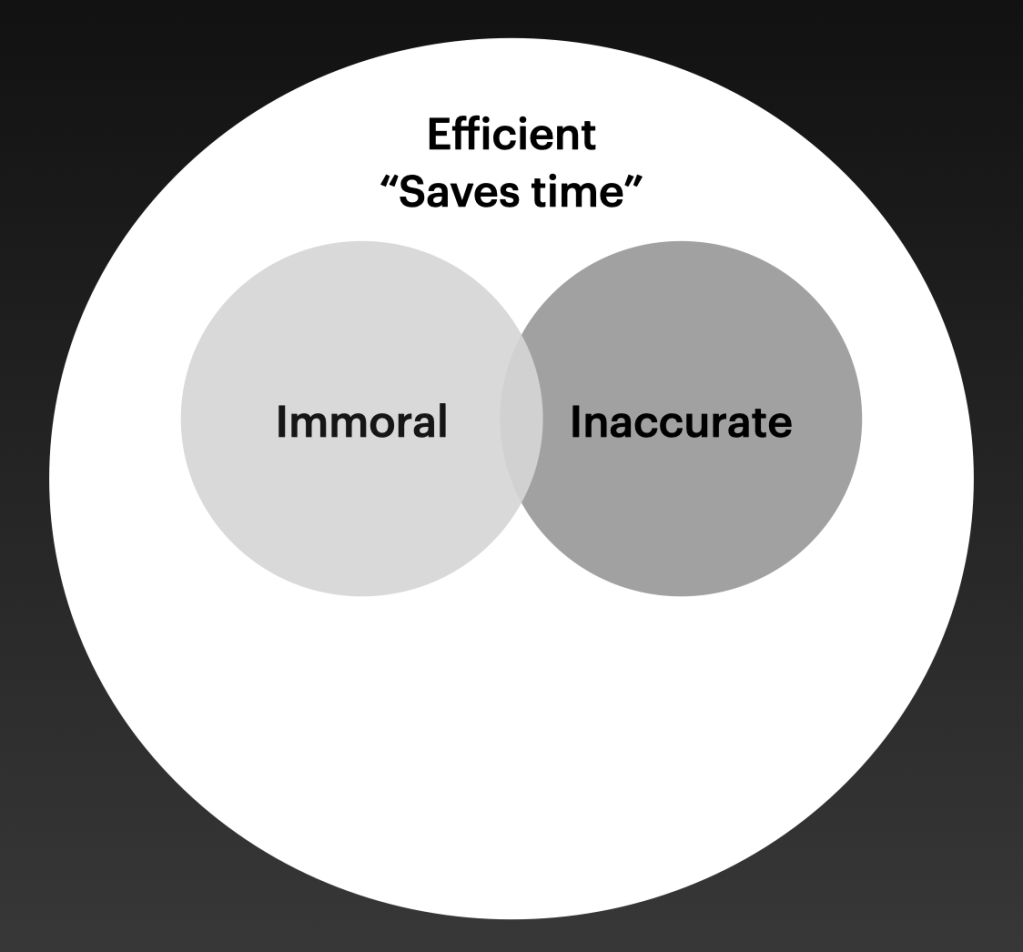
I created a Venn diagram recently to articulate when I think use of AI is ethical and when it’s not.

The smaller circles represent ways in which use of AI is problematic, while the remaining white space illustrates helpful ways in which one may utilize it to save time or accomplish meaningful tasks.

I want to be clear on two points: First, I do use programs like Chat GPT for some things. So I am not proposing a blanket rejection. And second, my focus here is almost exclusively on LLMs (Large Language Models) used to generate text and language. Thus, I am not interested in other ways that AI may be helpful, say, in coding, accounting, or other areas of life. My focus is on words.

My question is a simple one: When do programs like ChatGPT contribute to the good life, and when do they make me dumber, less personal, and less capable of being formed into a thoughtful and connected human being?

Let’s start with efficiency. As Jacques Ellul famously warned, the modern pull of “technique” tempts us to reduce every aspect of life—including relationships and spirituality—to a question of efficiency. In essence, if it saves time, do it.

Of course, efficiency may be a good thing. I do not ride a donkey to the office. I own a dishwasher. And I do not etch my writing on wax tablets. Broken, inefficient processes can be both frustrating and blameworthy. However, there are times when the modern idolatry of efficiency causes harm to others and ourselves.

Allow me to explain:

Circle #1: Efficient but Immoral: The most obvious way AI-use becomes unethical is when our drive to save time leads to immoral choices. Case in point: When I ask students not to use ChatGPT for a particular assignment (because I want them to think and grow by wrestling with ideas and words), to do it anyway is cheating. True, they may not get caught. But it is wrong nonetheless. Likewise, if my church expects me to write my own sermons (as they ought to… ), if I outsource an undo amount of that reflection to a robot, I am in the realm of immorality.

Frankly, many immoral decisions (whether robbing a bank or visiting a prostitute) are driven partly by our thirst for efficiency, which is to say, the drive to get something as fast as possible with the least amount of effort. And in these cases, the fact that it “saves time,” is hardly an excuse.

Circle #2: Efficient but inaccurate: A second problem with AI is the proliferation of falsehoods, inaccuracies, and other bogus depictions of reality. That’s because while programs like ChatGPT do a great job of producing grammatically correct sentences, they do not necessarily prioritize truth.

Hallucinations abound. And evidence is not hard to find: Sites like Google now prioritize bogus AI images of real animals, even when they look nothing like the actual creatures being searched.

LLMs invent sources that don’t exist, as attested by a friend of mine who was surprised to find his own name in footnotes, listed as the author of numerous academic works that don’t exist. And by some accounts, it’s going to get worse.

As Ted Gioia argues,

“Even OpenAI admits that users will notice ‘tasks where the performance gets worse’ in its latest generation chatbot. …

This isn’t a flaw in AI, but a limitation in the training materials. The highest quality training sources have already been exhausted—so AI is now learning from the worst possible inputs: Reddit posts, 4Chan, tweets, emails, and other garbage.

It’s going to get worse. Experts believe that AI will have used up all human-made training inputs by 2026. At that point, AI can learn from other bots, but this leads to a massive degradation in output quality.

In other words, AI will soon hit a brick wall—and face a dumbness crisis of epic proportions. That will happen around the same time that AI will have pervaded every sphere of society.

Are you worried? You should be.”

I can’t say whether all of this is accurate. But it further raises the specter of “the bogus” at a time when we are already drowning in it.

Circle #3: Efficient but impersonal: Now for the saddest (and weirdest) one.

As I watched the 2024 Olympics on Peacock with my kids, one of the commercials that ran on maddening repeat was the now infamous “Dear Sydney” ad for Google Gemini. The premise is bizarre. A dad asks AI to write a fan letter on behalf of his daughter to the American sprinter, Sydney McLaughlin-Levrone: “I’m pretty good with words,” he intones, “but this has to be just right.”

Responses to the ad were a mix of confusion coupled with a collective gag reflex. WHO IN THEIR RIGHT MIND WANTS AN AI-WRITTEN FAN LETTER!?? pretty much summed it up. Or in the words of Alexander Petri, that ad “makes me want to throw a sledgehammer into the television every time I see it.” After all, how do you possibly ruin the universally endearing act of a child authoring an imperfect but adorable note to her hero? Hey Gemini, can you help with that?

Google isn’t alone. I heard recently of a dad who asked ChatGPT to write the speech for his daughter’s wedding. And I personally received an 10-page email from a stranger, asking me to answer a list of questions about one of my books, The Mosaic of Atonement. For a small-time author, letters from readers can be encouraging (and sometimes not). But this one ended with an admission saying that it had been composed by AI. To be clear, the sender hadn’t bought the book. He hadn’t read the book. And he hadn’t even taken time to WRITE THE EMAIL he had sent me. Still, he wanted me to write a long response. (A friend suggested that I plug his 10-page email into ChatGPT and ask for a 10,000 word reply in Klingon.)

My claim for this third circle is simple: We should reject AI in instances where more genuine human interaction and personal attention is reasonably expected. That’s not every use of words (as when I asked ChatGPT to help me smooth out the legal jargon in an insurance claim after my car was totaled… [I repent of nothing!]), but it does require us to discern what parts of life cannot be delegated without a loss of love and human care. As L. M. Sacasas writes, “attention has moral implications.” (And that includes fan letters, sermons, and your daughter’s wedding speech.)

The potential cost is high: In addition to someone wanting to throw a sledgehammer at you, our epidemic of loneliness will continue to creep into domains normally immune to it. After all, as C. S. Lewis wrote, “We read to know that we are not alone.”

Circle #4: Efficient but infantilizing: For those who care about education and formation, this may be the most important circle. Admittedly, “infantilizing” is probably not the best word for it, but it speaks to the fact that education and discipleship are meant to move us toward maturity. And on that point, L. M. Sacasas seems right to note that the most important question to be asked of any technology is, “What kind of person will this make me?”

That is, how will this use of AI shape me?

In the humanities especially, to labor slowly over words, sources, and ideas is—without question—the best way to grow as a thinker and communicator. Believe me, the work is slow and often frustrating. But it changes you in ways that cannot be accomplished otherwise. Somewhere in his five million published words, Saint Augustine remarks that “people will never know how much I changed my mind by writing.” That sentiment resonates for me—in part, because I read and wrestled with it as I wrote a PhD on Augustine’s theology. That work changed me, tedious though it was.

In at least some cases, when we outsource the labor of thought and articulation, we move backward on the scale from Idiocracy to Augustine—which is a pretty fair diagnosis of many ills that currently afflict our cultural, political, and spiritual lives. (Let the reader understand.) The grammatically correct sentence is not the goal of writing. The goal is a well-formed and mature person.

In the words of Alan Noble, teachers must attempt to convey that

“the process of writing, when done well, is working magic in their minds, making them into better thinkers, better readers, better neighbors, better citizens. That writing will help them know themselves and others around them. But that writing will also take hard work, just as all good things take hard work. And to use AI to help with that hard work will rob their minds of all those good things. It would be like going to the gym to lift weights only to have someone come along and lift them for you. You’ll never grow stronger. You’ll never grow. You’ll only waste your time.”

Perhaps this case feels like a losing proposition. So be it. A final lie from the idol of efficiency is that only “successful” tasks are worth undertaking.

But for teachers and pastors especially, when it comes to the case for wisdom in our use of technology, the words of T. S. Eliot (in “East Coker”) still echo over the wasteland of soulless bureaucratic prose:

“For us, there is only the trying. The rest is not our business.”


For further reading on this topic, the folks cited in this post are excellent: Alan Noble, Ted Gioia, Alan Jacobs, and L. M. Sacasas.

Hello friends, thanks for reading. Please subscribe to receive future ones by email. This is especially valuable to me since I’ve decided not to promote the blog much on social media these days. I’m grateful for you. ~JM