“Silence” during Holy Week

“Silence” during Holy Week

Is God’s speech sometimes more painful than his silence?

This is but one question raised by Shūsaku Endō’s classic novel. And it is especially relevant as we now approach the end of Holy Week.

For almost the duration of story, Father Sebastian Rodrigues longs for just one word from God on behalf of his persecuted people. But when that word comes, it is the last thing the priest expected.

While I have yet to see the film adaptation of Silence by Martin Scorsese, I have just read the book for Lent.

It is not for the faint of heart.

SILENCE

[*SPOILERS BELOW]

The story follows the path of Jesuit missionaries as they set out for 17th century Japan.

After flourishing in a prior generation, Christianity now faces unspeakable persecution there as the faithful are brutally drowned at sea, slashed by samurai, and tortured over pits of human excrement. In the midst of the butchery, Father Rodrigues sneaks ashore to serve the suffering church, and to investigate the whereabouts of his mentor, Father Ferreira.

Ferreira had been a celebrated missionary, but rumors now swirl that he has renounced the faith and even trampled on a picture (fumie) of Christ as public proof of this apostasy.

Rodrigues must find out the truth.  Yet after a brief period of ministry, the priest is betrayed, captured, and finally brought to meet the man that he has searched for: Ferreira.

The famous missionary has now adopted the dress and customs of Japan, and he explains what led to his apostasy. After capture, he was hung upside down for three days over the dreaded pit, and all without recanting. But after being taken down, the local magistrate  devised a more insidious torture.

In Ferreira’s place, innocent peasants were suspended over the pit, and Ferreira was told that only his trampling upon the Christ-picture could free them. Ferreira trampled.

Eventually, Rodrigues is given the same choice, yet he resolves never to deny his Lord. Still, even before the fateful moment, the reader senses that Rodrigues’ resolve is sinking like the peasants in the sea.

His aching question throughout the novel has pertained to God’s silence in the face of suffering.

Why does he say nothing!?

“… the silence of God was something I could not fathom … surely he should speak but a word… .”

This excruciating muteness provides a backdrop for almost the entire novel.

Almost.

In the end, Rodrigues looks down at the picture of Jesus—worn and grimy from so many feet—and at long last he hears the voice of Christ, as clear as crystal:

“Trample! Trample! … It was to be trampled on by men that I was born into this world. It was to share men’s pain that carried my cross.”

The priest placed his foot upon the fumie [picture]. Dawn broke. And far into the distance the cock crew.

RESPONDING TO SILENCE

Is Rodrigues more like Jesus or Judas?

Is he more like Peter heading to his martyrdom, or Peter just before the rooster crowed?

Is it actually “Christ-like” for the priest to endure what he perceives to be “damnation” so that others might be freed?

And which is more intolerable for Rodrigues, God’s silence or his unexpected speech?

Which is more intolerable for us?

Rodrigues and Ferreira are hardly the only Christians to wrestle with such questions.

The apostle Paul himself once claimed that, if possible, he would gladly be “cut off from Christ” if it meant salvation for the Jews (Rom. 9.3).

And in a different vein, the ardent pacifist Dietrich Bonhoeffer signed on to a plot to kill Hitler while refusing to justify such violence. Instead, he was resolved to “bear the guilt,” so that others might go free.

Did Rodrigues do that?

Neither Paul nor Bonhoeffer publicly denounced their Lord.

But what if Christ had commanded them to “trample”?

Would Jesus say such a word?

Despite unanswered questions, Silence remains, in many ways, a deeply Christian work—which explains why the Pope recently offered Martin Scorsese a blessing on the movie version.

But unlike so much that passes for “Christian” art these days, Endo’s masterpiece does not gloss over the dark travails of faith.

And as such, it fits perfectly amid the silent shadows of the Lenten season.


Interested in understanding the Big Story of the Bible? Check out my new book: “Long Story Short: the Bible in Six Simple Movements,” available with Videoteachings to help church small groups.

Signup here to receive bonus content through my email Newsletter (“Serpents and Doves”).

I will not clog your inbox, and I will not share your email address.


This is a reposting of Lenten meditation from March, 2017.

“Tear this temple down”

“Tear this temple down”

There is a horrific irony that the iconic Notre Dame cathedral went up in a hail of flame and ash at the very start of Holy Week.

Holy week, of all times.

Nearly two millennia ago, Christ began this week with some similarly shocking actions in the temple of his day.

He walked into what was arguably the world’s most impressive house of worship, and pronounced judgment by turning over tables and condemning what had become a “den of [leston]” (brigands, robbers, revolutionaries). The event leads to a variety of interpretations, but both liberal and conservative scholars agree that Jesus’ actions in the temple led quickly and directly to his death.

It was the straw that broke the devil’s back.

At his trial, the false charge was that Christ had threatened to destroy the building:

“We heard him say, ‘I will destroy this temple made with human hands and in three days will build another, not made with hands’” (Mark 14:58).

But the “temple” he had spoken of was his body (John 2:21).

In the years that followed, the early church developed a strange new view of earthly sanctuaries. It was not that they had disdain for buildings. But for them, the body is the only true temple (1 Pet 2:5; 1 Cor 6:19).

God’s Spirit dwells not in brick and mortar but in flesh and bone.

The Spirit resides in the frail frame of an Indonesian teenager, trafficked for her sexual value. The Spirit rests in the elderly man, who suffers from dementia, and is forgotten by his family. The Spirit blows upon the fetus with Down Syndrome, the convict in the county jail, and the CEO in her corner office.

The body is our only temple.

This does not mean, of course, that earthly buildings are either bad or unimportant. Far from it! I feel sickened watching the famed spire of Notre Dame go tumbling into oblivion. What a loss! (And I have written similarly of even ancient, pagan shrines.)

Still, the message of Holy Week is that though our earthly dwellings (of all sizes, shapes, and skin colors) may be stripped to their very foundations “more can be mended than you know.”


Interested in understanding the Big Story of the Bible? Check out my new book: “Long Story Short: the Bible in Six Simple Movements,” available with Videoteachings to help church small groups.

Signup here to receive bonus content through my email Newsletter (“Serpents and Doves”).

I will not clog your inbox, and I will not share your email address.


*that last line is one of my favorites from Francis Spufford, in his work, Unapologetic.

Red in Tooth and Claw (pt 5)

Red in Tooth and Claw (pt 5)

The whole reason for this series on animal suffering was to sort through an honest question raised by Charles Darwin (see pt 1):

Why would an all-powerful, all-loving God permit so many “lower animals” to suffer and die in the countless centuries that he believed to have preceded human beings?

Last time, I highlighted an answer that has been suggested in the metaphor of “sacrifice.” In other words, might there be a sacrificial good that emerges from the grand and groaning world of creaturely predation?

Three theologians (Harrell, Rolston, and Coakley) answered “Yes.” And having presented their views already (pt 4), it is time now to subject them to a “priestly” inspection for purity or blemishes.

HARRELL’S SACRIFICIAL SNIPPET

First, Daniel Harrell hinted that we might reframe the apparent waste of creaturely death as a kind of “sacrifice” that—by virtue of its cost—helps humans see the “value” of the present world.

This appears to be a version of the “only way to greater good” theodicy. The payoff is a lesson whereby otherwise ungrateful humans gain a sense of gratitude for the price that was paid to get us here. In this way, Harrell’s reference to creaturely “sacrifice” is similar to the common patriotic call to remember the soldiers who have died to give us freedom.

The weakness of this proposal lies, first, in its lack of development. It is merely a snippet of thought in a brief “afterword” in book by two other authors (Venema and McKnight, Adam and the Genome).

Furthermore, it is by no means clear why this “teachable moment” should require so much bloodshed on the part of animals. Indeed, Harrell’s claim seems rather like a cattle rancher who decides to teach his children to be grateful for their warm beds by allowing his herd to perish in a blizzard, and then shuttering the local Humane Society for good measure.

Even if the cruel scenario did make the children thankful for their hearth and home, it is far from obvious why the “lesson” might be the only way to bring forth gratitude.

Harrell’s Creator seems vulnerable to a charge of “excessive force.”

ROLSTON’S WAY OF THE DRAGON

Second, Holmes Rolston III combined the “only way to greater good” defense with the notion of God’s co-suffering in creation. From his panentheistic perspective, “sacrifice” is not just a metaphor to teach us to be grateful but a reality in which divine and creaturely pain is inherently redemptive.

This “good” comes about not because there is some future resurrection for the individual gazelle or grizzly cub, but because there is an intrinsic and ongoing relation between the deaths of evolutionary victims and the redemptive “perfecting” of future life.

Rolston may be commended for desiring to see all of life through the lens of Christ and his cross. Unfortunately, his way of doing so includes a tendency to “baptize” the way of the dragon (the strong kill the weak), and then confuse it with the way of the Lamb.

If Rolston is correct, then the cross is not (as Scripture teaches) a punctiliar event that upends the world’s wisdom and power, but a “principle” that blesses violent grasping in a frightful case of the ends justifying the means (The ghost of Hegel this way comes).

By this logic, the feminist and liberationist opponents of atonement doctrine would be right in claiming that what happened on Golgotha is not just “divine child abuse” but a kind of plenary indulgence in the face of abusive power plays and “animal cruelty.”

This disaster cannot be overcome by locating God within the process.

COAKLEY’S PURPLE THREAD

That brings me, thirdly, back to Sarah Coakley.

The obvious challenge in appropriating Coakley’s argument is that it is not focused on theodicy at all, or on the perceived problem of animal suffering in particular. Her interest is in reconsidering the “rationality” of Christian belief and “sacrificial living” in an age in which the chief critics of the faith are evolutionists like Richard Dawkins and Daniel Dennett.

In the end, her claim is that “the ‘rationality’ of religious belief … may emerge from reflection on the mathematical patternings of evolution,” even if this logic must never be divorced from affective pulls toward “supernormal” sacrifice, displayed most fully in Christ, and to a lesser extent in saints and martyrs.

But this does not mean that Coakley’s sacrificial study is irrelevant to my “dead animal” fixation. She organizes her inaugural Norris-Hulse lecture around three colors that paint the (literal) backdrop to her study:

(1) red for violence,
(2) blue for analytic rationality,
(3) purple for Christ’s passion, mixed appropriately out of red and blue.

“To wax poetic,” states Coakley, “cooperation [is] the ‘thin purple line’ in evolution – the patterning of the special plenitude and productivity of ‘sacrifice’.”

To misquote Aleksandr Solzhenitsyn, she appears to be saying that this “thin purple line”—dividing good and evil (?)—“cuts through the heart,” not just of every human being (as Solzhenitsyn claimed), but perhaps through that of animals as well. As humans, Coakley believes that we retain the free choice to disown and discredit it.

Nonetheless, this “purple line” of creaturely self-sacrifice represents God’s “subtle pressure” woven into our biology “without which we would not be here at all.” And in Coakley’s estimation, it is the practice of this “rational [logika] sacrifice” (Rom 12:1–2) that “the world now urgently needs.”

All this is artfully framed and philosophically fascinating. But it remains to be clarified how Coakley’s “Sacrifice Regained” might relate to Darwin’s question (above).

With reference to this “thin purple line” (the sacrificial impulse) that has supposedly been implanted in the process of creaturely development, she appears to be saying that “God did it,” even while she acknowledges the darker potential of both cooperation and competition.

By reference to the “subtle trinitarian shape” to non-human cooperation, she attempts to highlight a “teachable moment” that is at once an apologetic tool and a kind of signpost pointing to Golgotha, and to a greater form of sacrifice. Yet again she remains free of the reductionism of “We did [all of] it” while also avoiding pan(en)theism and the claim that God is evil’s author.

What is absent from Coakley’s argument—perhaps because it clashes with the rationalistic blue of Cambridge sensibilities—is any reference to the role of Satan or evil spirits in the pre-fall world of animal predation. This is unsurprising for at least two reasons: First, we cannot be biblically certain what part, if any, fallen spirits played in primal history. And second, Walter Wink seems right to say that the devil remains, in sophisticated circles especially, “a scandal, a stone of stumbling, a bone in the throat of modernity” (Unmasking the Powers, 6).

Nonetheless, my own eulogy upon the carcasses of these “dead animals” will consider whether this diabolical “bone” within the modern throat might also warrant some paleontological (or rather: theological) inspection.

Next time.


Interested in understanding the Big Story of the Bible? Check out my new book: “Long Story Short: the Bible in Six Simple Movements,” available with Videoteachings to help church small groups.

Signup here to receive bonus content through my email Newsletter (“Serpents and Doves”).

I will not clog your inbox, and I will not share your email address.

Red in Tooth and Claw (pt 4)

Red in Tooth and Claw (pt 4)

“It’s like finding the Holy Grail clutched in the bony fingers of Jimmy Hoffa… .”

That’s The New Yorker’s description of a site called “Tanis”—a dig in North Dakota where a young paleontologist uncovered a treasure trove of fossils from the day Earth nearly died (see here).

According to scientists, the mass burial was created when an asteroid impact triggered a cataclysm that wiped out nearly 99.99999 percent of living organisms on the planet.

“The energy released was more than that of billion Hiroshima bombs.”

The asteroid hit near the Yucatan peninsula. But even on the opposite side of the globe, the entire Indian subcontinent burst into flames. The Earth itself became toxic, and not only dinosaurs but almost all plant life died. The body count was beyond comprehension.

The story is relevant because my current series has been considering the question of animal death and suffering from a theological perspective:

  • Part 1: Framing the problem via Darwin and Dawkins
  • Part 2: Options for “Who done it?”
  • Part 3: Two extremes to be avoided: Bambi-izing and Rene Descartes.

In this post, I’ll highlight what some Christians have thought to be a possible solution by viewing creaturely predation, suffering, and death through the lens of “sacrifice.”

ANIMAL DEATH AS “SACRIFICE”?

The New Testament has always claimed that life comes forth from a death of incalculable proportions. We call this the doctrine of atonement.

Likewise, at least three theologians have suggested that the metaphor of “sacrifice” may help us think about the “greater good” that flows forth from animal death in primal history.

1. Daniel Harrell

In a brief afterword to a recent book on Christianity and science (Adam and the Genome), the Congregationalist minister Daniel Harrell asks the following: “what if the apparent wastefulness” of animal predation and death was “understood as sacrifice?”

The final word is italicized for emphasis, but Harrell never explains his meaning beyond the claim that “The universe and humanity come about at immense cost, a cost that ascribes to them immense value (cf. John 3:16).”

In this line of reasoning, the vast amount of animal death may serve the good of making us grateful for the world that we inhabit.

2. Holmes Rolston III

A second thinker urging the use of sacrificial language is Holmes Rolston III.

Rolston’s claim is that animal death in Earth’s long history was actually necessary (like a kind of life-improving sacrifice) to produce certain goods that exist today. In his words, “The cougar’s fang has carved the limbs of the fleet-footed deer, and vice versa.” The claim is that creaturely life would not have developed in so many extraordinary ways without the survival of the fittest, and the deaths of countless less-fit creatures.

Rolston is sensitive, however, to the agony and suffering that his view entails for individual creatures, and he attempts to deal with that problem by finding God within the process, suffering through his creatures. In his view, the natural order is itself “cruciform” in that it reminds us of Christ’s passion even as God suffers with it.

In this argument, sacrifice comes into play because—just like on Golgotha—Nature “sacrifices” the individual for the sake of the whole, and in this way, the victims “share the labor of the divinity.”

Long before the cross, “the way of nature was already a via dolorosa.”

3. Sarah Coakley

A third and final theologian who has pressed the theme of sacrifice to speak of creaturely death is the British theologian Sarah Coakley. Her 2012 Gifford Lectures (accessible here) were entitled “Sacrifice Regained.”

Coakley builds her argument on recent scientific “game theory” that emphasizes not merely the selfishness and violent grasping that supposedly fueled creaturely development (i.e., the strong eat the weak), but the place of creaturely altruism (cooperation) that allows lifeforms to pass on their DNA by being willing to endure a “loss”—including death itself—in order to give life to others.

If this is true, then Coakley wonders if the same body (or rather: “bodies”) of evidence that Darwin saw as signs against God’s holy character might actually be read in the opposite way: as shadows of the cross.

Her claim is that there is a “subtle trinitarian shape” revealed through the cooperation and self-sacrifice of creatures: “a loss that is gain.” Yet she is also clear that creaturely cooperation and self-sacrifice fall short of the more radical self-sacrifice displayed by “supernormal” Christian witnesses. These greater witnesses (like saints and martyrs) model their self-giving love on Jesus Christ, who went well beyond the kind of “in group” love displayed by most animals and humans.

While some animals might “sacrifice” themselves in order to see their young survive, or to give life to members of their herd—this is still quite different from the inscrutable act of dying for one’s enemies, and being willing to leave no descendants (e.g., Acts 8:33, Isa 53:8). “If you [only] love those who love you,” Jesus might be heard to remark, what good is that!? Even orcas, hens, and grizzly bears do that! (Luke 6:32)

For Coakley, it is not only the proximity, but also the distance between animal cooperation and Christian “sacrifice” that must be emphasized. In this gap—between (the second) Adam and the animals—Coakley finds what she sees as an evolutionary argument for “a specifically Christian … theism.”

After all, a portion of the Christian tradition has long held that we are drawn to God partly by the example of others when we see a depth of love and devotion that—quite simply—makes no earthly sense.

In the inscrutable “loss” that is a gain—both in the animal kingdom and most fully in Jesus Christ—Coakley sees a signpost pointing to God’s heart.

CONCLUSION

Are any of these perspectives helpful?

In the face of cataclysmic events like the Tanis asteroid impact, does the lens of “sacrifice” help Christians think about animal death and suffering in a way that safeguards the Creator’s goodness?

In the next post, I’ll offer an evaluation.

Until then, Jimmy Hoffa and the Holy Grail will have to wait.


Interested in understanding the Big Story of the Bible? Check out my new book: “Long Story Short: the Bible in Six Simple Movements,” available with Video teachings to help church small groups.

Signup here to receive bonus content through my email Newsletter (“Serpents and Doves”).

I will not clog your inbox, and I will not share your email address.

Red in Tooth and Claw (pt 3)

Red in Tooth and Claw (pt 3)

You will find HER between Bambi and René Descartes.

That’s my mantra in this third installment in a series on animal suffering and the goodness of God. (Read posts one and two if you’re late to the carnage.)

My point here is that one cannot speak to the relative goodness or evil of animal predation until one first determines the extent to which animals actually do suffer.

To adopt what I’ll call a “Bambi perspective” is to overemphasize the continuity between animal and human experience. While to follow Descartes is to underappreciate the extent to which animal pain does seem—at least in some instances—to approach what one may call a “suffering” that raises questions for theology.

Now for the specifics.

1. CARTESIAN CALLOUSNESS

One option in this discussion is to side with René Descartes (1629–1649) in denying the very existence of animal “suffering.”

Descartes’ view was that animals were nothing more than soulless biological machines (automata), devoid of emotion, higher thought, and suffering. This belief led him to perform cruel experiments, including the torture and vivisection of live dogs, to observe their inner “machinery.”

Given today’s standards, this view may (rightly) seem both foolish and barbaric. To take just one example, I have watched what I take to be reliable footage of, say, elephant mothers grieving, sometimes to death, after the loss of a calf. These are not emotionless machines.

Still, one need to not go all the way with Descartes in order to adopt some version of the view that animals do not genuinely suffer. C. S. Lewis famously attempted this in his book The Problem of Pain. In fairness, Lewis was a lover of animals who even campaigned against vivisections. Still, his claim was that while an animal’s nervous system may deliver all the “letters” A, P, N, I – they do not “build it up into the word PAIN” because they lack the consciousness to reflect upon it as genuine subjects.

It is not obvious why Lewis thinks this is so, and later science has tended to disagree with him, even if it is true that animals do not suffer to the extent that humans do (For the scientific argument, see Michael Murray, Nature Red in Tooth and Claw, ch. 2: “Neo-Cartesianism”).

2. SENTIMENTAL BAMBI-IZING

An equal and opposite extreme to the Cartesian denial of animal suffering is the sentimental anthropomorphizing of non-human creatures (“Bambi-izing”). This error is at least partly fueled by cartoons, books, and movies in which the animals are “just like us, only more so.”

Examples of “Bambi-i-zation” (I consulted an English professor on that one) may be found on the radical fringe of the animal rights movement in which little or no distinction is made between the value of, say, a human baby and that of a sea turtle or a golden retriever.

It may also happen in a bizarre form of “forced veganism,” in which some pet owners are now feeding their unfortunate housecats “vegan pet food” in an attempt to be humane. To be clear, I have nothing against “vegan humans” (they sound delicious), but when forced on felines, the diet has an unintended consequence: the cats go blind and die.

Finally, a subtler form of Bambi-izing may be at work in the likes of Richard Dawkins. In the opening post (here), I ended with a famous quote from Dawkins’ River out of Eden:

The total amount of suffering per year in the natural world is beyond all decent contemplation.

Dawkins then goes on to describe a veritable holocaust outside our doors:

During the minute that it takes me to compose this sentence, thousands of animals are being eaten alive, many others are running for their lives, whimpering with fear, others are slowly being devoured from within by rasping parasites, thousands of all kinds are dying of starvation, thirst, and disease.

The universe that we observe has precisely the properties we should expect if there is, at bottom, no design, no purpose, no evil, no good, nothing but pitiless indifference.

To be clear, Dawkins is not wrong about the rasping, running, and devouring. But he is certainly imbalanced when he presents the created order as (seemingly) ONLY one big  bloodbath.

In fact, his work on “selfish genes” has now been roundly criticized by other biologists who point out the importance of cooperation, creaturely altruism, and even something approaching self-sacrifice within the animal realm (see esp. Martin A. Nowak).

The danger in only emphasizing the violent “Redness” of creation is that we invariably place ourselves in the “furry heads” of animals. We invariably–because of human empathy–“walk a mile in their ‘hooves’,” and in so doing we may exaggerate the full extent to which animal pain and suffering is like that experienced by humans.

The big idea is this: Both Cartesian callousness and sentimental Bambi-izing should be avoided.

CONCLUSION

Try as we might, we can’t know what it’s like to be an animal; thus we can’t know the full extent to which animals suffer. My hunch, however, is that “She” (that is, the truth) “lies somewhere between Bambi and René Descartes.”

Some animals do seem to experience life in such a way that the language of “suffering”—and perhaps “evil”—is appropriate, even while they do not suffer in the same way as humans.

If that is true, then the question of animal suffering and divine goodness is legitimate.

In the next post, I’ll come to a possible solution.


I’m considering this topic for a forthcoming book that is under contract with IVP Academic.

The work deals with the place of speculation in Christian theology.

Look for it (hopefully) in late 2020.


On holiness and “hot takes”

On holiness and “hot takes”

Why everybody needs an “Editor”

Thanks to the folks at The Wesleyan Church’s “Voices” blog for publishing a piece I wrote recently on the Holy Spirit as a firm but patient Editor.

In an age of “hot takes,” God’s perfecting Presence offers something better than a fleeting hit of dopamine. The Spirit offers holiness, not by our own merits but by divine grace.

You can access the article here.

Thanks also to Katya and Matt over at Zondervan Academic who inspired the post with their patient feedback on my forthcoming atonement book (see here).


Red in Tooth and Claw (pt. 2)

Red in Tooth and Claw (pt. 2)

Jesus is like a mother hen (Matt 23:37).

I’ll come back to that insight about two posts from now.

For now, the plan is to move forward from the question posed in “pt. 1” of this series on creaturely suffering and divine love (“Red in Tooth and Claw”). Does the massive amount of animal predation and pain speak against the goodness of the Creator?

On this question, John Wesley seemed sympathetic to the concerns expressed by Darwin (around a century before the famous biologist).

In a sermon called “The General Deliverance,” Wesley considered whether there might be

a plausible objection against the justice of God, in suffering numberless creatures that had never sinned to be so severely punished…

Having acknowledged the question, however, Wesley then claims that

the objection vanishes away, if we consider, that something better remains after death for these creatures also; that these likewise shall one day be delivered from this bondage of corruption, and shall then receive an ample amends for all their present sufferings.

There you have it.

Wesley thinks that your arthritic house cat might enjoy eternal bliss. And especially if you ever fed her vegan pet food. In that case, “Whiskers” will be closer to the throne than you. Selah.

But is it sufficient to assume that “animal heaven” would answer all questions of non-human suffering and divine goodness? Not everybody thinks so (including Wesley). In light of those remaining questions, my goal in this post is to lay out all the different answers to the theological “Who done it?” of animal pain, predation, and mortality.

I’ll save the footnotes for the book (I’m currently working on a chapter that dives into this debate), but here is my version of the various options:

I. NOBODY DID IT
II. WE DID IT
III. GOD DID IT
IV. EVIL SPIRIT(S) DID IT
V. “DON’T DO IT!”

ANSWERS ON THE ORIGIN OF ANIMAL SUFFERING

I. NOBODY DID IT

This is, of course, the Dawkins option. But it might also be the claim of those who hold that the material world is simply eternal. Both views are out of bounds for Christian orthodoxy.

II. WE DID IT

This was the most common Christian answer prior to the modern era. And it remains popular with so-called “young-earth creationists” (YECs). The idea is that while animal suffering may be both real and tragic, it did not occur before the fall of Genesis 3. It is a result of Adam’s sin; it does not precede it.

Despite scientific objections, the view might seem to accord with Paul’s claim that “death” entered the world because of “sin” (Rom 5:12) just as the “wages of sin is death” (Rom 6:23; cf. James 1:15).

This perspective may also seem to get God “off the hook” for what Darwin dubbed “the sufferings of millions of the lower animals.” But it is also seen, at least by some, as falling afoul of not just science but the Scriptures. (Since it may be the most well-known Christian position, I’ll spend a bit more time in showing why it is not the only option.)

Even amongst evangelical scholars (like those who trained me), many believe that the sin-wrought “death” of which Paul speaks is either of (1) an exclusively human variety or (2) of a spiritual kind that points to our salvific lifelessness apart from God’s grace. After all, Adam and Eve do not physically “die” on the literal day they that they eat the fruit, despite the prior warning that “in the day that you eat of it you shall surely die” (Gen 2:17 ESV). This fact leads many to see the “death” as spiritual in nature. If this reading is correct, then the presence of animal mortality before the fall of Genesis 3 would not necessarily contradict any aspect of biblical theology.

Scripture sometimes depicts the predation of the animal realm as part of its God-given glory. When Yahweh speaks to Job from the whirlwind, he gives no hint of seeing carnivores as a sad byproduct of sin. The Creator himself gives meat to the ravens (Job 38:41); he commands the eagle to “build its nest on high” to “feast on blood” (39:29–30); and he provides prey for the lions (38:39–41). In response to this bowel-shaking tour of creaturely life and death, Ronald Osborn claims that Job’s “Creator takes full responsibility for animal predation, and there is no hint that it is anything other than very good.” To claim otherwise is therefore to risk the rebuke of yet another question from the whirlwind: “Will the faultfinder contend with the Almighty?” (Job 40:2 NASB).

III. GOD DID IT

If the sovereign and holy God is seen to be the “Designer” of the creaturely circle of life and death, then one or more of the following caveats are sometimes used to show why God is not “evil” or cruel to have designed things this way.

A. God is BEYOND good and evil.
B. Animal predation (or at least some of it) is NOT evil.
C. God is UNITED with the process, suffering in and with it.
D. Animal predation serves to bring about some GREATER GOOD(S).
E. God designed predation, but only with the FOREKNOWN HUMAN FALL in view.

I’ll skip the commentary on all these for now and return to them in a later post. Suffice it to say that I find some of them more credible than others.

IV. EVIL SPIRIT(S) DID IT

The claim of the early Gnostics was that a lesser deity (the demiurge) was responsible for the shoddy workmanship of the material world. Hence their great hope was to “leave this earthen dumpster fire forever” (exact quote from Basilides [not really]) and live as disembodied spirits. Irenaeus brought the smack-down against this view in the 2nd c. AD.

The more common version of the evil spirits argument—as entertained by C. S. Lewis and many others—was that the rebellion of certain angels (Satan included) brought about a violent and disordered world, and that this realm of animal predation existed long before humans ever came upon the scene.

V. “DON’T DO IT!”

This last view holds that the very attempt to answer the question of animal suffering is an example of unholy and unhelpful speculation into matters that are simply too lofty for us (see, e.g., Job 38–41, Isa 55:8).

Something like this answer might be extrapolated from the late John Webster when he warns against the “vice” of curiosity, and against the tendency to subordinate theology to apologetics. In so doing, his claim is that we must stop focusing on the “problem” of evil and instead shift our eyes to God (the only answer to the problem of pain).

CONCLUSION

My goal here has not been to say which, if any, of these options helps answer the questions of Wesley and Darwin. I’ll write more on that in a subsequent post.

But remember: Jesus is like a mother hen.

And also: John Wesley believed in “puppy heaven.”


Interested in understanding the Big Story of the Bible? Check out my new book: “Long Story Short: the Bible in Six Simple Movements,” available with Video teachings to help church small groups.

Signup here to receive bonus content through my email Newsletter (“Serpents and Doves”).

I will not clog your inbox, and I will not share your email address.

Red in Tooth and Claw (pt 1)

Red in Tooth and Claw (pt 1)

“It’s like the garden of Eden.”

That’s how a friend of mine described the Chobe National Park, near the Okavango Delta.

I first went to Africa in the early 2000s. But it was not until a later trip that I saw Chobe. It is one of the few places left where one finds lions, leopards, hippos, crocodiles, impala, and myriad other species in their natural environments.

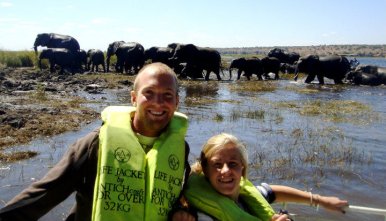
I took some students there in 2010.

Eden and elephants
Me, with friend and former student, Eden T.

At one point, our African guide drove the Land Rover alongside a herd of giraffes, and the creatures took flight around us. “Flight” is the best way to describe it—for whatever it was, it wasn’t running. Their spindly legs moved in slow motion though they were more than pacing our speeding vehicle.

giraffes
Before the stampede.

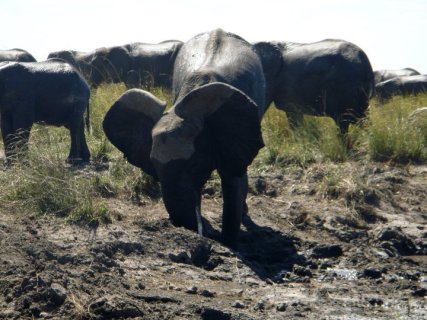
Later, we sat in a pontoon boat while a massive herd of elephants swam around us, moving from one side of the river to an island in the middle. Their trunks bobbed like fleshy periscopes. At the bank, we pulled close by the herd—too close in fact—and a mother elephant expressed displeasure with a false charge, a shaking of her head, and a trumpet blast of warning. Eden-like.

false charge
Elephant, telling us to “Back away!”

Or was it?

Now for a second Africa story:

On an earlier trip, in the lake region of Zambia, I sat in a wobbly canoe (much smaller than the pontoon boat) as a local fisherman shoved us away from shore. Then the realization hit me: There are probably crocodiles in here.

There were, in fact, (the villagers had told frightening stories of attacks; and I had seen a child scarred across his legs). One father even told of racing into the water to try to pull his son out of the crocodile’s mouth. The canoe had been a gift from my father-in-law, to help the fishermen build a business that did not depend (quite literally) upon the hand-hewn boats that were more vulnerable to local wildlife.

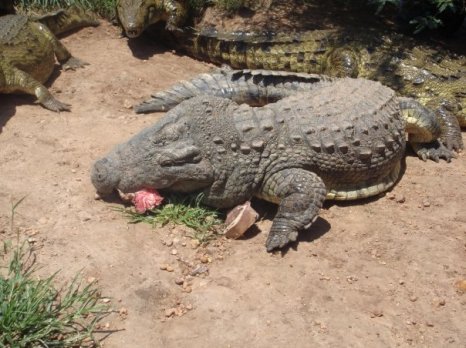
dinosaur
Picture I took of a crocodile/dinosaur, snacking on some hippo meat.

THE GRANDEUR AND THE GROANING

I bring up those two African experiences (Okavango and the “Croc canoe”) to make a point about the animal realm.

It is both blessed and bloody. There is grandeur and there is groaning. It may seem “like the garden of Eden” in Okavango, but it is fueled by a carnage of almost unimaginable proportions. It can even seem, says theologian David Bentley Hart, “as if the entire cosmos were somehow predatory.”

“We know,” says the apostle Paul, “that the whole creation has been groaning … until now” (Rom 8:22, ESV).

Speaking of crocodiles, Ronald Osborn, a former missionary kid from Africa, highlights the possibility that the “Behemoth” of Job 40 may actually be a crocodile, described in one translation as “chief of God’s works” even as he “devours cattle as if they are grass” and “crunches all wild beasts” in his jaws (NEB, vss. 15–34).

Then Osborn goes on to ask how Job’s endorsement of this crocodilic carnage matches up with his own experience.

“I have seen crocodiles on the riverbanks of Masai Mara in Kenya, near the end of the wildebeest migrations, their bellies distended from feasting. It is said they continue to kill even after they are engorged, without any interest in eating their prey.”

In the face of this seemingly wasteful bloodshed, Osborn concludes with frankness:

“These are the realities we must add our ‘Amen’ to if we grant the God of the whirlwind who glories in the Behemoth and the Leviathan the final word” (Osborn, Death Before the Fall, 157).

In the famous words of Tennyson: “Nature [is] red in tooth and claw.” So while we trust that “God is love indeed,” the violence of the natural realm can seem to “shriek against his creed” (“In Memoriam A.H.H.”).

And this bloody reality contributed to Charles Darwin’s loss of faith.

DARWIN’S DILEMMA

One of Darwin’s haunting questions pertained to what he called “the sufferings of millions of the lower animals throughout almost endless time.”

On the one hand, Darwin seemed open to the idea that human suffering might serve the good of “moral improvement” within God’s sovereign plan. But the number of humans seemed like nothing “compared with that of all the other sentient beings” (animals) that “often suffer greatly without any moral improvement” (Darwin, Autobiography, 90).

Darwin’s question was straightforward: Why would an all-powerful, all-loving God permit so many “lower animals” to suffer and die in the countless centuries that he believed to have preceded human beings?

This inquiry led to his most (in)famous pronouncement on the subject:

“What a book a devil’s chaplain might write on the clumsy, wasteful, blundering low and horridly cruel works of nature!” (Letter to Hooker, July 13, 1856)

For Darwin, this was not a minor issue. By his own account, the issue of animal suffering was one of the deciding factors that led him to away from orthodox Christianity and toward agnosticism.

“Whilst on board the Beagle I was quite orthodox, and I remember being heartily laughed at by several of the officers … for quoting the Bible as an unanswerable authority on some point of morality” (Autobiography, 85).

But in time,

“the very old argument from the existence of [animal] suffering against the existence of an intelligent First Cause [was indeed] a strong one” (Autobiography, 90).

THE ROAD AHEAD

In the next few blog posts, I want to consider the problem of animal suffering in relation to the Christian belief in a loving, holy Creator.

My question is this: How do those two ideas fit together: the groaning and the grandeur; the beauty and the bloodshed?

Or was Richard Dawkins right to say that,

“The total amount of suffering per year in the natural world is beyond all decent contemplation. During the minute that it takes me to compose this sentence, thousands of animals are being eaten alive, many others are running for their lives, whimpering with fear; others are being slowly devoured from within by rasping parasites…

The universe that we observe has precisely the properties we should expect if there is, at bottom, no design, no purpose, no evil, no good, nothing but pitiless indifference” (River out of Eden, 132).

Stay tuned.


If you’re interested in understanding the big story of the Bible, check out my most recent book: “Long Story Short: the Bible in Six Simple Movements,” available with Video teachings to help church small groups.

Signup here to receive bonus content through my email Newsletter (“Serpents and Doves”).

I will not clog your inbox, and I will not share your email address.

Justice without mercy

Justice without mercy

“Excessive zeal for justice always becomes satanic.”

That line comes from Walter Wink’s landmark study of the demonic: Unmasking the Powers. His point is not to disparage our need for justice but to season it with mercy, lest “Lady J” transform into, simply, “the accuser” (ha satan).

“Justice” often turns, like sour milk, to vengeance.

A similar theme exists in this provocative claim by Alan Jacobs:

When a society rejects the Christian account of who we are, it doesn’t become less moralistic but far more so, because it retains an inchoate sense of justice but has no means of offering and receiving forgiveness.

The great moral crisis of our time is not, as many of my fellow Christians believe, sexual licentiousness, but rather vindictiveness.

Social media serve as crack for moralists: there’s no high like the high you get from punishing malefactors. But like every addiction, this one suffers from the inexorable law of diminishing returns. The mania for punishment will therefore get worse before it gets better.

I’ve written on this before (here); but a similar point has now been made by a third and final figure: the famous atheist/neuroscientist, Sam Harris.

In reference to a recent spate of social media mobs that have called for the names, addresses, and (practically) the firstborn children of perceived offenders, Harris laments the fact that our modern culture has lost its ability to forgive (or even hear the evidence) amid its fervor for “justice.”

“We have to have a way back,” said Harris in a recent interview, regarding how the social media mob descends on certain persons with seemingly no mercy and no possibility of repentance or forgiveness.

Is there a lesson here from these three statements?

If anything, it is that a thirst for “justice” is not always an unalloyed good. We need mercy too. And humility (Mic 6:8).


Interested in understanding the Big Story of the Bible? Check out my new book: “Long Story Short: the Bible in Six Simple Movements,” available with Video teachings to help church small groups.

Signup here to receive bonus content through my email Newsletter (“Serpents and Doves”).

I will not clog your inbox, and I will not share your email address.

When politics BECOMES religion

When politics BECOMES religion

Here’s a bold pronouncement:

The fastest growing “religion” in America isn’t Buddhism, Islam, or that age-defying voodoo powder that Tom Brady’s trainer sprinkles in his Gatorade. Not even close. Over the past decade or so, America’s fastest growing religion has been the all-consuming pull of politics.

A recent article in The American Conservative suggests something like this – and it isn’t limited to just the “Right” or “Left.”

Looking back to 2008, Timothy P. Carney argues that one thing many of the chanting, fainting, I-will-never-wash-this-hand-again supporters of Barack Obama had in common with the reddest of “red hats” is that they had abandoned church and transferred their religious fervor to political messiahs.

Politics replaced religion.

Based on research by the Pew Research Center, Carney states that:

The best way to describe Trump’s support in the Republican primaries […] would be: white evangelicals who do not go to church.

They came to Trump seeking what they had lost because they had lost church.

This claim is muddied by the fact that some of these devotees still claimed the label “evangelical,” though they had long since left church. In fact, the subset of Trump voters dubbed “the Preservationists” was the group most likely to say that religion was “very important” to them even while they were least likely to attend religious gatherings.

What meaneth this?

One way of reading the statistic would be to say that for some of these folks, it was not so much a case of politics expressing their faith as it was political fervor becoming their faith. (Read the whole thing here to see if you agree.)

It would be wrong, however, to say that this is just a MAGA phenomenon. My hunch is that something similar could be said of the far Left.

ET TU BERNIE?

It is widely known that this demographic is less likely to attend church regularly, or to claim a religious affiliation. The “Nones” are on the rise, we hear repeatedly. But is “None” really the most accurate religious descriptor for some of the most vocal members of the secular Left?

How many of these marching, chanting, constantly posting anti-Trumpists might also be said to have transferred their “faith” to America’s new national religion?

After all, a quick gander at the leading “news” sites (whether Right or Left) shows a form of ideological purity and boundary-policing that would normally be reserved for the harshest of fundamentalist sects. Heresy is a live category here, as is excommunication and the social media equivalent of burning at the stake.

WHAT IS RELIGION?

The first point to be made in response to my argument is that it would be unfair to accuse all passionate voices (on the Right or Left) of having adopted a new religion.

Theologians like myself should be careful about turning everything into a “religion,” as if my kids’ passion for fruit snacks and animal crackers should be read through the lens of Dionysius and animal sacrifice.

“Some” is the key word above.

Still, I stand by my claim that we sometimes define “faith” and “religion” too narrowly.

In my usage, religion (or “worship”) is the assigning of ultimate, transcendent value to a particular object, person, or idea. Along these lines, even famous atheists like Christopher Hitchens have long referred to Soviet Marxism as a de-facto religion. (Hitchens knew this from experience; as a young Communist, he had gone to live in Castro’s Cuba.)

My contention is that we sometimes fail to define “worship” and “religion” broadly enough. As Nietzsche rightly saw, there are more idols in this world than one thinks.

WHAT TO DO?

But what should Christians do in the face of America’s fastest growing quasi-religion?

An initial move should be to examine our own hearts and habits.  How much time do I spend perusing political news versus reading Scripture?  Would a quick scan of my Facebook posts indicate that I am most passionate about?  How often do words like “Left” and “Right” pepper daily my daily vocabulary?  Do I spend hours a week listening to acerbic talk radio or other forms of highly biased political content?

Then, three quick applications for the church at large:

1. Don’t baptize rival kingdoms.

An initial step would be a refusal to baptize the political dog in the ecclesial manger, regardless of the color of its collar.

In American politics, both sides have had tendency to care selectively about certain sins, while conveniently ignoring others. Both sides have tended to “bundle” issues strangely at certain points (e.g., justice for all and abortion on demand). And both sides have found church leaders willing to “baptize” their moves in exchange for access to power. I’ll forgo the examples.

In the words of evangelical historian, Thomas S. Kidd:

we should never want our church leaders to become partisan campaigners, regardless of the party in question. [This move] disrupts the unity of the church, and invariably turns the church into a servant of temporal power rather than the kingdom of God.

2. Don’t retreat to private faith.

On the other hand, it would be equally disastrous to respond to our hyper-politicized moment with a retreat from social engagement altogether.

“Religion as a private matter.”

~Said no one in the Bible, ever.

A “private” faith is an irrelevant invention of the modern world. Thus Christians ought to care about the issues God cares about.

For me, that includes pressing matters of justice like abortion, racial reconciliation, and many others topics.

At the same time, we must be sure to take our cues from Scripture more than from the talking heads of Cable News, or the self-interested bosses of party politics.

3. Don’t lose interest in the “seed” growing slowly.

My sense is that some Christians have simply grown tired or bored with the difficult and unheralded work of soul-care and The Great Commission.

And strange as it sounds, I get it.

On every news site and every social media platform, we are told repeatedly that political realities are the most important, most interesting, and most cringe-worthy aspect of life. Who isn’t tempted to believe it?

Politics is the laser pointer, and we are the frantic cats that jump to and fro at the whims of “owners” after ad revenue. Politics is the fast-moving, shiny object from which you can hardly look away.

By comparison, the “seed” growing slowly beneath the soil doesn’t seem as exciting. If the Kingdom of God is like leaven mixed with dough (doing its work in secret, without headlines, and without a 12-hour news cycle), then politics is like gunpowder. It turns more heads, makes more noise, and sucks up all the oxygen. But that doesn’t mean it’s where the actions is.

The challenge of Christ’s strange kingdom is to trust that the “seed” growing slowly is what really matters.

The gospel is the treasure buried in the field; it is worth selling everything to have; and it is more fulfilling than our new national religion of political fixation.


Interested in understanding the Big Story of the Bible? Check out my new book: “Long Story Short: the Bible in Six Simple Movements,” available with Video teachings to help church small groups.

Signup here to receive bonus content through my email Newsletter (“Serpents and Doves”).

I will not clog your inbox, and I will not share your email address.