Flee Roy Moore’s evangelicalism

Flee Roy Moore’s evangelicalism

But take the real “evangel” with you.

When I typed up a quick blog post yesterday, I did so assuming that Roy Moore was about to win the Alabama Senate seat.

I was wrong.

Thank God.

To some, that may sound rather strange.  After all, I am precisely the sort of person that was supposed to carry Judge Roy to victory: I am Pro-Life, white, and evangelical in my theology.

According to the media, I am supposed to belong to that very “base” that was going to make the difference–despite no fewer than nine allegations of sexually predatory behavior toward children.

And despite Moore’s claim that “many problems would be solved” if we scrapped all constitutional amendments after the 10th one (Just so we’re clear: the 13th ended slavery; the 15th gave all races the vote; and the 19th gave votes to women).

Well, I do not belong to that “evangelical base”–because, in some cases, there’s nothing evangelical about it.


REQUIUM FOR “EVANGELICAL”

As some news outlets have been quick to trumpet, Moore’s strongest support came from the self-styled “evangelical” voter.

The most vexing evidence for such logic, came in a poll showing that a plurality of Alabama “evangelicals” reported being “more likely” to support him after numerous allegations of child sexual misconduct than before.

This left many of us scratching our heads.

Who could possibly be “more likely” to support someone “after” reports that he repeatedly stalked underage girls at the local mall while dressed like the cartoon sheriff from the movie Toy Story?

NOT SO FAST…

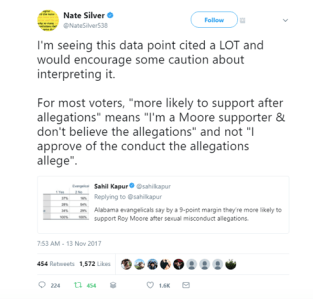
As many have pointed out, however, such polls should be viewed with suspicion (see here).
Screen Shot 2017-12-12 at 9.09.07 AM

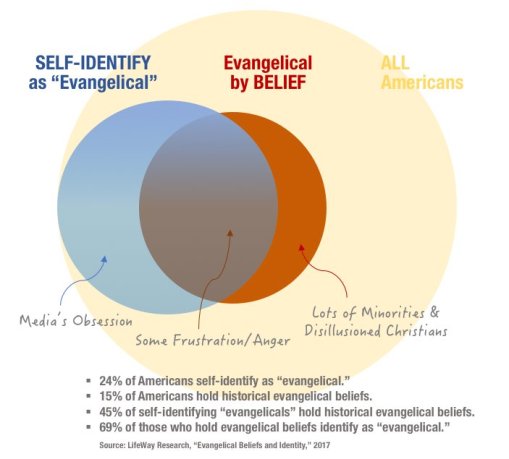
According the Wheaton professor Alan Jacobs: In parts of the country, “evangelical” has become synonymous with “whites who watch Fox News and consider themselves [vaguely] religious”–regardless of church attendance, Bible reading, or basic theological beliefs.

And while I love those people, that is not what the word means.
Evang. venn diagram

In short, the label has been corrupted.

In Roy Moore’s case, it was equated with the worst elements of partisan politics—hence it hangs like an albatross around the neck of many faithful and devoted Christ-followers.

(For what it’s worth, it also hurts the Pro-Life movement in the long run–like making Bull Connor the face of your anti-human trafficking campaign.)

Yet while many of us grieve the (earned) destruction of the “evangelical” label, we also worry that to look back longingly at the smoking ruins is to risk being turned into a pillar of insipid salt.

What, then, should one do with this beautiful but now corrupted label?

THE YEAR IS 1955

It bears noting that in 1955, Billy Graham faced a similar decision.

He had once been a self-identifying “fundamentalist,” back when that word was not synonymous with backwardness and bigotry. In its origin, the term had stood for the fundamentals of the faith. As did Graham.

Yet in 1955, he decided to drop the albatross for reasons that sound eerily familiar: it had been irrevocably tainted by un-Christlike beliefs and behaviors.

Even good words can be turned it seems—like raw oysters in the Alabama sun.

So Graham followed Jesus – out of “fundamentalism” in order to stay true to Scripture and the gospel (the “evangel”).

Or as cowboy Roy might say: “When your horse dies, get off.”

HOPPING OFF THE PENDULUM

What one does next, however, is important.

The temptation for many is simply to flee one rival kingdom for another.

If Roy Moore’s “evangelicalism” has turned a blind eye to egregious sexual and racial sins, one simply runs hard in the opposite direction.  After all, as Justice Ruth Bader Ginsberg once remarked:

            The true symbol of the United States is not the bald eagle. It is the pendulum.

But what if…?

What if it is partly our love of pendulums that caused this very mess?

NOW FOR THE GOOD NEWS 

My suggestion, then, is rather different: flee Roy Moore’s evangelicalism, but take the real “evangel” (i.e., gospel) with you

Because the real “evangel” is alive and well.

Just don’t look for it primarily in the halls of power.

That’s the same mistake we’ve been making for two thousand years: we long for thrones and forget to check the manger.

“I sent you prophets,” says Christ, “but you wanted lobbyists.”

“I sent you shepherds, but you wanted merchants of outrage.”

If you want the real evangel, here is some advice:

Look to the local homeless shelter, where Christ’s hands and feet are serving dinner to the other (equally valuable) members of his body.

Look to the recovery ministry meeting nightly in the church basement, sans cufflinks and news coverage.

Look to the crisis pregnancy center, where women who’ve been there reach out to women who are there.

Look to the high school football star (John) who takes my college Bible class even though it won’t count for credit at his eventual State school–he takes it because he loves Jesus.

Look to the college women (that I know) who spend their Spring Break fighting human trafficking in a Southeast Asia, rather than partying on some sandy beach in Destin.

Look to the group of older Christian women (the godly grandmas) who gather to encourage my young wife with wisdom gained from generations of parenting.

Look to the African-American couple serving faithfully in a predominantly white church, because they believe that the journey toward multi-ethnic community is worth it, even if it’s difficult.

And look to the Catholic nun, kneeling peacefully in the cold rain outside an abortion clinic, praying for the souls inside (doctors, mothers, and babies).

This is the REAL “evangel.”

It’s alive and well.

And in that sense, I don’t give a flying flip what happens to the Roy Moore version.

May you fail…

May you fail…

An unconventional benediction.

A few folks asked for a copy of the “unconventional” graduation blessing that I delivered for our December commencement yesterday.

Here it is:

I left out a couple stanzas on the spot (remembering something Jesus said of wordy prayers from podiums).

Nevertheless:

Class of 2017, hear these words:

May you fail  [long pause] … to seek significance in the plastic trinkets of this world / things like money, power, and fame. / And may you find significance in this: / that you are a beloved child of God / Etched in the image of Jesus Christ.

May you have enemies / So that you may love them just as Jesus did / and thus turn some of them to friends.

May you be disloyal citizens / to rival kings and rival kingdoms / So that you may prove true to good king Jesus / And see his Kingdom come.

May your life not go (entirely) as you have planned it / And in those moments, may you come to see that, alongside fidelity, God’s other name is “Surprise.”

And most of all: May you know that we, as your faculty, cannot wait to see you go / Not because we want to be rid of you / But because through your lives, our little ministries will multiply a hundredfold.

We love you; Godspeed.


+ Credit to Neil Plantinga for the idea that “God’s other Name is Surprise.”

“The lower classes smell”

“The lower classes smell”

Why our ideas matter less than we think.

Back in 1937, George Orwell claimed this about the divisions within British society:

The real secret of class distinctions in the West can be summed up in four frightful words: The lower classes smell (~Road to Wigan Pier).

The statement sounds offensive and reductionistic. Perhaps it is.

Yet Orwell’s goal was actually to challenge his fellow highbrow socialists on whether their ideas about dismantling the class structure were actually strong enough to work in the field—where people live, and sniff.

In the words of James K. A. Smith (citing Wigan Pier):

Orwell’s point is that the root of class distinctions in England is not intellectual but olfactory.  The habits and rhythms of the system are not so much cerebral as visceral; they are rooted in a bodily orientation to the world that eludes theoretical articulation, which is why theoretical tirades also fail to displace it. … “For no feeling of like or dislike is quite so fundamental as a physical feeling.”

In other words, you cannot solve a gut-level problem with a philosophy.

The visceral trumps the voluntary; fundamental dispositions are more caught than taught; and the “nose” (now speaking metaphorically) is mightier than the brain.

Now the kicker:

Almost every other kind of discrimination could be countered theoretically, with the weapons of facts, ideas, and information, “But physical repulsion cannot.”

What does this have to do with us?

Just this:

In America, we seem to have entered a cultural-political climate in which both sides are “physically repulsed” by one another. Sickened, even.

And sometimes for good reason.

Yet if this is so, then one should strongly question our ability to bridge the gap with education, rational discourse, or (gasp) blog posts. Orwell’s point is this: revulsion trumps reason every time—try as we might to overcome it.

In short, our “ideas” are not nearly as important for the way we engage the world as we would like to think.

As Smith argues, we are not primarily “thinking things” as Descartes posited. Nor even “believing things” as much of Christian culture claims. Even demons believe (Jms. 2.19).

For Smith, both of these mistaken anthropologies place too much emphasis upon the cognitive realm (“ideas”), whereas the Bible focuses more upon reforming the heart, the gut, or even “the bowels.”  (Even the biblical references to renewal of the “mind” are not given in a Cartesian sense.)

We are primarily loving-desiring beings.

And as such, much of our behavior is the product of pre-cognitive, affective, gut-level, and visceral reactions.

“The lower classes smell.”

But how does one disciple the olfactory senses?

How do “the bowels” get redeemed?

Next time.


See James K. A. Smith, Desiring the Kingdom: Worship, Worldview, and Cultural Formation (here). For a less academic version of Smith’s argument, see You are what you love: The Spiritual Power of Habit (here).

Jesus + Wine

Jesus + Wine

I’ve been behind on blogging lately as I’ve been working on other writing projects (more on that soon!).

As a partial remedy, here is a sermon that I preached Sunday on one of my favorite passages: Jesus turning water into what would have amounted to 757 bottles (do the math) of the choicest wine (Jn. 2).

Contrary to popular portrayals of Christianity–both by detractors and adherents–one takeaway is this: The pursuit of Christ (and holiness) is simultaneously the pursuit of Joy. 

Jesus is not the celestial equivalent of Ned Flanders; he is not a cosmic killjoy.

He is Lord of the Feast, and the bringer of overflowing life.

The wedding feast at Cana proves this, along with many other fascinating things.

As I note in the message, the outline takes cues from Tim Keller’s fantastic sermon: “Lord of the Wine.” Also, for more of the Bacchus / C.S. Lewis connection, see my prior post (here: “Saving Bacchus”).

Hope everyone is having a feast-worthy week!

Thou shalt not Cable News?

Thou shalt not Cable News?

Over at The Gospel Coalition, Trevin Wax is asking whether Christians should consider “pulling the plug” on an increasingly unsanctified form of television entertainment.

No, it’s not the racy or gratuitously violent scenes on “Skinamax” or other channels— it’s cable news.

Cable News

Here’s the money quote:

In a culture that has lost its appetite for truth and has developed an appetite for coarseness and sensationalism, cable news plays to our worst tendencies.

(Read the full thing here.)


Like me, Wax admits to having once been a bit of a “political junkie.” But as he puts it, “Election 2016 changed that.”

It wasn’t because, this time around, I was unable to enthusiastically support either candidate. It was a growing concern with the toxic atmosphere of the cable news channels and the worrisome trends they reveal about our society.

He then gives three reasons why the rise of niche-market news channels–tailor made to heighten our existing biases–have had cancerous effects.

Here they are:

  1. The Disappearing Aim of Journalism

While absolutely no one is unbiased, the claim here is that today’s cable news outlets (whether Fox News, CNN, or MSBC) aren’t even trying.

The aim is no longer truth or journalism; it’s ratings via sensationalized pandering to a specific demographic. For proof, one need only recall the admission of a CNN producer that the Russia scandal was “great for ratings.”

  1. The Disappearing Desire for Truth

Worse yet, many viewers do not seem to care.  We tune in for validation, not objectivity, and the media on both sides plays the music to our band.

  1. The Rise of News as Show

Wax’s third claim is that the line between news and entertainment has all but vanished.  What we have now are “shows,” or rather: “food fight journalism,” dished out by the likes of Hannity, Maddow, and (formerly) O’Reilly.

On this point, Wax gives a telling example from the life of Roger Ailes, Fox News founder and longtime Harvey Weinstein impersonator:

Ailes knew what types he wanted on that show: the “bombshell blonde,” the middle-of-the-road guy, the renegade, the brunette, and the token liberal (white or black) to round out the panel. When casting the show, he made it clear to the panelists that they were replaceable precisely because they were typecast.

In the end, such typecast replicability also led, by all accounts, to a newsroom that made Ron Burgundy’s look like a paragon of gender equality and female respect. The non-disclosure agreements were stacked like papal indulgences.

WAIT A MINUTE

But wait a minute… is all this an exageration?

Despite such strong indictments, Wax doesn’t want to go too far.

As he notes, moments of real journalism do sneak through on the cable channels.  And in moments of crisis, like the recent hurricanes, we are thankful to be “inspired by the stories of individual families, of daring rescues, and the ongoing relief efforts.”

Cable news is not all bad; not all options are equally biased; and simply tuning out to world events does not seem like a great alternative.

Perhaps one possibility then is to step away from cable–millennials like myself have long since done this (what are channels?)–and get our news from a variety of other sources.

The best of these may even involve (wait for it…) reading. While this would hardly free us from the grip of bias, the choice to read our news from more reputable sources would eliminate the endless food fights (read: panel discussions), engineered by Ailes and others. It would also prevent the binge-newsing that fuels an obsessive and over-politicized paranoia.

In the recent words of David Brooks:

[Our] public conversation is over-politicised and under-moralised … we analyse every single movement in the polls, but the big subjects about relationships and mercy and how to be a friend – these are the big subjects of life and we don’t talk about them enough. Or we have our moral arguments through political means, which is a nasty way to do it because then you make politics into a culture war.

A PROBLEM ON BOTH SIDES

As Wax makes clear, the problem exists on both the Right and Left.

In this, we have yet another example of how both extremes within our current culture wars are locked in a symbiotic existence that is simultaneously a carnal embrace.

They need each other; they are producing offspring (“As even your own poets claim”); and they ought to be in each other’s Christmas cards.

In the end, the greatest danger is what such WWE-inspired journalism does to us.

It changes us in subtle ways.  And it leaves us drawn (perhaps subconsciously) toward leaders with these qualities.

We form our media; then our media form us.

Before we know it, one might even feel “strangely warmed” toward a figure whose philosophical and rhetorical inspirations seem like an odd amalgam of Gordon Gecko and Ric Flair.  Hypothetically.

BEYOND LEGALISM

After reading Wax, my own takeaway was not a legalistic command along the lines of “Thou shalt not cable news.”

In all honesty, my own tradition has sometimes erred in this direction. My grandparents tell an old story of unloading the family moving van at a new church parsonage, only to be asked brusquely by a church elder:

“Do you own a television?”

“No,” replied my grandfather.

“Good; we throw those in the river!”

Neither Wax nor I are advocating this.

Even so, perhaps evangelicals would do well to recognize that “sex and cussing” are not the only forms of television viewing that can malform us when it comes to holiness.

Oh be careful little eyes…

We are Seven: On counting miscarriage

We are Seven: On counting miscarriage

“How many children do you have?”

That was the seemingly innocuous question that I asked my new acquaintance as we sat around the chips and salsa at our local Chili’s.

Like most parents, he answered with a number. Then he said the part that I had not expected:

“We had two miscarriages. And we always count those.”

While I responded with empathy, I recall thinking that most of us (myself included) do not publically number our children to include the little lives that never made it to delivery.

And on many levels, that is understandable.

We all deal with grief differently.  And it would be wrong to force one way of processing a failed pregnancy on others.

OUR MISCARRIAGE

About a year and a half ago Brianna and I walked through our own experience of miscarriage. And while it was sad for me, at the time, I was primarily concerned for her well-being.

After hearing a noise in our house, I came into our bedroom to find Brianna unconsciousness from blood loss.  I panicked.  Then I phoned my mom to watch our kids; I carried Brianna’s (now) semi-conscious body to the car, did my best to place her inside, and then drove us to the hospital.

Thankfully, she was soon okay.

But the baby had been deceased for several days.

Later, as some readers can relate, there was the awkward reality of having already told some folks that we were pregnant, and now having to explain.  Partly because of this, Brianna chose to share publically that she had lost a pregnancy.  And soon after, she was overwhelmed by the many friends and family who then confided their own stories–some far more traumatic than our own.

It happens often.  But that doesn’t make it nothing.

CONSISTENTLY PRO-LIFE

In Christian circles, one hears much about the need to be “Pro-Life,” and rightly so.

While the issue of abortion is polarizing, my own view leans on both Scripture and science to conclude that an unborn child is indeed a sacred human life, however small.

Even so, the consistent application of my “Pro-Life” stance involves much more than just abortion. It is a virtue that spans from womb to tomb, and sweeps up everything from welfare to warfare within its complicated wake.

I aim to be consistently Pro-Life.

Yet this too raises questions as to how I “count” our miscarriage.

WORDSWORTH OVER CHIPS AND SALSA

In a slightly different vein, something like my Chili’s conversation also happens in a classic poem by William Wordsworth (“We Are Seven”; pub. 1798).

Its verses recount an exchange between a traveler and a simple peasant girl.

The traveler asks:

“Sisters and brothers, little Maid, / How many may you be?”

“How many? Seven in all,” she said, / And wondering looked at me.

“And where are they? I pray you tell.” / She answered, “Seven are we; / And two of us at Conway dwell, / And two are gone to sea.

“Two of us in the church-yard lie, / My sister and my brother; / And, in the church-yard cottage, I / Dwell near them with my mother.”

Yet this statement brings confusion to the traveler: “I thought that you said seven.”

“You say that two at Conway dwell, / And two are gone to sea, / Yet ye are seven! I pray you tell, / Sweet Maid, how this may be.”

The misunderstanding, of course, involves the girl’s counting of her two dead siblings (“who in the church-yard lie”) as present members of her family.

Unfortunately, the mathematical modern adult doesn’t get it:

“You run about, my little Maid, / Your limbs they are alive; / If two are in the church-yard laid, / Then ye are only five.”

WE ARE SEVEN

As I read the poem recently (outside, on a nice morning, as is legally required of Wordsworth), it struck me that perhaps the number “seven” reflects our family too.

For if I were to begin consciously “counting” the child that we lost to miscarriage, then we would indeed be Seven. –(1) Brianna, (2) Josh, (3) Lucy, (4) Penny, (5) Ewan, (6) Baby unnamed, (7) Teddy.

And while I have no plans to begin saying this whenever someone asks about my children, perhaps it is a more consistent conclusion for those of us who consider ourselves “Pro-Life.”

After all, the weight of Wordsworth’s poem lies in the child’s stubborn insistence that death does not erase a child from the family roll.

To live at all is to be woven forever into the fabric of “present personhood.” We are eternal.

For to use Donne’s metaphor, “all mankind is of one author, and is one volume.” And while death is powerful and grievous, it cannot tear out words and pages from this book.  It can only translate them–if they be written in Christ’s blood–“into a better language.”

The trouble, however—as my two-year-old reminds me daily—is that children learn new “languages” far easier than grown-ups.

Thus even our ostensibly “Christian” thinking about miscarriage can often leave us thinking as only slightly more cordial versions of Wordsworth’s adult traveler, in need of child-like wisdom:

“How many are you, then,” said I, / “If they two are in heaven?” / Quick was the little Maid’s reply, / “O Master! we are seven.”

“But they are dead; those two are dead! / Their spirits are in heaven!” / ’Twas throwing words away; for still / The little Maid would have her will, / And said, “Nay, we are seven!


On Protests

On Protests

In recent weeks, social media has been ablaze with opinions over what does or does not constitute an “appropriate” protest.

This piece, however, is about a much older controversy.

Exactly five hundred years ago (this month) an act of dissent began that was far more incendiary than a few athletes kneeling for an anthem.

In the heart of Germany, a young monk named Martinus Ludher (Martin Luther) felt compelled to speak out against the abuses of his church—and particularly, against the unjust selling of indulgences.

Yet while many celebrate Luther’s legacy this year, it bears noting that he was hardly a hero to many at the time.

Protests, it seems, can be variously interpreted.

MEDIEVAL MEMEs

Thanks to J. Gutenberg’s 15th century invention of “social media,” one can still access a plethora of medieval memes depicting the Reformer in all manner of unflattering ways.

There was Luther as the beast of Revelation; Luther as the devil’s bagpipe (below); and Luther as a sex-crazed infidel who wanted only to satisfy his lust and break his vow of celibacy.

Lutherdevil

Like and share if you agree!!! –proclaimed the Hapsburg troll farms.

On the other side, the pope was also lampooned in a variety of viral .gifs, er… pamphlets.

The holy father was here depicted as a bare-breasted dragon with the head of an ass; and  as a decrepit pseudo-Jew riding a pig while holding a pile of steaming excrement.

Popeonsow
In the period, Jews were often erroneously slurred as riding pigs.

Apparently, the poop emoji is hardly new.

Nor, sadly, is anti-Semitism.

IMPERIAL REBUKE

In response to Luther’s protest, the Holy Roman Emperor himself decided to weigh in.  And in 1521, at the Diet of Worms (not a .gif), Charles V pronounced a somber “SAD!” over the idea of justification by faith alone.

Oddly, however, the interjection of a world leader only fueled the fire.

Luther’s protest spread.

BLOOD AND SWORD

In the wake of such polarization, one might hope that the following decades would bring a return to civility between the factions—both claiming to be Christians.

It did not.

So while the fruit of the Reformation is now seen in ideas like sola gratia, sola fide, and sola scriptura (grace alone; faith alone; Scripture alone)—the more immediate fruit was  the Thirty Years War: the deadliest religious conflict in European history.

Many cite this bloodshed today as a reason why Europe became aggressively post-Christian in the years to follow.  The idea was that strong theological commitments invariably bring bloodshed.  And while the twentieth century would show that atheists can wage jihad even more effectively (#Marxism), the damage was done.

WORTH THE TROUBLE?

So was Luther’s protest worth it?

I think it was–although I don’t agree with all his tactics.

As a Protestant myself (though one with great respect for Catholicism, and for my Catholic brothers and sisters), I tend to think that the Reformation was necessary, not least because the gospel badly needed a retrieval from the tentacles of medieval tradition.

Even so, Martin Luther was a terribly imperfect activist.

IMPERFECT ACTIVIST

Believing that all his adversaries were literally in league with Satan, Luther often chose the most profane words and images imaginable.  (I’ll let you Google it.)

He had seemingly never met an ad hominem—or a reference to the human G.I. tract—that he disliked, and he shared more than his share of “fake news” stories, especially against the Jews.

His treatment of “law” and “gospel” sometimes verged toward anti-nomianism.  And his anti-Semitism made the Holocaust more possible in modern Germany (though most of the blame for this lies elsewhere).

Partly to shore up political connections, he once commanded that the “murderous, thieving hordes of peasants” be slaughtered in the most inhumane of terms.  And while some of these peasants were indeed both murderous and thieving (see Münster), others were just poor farmers who had been frightfully oppressed by local lords.

Apparently revolts against an over-taxing monarchy can also be variously interpreted.

LESSONS LEARNED

What then is the point of this history lesson?

To be sure, every act of protest is unique–as is every “protestant.”

Thus it would be wrong to equate any of them, just as it would be wrong to declare every protest praiseworthy. Some are not.

Even so, we fool ourselves if we think that any act of dissent was ever deemed “appropriate” at the time.  That’s just not how it works.

Just ask the other Martin Luther. In 1966, Gallup registered MLK’s disapproval rating at 63%, while only 32% of Americans approved of him. Yet in 1999, MLK ranked #1 amongst U.S. citizens to be voted on.

Apparently it takes more than flash polls or “gut feelings” to discern morality.

And perhaps in one instance, it took a chronically cussing and perpetually constipated monk to get a needed conversation going.

Happy (early) Reformation Day.

Coyote America

Coyote America

In the Latino communities of the American southwest, there is a saying:

            The only thing smarter than a coyote is God.

And while we car-driving, blog-writing humans may take issue with this claim, just ask yourself this question:

How many coyotes have you seen holding fidget spinners?

I sat rapt recently as I listened to the nature historian Dan Flores talk about his recent book: Coyote America. 

It is essentially a biography of America’s most adaptive underdog.

And it is also a strange topic for a blog on faith and culture.

So we should probably address that weirdness.

A DEFICIT OF AWE

You may not know it, but coyotes are not exactly “click-generators” in the world of social media. They do not wear bikinis; they have no thoughts on Donald Trump; and (unlike cats) they do not appear on Youtube playing the piano. (I checked.)

So why write about them?

Two words: unexpected awe.

While there are many problems in the modern world, among the least acknowledged may be our loss of wonder.  Despite all our technological marvels, most of us are far too rarely dazzled.

So while we are awash with entertainment, we have a deficit of awe.

And from this evil Amazon.com cannot deliver us.

This state of disenchantment presents a problem for the church, because a capacity for wonder may be a prerequisite for what Calvin called the sensus divinitatis—our sense of the divine.

INTO THE WILD

In the Bible, such awe comes often out-of-doors–though not exclusively.

It presents itself in burning bushes; in stars that mark descendants; and in a grappling angel by a brook.

In such wild places, our sense of wonder is refreshed.

And this brings us back to the coyote.

ETERNAL UNDERDOG

While Flores’ book starts in prehistoric times, its most interesting parts reveal how the coyote flourished while other species were decimated by the settling of the American West–a period that brought perhaps the swiftest destruction of wildlife in world history.

Yet despite an all-out war on coyotes starting around 1915, the only noticeable result has been that they continue to spread like wildfire.

While first inhabiting only a portion of North America, the animals now stretch from beyond the arctic circle down into South America.  And what’s more, they now inhabit every major city in the United States.

The reason for their flourishing has something to do with what the apostle Paul identified as “power perfected in weakness” (2 Cor. 12.9).

Because coyotes adapted as the smaller, frailer cousin of the wolf, they could not rely on brute force to stay alive.  Instead, they had to lean into their wits and learn to leverage weakness.

Case in point: their use of howls and hormones.

COYOTE TINDER

According to Flores, when the female coyote howls (or yips) each night, one purpose is to take the roll of the respective mates within her group.

If a male does not respond—say, because he was trapped or shot or mauled—it triggers a chemical reaction within the alpha female that does two things, both of which are awe-inducing:

First, it sends her prematurely into heat; and second, it causes the ensuing litter to be larger than normal.

You might want to read that again. The mere absence of an answering “yip” both triggers heat and makes the litter larger than they would be otherwise.

Most likely, this adaptation emerged from a history of weakness and inferiority in the face of larger predators. Yet somehow, this tendency to get killed-off by bigger animals coincided with a freakish adaptation that gave coyotes an advantage.

Example number two:

FRAGILE PACKS 

While wolves tend to stay almost perpetually in tight-knit groups, coyotes are what Flores calls a “fragile pack” animal. This means that when they face pressure from their enemies, they tend to splinter into smaller groups and then cast about in search of new territory.

Because grey wolves group more rigidly, the killing of a single wolf often leads to the killing of the entire pack—sometimes aided by the use of the original hide as a way to lure others to an ambush. For such reasons, wolves were almost eliminated from the American West, while coyotes spread rapidly in all directions.

“They tried to scatter us,” you can almost hear them howling, “They didn’t realize we were seeds” (cf. D. Christianopoulos).

RESISTING APPLICATION

Okay, okay… so coyotes have some crazy adaptations that have led to flourishing – but what do we do with this?

The tendency, for preachers like myself, would be a move to application: something like, The Coyote Principle (Now available for $12.99!).

After all, the book of Proverbs tells us to “Consider the ant” in order to be wise. And if Solomon were relocated to the Sierra Madres, perhaps the text would read “Consider the coyote.”

To be sure, there are lessons to be gained from such creaturely longevity.

For instance:

  1. Weakness does not have to be a weakness. And:
  2. Scattering can be a form of conquest.

Yet the too-quick drive to application can be a fault of teachers like myself. And in some cases it borders on a sacrilege–what Kierkegaard called “pillaging the holy.”

Because while we may benefit from life-lessons, sometimes we have a deeper need to marvel merely at the wonders made by the Creator.

As Donald Miller writes in Through Painted Deserts:

I sometimes look into the endless heavens, the cosmos of which we can’t find the edge, and ask God what it means. Did You really do all this to dazzle us? 

In sum: application is no substitute for awe.

THAT SUCH THINGS SHOULD BE

A related point is made beautifully in John Steinbeck’s classic novel, The Grapes of Wrath.

In one scene, two ragged “okie” boys slide into a roadside gas station as their family migrates west in search of food and better fortunes. In patched overalls and dirt-streaked faces, the children halt suddenly before the candy case. There they stared

not with craving or with hope or even with desire but just with a kind of wonder that such things should be.

Perhaps this tells us something of how Christians ought to look at nature, at coyotes, at oceans, at eclipses, and even at our fellow man—not with craving or with quests for application, but with naked wonder that such things should be.

The LORD was (not) in the storm

The LORD was (not) in the storm

It can seem a cruel twist that hurricanes are called “acts of God.”

Yet it is crueler still when the label is confirmed by careless statements from both televangelists and secular celebrities alike (This sentence may contain redundancies).

Recently, the actress Jennifer Lawrence remarked (omnisciently) that the devastating hurricanes assailing Texas and Florida are Mother Nature’s “wrath” toward a nation that elected Donald Trump.

And while conservatives rightly decried the “word of knowledge,” it bears reminding that certain fundamentalists have long been making similar pronouncements. Pat Robertson blamed Haiti’s earthquake on their “pact with the devil”; Jerry Falwell attributed 9/11 to “gays and lesbians”; and John Hagee blamed Hurricane Katrina on the wickedness of New Orleans.

Why do people do this?

The problem, it seems, is not exclusively a liberal or a conservative one, but a tendency of human nature.

Despite our talk of grace, we often find karma more appealing.

There is something comforting about rendering disaster meaningful as retribution.  Retribution implies simplistic telos—and telos gives us consolation.  After all, it is always “the other side” that is to blame.

WERE THEY WORSE SINNERS?

Jesus faced this fallacy as well.

In Luke 13, Christ is approached by the ideological ancestors of “Katniss,” Hagee, and Robertson.  A tower had fallen in Siloam and there were casualties.  The natural assumption was therefore that the event was God’s judgment on the victims’ egregious sins.

But Jesus isn’t buying it.

“Do you think that these Galileans were worse sinners than all the other Galileans because they suffered this way? I tell you, no!” (Lk. 13.2–3).

The problem, it seems, is not with the notion that God sometimes judges sin dramatically; scripture says he does. Rather, the fault lies in the presumption that one can easily peer behind the veil to parse out when and how this happens.

When we do this, our statements usually become a kind “Rorschach test for prophets”—telling a lot about the speaker, but virtually nothing about Ultimate Reality.

When this happens, whether with J-Law or Pat Robertson, we often end up with a “God” who conveniently hates all the people we do.  And this move manages (impressively) to break both the first and second commandments simultaneously: we kick God off the throne of judgment (#1), and we remake him in our camera-ready image (#2).

For such reasons, the majority of Christians–not to mention past Hunger Games champions–resist the urge to openly attribute hurricanes to divine anger at specific targets.

THE HARDER QUESTION

Yet this hardly quells the questions posed by such disasters.

Especially to theists.

Case in point:

A few years ago, I was introduced to a new colleague of mine, named Mark. In telling me about his life and family, he mentioned that his boy had been struck and killed by lightning.

While the conversation continued, I did not.  I had recently become a first-time father myself; and my question was a blunt one:

Could I be Christian after that?

REDEFINING “ACTS OF GOD”

Are such terrible events really, as the insurance papers tell us, “Acts of God”?

One strand of Christianity says “Yes.”

While “Deism” views God as entirely detached from earthly affairs, “divine determinism” claims that every creaturely occurrence has as its cause God’s active will.

As David Bentley Hart explains it, in his excellent response to the southeast Asian tsunami (The Doors of the Sea):

Some theologians – Calvin, for instance – have denied that the distinction between what God wills and what he permits has any meaning at all.

Yet Hart finds this “unhealthy fascination” with God’s “dread sovereignty” unacceptable.

Thus he resists the urge to attribute every lightning strike on a suburban soccer field, every Indonesian child drowned in a tsunami, and every flattened Caribbean village to a simplistic “act of God.”

As he concludes:

It is a strange thing to seek peace in a universe rendered morally intelligible at the cost of a God rendered morally loathsome.

What though is the alternative?

THE LORD IN THE STORM

Between Deism and determinism lies the majority Christian position—and it is one that I share as a Wesleyan theologian.

God sometimes permits terrible disasters. We don’t know why entirely. (Perhaps grasping for the “knowledge of good and evil” is as troublesome now as it was in Eden.) Yet we trust that God is present in the suffering. Jesus proves this.

The claim here is that while the LORD is in the storm, he is not there as a sadistic force of retribution against the afflicted—much less his people.

Hart says it this way:

I do not believe we Christians are obliged — or even allowed — to look upon the devastation visited upon the coasts of the Indian Ocean [or elsewhere] and to console ourselves with vacuous cant about the mysterious course taken by God’s goodness in this world, or to assure others that some ultimate meaning or purpose resides in so much misery. Ours is, after all, a religion of salvation; our faith is in a God who has come to rescue His creation from the absurdity of sin and the emptiness of death, and so we are permitted to hate these things with a perfect hatred.

For while Christ takes the suffering of his creatures up into his own, it is not because he or they had need of suffering, but because he would not abandon his creatures to the grave. And while we know that the victory over evil and death has been won, we know also that it is a victory yet to come, and that creation therefore, as Paul says, groans in expectation of the glory that will one day be revealed. Until then, the world remains a place of struggle between light and darkness, truth and falsehood, life and death; and, in such a world, our portion is charity.

As for comfort, when we seek it, I can imagine none greater than the happy knowledge that when I see the death of a child I do not see the face of God, but the face of His enemy.

CONCLUSION

The point here is that Christians should resist naming horrific natural disasters as “acts of God,” just as we should resist the urge to blame them on whatever persons we find disagreeable.

When we fall victim to such errors we are more likely to be distracted from the final way that God is in the storm—not as a vindictive force of carnage, but as a healing presence in the hands and feet of his people.

In the end, the LORD is in the storm most palpably when we stop blaming long enough to pray and give and help.


For those interested in giving to those affected by Harvey and Irma, here is an organization that I trust (World Hope – Texas/Harvey). (World Hope – Irma Relief).

We need Winsome Persuasion

We need Winsome Persuasion

Some thoughts on beating bullhorns into plowshares

Sometimes it pays to judge a book by its cover.

Especially if it’s as beautiful and brilliant as that of Winsome Persuasion: Christian Influence in a Post-Christian World (by Tim Muehlhoff and Richard Langer of Biola).

image1
Cover Design: David Fassett; IVP Academic

The central image is of an upturned bullhorn that been strangely “botanized.”  The bell is now a base for flowers; and beauty grows in place of screaching words.

The idea reminds me of Isaiah 2.

In this famous passage, we are promised that, one day, warring nations will beat their “swords” into eternal “plowshares,” and their “spears into pruning hooks” (2.4).

And while that seems a long way off with regard to weaponry, it seems even longer with regard to words.

THE PREMISE

The book tackles the thorny question of how Christians should speak into a world that is marked increasingly by incivility.  (Do I really need to argue this!?)

On social media especially, Deborah Tannen claims that we now inhabit an “Argument culture” that goads us to approach others in a combative frame of mind.

What’s more, Christians (like others) have often stoked these fires through the unfortunate reality of “online dis-inhibition”—the phenomenon that leaves us unrestrained by face-to-face conventions.

(I know, it happened to me once.  Okay, twice.)

So what do we do?

While I can’t speak (yet) for the whole of the book, the most helpful facet thus far involves the authors’ three-fold breakdown Christian communication:

  1. Prophetic
  2. Pastoral
  3. Persuasive

Some definitions:

  1. PROPHETIC COMMUNICATION

The prophetic voice is often used as justification when we decide to “Tee off” on a particular issue. The justification is found in Jesus and the Hebrew prophets, who sometimes use strong language to call forth repentance from God’s people (“You brood of vipers!”). Such language has its place.

But according to Winsome Persuasion, the “prophetic voice” is almost entirely ineffective when used on those who do not share our foundational presuppositions.  It can rally the base, but to outsiders we merely sound like “bullies with bullhorns.”

In such cases: “Inflammatory rhetoric [breeds] inflammatory responses”—and the cycle continues.

This does not mean, of course, that prophetic speech is useless; but it does call for discernment regarding when it helps, and when it actually makes things worse.

If the danger of “cowardly silence” sits on one side, then the danger of “clanging gongs” sits on the other.

  1. PASTORAL COMMUNICATION

Second, the pastoral voice “appeals to the shared needs and suffering” of others, and it “offers healing … to those in need.”  In such ways, it is crucial in showing others that they are loved.

Yet while pastoral communication lays a relational foundation for transformation, it does not have the power to change minds on specific issues.

It comforts but it rarely converts.

This brings us to the title.

  1. PERSUASIVE COMMUNICATION

According to the authors, the persuasive voice “appeals to the common good and general revelation” while also seeking to “change viewpoints or practices within the culture.”

It is the practice of a “counterpublic”–a minority culture that nonetheless desires to influence dominant perspectives in order to bring about positive change.

And to do this, civility is key.

In this way, persuasive speech refuses to live in denial about the fact that the culture no longer shares “my” Christian presuppositions.  We’re not in Mayberry.  Thus what is needed is not simply more volume but rather an appeal to conscience and more broadly shared values.

In this way, winsome persuasion does not cede the public square; but it moves to “botanize the bullhorn” so that it produces more than thorns and thistles.

THE PROBLEM

The trouble (at least for me) is that such persuasion is difficult; it sometimes results in the communicator fielding fire from both sides; and it’s not as fun as ranting.

Likewise, for some of us (including me), winsome persuasion may require a fundamental change in posture.

Flashback: From a young age, it was quite clear that I would never be good at fighting with my fists.  My junior high football roster listed me—quite accurately—at a whopping 87 lbs.  Even so, it was clear that I had a knack for removing the “blade” from verbal plowshares to serve more sword-like purposes. I was quick with comebacks, snark, and sarcasm. And while that has its uses, it can also cause some problems.

Along such lines, a central claim of Muehlhoff and Langer is that today’s Christians have often chosen “prophetic” language in contexts that would be better served by “persuasive” speech.

“Clearly we have spoken up; the problem seems to be that we have spoken poorly.”

As Vaclav Havel wrote:

There is only one way to strive for decency, reason, responsibility, sincerity, civility, and tolerance, and that is decently, reasonably, responsibly, sincerely, civilly, and tolerantly.

I agree.

And one might even mount a biblical case for this conclusion.

THE BIBLICAL CASE 

In Scripture, the juxtaposition of prophetic and persuasive rhetoric is modeled in a variety of contexts.

Note, for instance, the difference in how Christ speaks to the (ostensibly) Jewish Herod Antipas (“that fox!”) and the way he speaks to Pontius Pilate.

Or note the difference between the way Paul speaks to the pagans of Mars Hill (Acts 17) and the way he speaks to the Judaizers of Galatians (“Hey guys, why stop with circumcision…!?  [5.12; my translation]).

There are exceptions, of course, but not as many as one might guess. (Let’s be honest, do we really want to make Elijah’s interaction with the Baal-boys our normative exemplar? It ends with mass execution.)

In the new covenant, Peter calls for the church to make its case to the pagan world “with gentleness and respect” (1 Peter 3.15).

Because while prophetic speech has its place in certain circumstances, I appreciate the call to consider more winsome ways—and to beat some bullhorns into plowshares.


Tim Muehlhoff and Richard Langer, Winsome Persuasion: Christian Influence in a Post-Christian World (Downers Grove, IL: IVP Academic, 2017).

Tim Muehlhoff is a professor of communication at Biola University; Richard Langer is professor of biblical of biblical and theological studies at Talbot School of Theology

(If you’re in the book, see here.)