After Rebuke of Russell Moore, some in SBC move to Censure John the Baptist Next

After Rebuke of Russell Moore, some in SBC move to Censure John the Baptist Next

Nashville, TN: One week after demanding the ouster of Dr. Russell Moore over his campaign-year criticism of Donald Trump (see here), a growing number of Southern Baptist leaders are now lobbying to remove (posthumously) the credentials of John the Baptizer, son of Zechariah and Elizabeth.

“Everyone calls him ‘the Baptist’,” said Kentucky pastor Cletus T. Ottweiler, “But I think it’s safe to say he doesn’t represent our values!”

According to reports, the reason for the proposed action stems from a Scriptural paper trail that links Moore’s political statements to those of John and several Old Testament prophets.

“We thought the problem started with Dr. Moore,” said former governor and SBC pastor, Mike Hucklebee. “But after consulting the Bible, we found the trouble goes MUCH deeper! Elijah, Amos, Isaiah, Jeremiah…— All these guys were WAY out of step with the people they were supposed to be representing. At some point ‘the base’ just gets sick of it. I mean, how can you hope to change a culture if you offend the most powerful people!?”

“Thankfully,” said Dallas pastor Mack Graham: “none of those Old Testament guys were officially listed as ‘Baptists’. So we’re focusing on Russell and John right now.”

In defense of John’s ministry, one source went so far as to say that “Among those born of women, there is no one greater!” Yet several high profile SBC pastors have dismissed this as the exaggeration of a close family member.


**The present post is an exercise in satire. For related (and probably funnier) material, see The Babylon Bee**

Winking at the Devil

Winking at the Devil

Every story needs a villain.

And in much of the Christian tradition, that character is unquestionably the devil.

In recent days, I’ve been focusing my energy on a non-blog-related project: a book on the atonement. And the present chapter has to do with Satan.  This sounds like a strange topic for the Christmas season. Yet the Scriptures connect it explicitly with Christ’s coming.  As 1 John writes:

“The reason the Son of God appeared was to destroy the devil’s work” (3.8).

Yet while belief in God is quite common throughout our culture, belief in Satan does not rank nearly so highly.

As the late Walter Wink put it, the demonic is “the drunk uncle of the twentieth century.” We keep them out of sight.  And we don’t talk about them at dinner parties.  As he goes on:

Nothing commends Satan to the modern mind. [He is] a scandal, a stone of stumbling, a bone in the throat of modernity.

As evidence, a recent Barna survey indicated that around half of American Christians do not believe in the devil as a living being. Rather, they tend to see him as a mere symbol for profound evil.

REVIVING “OLD SCRATCH”

In response to this, Richard Beck, in his new book Reviving Old Scratch, describes the modern experience somewhat like the plotline from an episode of “Scooby Doo.”

STAGE ONE: At the beginning of every episode, whatever evil that had transpired was blamed on some sort of ghost or goblin. The supernatural was everywhere! And it was up to no good. Beck calls this Stage One, or the period of “enchantment.”

STAGE TWO: Yet after some investigation by Scooby and the gang, it was invariably discovered that the “ghost” was really “Old man Cringle” with a fog machine, a bed sheet, and some fancy voice modulation. Beck calls this Stage Two: the age of “disenchantment.” And as he argues, it has much to commend it. After all, science has shown that many ancient superstitions were just that.

STAGE THREE: Yet in Stage Three (not included in the Scooby Doo episodes), Beck argues that we need a kind of “re-enchantment” if we want to account fully for the pervasive nature of evil in this world. In his view, this is not a simple return to a belief in a demon behind every bush. But nor is it the peculiarly modern (white, wealthy, and western) superstition of full-fledged naturalism.

TWO DANGERS

In his own way, C.S. Lewis proposed something similar. As he wrote:

There are two equal and opposite errors into which [we] can fall about the devils. One is to disbelieve in their existence. The other is to believe, and to feel an excessive and unhealthy interest in them.

The unhealthy interest is encountered in various forms. One is the tendency we all have to demonize our opponents, detecting whiffs of sulfur in their presence. Case in point:

hitler

Or as Beck writes:

            We always smell sulfur around those we want to kill.

A second form of unhealthy interest comes when Christians use Satan as an excuse to cover their own faults.

Along these lines, I recall once being in a meeting in which serious allegations (and serious evidence!) were brought forth regarding misconduct. When confronted, one leader responded that “This is just Satan getting angry because we’re doing such good work!”

Sometimes sulfur masks our own scent.

Thirdly, Satan can be wrongly used as a tool to terrify people into compliance, as seen in the Christian cottage industry that springs up around Halloween to scare the “heck” out of unsuspecting sinners as they wander through a warehouse version of the afterlife.

Such moves confuse a love of Jesus with fear of torture.

Finally, an excessive interest in “the devils” can lead to a dualism that puts God and Satan on (almost) the same level. This is not the biblical portrait. For as Luther wrote of Satan–and perhaps enacted by hurling his ink well at the devil–“one little word shell fell him.”

LOVE IS AN EXORCISM

Yet while “excessive interest” carries pitfalls, unbelief does too.

It does nothing to stop the march of minions. For as Wink notes: Disbelief in Satan did little to prevent him running roughshod across corporate boardrooms and bloodstained battlefields throughout modernity.

What is needed, Wink suggests, is a kind of exorcism, though not the kind from horror movies.  In his words:

The march across the Selma bridge by black civil rights advocates was an act of exorcism. It exposed the demon of racism, stripping away the screen of legality and custom for the entire world to see.

What’s more:

The best “exorcism” of all is accepting love. It is finally love, love alone, that heals the demonic. “How should we be able to forget those ancient myths about dragons,” wrote Rainer Maria Rilke, “who at the last minute turn into princesses that are only waiting to see us once beautiful and brave?”

CONCLUSION

In the end, Wink’s work (and even the above quote) shows forth certain faults. In particular, he demythologizes far more than I would, and his views on Christ, creation, and atonement are hardly biblical in certain respects.

Nonetheless, he did do the academy a great service by restarting the conversation on evil powers, and by showing how spirituality interlocks with political, psychological, and social forces of all kinds.

If you’re interested in reading more, try the following:

  • Walter Wink, Unmasking the Powers.(here)
    • An academic work, but very readable with vivid prose and applications.
  • Richard Beck, Reviving Old Scratch: Demons and the Devil for Doubters and the Disenchanted. (here)
    • An easy-to-read popularizing of some of Wink’s ideas.

Hillbilly Elegy

Hillbilly Elegy

An elegy is a lament for the dead.

And as J.D. Vance describes it, his is a memoir of a family and a culture that is (at best) on life support.

Hillbilly Elegy chronicles the plight of America’s working class whites through the saga of his own family, which was transplanted from Appalachia to a dying factory town in the Ohio Rust Belt.

vance
P: Naomi Mcculloch

The book skyrocketed to #1 on bestseller lists as it became apparent that Donald Trump had somehow swept these so-called Blue states. And while there are many reasons for this unexpected victory, much credit (or blame) went to the demographic Vance describes.

His memoir shines a light on Rust Belt poverty from the inside—and from the perspective of one who has both deep affection and scathing criticism for the culture of his youth.

I encourage you to buy it here.

FROM THE “HOLLER” TO THE FACTORY 

Like many hill people, Vance’s family left the “holler” to take well-paid factory work up north. Yet as times changed, the steel communities like Middletown, Ohio began hemorrhaging both jobs and hope. And with the addition now of rampant opioid addiction, the hemorrhaging continues.

As a boy, Vance never knew his father, and his mother was a prescription drug addict who rotated boyfriends and husbands more frequently than others rotate tires.

He was raised by “Mamaw”—a foul-mouthed, pistol-packing grandmother who got pregnant at age thirteen, and who had a soft spot for F-bombs and Jesus Christ (both the Savior and the curse word).

Despite her faults, Mamaw saved J.D., and he eventually went on to the Marine Corps, to college, and then to Yale Law School.

AN INDIGTMENT OF ENTITLEMENT

What I expected from the work was more an indictment of the Rust Belt’s failed economy: factories shuttered, jobs outsourced, pensions lost.

I anticipated stories about hard-working men and women who fell afoul of a changing world.

And there was some of this.

But more frequently, Vance pulled no punches in acknowledging the crippling laziness and entitlement that has besieged his friends and family. As he states:

This book is about reacting to bad circumstances in the worst way possible. It’s about a culture that increasingly encourages social decay instead of counteracting it (p. 7).

People talk about hard work all the time in places like Middletown. You can walk through a town where 30 percent of the young men work fewer than twenty hours a week and find not a single person aware of his own laziness … the rhetoric of hard work conflicts with the reality on the ground (pp. 57–58).

To many analysts, terms like “welfare queen” conjure unfair images of the lazy black mom living on the dole. Readers of this book will realize quickly that there is little relationship between that specter and my argument: I have known many welfare queens; some were my neighbors, and all were white (p.8).

We talk about the value of hard work but tell ourselves that the reason we’re not working is some perceived unfairness: Obama shut down the coal mines, or all the jobs went to the Chinese. These are the lies we tell ourselves to solve the cognitive dissonance—the broken connection between the world we see and the values we preach (p. 147).

FAMILY MATTERS

At the root of this problem were not just economic forces, but the wholesale breakdown of the family.

Our men suffer from a peculiar crisis of masculinity in which some of the very traits that our culture inculcates make it difficult to succeed in a changing world. … Virtuous fathers are in short supply in Jackson [KY], but they are equally scarce in the lives of my grandparents’ grandchildren.

When it came to motherly influence, Vance says things were not much better:

“I was nine months old the first time Mamah saw my mother put Pepsi in my bottle.”

As a teacher at my old high school told me recently, “They want us to be shepherds to these kids. But no one wants to talk about the fact that many of them are raised by wolves.”

In this environment, Vance claims that a stigma is often attached to those who try to better themselves. Thus they are “too big for their britches” and are ridiculed by friends and relatives.

HILLBILLY CHRISTIANITY

Another takeaway was the role that religion plays within this culture.

As Vance describes it: “[Here] in the middle of the Bible Belt, active church attendance is actually quite low.” And in the steel mill town that he grew up in, it was “about the same as ultra-liberal San Francisco.”

Most folks are nominally “Christian,” yet the faith is full of contradictions:

Mamah always had two gods: Jesus Christ and the United States of America. I was no different, and neither was anyone else I knew (p. 189).

For Vance personally, his own faith was ignited (momentarily) when he went to live briefly with his adopted father. This man had been divorced by Vance’s mother, and had now found God with a new family.

I devoured books about young-earth creationism, and joined online chat rooms to challenge scientists on the theory of evolution. I learned about millennialist prophecy and convinced myself that the world would end in 2007. I even threw away my Black Sabbath CDs (p. 95).

In my new church … I heard more about he gay lobby and the war on Christmas than about any character trait that a Christian should aspire to have. … Dad’s church required so little of me (p. 98).

As Vance describes it, this was “evangelical” theology. Yet for those of us who study such things, it is frustrating to note the way in which mindless fundamentalism has become synonymous with “evangelical.” Perhaps, as many now argue, the label is beyond repair.

Likewise, the result is easily predictable:

[I didn’t] realize that the religious views I developed during my early years with Dad were sowing the seeds for an outright rejection of the Christian faith (p. 99).

CONCLUSION

In the end, Hillbilly Elegy is an eye-opening look into a culture that (till recently) had gone mostly unseen by those of use who don’t live in it.

It is both love song and lament, both thank-you and Dear John.

Yet for those who want to understand what’s happening across the Rust Belt of this country, it is a required read.

Buy here.

See also, Strangers in Their Own Land (here)

The other Phoebe: Why an alleged chauvinist chose an ordained woman to deliver the world’s most influential letter

The other Phoebe: Why an alleged chauvinist chose an ordained woman to deliver the world’s most influential letter

“Sexist.”

For many moderns, this is a fitting description of the apostle Paul.

After all, there are a couple of famous passages in Paul’s letters that have been taken as forbidding women from positions of leadership and teaching in the church.

In fact, such texts are more complex than they appear.

And as folks like Ben Witherington have argued (here), they need not be seen as barring women from church leadership and preaching.

Thus my own tradition (The Wesleyan Church) has long affirmed both men and women in ministry, while also maintaining a high view Scripture.  And I am proud of that.

To arrive at this conclusion, however, one must deal not just with the so-called “problem passages” (e.g., 1 Cor. 14; 1 Tim. 2), but also with the real life women who were used by God and affirmed even by the likes of Paul himself (that supposed chauvinist!).

As just one example, there is Phoebe of Cenchreae.

I add her un-hooked-on-phonics town of origin to distinguish her from the more famous Phoebe—the one from Friends (see here).

phoebe
“If you want to receive emails about my upcoming shows, please give me money so I can buy a computer.” ~Phoebe Buffay

OUR SISTER PHOEBE

The other Phoebe—the one from Cenchreae—was tasked with delivering what may be the most influential letter ever written: Paul’s epistle to the Romans.

We meet her in chapter 16.

Here, she appears alongside two other female leaders. First, there is Priscilla, who helped to teach the orator Apollos about the way of Jesus. And second, there is Junia, who (according to the best translations) is called an “apostle” in her own right.

But my interest in Phoebe.

As Paul writes:

I commend to you our sister Phoebe, a diakonos of the church in Cenchreae. I ask you to receive her in the Lord in a way worthy of his people and to give her any help she may need from you, for she has been the benefactor of many people, including me (Rom. 16.1-2).

While it was always assumed that Phoebe was the one to take this letter  to Rome—probably tucked inside a heavy cloak, aboard an ancient ship—the discovery of a 9th century manuscript (Codex Angelicus) now adds further confirmation to this belief.

THE FIRST INTERPRETER?

And the delivery was no menial assignment.

As N.T. Wrights states:

The letter-bearer would normally be the one to read it out to the recipients and explain its contents. [Thus] the first expositor of Paul’s greatest letter was an ordained traveling businesswoman.

While some such terms (“ordained”) may be anachronistic, imagine a possible scenario:

After a dangerous journey, Phoebe arrives in the world’s most famous city.

Her hope is to bring gospel unity to a fractured church, divided along ethnic lines. And once there, she proceeds to shuttle between the various house-churches to get Paul’s message out.

Here, in living rooms and upper balconies, Phoebe reads the letter—start to finish—and fields questions on the parts that (still today!) are difficult.  Questions like:

Phoebe, what does Paul mean by “dikaiosune Theou”!?

Phoebe, what does it mean when it says: “God gave them up”!?

Phoebe, how exactly will “all Israel be saved”? And why is Paul so cryptic!?

Phoebe, is the apostle an Arminian or a Calvinist!? *sarcasm

With such possibilities in mind, Michael Bird asks the following in his new Romans commentary:

Could it be that the first person to publicly read and teach about Romans was a woman? If so, what does that tell you about women and teaching roles in the early church?

And for some 3rd century support, Origen of Alexandria states this of Chapter 16 as a whole:

This passage teaches that there were women ordained in the church’s ministry by the apostles’ authority … . Not only that—they ought to be ordained into the ministry, because they helped in many ways and by their good services deserved the praise even of the apostle.

CONCLUSION 

In the end, it is possible that Phoebe did little more than hand off the letter, and then return to Corinth.  After all, Romans 16 is hardly sufficient to develop a full theology of women in ministry.

And to be fair, many complementarians have attempted to read the Scriptures faithfully as well.  Not all who disagree with me on this are—to quote the movie Little Rascals—“He-man-woman-haters.” (Some are.  But not all.)

Regardless of one’ position on that question, however, all Christians can be thankful for the brave and crucial service of “our sister Phoebe.”

No one is called to “singleness” (reclaiming spiritual friendship)

No one is called to “singleness” (reclaiming spiritual friendship)

As many have noted, the modern church has sometimes treated “single” adults as we treat those with an unfortunate disease.

There is sympathy to be sure. And encouragement—perhaps in the form of a “small group” that also functions as the non web-based equivalent of e-Harmony.

But ultimately, the hope is to be cured of this unfortunate condition.

Here, the “gift” of singleness sounds somewhat like the gift of mononucleosis (though contracted differently).

Recently, however, some have proposed a recovery of Christian singleness as a sacred vocation.

After all, while many evangelical churches would never hire an unmarried Senior Pastor, folks like Jesus, Paul, Augustine, and John Stott seemed to do okay in ministry.

In short, it’s not just Catholics who have “strange” views on marriage and the ministry. We Protestant evangelicals have also bowed to a tradition that is rooted nowhere in the Bible.

Still, others suggest that the calling of “singleness” also carries problematic connotations if we do not pair it with the recovery of another calling.

A PERSONAL LETTER

In the recently released Two Views on Homosexuality, the Bible, and the Church, Wesley Hill shares part of a personal letter (with permission), sent from a friend:

It was a great relief to me to realize that if God is, in fact, calling me to a vocation of celibacy it does not mean I am called to “singleness.” God does not call anyone to singleness [as we conceive it in contemporary Western societies]. We are all created by God to live within kinship networks wherein we share daily life in permanent relationships.

The point here is that imagery of “singleness” carries connotations of a life lived as a Lone Ranger.

And this would have been news to many celibate ministers and missionaries (including Jesus) throughout Christian history.

EMACIATED FRIENDSHIP

Part of the problem, as C.S. Lewis long ago argued, is that our modern view of friendship has left us with an emaciated husk of the ideal.

While the ancients viewed friendship as among the highest of the loves, Freud argued that it could only be a disguised form of homosexual or heterosexual Eros.

Thus when folks from prior generations expressed deep (and even physical) affection for same sex friends, we moderns decided that everyone from Jesus (Jn. 13.23) to Abraham Lincoln was really a closeted homosexual.

Not so, says Lewis.

While homosexual relationships certainly existed throughout history, the claim is that we moderns often read them into the lives of people who simply had deeper friendships than us.

(After all, Facebook is a relatively new invention.)

Lewis then goes on to distinguish Freud’s romantic love from amicitia:

“Eros will have naked bodies; Friendship naked personalities.”

While some might disagree slightly with such a firm distinction (see again Hill in Two Views), the point is not merely to differentiate two types of love.

RECLAIMING SPIRITUAL FRIENDSHIP

The goal is also to reclaim deep and abiding spiritual friendship as an alternative to the false choice between either marriage or abiding lonesomeness.

God may call some to celibacy, Hill says, but he calls no one to “singleness” in the sense of a lonely and isolated pattern of living.

In short, we must reclaim spiritual friendship in the pattern of Jesus.


Is social media eroding our humanity?

Is social media eroding our humanity?

By all means, read this–and then contemplate a flip phone.

Since I’m on the road this week for a conference, I wanted a share some excerpts from an article by Andrew Sullivan (“I Used to Be a Human Being”).

While I differ with Sullivan on other issues, this piece is prophetic in detailing the perils of our addiction to technology and social media.

And after a week in which Facebook nearly drove some of us insane, it seems particularly timely.

Read the whole thing here.

Personally, while I continue to use social media (i.e., to share this post), I’ve recently instituted some boundaries after noticing some unhealthy tendencies.

Perhaps we all should.

Below are a few of my favorite quotes from Sullivan’s article in New York Magazine.

May they crush you in the best way possible:


mountain-selfie
Kim Dong-kyu, based on Wanderer Above the Sea of Fog, Caspar David Friedrich


If the internet killed you, I used to joke, then I would be the first to find out. Years later, the joke was running thin.

I was … a very early adopter of what we might now call living-in-the-web. And as the years went by, I realized I was no longer alone. …[T]he rewards were many: an audience of up to 100,000 people a day … a constant stream of things to annoy, enlighten, or infuriate me … and a way to measure success — in big and beautiful data — that was a constant dopamine bath for the writerly ego. If you had to reinvent yourself as a writer in the internet age, I reassured myself, then I was ahead of the curve. The problem was that I hadn’t been able to reinvent myself as a human being.

CONTACTS INSTEAD OF FRIENDS:

By rapidly substituting virtual reality for reality, we are diminishing the scope of this interaction even as we multiply the number of people with whom we interact. We remove or drastically filter all the information we might get by being with another person. We reduce them to some outlines — a Facebook “friend,” an Instagram photo, a text message — in a controlled and sequestered world that exists largely free of the sudden eruptions or encumbrances of actual human interaction. We become each other’s “contacts,” efficient shadows of ourselves.

ON DOPAMINE AND LONELINESS:

Has our enslavement to dopamine — to the instant hits of validation that come with a well-crafted tweet or Snapchat streak — made us happier? I suspect it has simply made us less unhappy, or rather less aware of our unhappiness, and that our phones are merely new and powerful antidepressants of a non-pharmaceutical variety. In an essay on contemplation, the Christian writer Alan Jacobs recently commended the comedian Louis C.K. for withholding smartphones from his children. On the Conan O’Brien show, C.K. explained why: “You need to build an ability to just be yourself and not be doing something. That’s what the phones are taking away,” he said. “Underneath in your life there’s that thing … that forever empty … that knowledge that it’s all for nothing and you’re alone … That’s why we text and drive … because we don’t want to be alone for a second.”

THE LINK TO SPIRITUALITY:

And so modernity slowly weakened spirituality, by design and accident, in favor of commerce; it downplayed silence and mere being in favor of noise and constant action. The reason we live in a culture increasingly without faith is not because science has somehow disproved the unprovable, but because the white noise of secularism has removed the very stillness in which it might endure or be reborn. …And yet our need for quiet has never fully gone away, because our practical achievements, however spectacular, never quite fulfill us. They are always giving way to new wants and needs, always requiring updating or repairing, always falling short. The mania of our online lives reveals this: We keep swiping and swiping because we are never fully satisfied.

That Judeo-Christian tradition recognized a critical distinction — and tension — between noise and silence, between getting through the day and getting a grip on one’s whole life. The Sabbath — the Jewish institution co-opted by Christianity — was a collective imposition of relative silence, a moment of calm to reflect on our lives under the light of eternity. It helped define much of Western public life once a week for centuries — only to dissipate, with scarcely a passing regret, into the commercial cacophony of the past couple of decades. It reflected a now-battered belief that a sustained spiritual life is simply unfeasible for most mortals without these refuges from noise and work to buffer us and remind us who we really are. But just as modern street lighting has slowly blotted the stars from the visible skies, so too have cars and planes and factories and flickering digital screens combined to rob us of a silence that was previously regarded as integral to the health of the human imagination.

If the churches came to understand that the greatest threat to faith today is not hedonism but distraction, perhaps they might begin to appeal anew to a frazzled digital generation. Christian leaders seem to think that they need more distraction to counter the distraction. Their services have degenerated into emotional spasms, their spaces drowned with light and noise and locked shut throughout the day, when their darkness and silence might actually draw those whose minds and souls have grown web-weary.

Then there were the other snares: the allure of online porn, now blasting through the defenses of every teenager; the ease of replacing every conversation with a texting stream; the escape of living for a while in an online game where all the hazards of real human interaction are banished.

WHAT TECH-GURUS KNOW:

When you enter the temporary Temple at Burning Man, the annual Labor Day retreat for the tech elite in the Nevada desert, there is hardly any speaking. … They come here, these architects of our internet world, to escape the thing they unleashed on the rest of us. 

CONCLUSION:

I haven’t given up, even as, each day, at various moments, I find myself giving in. There are books to be read; landscapes to be walked; friends to be with; life to be fully lived. And I realize that this is, in some ways, just another tale in the vast book of human frailty. But this new epidemic of distraction is our civilization’s specific weakness. And its threat is not so much to our minds, even as they shape-shift under the pressure. The threat is to our souls. At this rate, if the noise does not relent, we might even forget we have any.


When God establishes bad leaders: Reading Romans 13 on election day

When God establishes bad leaders: Reading Romans 13 on election day

As a college professor, one of the Bible courses I teach is Paul’s letter to the Romans.

And as luck (or rather: providence) would have it, the next passage on the docket—for the day after the 2016 presidential election—is none other than Romans 13.

It’s controversial, and it reads like this:

1 Let everyone be subject to the governing authorities, for there is no authority except that which God has established. The authorities that exist have been established by God. Consequently, whoever rebels against the authority is rebelling against what God has instituted, and those who do so will bring judgment on themselves. For rulers hold no terror for those who do right, but for those who do wrong. Do you want to be free from fear of the one in authority? Then do what is right and you will be commended. For the one in authority is God’s servant for your good. But if you do wrong, be afraid, for rulers do not bear the sword for no reason. They are God’s servants, agents of wrath to bring punishment on the wrongdoer. Therefore, it is necessary to submit to the authorities, not only because of possible punishment but also as a matter of conscience. This is also why you pay taxes, for the authorities are God’s servants, who give their full time to governing. Give to everyone what you owe them: If you owe taxes, pay taxes; if revenue, then revenue; if respect, then respect; if honor, then honor. 

The text has been unpopular for ages, and it has sometimes been abused.

It also raises massive questions.

For instance: What about truly wicked or dishonest leaders (like Hitler, Stalin, or Bill Belichick* [*joke] )? Did God establish them? What does “established” even mean? What are the limits of Christian submission to authority? And while we’re at it, didn’t Paul get his head chopped off by one of these divine “servants” (Nero)?

All this takes on added significance in the wake of this year’s presidential contest/raging dumpster fire.

Because regardless of who wins (I write this on election morning), the majority of Americans will be very disappointed with the kind of person we’ve elected.


Given that, it seems fair to ask this question:

What does Romans 13 have to say to Christians?

A few thoughts:

  1. God is sovereign over nations, kings, and presidents.

It’s worth noting that Caesar Nero would have found this text troubling for the exact opposite reason as many modern Christians. Paul’s claim, if we read carefully, is that all earthly authorities (exousias) fall below a crucified Jewish carpenter on the “org chart” of the cosmos.

As Jesus said to Pontius Pilate “You would have no authority if it were not given to you from on high” (Jn. 19.11). And since the later Caesars viewed themselves as gods, Paul’s statement represents a big demotion. As N.T. Wright likes to say:

“If Jesus is Lord, Caesar isn’t.”

In truth, this does not dispel the vexing questions regarding God’s role in “establishing,” bad leaders. Then again, if you’re expecting this blog to resolve the mystery of divine sovereignty, you’ll be sorely disappointed.

  1. Submission doesn’t mean unqualified obedience, but it does imply respect.

When Paul calls Christians to be subject (hupotassesthō) to governing authorities, he does not mean that we must do everything they say. As the book of Acts makes clear, there will be times when “We must obey God rather than human beings” (5.29).

Still, Paul is clear is that Christians should not be tax-evading (vs. 6–7) insurgents (vs. 2) who take every opportunity to thumb their noses at the emperor.

In 57 AD, Nero’s tax policies had become massively unpopular. There were riots. And in Judea, anti-Roman zeal had reached a fever pitch. Several Jews had even started blogging (*sarcasm).

Yet in the midst of this, Paul’s advice was for the church to remain calm, to remain on mission, to be good citizens, and to be respectful to authorities.

As N.T. Wright goes on:

Rome could cope with ordinary revolutions, but a community committed to the crucified and risen Lord, living out his story and teachings—now that was dangerous! 

  1. Paul practiced what he preached.

It’s easy to be cynical about Paul’s claim that “rulers hold no terror for those who do right.” And indeed, the irony drips like the blood from the blade of Paul’s executioner. (Is not beheading the archetypal form of terror? Turn on the news.)

pauls-death

Yet like Jesus, Paul was willing to live out this non-violent and respectful posture even to the bitter end.

In Acts 23, the apostle lost his temper (which makes me feel better) and shouted at the Jewish high priest who was having him beaten without cause: “God will strike you, you whitewashed wall!” (vs. 3). Then, after regaining his composure, Paul apologized:

Brothers, I did not realize that he was the high priest; for it is written: “Do not speak evil about the ruler of your people” (vs. 5).

Like many of us (read: me), Paul sometimes lost his cool when faced with the nonsense of political elites.  Yet in this case, he chose to respect the office, even when he could not respect the person holding it.

May we do likewise.

Missionaries, not Inquisitors: Columbus, Russell Moore, and Generational Mind Change

Missionaries, not Inquisitors: Columbus, Russell Moore, and Generational Mind Change

In flipping through some old books in my office, I came across this from David Bayles and Ted Orland (Art and Fear):

When Columbus returned from the New World and proclaimed the earth was round, almost everyone went right on believing [it] was flat. Then they died—and the next generation grew up believing the world was round. That’s how people change their minds.

Historically, the Columbus part is rubbish. The explorer did not prove that the world was round. People already knew that. What Columbus proved was that he was wrong about the earth’s circumference, and—more importantly—about Christian ethics.

My interest, however, is in the END of the quotation.

The idea here is that people mostly do not change their minds, even when confronted with new arguments. Instead, we tend to keep believing what we thought before—and then we die. Later on, our kids think differently.

We might call this the principle of GENERATIONAL MIND CHANGE.

For some, the recognition of this tendency leads to a narrative of PROGRESS in which the backward thinking of the past is slowly replaced with enlightenment and freedom. For others, it is tale of LOSS in which the wisdom of the ‘ol days gives way to cultural rot and muddled thinking.

Both are true in certain cases (see here).

My own generation, for instance, is far less likely to excuse, say, racism. But we are also far more likely to follow the Kardashians, or to confuse “tolerance” with full agreement.

Generational tendencies are a mixed bag. And every generation is diverse.

Given this, the point is not that such shifts are usually good or bad, but that (at some broad level) they do exist.

Now for an example:

RUSSELL MOORE

This week, I watched Russell Moore’s much hailed Erasmus Lecture. entitled: “Can the Religious Right be Saved?” It was a eulogy of sorts for a failed segment of the movement. And it was—in the view of many—brilliant (watch here; overview here).

My new theory is that Moore gives prophetic voice to what many younger evangelicals are feeling on this topic. But because he has the appearance of a 1950s Bible salesman (KJV only!), it is more difficult to dismiss him as “just another millennial” with hemp shoes and a secret love of socialism.

Like Samson, the secret’s in the haircut.

russell-moore

While the whole talk is instructive, Moore addresses a form of generational mind change that has taken place amongst many folks like myself—theologically conservative younger evangelicals (I’m still young, right?).

As he states:

There are no 22 year-old John Hagees. This is not because of liberalization. The next generation of these evangelicals pack orthodox confessional universities and seminaries, are planting orthodox confessional churches with astounding velocity. The evangelicals who are at the center of evangelical vitality are also the least likely to be concerned with politics. Again, this is not because they are liberal but because they keep a priority on the gospel and the mission that they do not wish to lose. The leaders they read and listen to are also often fairly indifferent to politics. … Those who do care about politics, and who lead populist movements, tend to be theologically vacuous, tied to populist ‘God and Country’ appeals that seem simultaneously idolatrous and angry to younger Christians, and often form a kind of “protection racket” seeking to silence Christian voices as “liberal” who wish to speak about such matters as racial justice.

While I might quibble with one or two things here,[1] my overall response is a hearty “Amen!”

As Moore continues:

We must remind ourselves that we are not inquisitors but missionaries [and] that we can be Americans best when we are not Americans first.

The problem, as he argues, is that segments of the Religious Right were never deeply formed by the gospel (the euangelion). Therefore:

One of the assumptions [was] that the church is formed well enough theologically and simply needs to be mobilized politically.

As Moore notes, this is simply wrong. Because when a gospel-formed theology is assumed (even when absent), what rushes in to fill the void is something more pernicious—often the pursuit of money, fame, and power:

As he argues:

The fundraising structure of political activism, left and right, means that often the most extreme and buffoonish characters are put forward. For the Religious Right, the strangeness to the world is not where the New Testament places it—in the scandal of the gospel—but in the willingness to say outrageous things on television. Some would suggest that even broaching this topic is “intellectual snobbery.” And yet, imagine a 1960s civil rights movement led not by Martin Luther King Jr. and John Lewis, but by Al Sharpton and Jeremiah Wright.  King did not simply speak to the passions of his followers but to the consciences of his detractors and to the consciences of those on the sidelines, overhearing it all. Behind that was a coherent set of ideas, grounded in the Bible and the Declaration of Independence.

In the end, Moore holds out hope that Religious Right may be saved, by an overhaul of leadership and by an encounter with more gospel-centered theology.

As he makes clear, his answer is not a withdrawal from the public square. Nor is he suggesting that Christians simply surrender to liberal shibboleths. From his perspective, both quietism and capitulation are copouts. Thus it was interesting to see ringing endorsements of the speech even from segments of the Religious Right itself.

colson-center
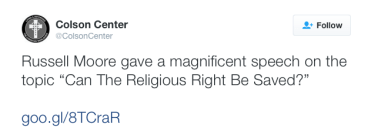
Tweet from the Colson Center

In this way, Moore’s conclusion was all the more jarring because it came from inside the camp of biblical and cultural conservatism. As he argued:

[The current political climate] did not give us this. This is a preexisting condition. The Religious Right turns out to be the people the Religious Right warned us about.

In response to all this, Rod Dreher addressed the question of whether Moore’s speech will change many minds within the old guard.

His answer—with which I agree—is a resounding “No.” That’s just not how these things work.

But in one sense, that point is irrelevant.

Because if Moore is right, the tectonic shift has already happened.

Time does not run backwards.

And for younger evangelicals, attempts to turn back the clock are likely to be about as effective as a robust argument that the world is flat.


[1] To modify Moore’s quote slightly, I would say, first, that many younger evangelicals do care about politics. They simply reject the preaching of partisanship  in place of Christ’s gospel. Likewise, many are frustrated that the old Religious Right has cared about some biblical values while ignoring others (See Moore’s comment about the voter guides which proclaimed a “biblical” position on term limits and the line item veto, but said nothing about racism and the abiding legacy of Jim Crow). Secondly, it may also be that Moore’s claims on the orthodoxy of younger evangelicals are a bit too rosy. My assumption on this point, however, is that his definition of what constitutes an “evangelical” means to exclude herterodoxy from the outset. Thus, he is not technically wrong here, despite the failure to mention the other side of the statistics.

The dazzling darkness

The dazzling darkness

~And Moses drew near unto the thick darkness where God was (Exod. 20.21).

“Apophaticism” is a strange word by any stretch of the imagination.

In theology, it refers to our inability to put God into speech. The true God is transcendent. He is mysterious. And because he is not an object in creation—like a beetle or a bag of marbles—all attempts to define and explain him exhaustively must fall short.

Like trying to pin a living tiger to the cardboard matting of one’s bug collection.

This is so, because, as T.S. Eliot wrote:

Words strain,

Crack and sometimes break, under the burden,

Under the tension, slip, slide, perish

So while we cannot do justice to what God IS, we can say some things about what God is NOT—while leaving space for mystery. This is apophasis.

As most acknowledge, this apophatic approach should be balanced by “cataphasis,” which refers to what can be said of God. This includes the reality that God is love, that he is holy, and many other things besides.

Yet while all these cataphatic claims are true, the apophatic tradition emphasizes that there are shadowlands as well—blank spaces on our maps. And at these points, our knowledge bumps against the veil of the infinite—or what Sarah Coakley of Cambridge calls “the dazzling darkness.”

I’ve been thinking of this recently because the Scottish Journal of Theology has just published an article of mine in which I engage with both Coakley and N.T. Wright regarding Paul, apophasis, the Holy Spirit, and the mystical tradition (see here).

I won’t attempt to duplicate that here, but I would like to ask a couple questions about the promise and the pitfalls of a more “apophatic” faith.  First, the promise.

THE PROMISE

One virtue of apophaticism is that some use of it is manifestly biblical.

Paul, for instance, glories in the fact that God’s judgments are “unsearchable,” and his paths “beyond tracing out.”

            Who has known the mind of the Lord?

Or who has been his counselor? (Rom. 11.34).

Beyond tracing.

This phrase strikes me, because while the inability to understand God often troubles us moderns, Paul sees it as a cause for worship (“To him be the glory forever!” [vs.36]).

One reason is that if you can “trace” your deity, you can be darn sure you’re worshiping an idol.

Idols are traceable; YHWH is not.

And this mystery is evident even in God’s clearest revelations.

Take Romans for instance. Here, Paul writes that:

since the creation of the world God’s invisible qualities—his eternal power and divine nature—have been clearly seen… (1.20).

The passage is clear that God has revealed himself through the created order: sunsets, supernovas, and the miracle of newborn life. The revelation is clearly seen. Yet note what is “seen”: God’s “invisible qualities.”

Can you describe for me what invisible qualities look like? Can you trace them? Please, draw me a picture of an invisible cat (*C.S. Lewis reference).

Perhaps the lesson here is that even amid the clarity of revelation, there is mystery and an overthrow of overreaching human intellect.

To acknowledge this seems important for those of us (read: me) who make a living talking and writing about God. There is a danger for me to pretend that I have “traced” the untraceable. And, once again, the biblical word for this is IDOLATRY.

At such points, apophasis can be helpful if I allow my pride to be pierced by what the Christian mystic Pseudo-Dionysius called “a ray of darkness.”

This is necessary, not just because of the great distance between God and I – but because of the great CLOSENESS. As the theologian Karen Kilby notes, our life “in” God makes it impossible to step back and view him from afar.

As Paul states in Acts 17: “In him we live and move and have our being.”

So in the same way that sitting inside a Boeing 747 makes it impossible to view the plane from a distance, so too our life in God makes “tracing” him impossible.

This, then, is the promise of apophaticism: (1) the piercing of our pride, and (2) a guard against idolatry.

What though about the pitfalls?

THE PITFALLS

When taken too far, however, apophasis may be a gateway drug to another A-word: agnosticism.

In my academic response to Coakley, I took issue (politely) with her description of the Christian life as “a love affair with a blank.”

Because while faith may sometimes feel like this (Eloi; Eloi…), Christians also believe that God has revealed himself in concrete ways: in the Scriptures, and most importantly, in Jesus Christ.

To forget this is to stand in the Areopagus of Acts 17 and bow down to that statue of “THE UNKNOWN GOD.”

In some cases, I suspect that the renewed interest in apophaticism (while helpful to a point) may be an academic attempt to avoid the uncomfortable clarity of Scripture at various points.

And when this happens, the “dazzling darkness” hides more pernicious spirits.

There is mystery, to be sure.

And there are “rays of darkness” that must pierce our prideful attempts to trace divinity.

But there are also rays of light.

Christ is the image of the invisible God. And to glimpse his character is to see the heart of the divine.

Why I’d rather lose my religious liberty than vote for Donald Trump

Why I’d rather lose my religious liberty than vote for Donald Trump

“When you’re a star, they let you do it. You can do anything.”

And while Donald Trump said this of women, it’s been more true of his relationship with the Religious Right.

In short, Donald Trump has treated the bride of Christ just like the other married women in that disgusting audio recording. Yet unlike more honorable brides, some evangelical leaders have done nothing to resist his self-serving advances.

This, indeed, is a profound mystery. But I am talking about Trump and the church.

prolifememe

To be honest, I thought I’d written my last post on this subject.

Then came the audio of Trump bragging about his sexual assaults. And yes, that is the proper word for it (You just “Grab them by the p—y; you can do anything!”).

So here we are. Once more unto the breach.

In past posts (for newcomers):

  • I lamented the fact that democracy gives you the candidates you deserve (here);
  • I predicted that despite playing coy initially, evangelicals would ultimately flock to Trump (here) like moths to an orange and hairspray-fueled flame.
  • And I argued that choosing the “lesser of two evils” is not always a rule to live by (here).
  • I’ve also made it clear, that I am no fan of Trump’s main opponent.
  • And I suggested (here) that, for me personally, focusing my voting energy on local and statewide issues is a solution to the high-stakes game of “Would you rather…?” that is the Presidential race.

Along slightly different lines, I also appreciated my pastor’s wise advice to think for yourself, to think biblically, and to vote accordingly.

This post, however, is about a different topic.

THE “RELIGIOUS LIBERTY” ARGUMENT

As many of my Christian friends more-or-less concede, Donald Trump is a lecherous braggart with no serious proposals, the temperament of a toddler, and a penchant for racism and misogyny.

But… they say… We still must vote for him, because if we don’t, we’ll lose our religious liberties. And that “trumps” everything.

I respect people who say this.

And indeed, one of the things I like about academics is that we often disagree (even in print), not because we dislike one another, but because critique brings clarity, and that helps us all.

In fact, amongst esteemed professors, the way you honor someone is to gather their friends from around the globe, and publically critique their work. 🙂

And while that may seem strange, there is something beautiful about it too, because it says that even severe disagreement need not sever friendship.

(Now back to the issue.)

THE GRAIN OF TRUTH

As best I can tell, the logic of the “religious liberty” argument runs as follows:

Christianity is under attack. And if we don’t elect this admittedly horrible person, we will face further marginalization in the future.

(Note: I toned down the prior sentence in the editing process. Originally, it read: “orange-tinted sexual predator,” but I will not say that. Many others are saying it. I will not.)

And to be honest, there are bits of the religious liberty narrative to which I’m somewhat sympathetic.

It concerns me that our culture has confused “tolerance” with “agreement” (see here). And there are some areas in which liberty has been eroded.

The problem, however, is not just that the threat is sometimes exaggerated.

The deeper issue is the assumption that Christians should publicly join themselves with truly horrible individuals (and ideas) in exchange for promised “favors.”

That’s not prophetic witness. It’s closer to prostitution.

THE EVANGELICAL FUTURE

And my fear, which is rapidly materializing, is that American evangelicalism will suffer permanent damage for its shameful part in Trump’s doomed and degenerate campaign.

Here are just a few:

  • We will increasingly be seen as a “White’s only” movement – and if you don’t believe that, just ask my black and Latino students.
  • We will increasingly be known as a misogynistic movement, which has been a concern already, given the way certain evangelicals have tried to keep women from serving in leadership roles.
  • And we will increasingly be an “over sixty” movement, because one needs only to look at the Stats to see that my own generation has little stomach for Trump, or for those who try to force us into supporting him in the name of Jesus.

White guys. Over sixty.

That is not the kingdom of God.

But it is in danger of becoming “American evangelicalism.”

MY PERSONAL OPINION

So what’s my personal answer to the religious liberty argument?

Here it is:

As a Christian, and a father of two girls, I would rather lose every shred of my religious freedom than align myself with this truly vile human being.

In fact, I would rather have Christianity assailed from without (by liberalism) than corrupted from within.

As history shows, we can survive being marginalized. We can even survive persecution (though the “p-word” is sometimes overused by the Religious Right).

But we cannot so easily survive brazen complicity with the worst elements of human behavior. Nor do we deserve to.

So, yes, I still care deeply about abortion, the supreme court, religious liberty, and everything else.

But as Christ’s bride, I will not be treated like that married woman who Trump took “furniture shopping” in an effort to buy her body.

I did try and f— her. She was married. And I moved on her very heavily.

Some things are more important than “furniture.”

And some things are more important than political favors.

That’s my opinion, and I’m sticking to it.


Now a brief addition to the original post to address a common critique:

I should probably clarify at this point, what I am NOT saying.  I am not saying (as some seem to think) that we, as Christians should simply “give away” our liberties or treat them lightly (Thus, the intentional use of the word “lose” instead of “give” in my admittedly hyperbolic title).

Since true liberties are given by God, they should not be encroached upon by anyone.  Period.  Nor should they be “given up” without right resistance. I’m not proposing that we stop caring about religious liberty–in fact, I explicitly state that I do care about it, and that there are areas of concern.

What I am saying is that the church should stay true to Christ and his values (which, for me, means saying “No” to both candidates). And if that means having to face further marginalization in the future, then we must face that also by staying true to Christ.

Nothing is gained by linking arms with a truly destructive and dangerous candidate simply because he promises certain favors to one particular group. In sum, I do not think this is a particularly controversial idea and there is ample precedent for it in the Scriptures.