“I Don’t Know”–Charles Kinsey, and the danger of our unknown motives

“I Don’t Know”–Charles Kinsey, and the danger of our unknown motives

“Why did you shoot me?” was the question Charles Kinsey asked of the Miami police officer standing over him.

The answer he received surprised him: “I don’t know.”

As you may know, Kinsey is a behavior therapist from Miami who works with autistic individuals. One of these, a young man, wandered away last week and sat down in the street. Kinsey attempted to retrieve him, and police arrived, called to the scene by someone reporting a man who looked suicidal, and who may have a gun.

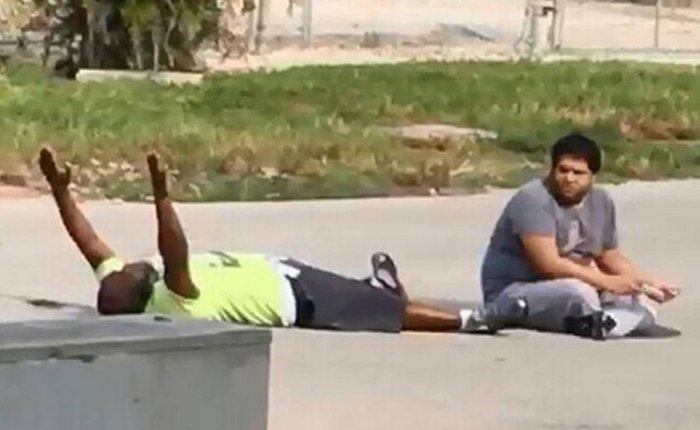
Kinsey explained to police that this was not the case, but to no avail. At the time that police fired, he was lying on his back, empty hands in the air, explaining loudly that the young man sitting next to him was autistic, that he was playing with a toy truck, and that Kinsey was his therapist.

All of this is clearly seen and heard on video (see here).

Kinsey begs officers not to shoot. He pleads with his client to stay calm. He continues to explain the situation, and he does everything imaginable to demonstrate that he is not a threat.

Well, perhaps not everything. He does not cease to be a black man.

Reports later showed that the police officer who shot Kinsey fired not once, but three times. Then after Kinsey was shot, he was handcuffed and laid out on the pavement for twenty minutes while bleeding from the bullet wound. Thankfully, he survived.

Later, when pressed about the incident, the police union claimed that the officer had shot Kinsey by mistake, while aiming at the unarmed autistic man, who they believed to have a gun. (This, despite clear audio of Kinsey explaining that it was a toy truck, and despite the fact that police then handcuffed the wounded/unarmed man (Kinsey) whom they were reportedly trying to “rescue”).

“I DON’T KNOW”

Much more could and should be said about this incident. Yet, surprisingly, this is not a post on racism and police misconduct, at least not exclusively.  (See here for that.)

For the record, my assumption is that most cops (indeed, the vast majority) perform their thankless jobs with honor, and that they deserve far better than the blanket blame that often dogs them. As I’ve said before, acknowledging real cases of police misconduct, should be a way of protecting good cops whose reputations are sullied by the actions of a few, and who are subject to cowardly acts of retribution.

In looking at this case, however, I want to focus on something few have covered: the odd RESPONSE to Charles Kinsey’s simple question: “Why did you shoot me?” Answer: “I don’t know.”

While some may read this explanation cynically (he and his lawyers had not settled on a “reason” yet), or skeptically (perhaps it never happened), I want to explore another possibility: Perhaps this strange response was honest. And perhaps—as the officer initially implied—he was genuinely baffled as to why he fired three times on an unarmed and fully compliant Good Samaritan.

If this is so, then maybe it says something important about the murky motives behind even our snap decisions.

“WE KNOW NOT WHY WE DO”

My proposal is this: In many cases, and especially under stress, humans do not make decisions by weighing the actual evidence. Especially when fear and conflict are involved, we simply react, and we do so based on a mental and emotional database of subconscious intuitions and assumptions.

And, while this gut-reaction, fight or flight reflex, may be life-saving if there is a lion in the bushes, it can be deadly to men like Charles Kinsey.

In truth, this proposal is not new. As best I can tell, it is corroborated by both psychology and brain science.[1] Here, the data suggests that in many cases, our subconscious mind makes decisions for us, and we may not even be aware of the real motives behind them. In short, we see what we have been conditioned to see by a wide variety of prior forces and (yes)prejudices.

Someone reported a gun.

There is a black man.

Is he lying?

That young man is not responding.

X X X

“Why did you shoot me?”

“I don’t know.”

To be clear, this does not excuse the officer for shooting Charles Kinsey. He should be held responsible.

Yet it may mean that all of us should pay more attention to the what is being fed into our subconscious, for as one psychologist notes (here), “that is the information that our brain uses to make decisions, before we even realize [that] we’ve made [them].”

BIBLICAL SUPPORT

In it’s own way, Scripture also supports this line of thinking.

In the book of Acts, a mob forms near Paul and company in the city of Ephesus. Things get tense, people see what they want, and by the end, Luke tells us that

“Some were shouting one thing, some another. [And get this…] Most of the people did not even know WHY they were there” (Acts 19.32).

Did you catch that last line?

Elsewhere, Scripture claims that the heart of fallen man is desperately wicked (this much should be obvious), yet the verse finishes like this: “who can know it?” (Jer. 17.9)

Note that the question is not “who can tame the wicked heart?” but rather “who can KNOW it?”

Sin has noetic side effects (Rom. 1.18). Perception is affected. And sometimes, even our full motives are unknown to us.

As the philosopher Ludwig Wittgenstein wrote:

“Nothing is so difficult as not deceiving yourself.”

This explains why one thing most all racists have in common is the belief that they are not racists. “Not me.  I don’t burn crosses.”

REDEMPTION

What then is the solution?

In the gospel, transformation comes not through the revamping of behavior, but through the “renewal of the mind” (Rom. 12.1). Thus repentance (meta-noia) is literally a turning of the nous (or mind) of the believer, so that it is conformed to the image of Christ (Rom. 8.29).

In short, even our subconscious must be reprogrammed by God’s grace, and by the careful searching of the Spirit. This may happen slowly, but it must happen, not just for people like the officer who fired on Charles Kinsey, but for all of us.

All of us must become more aware of the hidden assumptions, preconceptions, and prejudices that guide our thinking.

Lest the risen Jesus look down on us—as he did from the cross—and intercede once more: “Father forgive them, they know not WHY they do.”


[1] See C. S. Soon, M. Brass, H.J. Heinze, & J.D. Haynes, “Unconscious Determinants Of Free Decisions In The Human Brain,” Nature Neuroscience, 11:5 (2008), 543–5; J.L. Voss & K.A. Paller, “An electrophysiological signature of unconscious recognition memory” Nature Neuroscience, 12 (2009), 349-355.

Discipleship or Indoctrination: What’s the difference?

Discipleship or Indoctrination: What’s the difference?

What’s the difference between discipleship and indoctrination?

At several points, I’ve sat through sessions in which young people are being taught about the Christian worldview. Some have been quite good. Yet in others, I’ve had the following snippet of thought: “This is not discipleship; this is indoctrination.”

But what’s the difference?

In terms of literal meaning, there is nothing wrong with being brought “in” to certain doctrines (from the Latin, doctrina). That’s good. Yet words connote as well as denote. And “indoctrination” connotes negatively.

Here’s an incomplete attempt at a distinction:

  1. Discipleship embraces questions; indoctrination quashes them.

If you’ve ever read the Jesus story, you know how frequently he answers questions with more questions. This is not mere evasion, and it is not way a saying that there are no answers.  Instead, it is quintessentially Jewish and a method of discipleship.

I was reminded of this recently as I heard a quote by a Nobel laureate in physics, Isidor I. Rabi. He said that following:

Every mother in Brooklyn would ask [her child] after school: “So? Did you learn anything today?” But not my mother. She always asked me a different question. “Izzy,” she would say, “did you ask a good question today?”

Discipleship is fueled by good questions, while indoctrination gives rote answers. At its worst, it is an encouragement to flip happily to the back of the book and copy down conclusions that one has not worked through (and which may not even be correct).

Not all questions are benign (e.g., “Did God really say…?” [Gen. 3]), but that doesn’t mean that we can ignore or oversimplify them. That last bit brings me to the next point.

  1. Discipleship involves persuasion, not propaganda.

I sometimes ask my students: “What is propaganda?” In many cases, the response is vague, but often similar to that of the Supreme Court Justice Potter Stewart when defining pornography. He said, simply: “I know it when I see it.”

But do we always recognize our propoganda?

By my definition, propaganda presents a view of reality that is appealing but intentionally distorted. Indoctrination often does likewise.

Such slanted viewpoints are appealing, because we would like to simplify the complexities of life. Example: “Why don’t I have a job?” Donald Trump: “Mexicans. Obama. Everyone is stupid.”

For some, such caveman logic is appealing because it identifies clear “bad guys,” and then breaks problems into (sparsely punctuated) solutions. “Tarzan build wall.”

But while discipleship rejects religious propaganda, it must involve persuasion.

There is an objective. The goal is that people would be conformed to the image of Christ by the renewing of their minds. And this means tapping into emotion and desire. That’s not bad.

As Jonathan Edwards (1703–1758) famously put it:

I should think myself in the way of my duty, to raise the affections [emotions] of my hearers as high as I possibly can, provided … that [1] they are affected with nothing but truth, and [2] with affections that are not disagreeable to the nature of what they are affected with.

When this is done, we are in the realm of gospel persuasion (discipleship). But when the latter two shortcuts are taken, we slide into the bog of propaganda for the purpose of indoctrination. The ends do not justify the means.

  1. Discipleship requires dirty feet.

A few years ago, N.T. Wright wrote a fairly scathing critique of a book purporting to offer a “pilgrimage” approach to studying Jesus. Wright thought that the book did not engage enough with the ancient context of Jesus. Thus, as he put it:

“Real pilgrims would get their feet dirty on the dusty roads of ancient Palestine.” Yet what this book offered was a “pilgrimage by helicopter,” resulting in “pilgrims with suspiciously clean feet.”

Indoctrination often results in something similar:

“Disciples” with suspiciously clean feet. And that’s an oxymoron.

True discipleship happens in the midst of life, in all its messiness. It happens “on the way.” This does not mean, of course, that classroom learning is bad (I’m engaged in it). But it does mean that our “doctrines” must lead to engagement, and our theory must embrace praxis. If it doesn’t bring life to hurting people, then it is of little value.

In short: Discipleship requires dirty feet; indoctrination doesn’t.

Thus, to quote the Scriptures: “How beautiful are the [dirty] feet of those who bring good news” (Isa. 52.7; Rom. 10.15).

A CLOSING QUESTION:

So here’s a closing question: What are some further differences between discipleship and indoctrination?


Black and Blue: Race and Violence in the wake of Alton Sterling, Philando Castile, and the Dallas Massacre

Black and Blue: Race and Violence in the wake of Alton Sterling, Philando Castile, and the Dallas Massacre

How do you say something without adding to the noise?

Is it possible?

Over the past week, I’ve wanted to offer something redemptive in the wake of Alton Sterling, Philando Castile, and the massacre in Dallas.

“Don’t be silent,” many said. Yet my fear is to be like those who have nothing to say, but say it anyway.

Noise pervades.

And nuance is another casualty of violence. It seems to die alongside the victims.

Here, though, are a few half-formed thoughts:

  1. I need to listen. 

As a rural white kid, I know little of what it means to be black in America. That very obvious admission is an important step. Nor do I have experience in law enforcement. Given that, it would be wise for me to do some careful listening. We need to do that. While social media is a great place for “sounding off,” I wonder how much listening happens there. And as a white guy, I especially need to listen to the black community.

So here’s my most important point: While I am on vacation now, when I do return I’d like to sit down for lunch with some of my black friends and acquaintances. I need to listen—face to face—and I am ashamed to say I haven’t done that more. I’d also like to do that with some cops I know. It’s clear that we have a problem in this country, and my sense is that no solution will come until we actually hear each other, beyond the comment boxes.

Yet listening is not synonymous with silence, so here are a few more thoughts:

  1. It should not be difficult to decry BOTH senseless violence by police and senseless violence against cops.

A few weeks ago, I happened to see (again) the video of the Rodney King beating. It remains shocking. Here was a guy lying facedown (not resisting) while being clubbed almost to death after a traffic stop. It goes on and on.

Perhaps most shocking is then the remembrance that the officers were in fact acquitted of all wrongdoing. Go back and watch the video if that doesn’t shock you.

To be blunt, that’s why members of the black community find it difficult to “trust the investigation” after these events. They’ve seen that movie already. Literally.

So here’s my question: Why is it difficult to condemn THAT (what happened to King and certain other recent incidents) while also saying that most cops are decent people doing a difficult, dangerous, and thankless job?

Surely we can do both.

To prosecute bad cops is not to impugn police as a whole. It is not to say, monolithically, that cops are bad.

In the same way, to affirm that “black lives matter” and to admit that there is still a racial disparity in our justice system need not be “anti-police.” It may actually be pro-police, because for every Rodney King or Philando Castile, life gets more dangerous for the good and decent cops I know. And I don’t want that.

This is important: To decry police misconduct is itself a step toward protecting good cops, like those in Dallas who shielded protesters from bullets. It is actually part of what it means to be pro-cop.

  1. If you have a problem with the phrase “Black Lives Matter,” don’t read the Sermon on the Mount.

Some of my white friends have joined the ranks of those decrying the BLM slogan with the response that “All lives matter.” This is true. But it is also an adventure in missing the point. As Lecrae pointed out recently, it’s like angrily telling someone with lung cancer that “hey man, breast cancer matters too!” (see here.)

And for Christians especially, it is important to note that Christ’s most famous sermon does not say: “Blessed is everybody.”

Instead, Jesus goes out of his way to single out a marginalized minority from within a broader whole. Does God love everyone? Yes. Does everyone matter? Yes again. But Jesus still says, “Blessed are the poor … Blessed are the persecuted … Blessed are the meek.”

Christ exclusively and intentionally focuses upon smaller subsets of disenfranchised individuals inside a larger (blessed) populace.

I wonder how the ALM respondents would respond to Jesus’ sermon.

Would they tweet the following?

Actually Jesus, the rich and safe are blessed as well. Read Deuteronomy.

#AllLivesBlessed  #DivisiveRabbi 

One need not affirm every statement of the BLM organization in order to affirm that “Black Lives Matter.” (All organizations are mixed bags, including the police.) And to rigidly insist on “all lives matter,” in response to “black lives matter” is to display either ignorance or antipathy toward Jesus’ very way of preaching. 

  1. Violence is a feedback loop; only love can stop it.

Retributive violence is a feedback loop; it always grows and spreads.

Violence begets violence, begets violence, begets violence.

After the terrible massacre in Dallas, it became more difficult to deal with the lingering racial disparity in our criminal justice system. That retributive act (by a lone gunman) didn’t right the injustices done to Castile or Sterling. What it did was make the black community, and all of us, less safe. (My black friends know that.)

Because retributive violence almost always does this.

Thus again, the Sermon on the Mount:

“Blessed are the peacemakers” (Mt. 5.9).

CONCLUSIONS

In the end, there is no tidy solution to the racial divide within this country.

Reconciliation takes time and face to face relationships: barbecues, prayer meetings, hugs and handshakes.

And without question, the solution will come over dinner tables more than in the pixeled battlefield of cyberspace where all are bold and brilliant.

Remember that if you comment on this post. I’ll do likewise.


In Your Anger, Do Not Sin

In Your Anger, Do Not Sin

Question: How many of your best decisions have emerged from a fit of seething rage?

Last week, as I watched interviews with disgruntled BREXIT voters, a common theme emerged. Several had voted “Leave” as a way of expressing the anger of being left behind by their economy. They were upset, and perhaps for some good reasons.

Yet as the pound plummeted, markets dived, and the (potential) implications of the vote set in, some on the “winning” side expressed regret:

“It was simply a protest vote. I was angry. I felt like no one was listening, and I wanted to voice my frustration. I wish we could have a do-over.”

Comedians had a field day.

Despite the humor, this also brings up a serious point: Anger can be both warranted and dangerous. When we’re angry, we don’t think clearly. We throw off cost-benefit analysis, and sometimes, it comes back to bite us.

Thus the ancient words of Paul:

“In your anger, do not sin” (Eph. 4.26).

Or to paraphrase: “In your anger, don’t be stupid.”

WHY ANGER IS NEEDED

It is important, however, to note what Paul does not say. His command is not “Don’t be angry.”

Anger can be righteous and redemptive. Jesus got angry. And if things like hunger, racism, and gross incompetence don’t raise your ire, then there is something wrong with you.

When guided by the Spirit, anger can be the spark that lights the fuse of righteous action. Yet a controlled demolition of unjust structures is what’s needed, not a random bombing of anything in the vicinity. Anger (like TNT) is capable of both.

WHY ANGER IS NOT A VIRTUE

While anger jolts us out of apathy, it is not a virtue. If seen as one, then we end up assuming (wrongly) that the shrillest voice is that of wisdom. It is not.

Several commentators saw this phenomenon behind the rise of Donald Trump. While other candidates said: “I understand your anger,” Trump yelled “I am the angriest!” and then set out to show IN ALL CAPPS that he was the most fiery option on menu—a habanero amongst bell peppers; a boy amongst men. It worked. For awhile.

But few people enjoy an exclusive diet of habaneros for breakfast, lunch, and dinner. There are—how shall we put it—digestive repercussions. And the same is true with anger.

MY ANGER ISSUES

I wish I were immune from this.

I’m not.

This is “moving week” for us, which has involved one-hundred degree temps, inspectors who can find safety violations in a bar of soap, a moving company that suddenly does not have the truck we “reserved” (word used loosely), a scheduling mistake by PSO that delayed necessary repairs, and an electrician who turned out not to be licensed, leaving us with an expensive job that the city would not approve. Add to this three small children, a funeral message, a Sunday sermon, and (oh yeah) actually moving, and it was a volatile cocktail.[1]

All this came to a head as I worked to remove belongings from an attic that made Dante’s Inferno seem like a crisp fall day. “Why do we even have this [stuff]!?” I fumed. And instead of carrying said belongings down the stairs, I began to launch them through the attic opening as if I were manning the bomb bay in an old-time Flying Fortress. To complete the metaphor, several exploded.

It felt really good. Until I had to clean it up.

Sic semper ira.

Thus always with anger.

CONCLUSION


In sum, this post is simply a reiteration of the apostle Paul, said mostly to myself.

“In your anger, do not sin.” Also:

Realize that some things are not worth getting angry about.

Take a deep breath.

Don’t take things out on innocent bystanders.

And in your anger, don’t make a mess that takes far longer to cleanup than the one you were angry about in the first place.

Now, off to move more boxes…


[1] In truth, all these problems eventually worked out better than I could have hoped for. But in the moment, things were frustrating.

God of Immigrants: Three points for Christians to remember

God of Immigrants: Three points for Christians to remember

In some ways, the Bible is a chronicle of immigrants.

This is true from Adam to Abram, Moses to Mary, Jacob to Jesus.

The Scriptures record the sojourns of vulnerable families who set out from their native land in search of safety and provision.

This reality is even enshrined in a “creed” that the Israelites were to recite upon taking possession of the Promised Land.

When you have entered the land the Lord your God is giving you as an inheritance… Then you shall declare before the Lord your God: “My father was a wandering Aramean, and he went down into Egypt with a few people and lived there and became a great nation, powerful and numerous. But the Egyptians mistreated us and made us suffer, subjecting us to harsh labor. Then we cried out to the Lord, the God of our ancestors, and the Lord heard our voice and saw our misery, toil and oppression. So the Lord brought us out of Egypt with a mighty hand and an outstretched arm, with great terror and with signs and wonders… (Deut. 26.1, 5—8).

MY FATHER WAS A WANDERING IMMIGRANT

One reason for the recitation was to remind the people of their “rootless roots.”

They were not always planted in positions of security and dominance.

Their forefather (Jacob) had been a wandering immigrant in search of food and safety. And his own son (Joseph) had been trafficked to a foreign land.

Thus there was a call to treat later foreigners with hospitality.

“You shall not wrong or oppress a resident alien; for you were aliens in the land of Egypt” (Exod. 22.21).

“There shall be one law for the native and for the alien who resides among you.” (Exod. 12.49; Lev. 24.22).

“You shall not strip your vineyards bare…leave them for the poor and the alien” (Lev. 19.9–10; 23.22).

“When a foreigner resides among you in your land, do not mistreat them. The foreigner residing among you must be treated as your native-born. Love them as yourself, for you were foreigners in Egypt. I am the Lord your God” (Lev. 19.33–34; 24.22).

But what implications might this have for us today?

Spoiler alert: I don’t think it means that borders are meaningless and that all illegal immigration is okay.

THE DEBATE

As we know, immigration (both legal and illegal) remains a controversial subject.

Indeed, words like Trump, Syria, and “Brexit” now bear witness to this. (Incidentally, I have it on good authority that for every pun invented to describe an EU exit—a kitten dies. “Brussels pouts” killed untold thousands.)

But back to the topic.

Immigration issues are complex: national security, economic stability, fairness, race, religion, social services, the rule of law, and many more. And as always, both sides have sometimes oversimplified the conversation. With that in mind, there is no way that a brief blog post can do justice to the topic.

Given that, my goal is merely to set out three broad ideas that the American church must keep in mind amid the controversy.

  1. Commands to show hospitality to immigrants still apply to Christians.

While America is not ancient Israel, the Bible is clear that God wants his people to reach out in love and service to the immigrant and the foreigner. This much is non-negotiable. Jesus even says that to welcome the “stranger” is to welcome him. Thus a lack of love for the other may be a lack of love for Christ (Mt. 25).

  1. Care for immigrants does not mean endorsing all illegal immigration.

In addition to welcoming the foreigner, the Bible also calls Christians to respect the rule of law (e.g., Rom. 13; 1 Pet. 2). Thankfully, there are many legal ways to show love for immigrants, even if some are undocumented. Many churches lead citizenship classes, offer low-cost legal services, and host foreign language gatherings (see here).

As The Wesleyan Church states:

Immigration is an issue, but immigrants are people, and Christ’s love compels [us] to act as agents of Spirit-filled outreach and hospitality to all.

  1. Christians should embrace wise reform over (racist) rhetoric.

One thing that everyone admits is that U.S. immigration policy is broken. Change is needed. Yet wise reform is often impeded (on both sides) by rhetoric that is meant to score political points rather than address a complex issue.

In fairness, not all who call for a wall are being overtly racist. And it isn’t fair to say that those wanting to secure the border do so out of bigotry. Love and law need not be antithetical.

Still, there is often a not-so-subtle current of prejudice behind calls to “take back our country.” (Ironically, a phrase not usually uttered by Native Americans.) I know for a fact that my friends of other nationalities hear it this way.

For believers, the right attitude is that “our [true] citizenship is in heaven” (Php. 2) and that we ourselves are resident aliens (1 Pet. 1).

As Paul illustrates, “Christian racism” is a contradiction, an oxy-moron, and a failure to believe the gospel (e.g., Gal. 2.14). And when directed at immigrants, of whatever kind, it is a failure to remember one of the first “creeds” recited by God’s people:

“My father was a wandering Aramean…” (Deut. 26.5).

CONCLUSION

While these three points are too broad to offer specific solutions to many immigration issues, they may help Christians orient their hearts. And as Proverbs teaches, from the heart “flow springs of life” (Prov. 4.23).

First, say their names: A response to “the response” to Orlando

First, say their names: A response to “the response” to Orlando

“I think it’s important that you hear their names.”

Somehow, that was the line that finally broke me in the wake of the Orlando massacre. While others were discussing ISIS, weapons used, and the political implications, a reporter was slowly reading through a list of nearly fifty names, voice faltering, while adding information about each one.

  • Jean Carlos Mendez Perez (aged 35). He is remembered by his sister as a doting uncle, who loved to buy her children ice cream.
  • Brenda Lee Marquez McCool (aged 49). She loved to go dancing with her son. He survived.
  • Rodolfo Ayala-Ayala (aged 33). He worked at a blood donation center. “He’s alive in the lives that he saved,” said a co-worker.

For some of us,  hearing the names reminded us that this is about real people, not just politics.

A RESPONSE TO THE RESPONSE

So while there have been many responses to the shooting, this is not one of them.

It is not a response to what happened because I have no good response to that. It is a response to the response—and especially that on social media.

As Russell Moore notes (here), we used to be able to grieve together as a nation: Pearl Harbor, JFK’s assassination, and 9/11 were examples. We wept with those who wept (Rom. 12.15). And while there was some of that after Orlando, Moore is also right to say that

“the aftermath quickly turned into an excuse for social media wars.”

And as so often with such missive missiles, the minds of all combatants seemed made up so far in advance that the MEMEs had already been written. Indeed, in some cases, the bodies of the slain formed only minor speed bumps to be driven over on the way to making one’s point.

Whatever the debate, each side seemed clear on what this “proved”:

  • Guns: For some gun-lovers, the real problem was that victims themselves were unarmed. More guns in nightclubs; that’s how you fix mass-shootings. While for others, this showed that America’s firearm fixation is literally killing us.
  • Islam: For the new nationalists, this revealed that Trump was right in trying to ban all Muslim immigrants (never mind that the shooter was born here). While for the new atheists, this proved that religion itself is what “poisons everything.”
  • Homosexuality: For a handful of “Christians” (word used loosely), the problem seemed not so much the lives lost, but the ensuing support for the LGBT community. While for ardent secularists, this showed that all fervent “believers” (whatever the stripe) hate gays.

To be clear, I do not think that every point being made was invalid.

I even agree with several proposals on how to begin preventing the kind of shootings that happen in no other civilized country with this kind of stupid frequency.

But that is not what I want to talk about here.

WHAT WE’VE LOST

My observation is this: We seem to have lost the national ability to mourn PEOPLE, before making POLITICAL POINTS. And while some points matter, it is the people who are priceless.

In this case, bodies were still being pulled out Pulse nightclub when the pixeled pronouncements started flying. Donald Trump, for one, “mourned” as he does all things—by Tweeting—“I called it!” he crowed: “Appreciate the congrats for being right.”

You know, just like F.D.R. after Pearl Harbor.

Others were more thoughtful (which isn’t hard). Still, in many cases, as I went online last week, I couldn’t help but feel like there was something wrong with the insta-battles that broke out even before family members had been notified.

It was not always like this. Social media has changed things. And in this regard, for the worse.

FIRST, SAY THEIR NAMES

What then is my suggestion?

Hear this: I am not saying that those passionate about solutions should just stay silent. Not at all.

But I do think that before we venture into polemics, we should first do what a few thoughtful mourners did, and say their names. Weep with those who weep. Reach out to gay friends and family. Grieve with the grieving. Many people did this, and God bless them. (I especially appreciated this from the new Wesleyan General Superintendent Wayne Schmidt [here]; in fact, it was not a statement at all, but a prayer.)

To recount the names and faces of the fallen reminds us that they were real people, with real dreams, parents, siblings, friends, and children. They are not mere dead weight to be leveraged in the catapults that launch our online arguments.

Biblically speaking, the call to love and serve and grieve is not dependent (even one iota!) on whether the victims were gay or straight, liberal or conservative, Christian or atheist.

The imago Dei is the lone prerequisite.

So while we must seek solutions to such reckless acts of hatred, let’s not forget to weep with those who weep.

First, hear their names.  And perhaps that empathy may, in the end, lead us to work together to prevent such acts in the future.

Requiescat in pace.


Edward Sotomayor Jr., Stanley Almodovar III, Luis Omar Ocasio-Capo, Juan Ramon Guerrero, Eric Ivan Ortiz-Rivera, Peter O. Gonzalez-Cruz, Luis S. Vielma, Kimberly Morris, Eddie Jamoldroy Justice, Darryl Roman Burt II, Deonka Deidra Drayton, Alejandro Barrios Martinez, Anthony Luis Laureanodisla, Jean Carlos Mendez Perez, Franky Jimmy Dejesus Velazquez, Amanda Alvear, Martin Benitez Torres, Luis Daniel Wilson-Leon, Mercedez Marisol Flores, Xavier Emmanuel Serrano Rosado, Gilberto Ramon Silva Menendez, Simon Adrian Carrillo Fernandez, Oscar A Aracena-Montero, Enrique L. Rios, Jr., Miguel Angel Honorato, Javier Jorge-Reyes, Joel Rayon Paniagua, Jason Benjamin Josaphat, Cory James Connell, Juan P. Rivera Velazquez, Luis Daniel Conde, Shane Evan Tomlinson, Juan Chevez-Martinez, Jerald Arthur Wright, Leroy Valentin Fernandez, Tevin Eugene Crosby, Jonathan Antonio Camuy Vega, Jean C. Nives Rodriguez, Rodolfo Ayala-Ayala, Brenda Lee Marquez McCoo, Yilmary Rodriguez Solivan, Christopher Andrew Leinonen, Angel L. Candelario-Padro, Frank Hernandez, Paul Terrell Henry, Antonio Davon Brown, Christopher Joseph Sanfeliz, and Akyra Monet Murray.

Why the “wrong side of history” may be right (sometimes)

Why the “wrong side of history” may be right (sometimes)

Thanks to the folks over at Seedbed for publishing a piece that I was asked to write on the threat of being on “the wrong side of history.”

You can access that here.

Two brief snippets:

The gist of the “wrong side” argument is that in past centuries, great evils were defended in the name of God and tradition […] There is some truth in this of course. Great wrongs were, and continue to be, defended under the guise of “God’s will” and the oppressive cloak of tradition. Yet the meme is hardly absolute. And in many cases, it is simply wrong.


Here’s [another] problem: If history’s moral judgments are the unjust product of the victors’ power plays, then why trust them? If history is written by “those who have hanged heroes,” then perhaps the “wrong” side is actually closer to being right! Perhaps, as some suggest, justice lies more on history’s underside.

If this is so, then Christians have yet one more reason to discard the moral shaming of the “wrong side” argument.

For in a bit of beautiful irony, we believe that history’s crucified victim is also its great victor. The Lamb who was slain is seated on the throne, and his word is weightier than the shifting sands of public opinion. His verdict (not that of “history”) matters most.

The house of mourning: a post for those who grieve, in memory of Daniel Berg

The house of mourning: a post for those who grieve, in memory of Daniel Berg

One year ago, I stood next to the bed of my brother-in-law, and watched him die.

Daniel was only thirty: funny, young, and handsome. He was a loving husband to my youngest sister, who is perhaps the kindest and strongest person I know. They were still newlyweds.

Livi and Daniel

This death, and the terrible decline that preceded it, are the worst things I have ever witnessed. ALS is insidious. And despite endless ice buckets dumped on countless heads, no cure exists.

Daniel in couch

Watching Daniel die changed me. While I have no claim to the kind of grief borne by my sister and by his more immediate family, Daniel’s passing stole some measure of my innocence.

In movies, death is valorized and sanitized, but there is one thing the films get wrong: death’s color. On screen, the deceased look like they are merely sleeping. But Daniel did not look like that. While he died painlessly, I could not join others in kissing his face, holding his hands, or stroking his hair.

I just wanted to get out of there—to flee the room, avert my gaze, cover up his body—anything to escape the pallor that had replaced his former complexion. The image scarred me. I still see it.

As the theologian John Zizioulas writes:

“There is no greater contradiction than a dying being” (Being as Communion).

Death is an affront, or as Paul writes, an “enemy” (1 Cor. 15.26). It is an intruder in God’s good creation.

A GRADUATION FALSEHOOD

That is why I wriggled uncomfortably in my chair last month as I heard a graduation speaker (and pastor) affirm the words of the late Steve Jobs:

“Death is very likely the single best invention of Life. It is Life’s change agent. It clears out the old to make way for the new.”

This may sound nice at first, but when applied to actual people–a son or daughter, a spouse or friend–it is insulting and absurd.

Skubalon,” as Paul would say (Php. 3.8). Excrement.

It is wrong because it treats human beings like excess inventory at a used car lot: Act now! – older models must go! 

Skubalon.

Death is not Life’s best creation, and while Jobs said it, he did not actually believe it. If he had, he would not have fought so furiously (and valiantly) to fend off this great “invention.”

For those who mourn—and there are many—such platitudes don’t wash against the image of a departed loved one.

The bony hand of death cannot be manicured, bejeweled, and made pretty. It is always ugly, always cold, always an offense. True, we are often glad to know that a loved one is no longer suffering, and that they are “with Jesus.” But it is not death we celebrate; it is the cessation of pain, and their presence with God.

Death remains an enemy combatant.

A DOUBLE CRUELTY 

And then there are those left behind. For the bereaved, a double cruelty of death is that the wider world simply continues on as if nothing much has changed. A continent has been wiped off the map, and the cartographers have scarcely noticed.

“It’s as if they are erasing him,” my sister said once to me, amid the flood of paperwork to change her marital status, her mortgage listing, her tax information. But the people sending medical bills remembered.

This “double cruelty” is poignantly depicted in Anthony Doerr’s Pulitzer prize winning novel, All the Light we Cannot See. In a scene set in World War II, a young French girl stands in the empty room of a departed loved one:

[It] smells of peppermint, candle wax, six decades of loyalty. […] German sailors sing a drunken song in the street, and a house spider over the stove spins a new web every night, and to [her] this is a double cruelty: that everything else keeps living, that the spinning earth does not pause for even an instant in its trip around the sun.

Here, to quote a further line, God can seem like

“only a white cold eye, a quarter-moon, poised above the smoke, blinking, blinking, blinking, as [one] is gradually pounded into dust.”

Despair lurks.

BLESSED ARE THOSE WHO MOURN

The question then is this: Is there an alternative to these two dead ends? First, the delusional attempt to say that death is “life’s best invention.” And second, the lonely despair that finds no comfort.

Perhaps one alternative is a certain kind of grief.

As Paul said, “we do not grieve like those who have no hope” (1 Thess. 4.13). But we do grieve. And that is for the best.

As Nicholas Wolterstorff states in a tribute to a son who died:

“Grief is existential testimony to the worth of the one loved. That worth abides” (Lament for a Son).

Or as Tennyson writes:

            “Let love clasp Grief lest both be drowned” (In Memoriam A.H.H.).

Such words ring truer than false attempts to whitewash death as “Life’s best invention.”

DEATH BE NOT PROUD

Yet more is required to fend off despair.

We need not merely to grieve honestly, we need hope that death is not the end—that the “brief candle,” as Shakespeare called it, shall reignite and “run like sparks through the stubble” (Wis. 3.7).

Death is cocky after years of sway. Understandably.

Yet in the empty tomb of Jesus, there is a hint that “the blood-dimmed tide” (Yeats) has already turned, almost imperceptibly.

“Death, be not proud,” as Dunne wrote, “though some have called thee.”

“One short sleep past, we wake eternally

And death shall be no more; Death, thou shalt die.”

THE EMPTY TOMB

In the months after Daniel’s death, I had a chance to visit Israel with my sister (his widow) and my father. Daniel had always wanted to go. We stood together in the empty garden tomb at Gordon’s Calvary, and cried, and smiled.

emptytomb

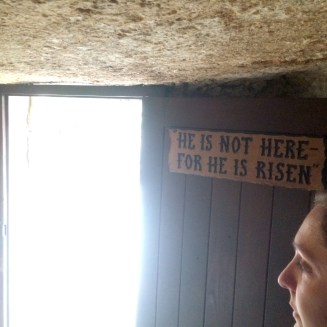
Inside, a simple wooden sign reads: “He is not here – he is risen.”

And behind those words, I heard those of Francis Spufford:

“More can be mended than you know.”

For those who mourn as Christians, that hope provides a balance to the bitterness of death. Some sweet wine mixed with the gall. It does not take away the sting of death, but it allows us to walk on, limping. And that limp, like Jacob’s (Gen. 32), is evidence that we have been touched by someone real, someone good, someone eternal.

So if you grieve today, hear these final words of Kate Braestrup:

“Walk fearlessly into the house of mourning; for grief is just Love squaring up to its oldest enemy. And after all these mortal human years, Love is up to the challenge.”

Not here

~In loving memory of Daniel Berg.


Why choosing “the lesser of two evils” is not always a rule to live by

Why choosing “the lesser of two evils” is not always a rule to live by

Last week, I predicted (here) that an increasing number of “evangelical leaders” would begin endorsing a certain Republican presidential candidate, especially after a scheduled “meet-cute” slated for June.

I also lamented this.

To be honest, I don’t like posting on such topics, primarily because discussing politics on the internet is about as promising as trusting your three-year-old with your stock portfolio (Why do we own four hundred shares of Dora the Explorer, Inc.!?).

Still, I feel enough of an obligation to distance the gospel of Jesus from the gospel of Trump that I’m willing to deal with the inevitable fallout. All things being equal, I’d happily write a similar post on Trump’s likely opponent. But it’s not necessary. The number of evangelicals rushing to join the family Clinton is similar those rushing to join the family Manson. Roughly.

THE CRITIQUE

In regard to all the comments, both positive and critical, the most common critique (by far) ran basically as follows:

Jesus isn’t running, so we must choose “the lesser of two evils.”

Because this point was made by many different people, I thought that it deserved a respectful response.

THE “LOTE” (LESSER OF TWO EVILS) 

Since I agree with the first claim (“Jesus isn’t running”), I’m only going to examine the logic of the second part (“In elections, we must choose between the lesser of two evils”).

And I do mean logic. Given this, I will intentionally avoid all mention of particular candidates: No Trump, Hillary, Bush, Bernie, or Adolf Hitler references allowed. Hallelujah. I’m only examining the premise.

Here’s my thesis:

While choosing the “lesser of two evils” (or: LOTE) may often be warranted, it is not always so.

Thus, it is not an “axiom” to live by.

To clarify, an axiom is a statement regarded as being established or self-evidently true.

The LOTE argument is not an axiom, because it is very far from being self-evident. And for Christians especially, there are instances in which it may be especially problematic.

But let’s start with the obvious.

THE OBVIOUS

The fact is that choosing the better of two imperfect options often makes great sense.

To use a ridiculous example: Let’s say you commit a terrible crime and the judge gives you a choice of punishment: “For the next week, you must either listen to non-stop Nickelback, or watch non-stop episodes of PBS’s Caillou.” (If you have kids [or ears], you know the terror of this verdict.) And in this scenario, you should try to choose the lesser of two evils.

I also agree that a LOTE vote often makes good sense. It has even been my own approach.

It’s not inherently wrong; it’s just not always right. So it’s not an axiom.

Here’s why: The following are three instances in which it may be wise to set aside LOTE logic.

1. WHEN YOU REACH YOUR “GAG THRESHOLD”

Personally, I begin re-thinking the LOTE mentality when the two major options presented to me make me feel physically ill. Like: I-need-to-go-lay-down-now ill. Let’s call this “the gag threshold.” Of course, some things that disgust me may not bother you at all. You may like beef in your seven layer desserts (Friends reference). I do not.

In elections, I can easily vote for someone that I disagree with on a variety of issues, especially if I perceive them to be the slightly better option. But once both major choices cross far beyond my gag threshold, I jump off the LOTE boat like it’s the Titanic.

In such cases, choosing either one feels dirty and complicit, as if one is siding with ideas that are base, inane, or dangerous.

I think most people know this. We just have different gag thresholds. If the general election came down to Vader versus Voldemort, I’m joining the dark side just because one might technically be worse (#GryffindorForever).

The gag threshold is the first sign that one may look beyond the LOTE.

2. WHEN IT’S UNCLEAR WHO’S WORSE

A second problem for the LOTE axiom is the assumption that one always knows the lesser evil. In some cases, I don’t. And in others, I think I do, but I am probably wrong.

As someone asked me recently: “How does it feel to be wrong?”

Answer: “It feels exactly like you’re right.”

As an axiom, the LOTE approach may presume infallible knowledge of the future, and I don’t have that.

3. WHEN THERE ARE MORE THAN JUST TWO OPTIONS

A third and final problem for the LOTE rule is the idea that there are always and only two options in a given election.

In fact, there’s no rule requiring you to vote for either the Republican or the Democratic nominee in order to be a responsible citizen. Vote for whomever you want. Especially if you’ve reached your “gag threshold” (point one), or if it’s not clear (to you at least) which candidate is actually worse (point two).

Now for the likely objections:

“But I want my vote to count!”

Good news: your vote counts for the same amount regardless. You have one vote (Unless you lived in Chicago in 1960).

Now, if what you really mean is “I want my vote to determine the outcome,” then there’s bad news: your vote has probably never counted, and it probably never will.

“But if I don’t vote for A, it might as well be a vote for B.”

Not exactly. This claim has rhetorical force, but it’s logical nonsense. Strictly speaking, no one takes all the votes for Mickey Mouse and adds them to the total for the Republican or Democratic nominee. Choosing “A” is the same as choosing “A”; choosing “C” is not.

Also, one reason for not always following one’s usual party affiliation is to demonstrate that you will not simply rubber stamp whomever they set forth simply because “the other side” might win. If that mentality wins out, then parties are not held accountable.

“But I want to vote for someone who can actually win.”

Why? Since when is “voting for the winner” a core value in democracy? And when did Jesus ever say: “Blessed are the winners”? That sounds like someone else.

Betting on the winner makes great sense at a dog track, but you don’t get points for it in elections. If you’ve reached your gag threshold, or if it’s not clear who’s worse, then what do you gain from (possibly) siding with the winning candidate? What you might lose is credibility if your candidate proves to be a “Vader-mort.”

To paraphrase the great Atticus Finch says in To Kill a Mockingbird,

Sometimes [conviction] is when you know you’re licked before you begin, but you … see it through no matter what.

CONCLUSION

In sum, I’m thankful for all the interaction on my prior post.  And I completely agree that there is often nothing wrong with trying to choose the better of two imperfect options.

It may be wise.

But it doesn’t automatically make good sense.

And if a day comes when the two major choices make death by Nickelback or Caillou seem desirable, then one is free to look for other options.

Why I won’t be attending the evangelical “meet-cute” with Donald Trump (even though I wasn’t asked to)

Why I won’t be attending the evangelical “meet-cute” with Donald Trump (even though I wasn’t asked to)

Last week, it was announced that a veritable troop of “evangelical leaders” has been invited to a closed-door meeting with Donald Trump. The reason, according to Tony Perkins, is to “have a conversation that could lead to a better understanding of what Trump has to offer the country.”

Sadly, I will not attend.

Trump Bible

One reason is that I was not invited. That part is understandable. I am not that important. Then again, my absence is probably for the best. Because unlike Perkins, I have seen quite enough of what Mr. Trump “has to offer the country.”

But aside from not being invited, and not needing more info on what Mr. Trump is “offering,” I also have a third reason for not attending:

I know a“meet-cute” when I see one.

And the outcome of this one feels, sadly, predictable.

What, you ask, is a meet-cute?

THE MEET-CUTE

According to Google—a trusted source for university professors like myself—a “meet-cute” is a scene from romantic comedies in which an odd couple (two people who would never normally see eye-to-eye) comes together through a zany encounter, and finds unexpected chemistry.

In this case, picture John Cusack from Serendipity, except older, orange, and with a comb-over that defies Newtonian physics. Burn that image in your mind. Meditate upon it. Selah.

And as for the meet-cute between Trump and evangelicals, the movie trailer writes itself. (Pro tip: Use that special movie trailer voice).

This summer:

They’re so different! He’s a foul-mouthed billionaire, with misogynistic tendencies, xenophobic tirades, and a penchant for conspiracy theories.

She’s a small town good girl who likes Chris Tomlin records, Beth Moore Bible studies, and has long since “kissed dating goodbye.” It should never work!

But then the unexpected happens. And as Paula Abdul told us, opposites attract.

Coming June 21st (since that’s the date of the meeting).

MY PREDICTION

All kidding aside, I can’t say for certain what will happen at this pow wow between Trump and evangelicals. Perhaps it’s just a chance to speak truth to power. Still, I do have an unfortunate prediction.

My guess is that in the weeks that follow, we should expect an increasing number of statements like the following from the “evangelical leaders” in this romantic tragedy:

While we’ve had differences with Mr. Trump in the past, we were very encouraged by our time together. He really listened to us! And we feel confident that our goals align in many areas.

In the end, this election is just too important for evangelicals to sit out. We must defeat Hillary Clinton in November. And that is why I am prepared to pledge my support to Donald J. Trump for Sultan, I mean, PRESIDENT of the United States.

Sincerely, Dr. Faustus.

Or as a clever cartoonist captioned recently, the revised baptismal declaration runs as follows:

“Do you renounce Satan and all his works?”

“I do. But I’ll still support him if he’s the nominee.”

I’m having a bit of fun with this, but the prediction about more evangelicals endorsing Trump (after the meet-cute of course) is serious. And I hope I’m wrong.

IF I WERE ATTENDING

But since I’m not attending, there are a few things that I would like someone to have a “conversation” about. So if you were invited (Russell Moore; were they brave enough to invite you?), feel free to pass this along.

Or just tweet it.

I’m sure @realDonaldTrump will give a thoughtful response, per usual.

Here goes:

Mr. Trump,

You’ve been reported as saying that “Laziness is a trait in blacks.”[1] Did you mean to include Mexicans in that? Or do you see them as hard working “rapists” and “murderers”?

And about your theology: You brag frequently (as only you can) about your Christian faith. Jerry Falwell Jr. even likened you to Jesus! That’s huge Mr. Trump. Jesus is like the Steve Jobs of the evangelical org chart. I know, I know, you prefer Messiahs who didn’t get captured, but still, take it as a compliment.

Anyway, given all that Christian fervor, Mr. Trump, how is it that you claim NEVER to have asked God for forgiveness? Not even once!? That’s impressive. Maybe you are more Christ-like than even Mr. Falwell thinks. (He can ask you for forgiveness later.)

And what more shall I say? For time would fail me to tell of the misogyny, the vulgarity, the extramarital affairs, the over-the-top boasting of sexual prowess, the recent and vocal support for things like abortion, Planned Parenthood, and, oh yeah, Hillary Clinton (as late as 2012).

Then there’s the way you repeatedly misspell the word “White” in your campaign slogan (Seriously, “G-R-E-A-T” isn’t even close, but I guess spellcheck wouldn’t catch that). And the way you repeatedly incite supporters to acts of violence in exchange for legal fees. Classy stuff. Very Christian.

512px-maga-svg

I could go on and on.

But I realize now another reason why I was not invited to the evangelical meet-cute:

I would totally kill the When-Harry-Met-Sally buzz.

CONCLUSION

In closing, I must clarify that this post is not a veiled attempt to support Mr. Trump’s opponent come November. I’m sure that will be the pushback, but it doesn’t fly. Because fears of “the alternative” do not justify complicity with the kind of shameful nonsense detailed above. And endorsements equal complicity.

Likewise, I do not begrudge anyone for attending the meet-cute. I hope they do. (Especially folks like Russell Moore; we need them there.) And I hope they tell Trump, more graciously than I have, why they can’t support him.

But that hope does not change my above prediction.

Whatever happens, one point stands supreme: As Christians, we must remember that the Kingdom of God—and not some partisan loyalty—is our true political affiliation.

Lordship is a political concept after all–and we follow the Lamb. Not the Elephant. Not the Donkey. Certainly not the Donald.

So while many evangelicals may be swayed by the caviar and cocktails (er…, iced tea) at the upcoming meet-cute, I will not be.

And not just because I’m not invited.

Vicit Agnus noster; eum sequamur.


[1] Unlike all other quotes in this post, this one alone cannot be corroborated with video evidence (hence the qualifier, “You’ve been reported as saying”). The quote comes from the former president of the Trump Plaza Hotel, John R. O’Donnell, in a Trump biography. When asked about the allegations, Trump did not deny them, saying that “The stuff O’Donnell wrote about me is probably true. The guy’s a f*#king loser.” This acknowledgement came in Trump’s 1999 interview with Playboy. Again, all very classy.