Something more than civilization

Something more than civilization

In-keeping with my claim that reading is rereading, I spent an evening recently flipping through Alan Jacobs’ excellent book, The Year of our Lord 1943: Christian Humanism in an age of Crisis.

He notes how, in a time of total war, an assortment of Christian poets, novelists, and philosophers produced some of the most remarkable and enduring work of the century. The players include Jacques Maritain, W. H. Auden, C. S. Lewis, Simone Weil, and T. S. Eliot.

More interesting still was that these folks were neither pastors nor theologians, and they did not focus explicitly on current events (i.e., the latest headlines), though the geopolitical world was quite literally on fire.

Instead, they turned to the humanities and education—poetry, novels, philosophy, and habits of prayerful contemplation—as ways of rebuilding the ruins of a fallen civilization on a more robust foundation than merely the desire to “save” civilization.

Perhaps civilization has been imperiled, wrote C. S. Lewis in 1942, “by the fact that we have all made civilization our summum bonum [highest good]. And “Perhaps civilization will never be safe until we care for something else more than we care for it.”

Many of them also identified a malignant common thread between the likes of Hitler, Stalin, and even many within the allied powers: a technocracy of domination, devoid of humane religious and moral underpinnings.

As Auden wrote, in a paragraph on “techinique” and “temporal power,”

“What fascinates and terrifies us about the Roman Empire is not that it finally went smash but that . . . it managed to last for four centuries without creativity, warmth, or hope.”

Or Jacques Maritain in Education at the Crossroads:

Technology is good, as a means for the human spirit and for human ends. But technocracy, that is to say, technology so understood and so worshipped as to exclude any superior wisdom and any other understanding than that of calculable phenomena, leaves in human life nothing but relationships of force, or at best those of pleasure, and necessarily ends up in a philosophy of domination. A technocratic society is but a totalitarian one.”

Or C. S. Lewis:

“What we call Man’s power over Nature turns out to be a power exercised by some men over other men with Nature as its instrument.”

LESSONS FROM THE RUBBLE

Jacobs’ point is that each of these writers (despite deep differences and numerous blind spots) strove with astonishing energy—at what might seem the least convenient time—to throw a lifeline to their readers in the form of deeply literate and thoughtful form of Christianity, which was neither a withdrawal from the public square, nor a breathless regurgitation of political talking points. “I see no hope for the Church,” wrote C. S. Lewis, “if it allows itself to become just an echo for the press” (or government).

Thus, if one wants to learn what a faithful form of cultural rebuilding looks like, we would do well to consider their examples.

Here then are Jacobs’ concluding lines—which seem more needed now than ever:

“If ever again there arises a body of thinkers eager to renew Christian humanism they should take great pains to learn from those we have studied here”

SIGNS OF LIFE

I revisited the book, in part, because Jacobs just announced his coming retirement from the Honors College at Baylor University. Still, as he heads off to (hopefully) write more books, there are signs that small pockets of this kind of thoughtful and historically-rooted Christian education are beginning to bear fruit.

The work isn’t sexy, and it won’t garner headlines, but it is happening in small corners even now.

Case in point: This Spring, twelve students signed up to take an Honors College class with me on Dostoevsky and discipleship, as witnessed in his brilliant but difficult novel, The Brothers Karamazov. The students come from a host of majors—accounting, biology, ministry. Most don’t need the course to graduate, but they’ve been convinced, partly by my soapbox evangelism, that the way through life’s toughest questions is more likely to run through the Great Books than by machine-gunning prompts into Chat GPT.

Evidence 2: Last week, I drove down to Oklahoma Baptist University to learn from one of their Honors seminars in which college students meet at 8am each morning (roughly 4am “CST” [College Student Time]) to discussGreat Books from a Christian perspective. The class was excellent. Not a smartphone in sight. Books and notebooks open. Insightful conversation. It was led by a church history professor, and the program is overseen by Oklahoma’s former poet laureate, Ben Myers.

Evidence 3: As I thumbed through a catalogue of books due to come out soon on the topics of theology, the arts, and culture, it was striking to see how many of those authors had been shaped and trained (in some way) by what might be called the “Baylor pipeline” in which Alan Jacobs has served for years within their Honors College. I am under no illusions (whatsoever!) that Baylor is a perfect place. Still, at least one pocket there has become quiet but consequential hub of deep and humane Christian learning, tucked within a Big 12 school.

All that to say, take heart.

For in the words of Auden, though “our world” seems “Defenceless under the night,” still, “Ironic points of light / Flash out whereever the Just / Exchange their messages.” And so,

May I, composed like them
Of Eros and of dust,
Beleaguered by the same
Negation and despair,
Show an affirming flame


Hello friends. Please subscribe to these posts via the button on the home page to receive future posts by email. This is helpful since I’ve decided (mostly) to uncouple the blog from social media. I’m grateful for you. ~JM

When (not) to use AI: a Venn diagram

When (not) to use AI: a Venn diagram

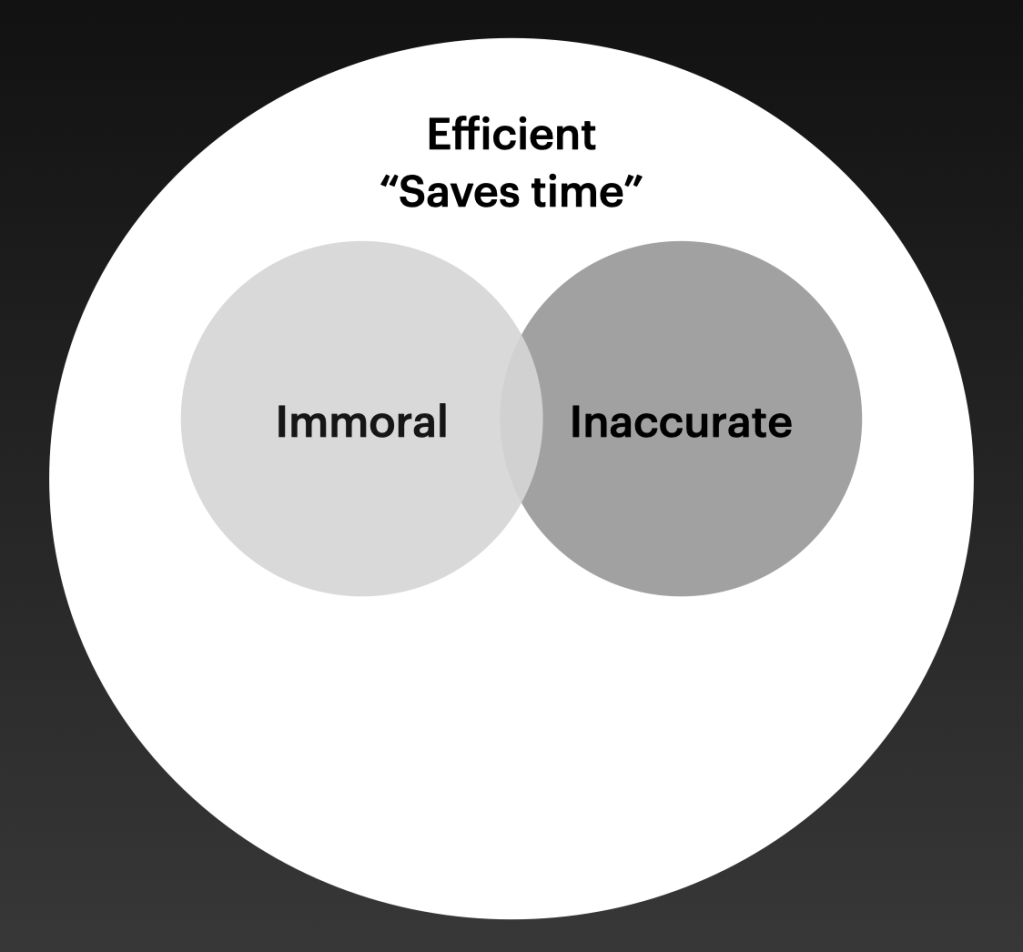
I created a Venn diagram recently to articulate when I think use of AI is ethical and when it’s not.

The smaller circles represent ways in which use of AI is problematic, while the remaining white space illustrates helpful ways in which one may utilize it to save time or accomplish meaningful tasks.

I want to be clear on two points: First, I do use programs like Chat GPT for some things. So I am not proposing a blanket rejection. And second, my focus here is almost exclusively on LLMs (Large Language Models) used to generate text and language. Thus, I am not interested in other ways that AI may be helpful, say, in coding, accounting, or other areas of life. My focus is on words.

My question is a simple one: When do programs like ChatGPT contribute to the good life, and when do they make me dumber, less personal, and less capable of being formed into a thoughtful and connected human being?

Let’s start with efficiency. As Jacques Ellul famously warned, the modern pull of “technique” tempts us to reduce every aspect of life—including relationships and spirituality—to a question of efficiency. In essence, if it saves time, do it.

Of course, efficiency may be a good thing. I do not ride a donkey to the office. I own a dishwasher. And I do not etch my writing on wax tablets. Broken, inefficient processes can be both frustrating and blameworthy. However, there are times when the modern idolatry of efficiency causes harm to others and ourselves.

Allow me to explain:

Circle #1: Efficient but Immoral: The most obvious way AI-use becomes unethical is when our drive to save time leads to immoral choices. Case in point: When I ask students not to use ChatGPT for a particular assignment (because I want them to think and grow by wrestling with ideas and words), to do it anyway is cheating. True, they may not get caught. But it is wrong nonetheless. Likewise, if my church expects me to write my own sermons (as they ought to… ), if I outsource an undo amount of that reflection to a robot, I am in the realm of immorality.

Frankly, many immoral decisions (whether robbing a bank or visiting a prostitute) are driven partly by our thirst for efficiency, which is to say, the drive to get something as fast as possible with the least amount of effort. And in these cases, the fact that it “saves time,” is hardly an excuse.

Circle #2: Efficient but inaccurate: A second problem with AI is the proliferation of falsehoods, inaccuracies, and other bogus depictions of reality. That’s because while programs like ChatGPT do a great job of producing grammatically correct sentences, they do not necessarily prioritize truth.

Hallucinations abound. And evidence is not hard to find: Sites like Google now prioritize bogus AI images of real animals, even when they look nothing like the actual creatures being searched.

LLMs invent sources that don’t exist, as attested by a friend of mine who was surprised to find his own name in footnotes, listed as the author of numerous academic works that don’t exist. And by some accounts, it’s going to get worse.

As Ted Gioia argues,

“Even OpenAI admits that users will notice ‘tasks where the performance gets worse’ in its latest generation chatbot. …

This isn’t a flaw in AI, but a limitation in the training materials. The highest quality training sources have already been exhausted—so AI is now learning from the worst possible inputs: Reddit posts, 4Chan, tweets, emails, and other garbage.

It’s going to get worse. Experts believe that AI will have used up all human-made training inputs by 2026. At that point, AI can learn from other bots, but this leads to a massive degradation in output quality.

In other words, AI will soon hit a brick wall—and face a dumbness crisis of epic proportions. That will happen around the same time that AI will have pervaded every sphere of society.

Are you worried? You should be.”

I can’t say whether all of this is accurate. But it further raises the specter of “the bogus” at a time when we are already drowning in it.

Circle #3: Efficient but impersonal: Now for the saddest (and weirdest) one.

As I watched the 2024 Olympics on Peacock with my kids, one of the commercials that ran on maddening repeat was the now infamous “Dear Sydney” ad for Google Gemini. The premise is bizarre. A dad asks AI to write a fan letter on behalf of his daughter to the American sprinter, Sydney McLaughlin-Levrone: “I’m pretty good with words,” he intones, “but this has to be just right.”

Responses to the ad were a mix of confusion coupled with a collective gag reflex. WHO IN THEIR RIGHT MIND WANTS AN AI-WRITTEN FAN LETTER!?? pretty much summed it up. Or in the words of Alexander Petri, that ad “makes me want to throw a sledgehammer into the television every time I see it.” After all, how do you possibly ruin the universally endearing act of a child authoring an imperfect but adorable note to her hero? Hey Gemini, can you help with that?

Google isn’t alone. I heard recently of a dad who asked ChatGPT to write the speech for his daughter’s wedding. And I personally received an 10-page email from a stranger, asking me to answer a list of questions about one of my books, The Mosaic of Atonement. For a small-time author, letters from readers can be encouraging (and sometimes not). But this one ended with an admission saying that it had been composed by AI. To be clear, the sender hadn’t bought the book. He hadn’t read the book. And he hadn’t even taken time to WRITE THE EMAIL he had sent me. Still, he wanted me to write a long response. (A friend suggested that I plug his 10-page email into ChatGPT and ask for a 10,000 word reply in Klingon.)

My claim for this third circle is simple: We should reject AI in instances where more genuine human interaction and personal attention is reasonably expected. That’s not every use of words (as when I asked ChatGPT to help me smooth out the legal jargon in an insurance claim after my car was totaled… [I repent of nothing!]), but it does require us to discern what parts of life cannot be delegated without a loss of love and human care. As L. M. Sacasas writes, “attention has moral implications.” (And that includes fan letters, sermons, and your daughter’s wedding speech.)

The potential cost is high: In addition to someone wanting to throw a sledgehammer at you, our epidemic of loneliness will continue to creep into domains normally immune to it. After all, as C. S. Lewis wrote, “We read to know that we are not alone.”

Circle #4: Efficient but infantilizing: For those who care about education and formation, this may be the most important circle. Admittedly, “infantilizing” is probably not the best word for it, but it speaks to the fact that education and discipleship are meant to move us toward maturity. And on that point, L. M. Sacasas seems right to note that the most important question to be asked of any technology is, “What kind of person will this make me?”

That is, how will this use of AI shape me?

In the humanities especially, to labor slowly over words, sources, and ideas is—without question—the best way to grow as a thinker and communicator. Believe me, the work is slow and often frustrating. But it changes you in ways that cannot be accomplished otherwise. Somewhere in his five million published words, Saint Augustine remarks that “people will never know how much I changed my mind by writing.” That sentiment resonates for me—in part, because I read and wrestled with it as I wrote a PhD on Augustine’s theology. That work changed me, tedious though it was.

In at least some cases, when we outsource the labor of thought and articulation, we move backward on the scale from Idiocracy to Augustine—which is a pretty fair diagnosis of many ills that currently afflict our cultural, political, and spiritual lives. (Let the reader understand.) The grammatically correct sentence is not the goal of writing. The goal is a well-formed and mature person.

In the words of Alan Noble, teachers must attempt to convey that

“the process of writing, when done well, is working magic in their minds, making them into better thinkers, better readers, better neighbors, better citizens. That writing will help them know themselves and others around them. But that writing will also take hard work, just as all good things take hard work. And to use AI to help with that hard work will rob their minds of all those good things. It would be like going to the gym to lift weights only to have someone come along and lift them for you. You’ll never grow stronger. You’ll never grow. You’ll only waste your time.”

Perhaps this case feels like a losing proposition. So be it. A final lie from the idol of efficiency is that only “successful” tasks are worth undertaking.

But for teachers and pastors especially, when it comes to the case for wisdom in our use of technology, the words of T. S. Eliot (in “East Coker”) still echo over the wasteland of soulless bureaucratic prose:

“For us, there is only the trying. The rest is not our business.”


For further reading on this topic, the folks cited in this post are excellent: Alan Noble, Ted Gioia, Alan Jacobs, and L. M. Sacasas.

Hello friends, thanks for reading. Please subscribe to receive future ones by email. This is especially valuable to me since I’ve decided not to promote the blog much on social media these days. I’m grateful for you. ~JM

Pale Rider

Pale Rider

“Wars and plagues are remembered differently.”

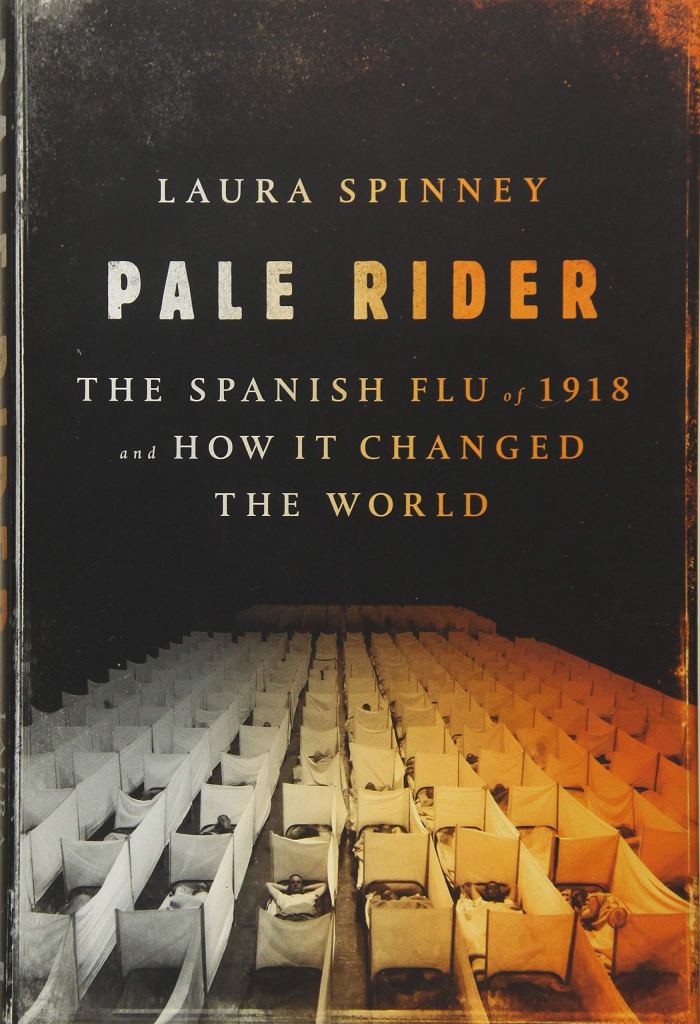
That’s one of the closing insights from Laura Spinney’s book, Pale Rider: The Spanish Flu of 1918 and How it Changed the World.

I read it recently to gain some perspective on COVID-19, and the upheaval that has accompanied it in 2020. (Quick note: Since Spinney’s book was published in 2017, it cannot be accused of rewriting history to provide commentary on our present crisis.)

Without a doubt, the two outbreaks—separated by a hundred years—are different. The Spanish Flu killed between 50 and 100 million people. And its occurrence on the heels of World War I made it a perfect storm of death and dissolution. In some cases, the flu finished off victims who were malnourished, riddled with tuberculosis, and without what we think of now as modern medicine.

The Spanish Flu also had a terrible “W-shaped” mortality curve, whereby it killed not only the very old and very young, but also a startling number of healthy young adults (28 years old was the peak of this curve, which may have something to do with the first flu virus these individuals were exposed to as children).

Undoubtedly, the two pandemics are not the same.

But there is something to be learned from the way history sometimes rhymes.

  1. Pandemics are social phenomena as much as medical ones

What Spinney means by this point is that the tumult caused by a plague goes far beyond the disease itself. Our ideologies show symptoms too.

And conspiracy theories spread as fast as the virus (see here).

In 1918, the Plandemic brain-worm took the form of a rumor that the Spanish Flu was manufactured by the German drug company Bayer—and distributed to Allied nations by way of aspirin packets.

In Washington D.C., newspapers printed the claim of Lieutenant Philip S. Dane, head of health and sanitation, when he asserted that the Germans had deliberately sown the flu in America to defeat us.

This was false, in part, because the leading theory now is that the Spanish Flu started near Fort Riley, Kansas. Patient zero was a corn-fed farm kid named Albert Gitchell who may have contracted the pestilence when it jumped from a duck, to a pig, to a human.

a God-fearing boy who had grown up on a farm and known no other life, unwittingly carried the virus into the American war machine, whence it was exported to the rest of the world (164).

  1. Masks and kids and empty stadiums

Like today, there was some controversy over use of masks in 1918.

In select cities, mask use probably cut the death toll in half. But the mayor of San Francisco faced a PR nightmare in 1918 when he was caught on camera with his mask dangling from one ear while watching an Armistice parade.

Some Christian ministers, like Father Bandeaux of New Orleans, protested the closing of churches in 1918. And in one case, packed worship services were held wherein dozens of parishioners were invited to come forward and kiss a single holy relic—the kiss of death, in some cases.

Footballers played to empty stadiums. And there was a bitter debate over whether children should return to school. New York’s health commissioner, Royal S. Copeland, was lambasted for allowing public education to continue, only to be vindicated when the flu was practically absent from the city’s school-age children that fall.

  1. Presidents, the poor, and pieces of a lung

In an echo of 2020, President Woodrow Wilson came down with a severe case of the flu while negotiating what became the treaty of Versailles. He raved with delirium and was, by some accounts, never the same after surviving it.

The president’s illness may have contributed to the disastrously harsh nature of the treaty. Apparently, Wilson’s sickness rendered him unable to fight for a more merciful arrangement (which he wanted), and which might have prevented the bitter rise of Hitler and the Third Reich.

Like in 2020, the poor were hit hardest. The death rate was lowest in developed countries like the United States and Australia. It was worst amongst populations that lacked proper sanitation, housing, water, and healthy food supplies.

In India alone, around 15 million people died.

Ninety percent of folks who got the Spanish flu experienced nothing worse than a bout of seasonal influenza—but in poor regions, and especially amongst indigenous populations like the Inuit of Alaska, the result was much worse. Entire villages were wiped out.

In one of these Alaskan mass graves, a San Francisco doctor embarked, in the 1990s, upon a controversial mission. He exhumed a body of a flu victim from the permafrost, packaged up her mostly frozen lung tissue, and shipped it off to researchers. Scientists then combined its genetic information with a lung sample from British soldier to resurrect the Spanish Flu.

After almost a century of lying frozen and dormant, the Spanish Flu is now alive and well in the CDC’s Level Four lab in Atlanta, Georgia.

CONCLUSION

What is the point of reading histories like Spinney’s Pale Rider?

One benefit is perspective. In the age of social media and Cable News myopia, we are beset by “presentism”—that’s Alan Jacobs’ word for what it means to drown in a deluge of constantly breaking information. Because there is SO MUCH information, many people commit an act of intellectual triage whereby we accept only those stories that confirm our pre-existing biases.

We are thus left in our silos of tribalism, anxiety, and the prison of the present tense.

History can’t solve all those problems, but it can grant perspective.

Wars and plagues are remembered differently.

So while six times as many Britons died of the Spanish Flu than in the trenches—we are only now beginning to read books like Pale Rider.


Click the green “Follow” button to never miss a post.

Want to support this blog? Here are some other things I’ve written:

Signup here to receive bonus content through my email Newsletter, “Serpents and Doves.”

Justice without mercy

Justice without mercy

“Excessive zeal for justice always becomes satanic.”

That line comes from Walter Wink’s landmark study of the demonic: Unmasking the Powers. His point is not to disparage our need for justice but to season it with mercy, lest “Lady J” transform into, simply, “the accuser” (ha satan).

“Justice” often turns, like sour milk, to vengeance.

A similar theme exists in this provocative claim by Alan Jacobs:

When a society rejects the Christian account of who we are, it doesn’t become less moralistic but far more so, because it retains an inchoate sense of justice but has no means of offering and receiving forgiveness.

The great moral crisis of our time is not, as many of my fellow Christians believe, sexual licentiousness, but rather vindictiveness.

Social media serve as crack for moralists: there’s no high like the high you get from punishing malefactors. But like every addiction, this one suffers from the inexorable law of diminishing returns. The mania for punishment will therefore get worse before it gets better.

I’ve written on this before (here); but a similar point has now been made by a third and final figure: the famous atheist/neuroscientist, Sam Harris.

In reference to a recent spate of social media mobs that have called for the names, addresses, and (practically) the firstborn children of perceived offenders, Harris laments the fact that our modern culture has lost its ability to forgive (or even hear the evidence) amid its fervor for “justice.”

“We have to have a way back,” said Harris in a recent interview, regarding how the social media mob descends on certain persons with seemingly no mercy and no possibility of repentance or forgiveness.

Is there a lesson here from these three statements?

If anything, it is that a thirst for “justice” is not always an unalloyed good. We need mercy too. And humility (Mic 6:8).


Interested in understanding the Big Story of the Bible? Check out my new book: “Long Story Short: the Bible in Six Simple Movements,” available with Video teachings to help church small groups.

Signup here to receive bonus content through my email Newsletter (“Serpents and Doves”).

I will not clog your inbox, and I will not share your email address.

But I deleted it

But I deleted it

I’ve been on a blogging hiatus lately as I’m been under a deadline to get a book manuscript polished up and sent back to the editor (Yes, Katya, I am working on it!).

But I took time last week to type up what I thought was a pithy response to a particular hot-button cultural issue that had been nagging me.

I wrote it; I rewrote it; and I even had some friends weigh in.

Then, after all that work, I deleted the whole thing. (Which was really hard because it had a corny joke about a “salvation” that is seen as coming sola Twittera–by social media alone.)

I won’t go into the details, but suffice it to say I had an inkling of discernment (which is all I ever have…) that the last thing the world needed was one more pontification on something that I actually don’t know very much about.

On that note, I’ve found the following eight insights helpful for those times that I am tempted to think that I must always open my mouth/keyboard.

These come from the evangelical-Anglican and Baylor English professor, Alan Jacobs.

In his words:

Going off half-cocked is now widely perceived as a virtue, and the disinclination to do so as a vice.

What ‘s more:

that poorly informed and probably inflammatory statement of [My] Incontrovertibly Correct Position must be on the internet . . . or it doesn’t count towards your treasury of merit.

But must I always weigh in on every hot-button issue?

As Jacobs reminds himself:

  1. I don’t have to say something just because everyone around me is.
  2. I don’t have to speak about things I know little or nothing about.
  3. I don’t have to speak about issues that will be totally forgotten in a few weeks or months by the people who at this moment are most strenuously demanding a response.
  4. I don’t have to spend my time in environments that press me to speak without knowledge.
  5. If I can bring to an issue heat, but no light, it is probably best that I remain silent.
  6. Private communication can be more valuable than public.
  7. Delayed communication, made when people have had time to think and to calm their emotions, is almost always more valuable than immediate reaction.
  8. Some conversations are be more meaningful and effective in living rooms, or at dinner tables, than in the middle of Main Street.

None of this means, of course, that I will stop writing on issues that matter–even when they’re considered controversial.  I come, after all, from a theological tradition (Wesleyanism) that refused to shut up on things like slavery and women’s rights, even they had been dubbed “too radical” for respectable Christians to weigh-in on.

So once I’m not buried under a book manuscript (which should be sometime in the next decade) I plan to keep thinking in public with what I hope is a mix of grace and truth–or at the least “grammar.”

And I hope other thoughtful people do too.

Still, it is freeing to recall occasionally that the world’s salvation does not come sola Twittera.  Or in my more long-winded case: sola blogos. 


Check out my new book (Long Story Short: the Bible in Six Simple Movements), now available at Seedbed.com.

Signup here to receive bonus content through my email Newsletter (“Serpents and Doves”).

I will not clog your inbox, and I will not share your email address.

Jeff Sessions and the “Whisky bottle Bible”

Jeff Sessions and the “Whisky bottle Bible”

ON THE DANGER OF MISUSING SCRIPTURE IN PUBLIC

In the words of Miss Maudie, from Harper Lee’s To Kill a Mockingbird: 

“Sometimes the Bible in hand of one man is worse than a whiskey bottle in the hand of [another].” 

And after the statements yesterday by Jeff Sessions and Sarah Sanders, we see why.

In response to the U.S.A.’s cruel and unnecessary practice of now separating even nursing babies from their undocumented mothers on the southern border, Sessions offered this gem of biblical interpretation:

I would cite you to the Apostle Paul and his clear and wise command in Romans 13, to obey the laws of the government because God has ordained them for the purpose of order.

Likewise, Sanders said:

I can say that it is very biblical to enforce the law. That is actually repeated a number of times throughout the Bible.

She then claimed that any inability to grasp this “biblical truth” was due to rank stupidity: “I know it’s hard for you to understand even short sentences, I guess.”

Well, I don’t know if I’m stupid.

But here’s a short sentence: “You’re wrong.”

And I don’t say that as some Lefty shill who opposes all border security [see here]. In fact, my point holds even if you agree with the abhorrent practice of forcing moms and dads to listen to the screams of their young children for no reason other than a kind of psychological torture.

WHAT SCRIPTURE ACTUALLY TEACHES

This post is about the meaning of the passage Sessions cited.

In fact, I happen to teach an entire course on the book from which it comes (Paul’s letter to the Romans), just in case he wants to audit it this fall.

What Romans 13 actually commands is not an obedience to (much less an endorsement of) to all governmental laws.  Rather, its call is that we “be subject” to the ruling authorities by giving “what you owe them.”

If you owe taxes, pay taxes; if revenue, then revenue; if respect, then respect; if honor, then honor (vs. 7).

Yet as Paul’s life shows, what you “owe” Caesar is not carte blanche obedience. That’s idolatry. (Another short sentence.)

In fact, by the implied “Bible-logic” of Sessions and Sanders, Pharaoh’s daughter should have drowned young Moses in the Nile; Israelite exiles should have bowed to the idol of Nebuchadnezzar, and the apostles should have stopped preaching when commanded by the “ruling authorities.”

“Obey the ruling authorities…”

THE “WHISKY BIBLE”

With a nod to “Miss Maudie,” this is precisely the kind of nonsense that results when you start quoting from your “whisky bottle Bible”—i.e., a sacred text that is decontextualized and twisted to affirm a sinful, partisan agenda.

And Romans 13 has a long history of such abuse.

It was used by Hitler and the German Christians; and it was leveraged to justify laws on slavery and segregation.

It bears noting, however, that Paul himself was eventually killed by the government for his annoying refusal to stop proclaiming a greater King named Jesus.

So let me say this in summation of Jeff Sessions’ exegesis: His reading is on par with the claim that “Speed Limit” signs are meant to regulate one’s daily dose of amphetamines.

And it’s not just me who thinks so  – even Franklin Graham, one of the President’s biggest mascots amongst religious leaders, has condemned the policy, calling it “disgraceful” (here).

NOT JUST A TRUMPIST PROBLEM

In truth, however, use of the “whisky Bible” is not unique to one political party—just as the separation of illegal immigrant families seems not to be entirely unique to the current administration, even though the practice has been codified and universalized by it. (Recall the famous picture of undocumented children caged up like dogs during the Obama years.)

All partisans (or rather: all Christians) have a tendency to hijack Scripture to serve our preconceived agendas.

On the Left, this happens (say) when passages on love and inclusion are taken to mean that particular moral absolutes are exchanged for a gospel of warm fuzzies. Or, more likely, when some forget that unborn children don’t deserve to be literally “ripped” from their mothers either.

“Whisky Bibles” come in a variety of flavors. And the tendency is to just play one off against the other. Southern comfort versus, uh…, whatever they drink in California.

Some Christians even swap out their favorite “tipsy” proof-texts depending on who’s in power at the time.

For example, it’s fascinating to see that the same crowd who was just three years ago shouting “We must obey God rather than man” (Acts 5.29) now cites Romans 13 as a divine endorsement of all governmental policies.

Could any sober person miss the irony?

A CALL TO DEEPER FAITH

One solution to such “drunken” interpretations is for Christians to be more deeply formed by the text we claim to believe. We need more than prooftexts plus a CableNews subscription.

Yet unfortunately, even amongst so-called “evangelicals,” such deep formation by the word of God is actually somewhat rare.

As Alan Jacobs writes (here):

The lesson to be drawn here is this: the great majority of Christians in America who call themselves evangelical are simply not formed by Christian teaching or the Christian scriptures. They are, rather, formed by the media they consume — or, more precisely, by the media that consume them.

The Bible is just too difficult, and when it’s not difficult it is terrifying. So many Christians simply act tribally, and when challenged to offer a Christian justification for their positions typically grope for a Bible verse or two, with no regard for its context or even its explicit meaning.

CONCLUSION

We must do better.

But it will require, in Luther’s words, that our “conscience [be] held captive to the word of God,” rather than the “boozy” whims of ill-informed and partisan prooftexting.


Like this post? Signup here to receive (free) bonus content through my “Serpents and Doves Newsletter.”

Each newsletter will contain material not available on the blog–including excerpts from forthcoming books, videos, and a chance to help me craft future content for both print and online publications.

I will not clog your inbox, and I will not share your email address.

Beware the “lumpers”!

Beware the “lumpers”!


If there’s one thing we could use now in our current state of cultural cannibalism, it’s the ability to do a bit less “lumping.”

(And, no, that’s not a reference to your mashed potato preferences.)

The term derives from Darwin, yet while Darwin used it biologically, Alan Jacobs—Christian author and English Lit professor—uses it to write (here) about our current state of public discourse.

Hint: it’s bad.

We live now, says Jacobs, in the golden age of “lumpers”—as evidenced by our tendency to reduce all those with whom we disagree to a monolithic and dismissive hashtag.

#cuckservative

#whiteprivilege

#RINO

#snowflake

On the one hand, some labels are necessary for human communication, and we can’t escape the use of shorthand. But as Jacobs notes, when we lump and label indiscriminately, we fail to actually think (not to mention “see” and “hear” each other).

In the words of George Orwell, in his essay: “Politics and the English Language”

When one watches some tired hack on the platform mechanically repeating the familiar phrases […] one often has a curious feeling that one is not watching a live human being but some kind of dummy.

And this is not altogether fanciful. A speaker who uses that kind of phraseology has gone some distance toward turning himself into a machine. The appropriate noises are coming out of his larynx, but his brain is not involved…

Thank God Orwell never lived to see the land of Twitter.

A CELEBRATION OF “SPLITTING”

But if lumping is a problem under certain circumstances, what is the alternative?

Jacobs calls it “splitting”—and he finds a beautiful example in a pioneer of women’s higher education: Dorothy Sayers (1893 – 1957).

Sayers was a committed Christian, one of the first women to graduate from Oxford, a brilliant writer of both fiction and nonfiction, and a friend of C.S. Lewis.

She was also a feminist, in the best sense of the word—desiring equality of opportunity for men and women.

In her view:

What is repugnant to every human being is to be reckoned always as a member of a class and not as an individual person.

Her point is not that it is bad to belong to a particular group—be it gendered, racial, or religious.  Nor is she claiming that such differences are mere “social constructs.” (She was not a so-called postmodernist.)

On the contrary, our places of belonging are important, and we shouldn’t pretend they don’t exist (Re: the ridiculous if well-intentioned: “I don’t see [skin] color.” Seriously; unless you have macular degeneration, don’t say that.)

It’s not wrong to recognize our differences and groupings.  But when we “lump” all members of a set together in dismissive ways, we often say things that erase one’s individual humanity.

Thus our Twitter and Facebook posts end up as some version of the following:

“God” (used either as curse-word or a prayer), “thank you that I am not like other people—robbers, evildoers, adulterers—or even like this [Liberal, Conservative, secular, fundamentalist, millennial, baby-boomer, Muslim, Trumpist, Social Justice Warrior].”

Depending on one’s in-group, the words within the brackets will vary, yet the commonality resides in a self-righteous “lumping” under dismissive labels that reduce the shared humanity of others.

Hence the title of Sayers’ provocative essay: “Are women human?” (here)

Now my favorite quote.

Drawing on her own experience as one of the first women to receive a degree from Oxford, she writes:

When the pioneers of university training for women demanded that women should be admitted to the universities, the cry went up at once: “Why should women want to know about Aristotle?”

The answer is not that all women would be better for knowing about Aristotle […] but simply: “What women want as a class is irrelevant. I want to know about Aristotle. 

I, eccentric individual that I am […] and I submit that there is nothing in my shape or bodily functions which need prevent my knowing about him

As Jacobs’ notes, there is a kind of “blessed selfishness to this cry.”  It is a celebration of the “eccentric individual” who doesn’t give a rip whether Aristotle is perceived as useful for her “class”!

In the words of the Roman poet Terence: Homo sum, humani nihil a me alienum puto.

“I am human, and nothing human is alien to me.”

Here, here!

Or as Jacobs concludes: “Let a billion eccentric individuals flourish.”

Even lumpers.


See here for Alan Jacob’s fantastic book, How to Think: A Survival Guide for a World at Odds – from which much of this post was proudly stolen…

Flee Roy Moore’s evangelicalism

Flee Roy Moore’s evangelicalism

But take the real “evangel” with you.

When I typed up a quick blog post yesterday, I did so assuming that Roy Moore was about to win the Alabama Senate seat.

I was wrong.

Thank God.

To some, that may sound rather strange.  After all, I am precisely the sort of person that was supposed to carry Judge Roy to victory: I am Pro-Life, white, and evangelical in my theology.

According to the media, I am supposed to belong to that very “base” that was going to make the difference–despite no fewer than nine allegations of sexually predatory behavior toward children.

And despite Moore’s claim that “many problems would be solved” if we scrapped all constitutional amendments after the 10th one (Just so we’re clear: the 13th ended slavery; the 15th gave all races the vote; and the 19th gave votes to women).

Well, I do not belong to that “evangelical base”–because, in some cases, there’s nothing evangelical about it.


REQUIUM FOR “EVANGELICAL”

As some news outlets have been quick to trumpet, Moore’s strongest support came from the self-styled “evangelical” voter.

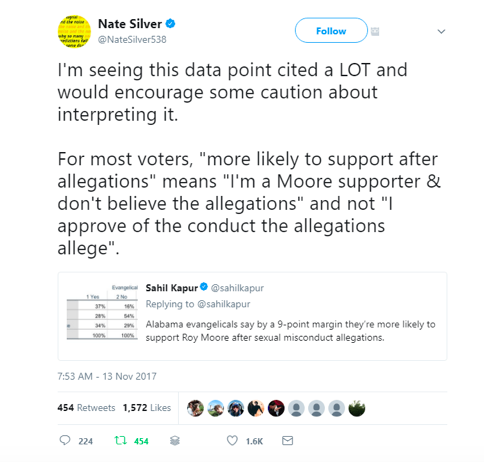
The most vexing evidence for such logic, came in a poll showing that a plurality of Alabama “evangelicals” reported being “more likely” to support him after numerous allegations of child sexual misconduct than before.

This left many of us scratching our heads.

Who could possibly be “more likely” to support someone “after” reports that he repeatedly stalked underage girls at the local mall while dressed like the cartoon sheriff from the movie Toy Story?

NOT SO FAST…

As many have pointed out, however, such polls should be viewed with suspicion (see here).

Screen Shot 2017-12-12 at 9.09.07 AM

According the Wheaton professor Alan Jacobs: In parts of the country, “evangelical” has become synonymous with “whites who watch Fox News and consider themselves [vaguely] religious”–regardless of church attendance, Bible reading, or basic theological beliefs.

And while I love those people, that is not what the word means.

Evang. venn diagram

In short, the label has been corrupted.

In Roy Moore’s case, it was equated with the worst elements of partisan politics—hence it hangs like an albatross around the neck of many faithful and devoted Christ-followers.

(For what it’s worth, it also hurts the Pro-Life movement in the long run–like making Bull Connor the face of your anti-human trafficking campaign.)

Yet while many of us grieve the (earned) destruction of the “evangelical” label, we also worry that to look back longingly at the smoking ruins is to risk being turned into a pillar of insipid salt.

What, then, should one do with this beautiful but now corrupted label?

THE YEAR IS 1955

It bears noting that in 1955, Billy Graham faced a similar decision.

He had once been a self-identifying “fundamentalist,” back when that word was not synonymous with backwardness and bigotry. In its origin, the term had stood for the fundamentals of the faith. As did Graham.

Yet in 1955, he decided to drop the albatross for reasons that sound eerily familiar: it had been irrevocably tainted by un-Christlike beliefs and behaviors.

Even good words can be turned it seems—like raw oysters in the Alabama sun.

So Graham followed Jesus – out of “fundamentalism” in order to stay true to Scripture and the gospel (the “evangel”).

Or as cowboy Roy might say: “When your horse dies, get off.”

HOPPING OFF THE PENDULUM

What one does next, however, is important.

The temptation for many is simply to flee one rival kingdom for another.

If Roy Moore’s “evangelicalism” has turned a blind eye to egregious sexual and racial sins, one simply runs hard in the opposite direction.  After all, as Justice Ruth Bader Ginsberg once remarked:

            The true symbol of the United States is not the bald eagle. It is the pendulum.

But what if…?

What if it is partly our love of pendulums that caused this very mess?

NOW FOR THE GOOD NEWS 

My suggestion, then, is rather different: flee Roy Moore’s evangelicalism, but take the real “evangel” (i.e., gospel) with you

Because the real “evangel” is alive and well.

Just don’t look for it primarily in the halls of power.

That’s the same mistake we’ve been making for two thousand years: we long for thrones and forget to check the manger.

“I sent you prophets,” says Christ, “but you wanted lobbyists.”

“I sent you shepherds, but you wanted merchants of outrage.”

If you want the real evangel, here is some advice:

Look to the local homeless shelter, where Christ’s hands and feet are serving dinner to the other (equally valuable) members of his body.

Look to the recovery ministry meeting nightly in the church basement, sans cufflinks and news coverage.

Look to the crisis pregnancy center, where women who’ve been there reach out to women who are there.

Look to the high school football star (John) who takes my college Bible class even though it won’t count for credit at his eventual State school–he takes it because he loves Jesus.

Look to the college women (that I know) who spend their Spring Break fighting human trafficking in a Southeast Asia, rather than partying on some sandy beach in Destin.

Look to the group of older Christian women (the godly grandmas) who gather to encourage my young wife with wisdom gained from generations of parenting.

Look to the African-American couple serving faithfully in a predominantly white church, because they believe that the journey toward multi-ethnic community is worth it, even if it’s difficult.

And look to the Catholic nun, kneeling peacefully in the cold rain outside an abortion clinic, praying for the souls inside (doctors, mothers, and babies).

This is the REAL “evangel.”

It’s alive and well.

And in that sense, I don’t give a flying flip what happens to the Roy Moore version.