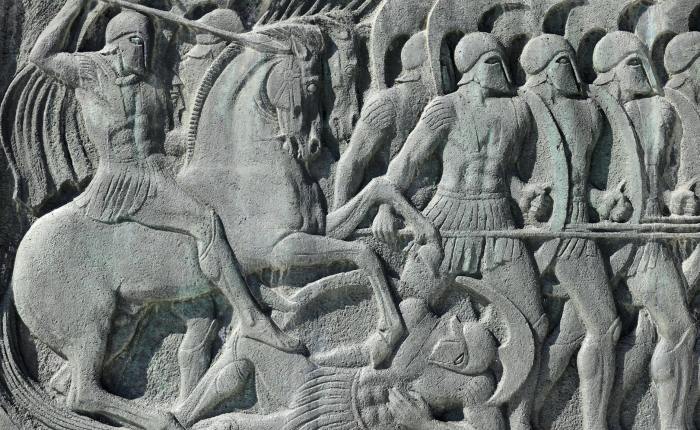
Battle for the dead (part 1)

Battle for the dead (part 1)

One of my summer reads this year was a slow journey through Homer’s Iliad—the great archetype of our war stories, action movies, and (in a way) superhero universes.

Among other insights, I was struck by how much of the fighting is focused not on killing an enemy or conquering a bit of ground, but on the furious desire to protect or desecrate a corpse.

The Iliad is, in many ways, a struggle for the dead–whether for the corpse of Sarpedon (mortal son of Zeus), Patroclus (intimate of Achilles), or Hector (favored son of Priam and champion of Troy).

“Human mortality is at the center of it all,” writes Emily Wilson. “I know no other narrative that evokes with such unflinching truthfulness the vulnerability of the human body.”

Yet unlike modern action movies, that bodily vulnerability (in the Iliad) is just getting started when one’s final breath departs through “the fence of teeth” (Book 9.529).

Shame and honor lie at the root of such concerns, as do ancient pagan assumptions about the requirement of proper funeral rites for a departed shade to enter Hades.

Unfortunately, countless other deaths occur in the attempt to secure the body of an enemy or comrade.

I’m interested in the point for several reasons:

  1. N. T. Wright points out that Homer functioned somewhat like the “Old Testament” for ancient pagan audiences, in a way roughly analogous to how the Hebrew Scriptures remained foundational for Christians.
  2. I agree with C. S. Lewis about the value of old books to reveal our modern blind spots, not because they are infallible, but because they do not share our unexamined assumptions.
  3. I’m convinced many well-meaning Christians lack a proper view of the body both before and after death. Thus, reflecting on this subject in the Iliad (alongside Scripture) might actually make us more faithful Christians.

In Homer’s story, the struggle for the dead happens in at least three ways: (i.) corpse care, (ii.) desecration, (iii.) divine intervention to stave off decay.

CORPSE CARE

The importance of proper corpse care is demonstrated by Achilles, as he sets out to wash and rub with olive oil the body of his dear friend Patroclus, and to fill his wounds with ointment (18.438).

Though Achilles feels compelled to avenge his comrade, he cannot bear the thought of what may happen to the body in his absence:

I am still most terribly afraid for brave Patroclus

Whose body has been hacked with so much bronze.
Flies may get in his wounds and worms may grow there,
Dishonoring his corpse. His life is gone,
And now his flesh may rot (19.30-36).

The mirror of this heartrending concern is found in Priam, who ultimately sneaks behind Greek lines to plead with Achilles for the body of his beloved son, Hector.

In that meeting, “They both remembered those whom they had lost.” And “Curled in a ball beside Achilles’ feet, Priam sobbed desperately,” in a fatherly move that finally breaks the callous wrath of his adversary (24.631–35).

DESECRATION

The desire to care for the bodies of friends and family is matched by an unholy drive to desecrate the corpses of one’s enemies.

Achilles exceeds all others in this impiety, for which the deathless gods are furious with him (24.146), since he does not stop at merely killing foes or stripping their armor, but commits abominations on their corpses.

In the final battle between Achilles and Hector, the matter of who will win is never in doubt. The only question, even for Hector, is what Achilles will do to his corpse.

Despite pleas from his dying adversary, Achilles proclaims:

If only I had will and heart to do it
I would carve up your flesh and eat it raw […]

No one can save your body from the dogs,
not even if they bring me as a ransom
ten times or twenty times the usual rate (22.465-70).

True to his word, Achilles then commits “shameful atrocities on noble Hector,” piercing the tendons behind both his feet (#foreshadowing) and dragging him behind his chariot. Upon finishing his circuits ‘round the body of Patroclus, Achilles leaves Hector’s corpse face down in the dirt—unburied, unreturned, and yet (incredibly…) undecayed.

This brings us to the last point.

MIRACULOUS INTERVENTION

It would not be Homer if the gods did not intervene.

In each case (Sarpedon, Patroclus, Hector), divinities step in not to save or resurrect the warriors, but to preserve their corpses:

even now in death, Apollo pitied
Hector, and kept his body free from taint
He wrapped a golden cape, an aegis, round him,
To ensure the dragging never scratched his skin (24.24-27).

Though Hector’s body has been abused and left unburied for twelve days, still “dewy-fresh he lies”; and his many wounds “are quite closed up” (24.520).

Despite violent death outside the city gates, Apollo will not allow his holy one to see decay.

A father intervenes, a trip is made to the one responsible for his death, and a brave plea is made for the body.

Now what does that sound like?

In the next post I’ll unpack why this still matters.


Hello friends. Please subscribe on the homepage to receive these posts by email. This is especially helpful since I’ve decided (mostly) to uncouple the blog from social media. Thanks for reading. ~JM

Something more than civilization

Something more than civilization

In-keeping with my claim that reading is rereading, I spent an evening recently flipping through Alan Jacobs’ excellent book, The Year of our Lord 1943: Christian Humanism in an age of Crisis.

He notes how, in a time of total war, an assortment of Christian poets, novelists, and philosophers produced some of the most remarkable and enduring work of the century. The players include Jacques Maritain, W. H. Auden, C. S. Lewis, Simone Weil, and T. S. Eliot.

More interesting still was that these folks were neither pastors nor theologians, and they did not focus explicitly on current events (i.e., the latest headlines), though the geopolitical world was quite literally on fire.

Instead, they turned to the humanities and education—poetry, novels, philosophy, and habits of prayerful contemplation—as ways of rebuilding the ruins of a fallen civilization on a more robust foundation than merely the desire to “save” civilization.

Perhaps civilization has been imperiled, wrote C. S. Lewis in 1942, “by the fact that we have all made civilization our summum bonum [highest good]. And “Perhaps civilization will never be safe until we care for something else more than we care for it.”

Many of them also identified a malignant common thread between the likes of Hitler, Stalin, and even many within the allied powers: a technocracy of domination, devoid of humane religious and moral underpinnings.

As Auden wrote, in a paragraph on “techinique” and “temporal power,”

“What fascinates and terrifies us about the Roman Empire is not that it finally went smash but that . . . it managed to last for four centuries without creativity, warmth, or hope.”

Or Jacques Maritain in Education at the Crossroads:

Technology is good, as a means for the human spirit and for human ends. But technocracy, that is to say, technology so understood and so worshipped as to exclude any superior wisdom and any other understanding than that of calculable phenomena, leaves in human life nothing but relationships of force, or at best those of pleasure, and necessarily ends up in a philosophy of domination. A technocratic society is but a totalitarian one.”

Or C. S. Lewis:

“What we call Man’s power over Nature turns out to be a power exercised by some men over other men with Nature as its instrument.”

LESSONS FROM THE RUBBLE

Jacobs’ point is that each of these writers (despite deep differences and numerous blind spots) strove with astonishing energy—at what might seem the least convenient time—to throw a lifeline to their readers in the form of deeply literate and thoughtful form of Christianity, which was neither a withdrawal from the public square, nor a breathless regurgitation of political talking points. “I see no hope for the Church,” wrote C. S. Lewis, “if it allows itself to become just an echo for the press” (or government).

Thus, if one wants to learn what a faithful form of cultural rebuilding looks like, we would do well to consider their examples.

Here then are Jacobs’ concluding lines—which seem more needed now than ever:

“If ever again there arises a body of thinkers eager to renew Christian humanism they should take great pains to learn from those we have studied here”

SIGNS OF LIFE

I revisited the book, in part, because Jacobs just announced his coming retirement from the Honors College at Baylor University. Still, as he heads off to (hopefully) write more books, there are signs that small pockets of this kind of thoughtful and historically-rooted Christian education are beginning to bear fruit.

The work isn’t sexy, and it won’t garner headlines, but it is happening in small corners even now.

Case in point: This Spring, twelve students signed up to take an Honors College class with me on Dostoevsky and discipleship, as witnessed in his brilliant but difficult novel, The Brothers Karamazov. The students come from a host of majors—accounting, biology, ministry. Most don’t need the course to graduate, but they’ve been convinced, partly by my soapbox evangelism, that the way through life’s toughest questions is more likely to run through the Great Books than by machine-gunning prompts into Chat GPT.

Evidence 2: Last week, I drove down to Oklahoma Baptist University to learn from one of their Honors seminars in which college students meet at 8am each morning (roughly 4am “CST” [College Student Time]) to discussGreat Books from a Christian perspective. The class was excellent. Not a smartphone in sight. Books and notebooks open. Insightful conversation. It was led by a church history professor, and the program is overseen by Oklahoma’s former poet laureate, Ben Myers.

Evidence 3: As I thumbed through a catalogue of books due to come out soon on the topics of theology, the arts, and culture, it was striking to see how many of those authors had been shaped and trained (in some way) by what might be called the “Baylor pipeline” in which Alan Jacobs has served for years within their Honors College. I am under no illusions (whatsoever!) that Baylor is a perfect place. Still, at least one pocket there has become quiet but consequential hub of deep and humane Christian learning, tucked within a Big 12 school.

All that to say, take heart.

For in the words of Auden, though “our world” seems “Defenceless under the night,” still, “Ironic points of light / Flash out whereever the Just / Exchange their messages.” And so,

May I, composed like them
Of Eros and of dust,
Beleaguered by the same
Negation and despair,
Show an affirming flame


Hello friends. Please subscribe to these posts via the button on the home page to receive future posts by email. This is helpful since I’ve decided (mostly) to uncouple the blog from social media. I’m grateful for you. ~JM

Love is God, but not like you think

Love is God, but not like you think

C. S. Lewis famously proclaimed,

“Love ceases to be demon only when it ceases to be a god.”

He was quoting M. Denis de Rougemont. But just two sentences later, Lewis writes the following in his own words:

“the truth that God is love may slyly come to mean for us the converse, that love is God” (The Four Loves, p. 7).

In one sense, I agree – as do scores of Christians who assert some version of the following: God is love, but love is not God.

For instance, A. W. Tozer:

Equating love with God is a major mistake which has produced much unsound religious philosophy and has brought forth a spate of vaporous poetry completely out of accord with the Holy Scriptures and altogether of another climate from that of historic Christianity.

Or (after a quick Google search), the “Fierce Marriage Podcast,” which describes an episode like this:

“God is love… but, love isn’t God!” In this episode we’ll look at the wonderful, counter-cultural, biblical idea of love.

The idea here is that we often make an idol of what we call “love”—as defined by feelings of romantic ecstasy, emotional attachment, sexual desire, or a piercing (almost painful) longing for another creature—whether it’s for a boyfriend, a child, or a Labrador Retriever.

There’s truth to this danger, especially because most of us—whether we know it or not—are more children of Romanticism (e.g., Rousseau, Byron, Shelley, Keats, Disney, Nicholas Sparks, Taylor Swift) than we are of a cold and sterile Rationalism. What’s more, the danger is not that we would love too much, but that our loves become misdirected and disordered, so that we chase endlessly after a particular feeling, and end up worshiping created things instead of the Creator. Ironically, to do so may also destroy the objects of our love (and ourselves) because created things cannot possibly bear the weight of divine expectations.

In response, Lewis, Tozer, and “Fierce Marriage” have this to say: God is love (1 John 4:8), but love is not God.

AUGUSTINE’S REBUTTAL

It may surprise us to learn, however, that the greatest theologian in church history disagreed, at least in one sense.

Saint Augustine by Philippe de Champaigne

Saint Augustine wrote this in reflecting on 1 John’s claim that “God is Love.”

“[V]ery Love is God: for openly it is written,
‘God is Love.’”
~ Augustine, Enarrationes in Psalmos, 98.4.

If his assertion seems flimsy, Augustine then returns to 1 John (and other texts) for additional proof: “whoever abides in love abides in God” (1 John 4:16). For Augustine, it’s crucial to note that Scripture is not here describing a flowery human emotion, but a divine person (more on that in a moment).

Hence, if (1) God is Love, and (2) abiding in Love is abiding in God, then it follows inescapably that (3) Love is God. On one level, the argument may be read somewhat like a math equation. You cannot say 2+2 = 4 without also affirming that 4 = 2 + 2. If Deus (God) = dilectio (love), then the converse is true. And that fact does not care about your feelings.

LOVE AND TRINITY

But… (and we must not miss this “But”) Augustine’s argument then takes a turn that makes it very different from a pop song, fused with a Nicholas Sparks novel, drizzled with a sugar-free glaze of suburban spirituality.

He begins to think about the Trinity.

His question is as follows: If God is Love, and if Love is from God, and if abiding in Love is abiding in God as God abides in us (all of which are taught in Scripture), then which person of the Trinity ought to be identified as the divine Love that simultaneously fills us even as it links us both to God and other people?

Augustine’s answer is the Holy Spirit,

“by which the begotten is loved by the One who begets him and in turn loves the begetter.”
~Augustine, De Trinitate, 6. 7.

After all, Augustine’s favorite Bible verse was Romans 5:5:

“God’s love has been poured out into our hearts through the Holy Spirit, who has been given to us.” ~Romans 5:5

WHO IS RIGHT?

So, should we side with Lewis or Augustine?

In the end, it depends entirely on whose definition of “love” you’re willing to accept, and which god you’re talking about. Augustine writes of Love’s divine origin, Lewis speaks of creaturely echoes. One is the pure spring, the other is the creaturely river that flows invariably through tainted soil. Lewis thus explains:

Every human love, at its height, has a tendency to claim for itself a divine authority. It’s voice tends to sound as if it were the will of God Himself (The Four Loves, emphasis mine, p.7)

In the end, Lewis, Tozer, and “Fierce Marriage” all defer (in differing degrees) to a fallen and culturally-defined account of the word. Hence, they speak of it as a “demon” when it assumes the place of a “god.” I get this move. And I’ve probably made it too.

But it comes at a cost, not just because it risks sounding like illogical nonsense (2+2=4 but 4 ≠ 2+2), but because it means we’ve settled(?) for a fallen definition in place of the real thing. Dare I say, for “mud pies in a slum because [we] cannot imagine what is meant by the offer of a holiday at the sea.”

Augustine defines Love in light of the Trinity, so “demonic” definitions are ruled out from the start.

Of course, that’s no defense of twisted, selfish, or sinful expressions of what we call “love” down here. (Augustine knew that better than most.) Instead, it’s an invitation to let God define the word that is itself definitive of God’s holy character, poured out by the Holy Spirit, into our hearts.

In other words: Love is God, but maybe not like you think.


Hello friends. You can subscribe to this blog via the green button on the home page to receive future posts by email. This is helpful since I’ve decided (mostly) to uncouple the blog from social media. I’m grateful for you. ~JM

“The world is possessed”

“The world is possessed”

“I’ve found it an effective rule of therapy to accept . . . that most people nowadays are possessed.”

So says the psychiatrist Dr. Thomas More in Walker Percy’s darkly funny dystopian novel, Love in the Ruins. The subtitle describes it as “The Adventures of a Bad Catholic at a time near the End of the World.”

I was carrying the novel through a Tulsa coffeeshop recently when a stranger stopped me to remark, “That book changed my life.” (What a gift it to hear such words in an age where many of us spend our free time staring into 3-inch screens that are the self-authorized equivalent of Fahrenheit 451.)

Percy was a Southern writer and a practicing Catholic whose works engage themes of alienation, faith, and the decline of American culture. Though written in 1971, Love in the Ruins reads as more relevant than ever in its focus on cultural unraveling, partisan factions descending toward violence, unchecked technological power, and, well . . . demonic possession.

After all, how else can you describe some of the mind viruses that have taken root in segments of American cultural and political life?

The book is also funny. All sides are skewered, but my favorite barb involves a group of (clearly) evangelicals who partner with an evangelistic organization to hold Pro Am golf tournament that includes a massive banner which reads, “Jesus Christ: Greatest Pro of them All!”

But back to Satan.

A WHIFF OF SULFUR

It can be a dangerous to speak of demons and possession loosely.

Richard Beck rightly observes that we too often smell “a whiff of sulfur” around our enemies. Hence, allegations of satanic interference have been (and still are) used to excuse acts of violence. (They were used that way against Jesus.) And in the words of a more recent writer, “They’re burning all the witches, even if you aren’t one.”

Still, I’ve been struck recently by passages like 1 John 5:19:

“…the whole world is under the control of the evil one.”

What does that sound like? (And believe me, I am not speaking only of non-religious folks when considering the afflicted.)

I was at an conference years ago where a roomful of academics (the technical term is a “balding of professors”) were debating the difference between being “filled with the Spirit” and being “possessed.” One of which we normally assume to be more common than the other.

At this point, the distinguished scholar Ephraim Radner spoke up to say something like the line from Percy: “Well, maybe the whole world is possessed.” It carried weight since he’s about the farthest thing imaginable from a wild-eyed witch-burner, or an exorcist for hire.

My goal here is not to exhaustively develop this idea.

Partly because I do not know what to make of it.

So let’s turn to two quotes from authors smarter than myself.

C. S. LEWIS

First, C. S. Lewis, in The Abolition of Man:

“We are born into a world where magic and miracles are seen as fairy tales, but in truth, we are under a spell ourselves—the spell of modernity. To break this enchantment, we need the strongest enchantment of all.”

He’s wrong to call it modernity.

Or at least that label no longer seems right. Perhaps Nietzsche was closer when writing of the “old strong gods” returning to the stage after mistakenly being assumed dead somewhere in a prior Act of the drama.

L. M. SACASAS

Second, here is L. M. Sacasas, in his argument (borrowed from Robin Sloan) on the need for “verbal amulets”—a metaphor for short quotations that have the power to guard our hearts and minds against the “spirits of our age.”

Such phrases or fragments [are] charged with a certain power. Like an amulet worn around the neck, these words might somehow shield or guide or console or sustain the one who [holds] them close to mind and heart.

In this way, these words may function like prayers of blessing and protection against a kind of “groupthink” that could almost be termed, corporate possession.

Sacasas suggests the following as examples holding exorcistic promise:

“Ideologies are never interested in the miracle of being.” ~Hannah Arendt

“We do not obtain the most precious gifts by going in search of them but by waiting for them.” ~Simone Weil

“We live the given life, and not the planned.” ~Wendell Berry

“Attention has moral implications.” ~L. M. Sacasas

AN AMULET OF MY OWN

I’ve been pondering all of this as I work on my next book, which offers what I hope will be a “spell breaking” look at a single verse of Scripture (a verbal amulet from the Old Testament). More on that some other time.

The working dedication reads as follows:

For Teddy Brian McNall

Here is an amulet.
Put it on. It is made not of precious metal, gems, or bone—
But of ancient words in foreign tongue.
Keep it close to ward off the evil spirits of our age.

And here’s to you this week, dear reader:

May you receive the gift of exorcism.


Hello friends, thanks for reading. Please subscribe to receive future ones by email. This is especially valuable to me since I’ve decided not to promote the blog much on social media these days. I’m grateful for you. ~JM