An Odor of Decay

An Odor of Decay

This is the final post in a three-part series on the mortal human body in two classic works of literature: Homer’s Iliad and Dostoyevsky’s The Brothers Karamazov. Though the topic may seem morbid, it grants an opportunity to reflect on God’s continued care for “this earthly tent” even after death, and to reclaim The Great Books as conduits for Christian formation.

Now… allow me to share something I don’t like about the handling of this subject in the Iliad, and how Dostoyevsky helps.

An Odor of Decay

One of the more brilliant and poignant moves by Dostoyevsky in The Brothers Karamazov involves what happens to the body of the saintly Elder Zosima.

Zosima is, in many ways, the voice of Christian love within the work. And as he nears death, many expect some great miracle to accompany his soul’s departure. Perhaps the corpse will smell of lavender and be miraculously preserved. Perhaps the heavens will portend some sign of triumph and approval. Perhaps (like Elisha) his remains will work great wonders to convert the scoffers and the skeptics.

But none of this transpires.

Dostoyevsky patterns this part of The Brothers Karamazov on the traditional Russian construction of a saint’s life (zhitie), where a holy person’s relics perform signs or withstand decomposition.

Yet shockingly, for Zosima, his corpse almost immediately emits a terrible stench of fleshly corruption: an odor of decay that sets in far faster than normal.

To quote the KJV in its description of Lazarus: “He stinketh.”

The scene was so scandalous Dostoyevsky had to beg his publisher not to censor it, and he implores his editor to leave in the more jarring Russian word for “stank.”

The expedited smell of rot causes some to declare Zosima a false teacher. And the combination of rumors and self-righteous gloating from his enemies drives the story’s hero, Alyosha Karamazov (Alexey), to question his faith, reach for a glass of vodka, and head off to visit a woman of ill repute (Grushenka) who has designs on debauching the young monk.

From Homer to Dostoyevsky

I bring up this strange happening because I find it to be a helpful counterbalance to a trend I spoke of previously (here and here) in Homer’s Iliad.

In Homer, the gods always dole out special treatment in who gets cared for both before and after death. Great warriors and the sons of deities get extra care and preservation, as when “Apollo pitied Hector, and kept his body free from taint.” Meanwhile, the rest of us rot.

When a spear is hurled at the mortal child of a god or goddess, it gets bumped off course by a nepotistic divinity. But it never clatters harmlessly to the sand. It always skewers some poor schmuck standing just behind the target.

Life still feels like that sometimes. The powerful and privileged get special treatment. And they have special resources to keep them “well preserved” despite the fact that death still comes.

But not with Zosima.

So why does Dostoyevsky tell his story this way?

Why does the saint emit an odor of decay in The Brothers Karamazov, whereas Homer keeps his main characters lemon fresh until the funeral pyre is lit?

The answer, I think, has to do with Dostoyevsky’s own wrestling match with faith and doubt in a world where God’s presence isn’t always discernible. And it hows his tenacity to cling to resurrection hope even when “the gods” don’t provide proof of their affections.

The Other Alexey

The epigraph for The Brothers Karamazov is a quote from John 12:24:

“Very truly I tell you, unless a kernel of wheat falls to the ground and dies, it remains only a single seed. But if it dies, it produces many seeds.”

It is, in many ways, the key that unlocks the entire novel.

Though Dostoyevsky names his hero Alexey Fyodorovich, the ghost of another Alexey hovers over the story’s most painful questions: the author’s three-year-old son (Alexey Fyodorovich), who died just before the book was written, of the epilepsy inherited from Dostoyevsky.

In many ways, The Brothers Karamazov is a father’s raw attempt to work through crushing grief and anger while refusing to relinquish gritty Christian hope. “Unless a seed falls into the ground…,” you can almost hear him reciting as he hammers out his tale of fathers and sons, faith and doubt, death and longed-for immortality.

If the problem in Homer is that the gods intervene too much (and too capriciously), the worry in Brothers is that God might not exist at all, or that he has much to answer for in creating a world where children suffer, die, and then decay.

There is a reason why Job was Dostoyevsky’s favorite book of Scripture.

Bow and Kiss

I’ll teach through Brothers this year in a special class on Christian worldview, offered in the OKWU Honors College.

The goal is to examine some of the biggest human questions through the lens of deeply Christian work of literature—which, when read slowly and discussed deeply (without smartphones or chatbots to give our brains “the odor of decay”), has the capability of forming us more fully in Christ’s image.

So back to the question: Why does Dostoyevsky make his saintly elder stink in excess of nature?

No answer is given.

But several clues are important.

First, Zosima’s last act before dying is to bow and kiss the earth (the place where seeds must fall and decompose in order to bear fruit).

Second, upon going to the alleged prostitute (Grushenka) in his bitter grief, Alexey and the woman do nothing unseemly. Instead, her compassion over Zosima’s death and Alexey’s lack of self-righteous judgment of her past end up transforming both characters—so that neither is ever the same. (Dostoyevsky clearly wants us to notice that this spiritual “fruit” would never have sprung forth except from soil fertilized by the “miracle” of Zosima’s premature decay.)

Third, when Alexey goes next to stand vigil by the Elder’s body, the passage being read over the casket is John 2: the wedding feast at Cana. Here, wine is miraculously made by Christ from water. And what is such wine? It is the product of expedited(!) fermentation that—in John 2—causes the disciples to put their faith in the Messiah.

Thus, even decomposing matter is transformed into fertilizer for an unexpected harvest that far exceeds the single seed.

Conclusion

What I love about Dostoyevsky’s treatment of the mortal human body is his gritty ability to hold together resurrection hope with a world that still smells with the odor of decay.

Whereas Homer’s vision is both formulaic and fatalistic (special people get “preserved” but none get resurrected), Dostoyevsky’s mind is open to surprises that are simultaneously more painful, mysterious, and hopeful.

“Bright sadness” is the paradoxical description that is often used.

Or to steal an oft-quoted line from the Nicaraguan poet Ernesto Cardenas, they tried to bury us, they didn’t realize we were seeds.


Hello friends. Please subscribe on the homepage to receive these posts by email. This is especially helpful since I’ve decided (mostly) to uncouple the blog from social media. Thanks for reading. ~JM
Battle for the dead (part 1)

Battle for the dead (part 1)

One of my summer reads this year was a slow journey through Homer’s Iliad—the great archetype of our war stories, action movies, and (in a way) superhero universes.

Among other insights, I was struck by how much of the fighting is focused not on killing an enemy or conquering a bit of ground, but on the furious desire to protect or desecrate a corpse.

The Iliad is, in many ways, a struggle for the dead–whether for the corpse of Sarpedon (mortal son of Zeus), Patroclus (intimate of Achilles), or Hector (favored son of Priam and champion of Troy).

“Human mortality is at the center of it all,” writes Emily Wilson. “I know no other narrative that evokes with such unflinching truthfulness the vulnerability of the human body.”

Yet unlike modern action movies, that bodily vulnerability (in the Iliad) is just getting started when one’s final breath departs through “the fence of teeth” (Book 9.529).

Shame and honor lie at the root of such concerns, as do ancient pagan assumptions about the requirement of proper funeral rites for a departed shade to enter Hades.

Unfortunately, countless other deaths occur in the attempt to secure the body of an enemy or comrade.

I’m interested in the point for several reasons:

  1. N. T. Wright points out that Homer functioned somewhat like the “Old Testament” for ancient pagan audiences, in a way roughly analogous to how the Hebrew Scriptures remained foundational for Christians.
  2. I agree with C. S. Lewis about the value of old books to reveal our modern blind spots, not because they are infallible, but because they do not share our unexamined assumptions.
  3. I’m convinced many well-meaning Christians lack a proper view of the body both before and after death. Thus, reflecting on this subject in the Iliad (alongside Scripture) might actually make us more faithful Christians.

In Homer’s story, the struggle for the dead happens in at least three ways: (i.) corpse care, (ii.) desecration, (iii.) divine intervention to stave off decay.

CORPSE CARE

The importance of proper corpse care is demonstrated by Achilles, as he sets out to wash and rub with olive oil the body of his dear friend Patroclus, and to fill his wounds with ointment (18.438).

Though Achilles feels compelled to avenge his comrade, he cannot bear the thought of what may happen to the body in his absence:

I am still most terribly afraid for brave Patroclus

Whose body has been hacked with so much bronze.
Flies may get in his wounds and worms may grow there,
Dishonoring his corpse. His life is gone,
And now his flesh may rot (19.30-36).

The mirror of this heartrending concern is found in Priam, who ultimately sneaks behind Greek lines to plead with Achilles for the body of his beloved son, Hector.

In that meeting, “They both remembered those whom they had lost.” And “Curled in a ball beside Achilles’ feet, Priam sobbed desperately,” in a fatherly move that finally breaks the callous wrath of his adversary (24.631–35).

DESECRATION

The desire to care for the bodies of friends and family is matched by an unholy drive to desecrate the corpses of one’s enemies.

Achilles exceeds all others in this impiety, for which the deathless gods are furious with him (24.146), since he does not stop at merely killing foes or stripping their armor, but commits abominations on their corpses.

In the final battle between Achilles and Hector, the matter of who will win is never in doubt. The only question, even for Hector, is what Achilles will do to his corpse.

Despite pleas from his dying adversary, Achilles proclaims:

If only I had will and heart to do it
I would carve up your flesh and eat it raw […]

No one can save your body from the dogs,
not even if they bring me as a ransom
ten times or twenty times the usual rate (22.465-70).

True to his word, Achilles then commits “shameful atrocities on noble Hector,” piercing the tendons behind both his feet (#foreshadowing) and dragging him behind his chariot. Upon finishing his circuits ‘round the body of Patroclus, Achilles leaves Hector’s corpse face down in the dirt—unburied, unreturned, and yet (incredibly…) undecayed.

This brings us to the last point.

MIRACULOUS INTERVENTION

It would not be Homer if the gods did not intervene.

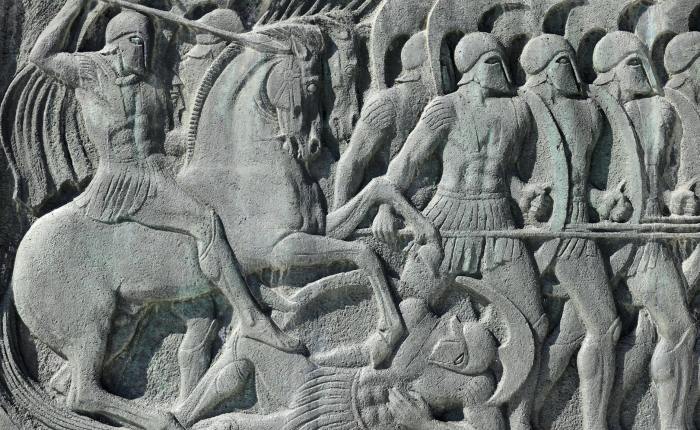
In each case (Sarpedon, Patroclus, Hector), divinities step in not to save or resurrect the warriors, but to preserve their corpses:

even now in death, Apollo pitied
Hector, and kept his body free from taint
He wrapped a golden cape, an aegis, round him,
To ensure the dragging never scratched his skin (24.24-27).

Though Hector’s body has been abused and left unburied for twelve days, still “dewy-fresh he lies”; and his many wounds “are quite closed up” (24.520).

Despite violent death outside the city gates, Apollo will not allow his holy one to see decay.

A father intervenes, a trip is made to the one responsible for his death, and a brave plea is made for the body.

Now what does that sound like?

In the next post I’ll unpack why this still matters.


Hello friends. Please subscribe on the homepage to receive these posts by email. This is especially helpful since I’ve decided (mostly) to uncouple the blog from social media. Thanks for reading. ~JM

When celebrities die

When celebrities die

What exactly is going on within our collective psyche when a very famous person dies under tragic circumstances?

For the past few weeks, I’ve been researching the subject of my next book. Its focus is upon the way “celebrity” and a celebrity-obsessed culture has come to influence American evangelicalism.

My claim is that a fixation on fame and famous people is creating certain problems for the church, despite our claim that only God be worshipped and adored. My argument is that evangelicalism needs to be “de-famed” so Jesus won’t be.

Then, in the midst this research, a helicopter crashed.

AN UNDENIABLE TRAGEDY

Kobe Bryant, his young daughter, and seven others were tragically killed.

The internet exploded.

Like most people, I never met Kobe. I wasn’t a Laker fan. And I wondered (years ago) about the sexual assault charge that was ultimately dropped against him. How do you judge the character of someone you’ve never met?

Still, like everybody else, I was shocked and saddened. A rush emotions followed: His daughter too!? It can’t be. What must his wife and family be enduring!?

I wasn’t alone.

WHAT IS A CELEBRITY?

Then I began to ask another question: How does my strong reaction to Kobe’s death fit with my research into our celebrity culture?

In his book Celebrity Worship, Pete Ward attempts to unpack just what is a “celebrity” and why they matter to us.

A celebrity, Ward says, is a “mediated person.” Celebrities are those persons who have been elevated and magnified by a complex mix of technology, media, industry, and social relationships. Ward’s claim is that our deep connection to celebrities is not actually about them—it’s about us, and the formation of the modern “self.”

To see the young and smiling face of Kobe Bryant, memorialized on CNN, is to be reminded of how fragile our lives are. It is also to be transported back in time to watching basketball with one’s own father or high school friend. It is to place myself in Kobe’s seat in the helicopter (the seat of a father), and to look into my own daughter’s eyes. It is to empathize with a grieving widow and grieving children. It is to relive our own grief and trauma vicariously.

And after that, it is to find a collective outlet for that groan on social media. (This isn’t wrong.)

In Ward’s words, “Celebrities are important, because they are one of the primary resources used in processing the project of the self” (4).

WHEN CELEBRITIES DIE

After the death of Michael Jackson, and in spite of widespread evidence of child molestation, Ward notes how the public reacted with intense grief and deep affection.

MJ’s music had formed the soundtrack for countless lives.

Hence the public was not mourning an accused child molester, or even a phenomenal performer (he was likely both). They were mourning what his music represented in their stories.

A man named Paul put it this way:

“I immediately thought of my brother with whom I held great parties and where we danced like MJ, we were teenagers […] My brother was important to me.”

LISTENING AND LEARNING

These kind of celebrity deaths also provide an opportunity for  us to ask important questions of ourselves. For instance:

1. What am I actually grieving?

Like the young man (Paul) who was thoughtful enough to link the death of Michael Jackson to his past relationship with his own brother—we should ask what our grief over persons we have never met might be trying to teach us.

What are we grieving beyond the individual who has died?

What if the death of Michael Jackson led not to a shrine at his personal amusement park (which, if we are honest, was more a crime scene than a temple), but to conversations with one’s own brother, mother, pastor, friend, or therapist?

We like to run from death and grief. And events like this ask us to connect to the deeper sources of our pain.

2. What about the others?

Here’s another question to be wrestled with: Do I really believe that every person—no matter how famous, beautiful, or powerful—is created equally in the image of God?

Equality is a value in the modern West. But our responses to celebrity raise questions as to how deeply we believe in it.

Is the death of a poor and unnamed Chinese girl every bit as precious in the sight of God as that of Kobe Bryant? Do I actually feel this to be true, despite the fact that the young girl’s death (or that of the unborn baby) will get little personal coverage, in part because a given government has a vested interest in saving face?

Celebrity deaths give us occasion to grapple with these uncomfortable questions about equality and the sanctity of life.

3. Is the ache an echo of a Voice?

The Judeo-Christian tradition has long held that God has placed eternity (or a longing for transcendence) in the human heart.

The ache over mortality is therefore meant to be an echo of a Voice. It is a “dispatch” from transcendence, and even ardent secularists can hear it.

In the words of James K. A. Smith (citing Charles Taylor), the “closed take” on reality (No God, no transcendent meaning, no afterlife)

can’t seem to get rid of a certain haunting, a certain rumbling in our hearts. There is a spectre haunting our secular age, the “spectre of meaninglessness”—which is a dispatch from [divine] fullness.

CONCLUSION

In the end, it is good and right to mourn celebrity deaths. It is good and right because they are people made in God’s image.

Yet these tragedies may also serve as reminders of important truths (or falsehoods) that we would like to ignore.

All life is sacred. All human death is an intrusion into God’s good world. And this mortal ache—while painful—may form a trail of breadcrumbs leading to a Table where we hear the same truths Kobe did at his last worship service, just hours before his death:

This is my body.

This is my blood.

Do this in remembrance of the Christ who conquered death, and who alone is worthy to be worshipped.


Click the green “Follow” button to never miss a post.

Signup here to receive bonus content through my email Newsletter, “Serpents and Doves.”

The house of mourning: a post for those who grieve, in memory of Daniel Berg

The house of mourning: a post for those who grieve, in memory of Daniel Berg

One year ago, I stood next to the bed of my brother-in-law, and watched him die.

Daniel was only thirty: funny, young, and handsome. He was a loving husband to my youngest sister, who is perhaps the kindest and strongest person I know. They were still newlyweds.

Livi and Daniel

This death, and the terrible decline that preceded it, are the worst things I have ever witnessed. ALS is insidious. And despite endless ice buckets dumped on countless heads, no cure exists.

Daniel in couch

Watching Daniel die changed me. While I have no claim to the kind of grief borne by my sister and by his more immediate family, Daniel’s passing stole some measure of my innocence.

In movies, death is valorized and sanitized, but there is one thing the films get wrong: death’s color. On screen, the deceased look like they are merely sleeping. But Daniel did not look like that. While he died painlessly, I could not join others in kissing his face, holding his hands, or stroking his hair.

I just wanted to get out of there—to flee the room, avert my gaze, cover up his body—anything to escape the pallor that had replaced his former complexion. The image scarred me. I still see it.

As the theologian John Zizioulas writes:

“There is no greater contradiction than a dying being” (Being as Communion).

Death is an affront, or as Paul writes, an “enemy” (1 Cor. 15.26). It is an intruder in God’s good creation.

A GRADUATION FALSEHOOD

That is why I wriggled uncomfortably in my chair last month as I heard a graduation speaker (and pastor) affirm the words of the late Steve Jobs:

“Death is very likely the single best invention of Life. It is Life’s change agent. It clears out the old to make way for the new.”

This may sound nice at first, but when applied to actual people–a son or daughter, a spouse or friend–it is insulting and absurd.

Skubalon,” as Paul would say (Php. 3.8). Excrement.

It is wrong because it treats human beings like excess inventory at a used car lot: Act now! – older models must go! 

Skubalon.

Death is not Life’s best creation, and while Jobs said it, he did not actually believe it. If he had, he would not have fought so furiously (and valiantly) to fend off this great “invention.”

For those who mourn—and there are many—such platitudes don’t wash against the image of a departed loved one.

The bony hand of death cannot be manicured, bejeweled, and made pretty. It is always ugly, always cold, always an offense. True, we are often glad to know that a loved one is no longer suffering, and that they are “with Jesus.” But it is not death we celebrate; it is the cessation of pain, and their presence with God.

Death remains an enemy combatant.

A DOUBLE CRUELTY 

And then there are those left behind. For the bereaved, a double cruelty of death is that the wider world simply continues on as if nothing much has changed. A continent has been wiped off the map, and the cartographers have scarcely noticed.

“It’s as if they are erasing him,” my sister said once to me, amid the flood of paperwork to change her marital status, her mortgage listing, her tax information. But the people sending medical bills remembered.

This “double cruelty” is poignantly depicted in Anthony Doerr’s Pulitzer prize winning novel, All the Light we Cannot See. In a scene set in World War II, a young French girl stands in the empty room of a departed loved one:

[It] smells of peppermint, candle wax, six decades of loyalty. […] German sailors sing a drunken song in the street, and a house spider over the stove spins a new web every night, and to [her] this is a double cruelty: that everything else keeps living, that the spinning earth does not pause for even an instant in its trip around the sun.

Here, to quote a further line, God can seem like

“only a white cold eye, a quarter-moon, poised above the smoke, blinking, blinking, blinking, as [one] is gradually pounded into dust.”

Despair lurks.

BLESSED ARE THOSE WHO MOURN

The question then is this: Is there an alternative to these two dead ends? First, the delusional attempt to say that death is “life’s best invention.” And second, the lonely despair that finds no comfort.

Perhaps one alternative is a certain kind of grief.

As Paul said, “we do not grieve like those who have no hope” (1 Thess. 4.13). But we do grieve. And that is for the best.

As Nicholas Wolterstorff states in a tribute to a son who died:

“Grief is existential testimony to the worth of the one loved. That worth abides” (Lament for a Son).

Or as Tennyson writes:

            “Let love clasp Grief lest both be drowned” (In Memoriam A.H.H.).

Such words ring truer than false attempts to whitewash death as “Life’s best invention.”

DEATH BE NOT PROUD

Yet more is required to fend off despair.

We need not merely to grieve honestly, we need hope that death is not the end—that the “brief candle,” as Shakespeare called it, shall reignite and “run like sparks through the stubble” (Wis. 3.7).

Death is cocky after years of sway. Understandably.

Yet in the empty tomb of Jesus, there is a hint that “the blood-dimmed tide” (Yeats) has already turned, almost imperceptibly.

“Death, be not proud,” as Dunne wrote, “though some have called thee.”

“One short sleep past, we wake eternally

And death shall be no more; Death, thou shalt die.”

THE EMPTY TOMB

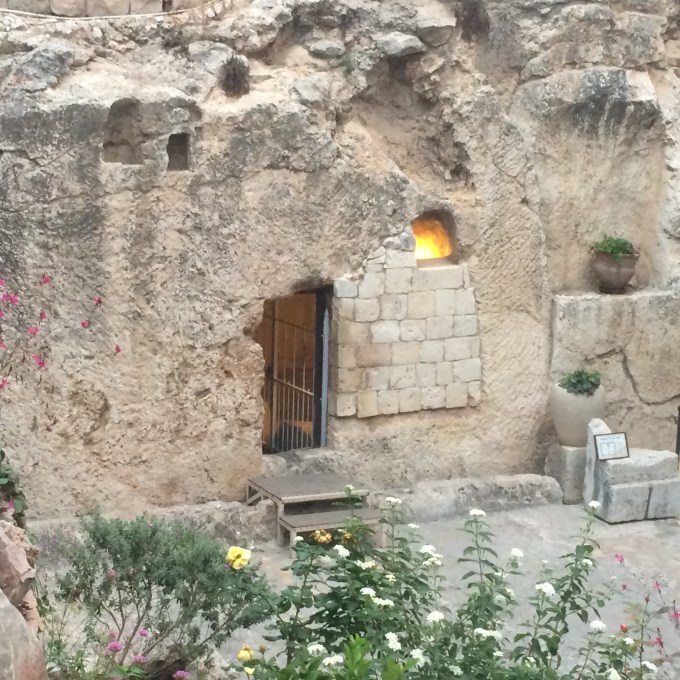
In the months after Daniel’s death, I had a chance to visit Israel with my sister (his widow) and my father. Daniel had always wanted to go. We stood together in the empty garden tomb at Gordon’s Calvary, and cried, and smiled.

emptytomb

Inside, a simple wooden sign reads: “He is not here – he is risen.”

And behind those words, I heard those of Francis Spufford:

“More can be mended than you know.”

For those who mourn as Christians, that hope provides a balance to the bitterness of death. Some sweet wine mixed with the gall. It does not take away the sting of death, but it allows us to walk on, limping. And that limp, like Jacob’s (Gen. 32), is evidence that we have been touched by someone real, someone good, someone eternal.

So if you grieve today, hear these final words of Kate Braestrup:

“Walk fearlessly into the house of mourning; for grief is just Love squaring up to its oldest enemy. And after all these mortal human years, Love is up to the challenge.”

Not here

~In loving memory of Daniel Berg.