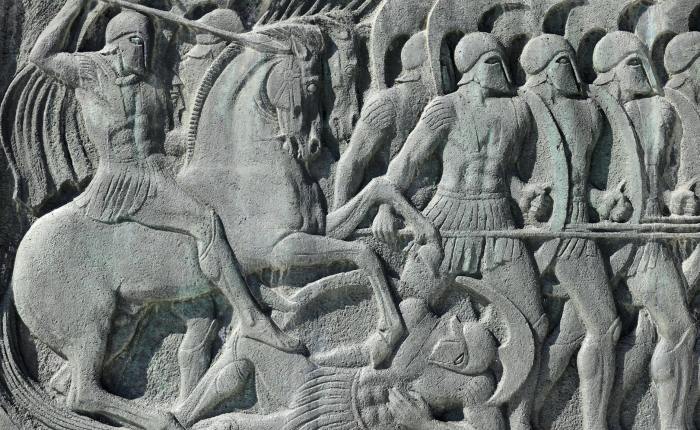
One of my summer reads this year was a slow journey through Homer’s Iliad—the great archetype of our war stories, action movies, and (in a way) superhero universes.
Among other insights, I was struck by how much of the fighting is focused not on killing an enemy or conquering a bit of ground, but on the furious desire to protect or desecrate a corpse.
The Iliad is, in many ways, a struggle for the dead–whether for the corpse of Sarpedon (mortal son of Zeus), Patroclus (intimate of Achilles), or Hector (favored son of Priam and champion of Troy).
“Human mortality is at the center of it all,” writes Emily Wilson. “I know no other narrative that evokes with such unflinching truthfulness the vulnerability of the human body.”

Yet unlike modern action movies, that bodily vulnerability (in the Iliad) is just getting started when one’s final breath departs through “the fence of teeth” (Book 9.529).
Shame and honor lie at the root of such concerns, as do ancient pagan assumptions about the requirement of proper funeral rites for a departed shade to enter Hades.
Unfortunately, countless other deaths occur in the attempt to secure the body of an enemy or comrade.
I’m interested in the point for several reasons:
- N. T. Wright points out that Homer functioned somewhat like the “Old Testament” for ancient pagan audiences, in a way roughly analogous to how the Hebrew Scriptures remained foundational for Christians.
- I agree with C. S. Lewis about the value of old books to reveal our modern blind spots, not because they are infallible, but because they do not share our unexamined assumptions.
- I’m convinced many well-meaning Christians lack a proper view of the body both before and after death. Thus, reflecting on this subject in the Iliad (alongside Scripture) might actually make us more faithful Christians.
In Homer’s story, the struggle for the dead happens in at least three ways: (i.) corpse care, (ii.) desecration, (iii.) divine intervention to stave off decay.
CORPSE CARE
The importance of proper corpse care is demonstrated by Achilles, as he sets out to wash and rub with olive oil the body of his dear friend Patroclus, and to fill his wounds with ointment (18.438).
Though Achilles feels compelled to avenge his comrade, he cannot bear the thought of what may happen to the body in his absence:
I am still most terribly afraid for brave Patroclus
Whose body has been hacked with so much bronze.
Flies may get in his wounds and worms may grow there,
Dishonoring his corpse. His life is gone,
And now his flesh may rot (19.30-36).
The mirror of this heartrending concern is found in Priam, who ultimately sneaks behind Greek lines to plead with Achilles for the body of his beloved son, Hector.
In that meeting, “They both remembered those whom they had lost.” And “Curled in a ball beside Achilles’ feet, Priam sobbed desperately,” in a fatherly move that finally breaks the callous wrath of his adversary (24.631–35).
DESECRATION
The desire to care for the bodies of friends and family is matched by an unholy drive to desecrate the corpses of one’s enemies.
Achilles exceeds all others in this impiety, for which the deathless gods are furious with him (24.146), since he does not stop at merely killing foes or stripping their armor, but commits abominations on their corpses.
In the final battle between Achilles and Hector, the matter of who will win is never in doubt. The only question, even for Hector, is what Achilles will do to his corpse.
Despite pleas from his dying adversary, Achilles proclaims:
If only I had will and heart to do it
I would carve up your flesh and eat it raw […]No one can save your body from the dogs,
not even if they bring me as a ransom
ten times or twenty times the usual rate (22.465-70).
True to his word, Achilles then commits “shameful atrocities on noble Hector,” piercing the tendons behind both his feet (#foreshadowing) and dragging him behind his chariot. Upon finishing his circuits ‘round the body of Patroclus, Achilles leaves Hector’s corpse face down in the dirt—unburied, unreturned, and yet (incredibly…) undecayed.
This brings us to the last point.
MIRACULOUS INTERVENTION
It would not be Homer if the gods did not intervene.
In each case (Sarpedon, Patroclus, Hector), divinities step in not to save or resurrect the warriors, but to preserve their corpses:
even now in death, Apollo pitied
Hector, and kept his body free from taint
He wrapped a golden cape, an aegis, round him,
To ensure the dragging never scratched his skin (24.24-27).
Though Hector’s body has been abused and left unburied for twelve days, still “dewy-fresh he lies”; and his many wounds “are quite closed up” (24.520).
Despite violent death outside the city gates, Apollo will not allow his holy one to see decay.
A father intervenes, a trip is made to the one responsible for his death, and a brave plea is made for the body.
Now what does that sound like?
In the next post I’ll unpack why this still matters.
Hello friends. Please subscribe on the homepage to receive these posts by email. This is especially helpful since I’ve decided (mostly) to uncouple the blog from social media. Thanks for reading. ~JM
 joshuamcnall.com