But I deleted it

But I deleted it

I’ve been on a blogging hiatus lately as I’m been under a deadline to get a book manuscript polished up and sent back to the editor (Yes, Katya, I am working on it!).

But I took time last week to type up what I thought was a pithy response to a particular hot-button cultural issue that had been nagging me.

I wrote it; I rewrote it; and I even had some friends weigh in.

Then, after all that work, I deleted the whole thing. (Which was really hard because it had a corny joke about a “salvation” that is seen as coming sola Twittera–by social media alone.)

I won’t go into the details, but suffice it to say I had an inkling of discernment (which is all I ever have…) that the last thing the world needed was one more pontification on something that I actually don’t know very much about.

On that note, I’ve found the following eight insights helpful for those times that I am tempted to think that I must always open my mouth/keyboard.

These come from the evangelical-Anglican and Baylor English professor, Alan Jacobs.

In his words:

Going off half-cocked is now widely perceived as a virtue, and the disinclination to do so as a vice.

What ‘s more:

that poorly informed and probably inflammatory statement of [My] Incontrovertibly Correct Position must be on the internet . . . or it doesn’t count towards your treasury of merit.

But must I always weigh in on every hot-button issue?

As Jacobs reminds himself:

  1. I don’t have to say something just because everyone around me is.
  2. I don’t have to speak about things I know little or nothing about.
  3. I don’t have to speak about issues that will be totally forgotten in a few weeks or months by the people who at this moment are most strenuously demanding a response.
  4. I don’t have to spend my time in environments that press me to speak without knowledge.
  5. If I can bring to an issue heat, but no light, it is probably best that I remain silent.
  6. Private communication can be more valuable than public.
  7. Delayed communication, made when people have had time to think and to calm their emotions, is almost always more valuable than immediate reaction.
  8. Some conversations are be more meaningful and effective in living rooms, or at dinner tables, than in the middle of Main Street.

None of this means, of course, that I will stop writing on issues that matter–even when they’re considered controversial.  I come, after all, from a theological tradition (Wesleyanism) that refused to shut up on things like slavery and women’s rights, even they had been dubbed “too radical” for respectable Christians to weigh-in on.

So once I’m not buried under a book manuscript (which should be sometime in the next decade) I plan to keep thinking in public with what I hope is a mix of grace and truth–or at the least “grammar.”

And I hope other thoughtful people do too.

Still, it is freeing to recall occasionally that the world’s salvation does not come sola Twittera.  Or in my more long-winded case: sola blogos. 


Check out my new book (Long Story Short: the Bible in Six Simple Movements), now available at Seedbed.com.

Signup here to receive bonus content through my email Newsletter (“Serpents and Doves”).

I will not clog your inbox, and I will not share your email address.

Beyond outrage

Beyond outrage

It is by now cliche to note that we live in an “outrage culture.”

And there are obvious drivers:

  • partisan politics,
  • social media (see here),
  • the satisfaction I receive from virtue signaling,
  • And (of course) the financial incentives that some have to keep us in a constant state of amygdala agitation.

On that last point, see below for a humorous look at how Facebook in particular makes a fortune this way (warning: some profanity).


In light of all this, I’m considering drafting an illustrated children’s book in which tiny, anthropomorphized logos of Twitter, CNN, and Fox News hold a frenzied footrace to the bottom of the brainstem.

Working titles include: “3, 2, 1… Civil War” and “The fast and the furious-er.”

(It will be a sequel to my classic children’s tale on bias: “Everybody skews” [see here].)

THE RIGHT KIND OF OUTRAGE

But there is also another reason for outrage, and we must not forget it.

That is, some things are genuinely outrageous.

Some things are simply wrong.

And if those things fail to bother us, then the problem is not an “outrage culture” or “the social media mob,” but our own callousness, and the fact that our allegiances have been coopted by rival kings and rival kingdoms.

THE PHOTO BY THE WINDOW

Perhaps the ultimate example of such callous compartmentalization is relayed by the British spy, John Weitz (here), who helped liberate the Nazi death camp at Dachau.

Upon approaching the gas chamber where countless families had been slaughtered, Weitz noticed a photograph of young German children taped next to the window that looked in upon the death room.

A Nazi father had apparently taped the photo there, by his “work station,” so he could gaze fondly on his own children while remaining unmoved by the wanton evil being done to “theirs.”

He was a loving dad – no outrage here.

THIS PAST WEEK

So this past week, I added my own voice to thousands of others (Republicans, Democrats, Independents) calling for a halt to using kids as pawns in a dispute regarding immigration—especially by way of out-of-context Bible verses.

Then, to my surprise, something happened: it worked. Kind of.

Public outcry brought a change (Thank God!), albeit an incomplete one since many children remain separated from their parents and there is some question over if and when they will ever be reunited. Apparently the whole process was pretty chaotic [*resists further comment and keeps moving].

Nonetheless, this good change raises an important question:

What next?

What comes after an initial spike in outrage achieves a portion of its goal?

BEYOND OUTRAGE

My interest here is not just with this particular issue (though it is important), but with a “meta-phenomenon” — that is, what outrage does well and what it does more poorly.

Here then is my tentative conclusion:

In some cases, the same traits that are needed in a crisis can be counterproductive to crafting long-term solutions.

I say this because long-term solutions require compromise, listening, and the ability to ratchet down the rhetoric in search of common ground.

Hence the problem is not that outrage is unwarranted, but that it is incomplete on its own. We need more. In the aftermath of crisis, we need to transfer some energy from the amygdala to the other parts of the brain.

We all know this in other areas, I think.

  • The person you want next to you in the Zombie apocalypse may not be the one you want running your company, chairing the school board, or leading your marriage counseling.
  • The skills needed to facedown Hitler may not be the ones that make for a successful peacetime leader (Read a Churchill biography; or a Stalin one).
  • And the recipe for alerting the masses (amygdala!) may not be the same as that required to solve complex problems with the prefrontal cortex.

My fear, however, is that we are far better at the former than the latter — I know I am.

So here’s to wisdom on how to translate righteous zeal into Christian justice, and on how to going beyond outrage to thoughtful long-term solutions.


On the subject of immigration reform and border security in particular, I am particularly thankful for the statement set forth recently by my own denomination, The Wesleyan Church (see here).


Like this post? Signup here to receive bonus content through my email Newsletter.

Each newsletter will contain material not available on the blog–including excerpts from forthcoming books, videos, and a chance to help craft future content (i.e., make it better) for both print and online publications.

I will not clog your inbox, and I will not share your email address.


American Suicide

American Suicide

Several years ago, there was a mediocre movie made by M. Night Shyamalan, called The Happening.

It was a horror-thriller sort of film, involving hundreds of senseless murders.

Yet the twist in The Happening was that the linked-together killings were committed not by a psychopath or super villain.

They were suicides.

In the movie, some unseen force—in the air or in the water—was causing Americans to self-delete in catastrophic numbers.

And that’s precisely what is happening now–though less dramatically.

AMERICAN HAPPENING

We are in the midst of an American Happening.

And I don’t say that because of Anthony Bourdain (though I was a fan), Kate Spade, or the many other celebrities who have tragically claimed their lives in recent months.

It’s a cold, hard fact–and not just for famous people.

As the New York Times reports (here):

Between 1999 and 2016 [American suicides] increased 25 percent

And

In 2016, there were more than twice as many suicides as homicides.

THE QUESTION THAT NEEDS ASKING

Why?

Depression, yes, but what else accounts for it?

To be honest, I don’t know.  I’m not trained to answer complicated questions on depression, mental health, and shifting trends in sociology.

But come on: 25 percent!?

With the caveat that my knowledge on this topic is very limited, the following are some very tentative thoughts—Not “13 Reasons Why” (though I have written on that previously), but something.

THIRTEEN REASONS WHY

  1. The dark side of “social” media.

It’s not hard to name the biggest social change between 1999 and 2016. It may be the biggest technological shift since electricity: the advent of the internet, and social media.

And despite all its vaunted benefits, for some young people especially, there is no doubt that the smartphone–complete with Facebook, Instagram, and Snapchat Apps–has become a suicide machine.  It is a way to compare “my life” to the filtered version of “theirs.” It is a way to get addicted to porn and drown silently in shame.  And for some young people especially, it is a way to bully, retaliate, and take so-called “mean girl” antics to a whole new level.

Is it any wonder, then, that suicides for girls aged 10 to 14 have tripled since 1999?

If there is a lesson here, it is to think carefully about how and when kids are allowed to utilize such “tools”—and about what boundaries we ourselves need (I’m speaking to myself as much as anyone).  

  1. Secularization and the sanctity of life.

In Christian history, the stigma surrounding suicide was massive (and not always helpful).

Given that, it bears reminding that self-murder was not always frowned upon by ancient Greeks or certain Eastern cultures.

In some ways, the shift to secularism is a reversion to pre-Christian ways of thinking. Here, the body (this “meat-suit” as it often [gnostically] referred to) may be done with as one pleases.  It seems unsurprising, then, that suicides would increase.

In the Latin phrase inscribed upon some pagan tombs: Non fui, non sum, non curo. “I was not; I am not; I care not.”

  1. Opioids and other addictions.

The time from 1999 to 2016 is also the period in which opioid addiction went from “problem” to “pandemic.”

And as with all addictions, I imagine feelings of shame and utter helpfulness can lead some to end their lives.  Consider how many of the recent celebrity suicides involved people battling addiction (Bourdain was very open about his past struggles with heroin).

It is all the more shocking then that such dangerous opioids—getting more powerful every year as drug companies rush to outdo one another–are so widely available. 

  1. The aftershocks of war.

For the USA, 1999 to 2016 was also a time of almost non-stop war, even if folks like me (like the vast majority of Americans) were allowed to go blissfully on as if little had changed except the added TSA security.

The soldiers weren’t so lucky.

And in terms of suicides, such conflicts have been decimating.

I spoke to a former Navy SEAL recently who told me he’d lost two friends in a week. “The enemy doesn’t kill us nearly as effectively as we do.”

There are probably many reasons for this: PTSD; traumatic brain injury; lack of brotherhood or sisterhood upon returning home; a public that hardly noticed they were fighting; the inability to win a war against an “idea.”

Whatever the case, we must do a better job of reaching out to veterans; and in thinking carefully before galloping off to wars without sufficient consideration for the human costs both on and off the battlefield.

  1. “Contagion” and crowd dynamics. 

In the words of one parent (here), after a year in which his child’s school endured an unbelievable six(!) teen suicides, there is an element of “contagion” at work with instances of self-harm. As he writes:

Suicide–even those of strangers–poisons the air my young sons breathe. You can’t quarantine it. Every episode of self-deletion compounds our sense of collective despair, making further episodes more likely. I’m watching it happen in my own community.

Malcolm Gladwell sees the same phenomenon at work in school shootings. A generation ago they never happened; yet with each ensuing occurrence the “threshold” lowers till the next becomes almost a foregone conclusion.  In short, it’s tough to close Pandora’s box; The Happening is not just science fiction.

  1. Erasing Hell.

Historically speaking, it is hardly disputable that one reason that some deeply hurting individuals said “No” to suicide was the fear that such an act would consign them to the fires of hell. (It was, for instance, a “mortal sin” in Catholic tradition.)

So while the Bible doesn’t teach this claim explicitly, there is no doubt that an “erasing” of the fear of Hell within modernity has also (for some people) erased a reason to keep living in extreme duress. (And I don’t say that as one who “uses” Hell as a cheap scare-tactic.)

7. Affluenza

One would think that wealth would make us happier and less-prone to suicide. Not so.  As Time Magazine noted (here) in 2012:

all else being equal, suicide risks are higher in wealthier neighborhoods, a morbid demonstration of the folly of trying to “keep up with the Joneses.”

As one might expect, they are also high in times of unemployment, yet an additional

twist comes when you look at low income individuals who live in high income areas. According to the study, they face greater suicide risk than those living in low-income areas. The study’s authors call it a “behavioral response to unfavorable interpersonal income comparisons.”

  1. “The satan”

Even in Christian circles, to bring up the devil is something you don’t do at dinner parties.

“Old Scratch” is, as Walter Wink puts it: “a scandal” and “a bone in the throat of modernity” (See here for a prior post on the topic).

It bears noting, however, that the Hebrew word for Satan (ha satan) is not a name, but a title and a job description: “The accuser.”

“The satan” is the one who—often through a nagging inner voice—brings accusations:

“You’re worthless. Everyone would be better off if you weren’t here.”

And like every other factor on this numbered list, such “reasons” are ultimately bad ones—even while they can seem crushing.

So whether you believe in the devil or not, it’s imperative that you stop listening to him.

CONCLUSION 

In the end, I don’t know all the reasons for this American Happening. And many more could undoubtedly be listed.

But I do know this: we need you.

So if you’re struggling with depression or suicidal ideations, I hope you’ll tell someone (email me if nothing else), cause it’s time this mediocre movie got a whole lot better.

National Suicide Prevention Hotline: 1-800-273-8255


The title for this post was taken from Rod Dreher’s recent discussion of the topic (see here).

Beware the “lumpers”!

Beware the “lumpers”!


If there’s one thing we could use now in our current state of cultural cannibalism, it’s the ability to do a bit less “lumping.”

(And, no, that’s not a reference to your mashed potato preferences.)

The term derives from Darwin, yet while Darwin used it biologically, Alan Jacobs—Christian author and English Lit professor—uses it to write (here) about our current state of public discourse.

Hint: it’s bad.

We live now, says Jacobs, in the golden age of “lumpers”—as evidenced by our tendency to reduce all those with whom we disagree to a monolithic and dismissive hashtag.

#cuckservative

#whiteprivilege

#RINO

#snowflake

On the one hand, some labels are necessary for human communication, and we can’t escape the use of shorthand. But as Jacobs notes, when we lump and label indiscriminately, we fail to actually think (not to mention “see” and “hear” each other).

In the words of George Orwell, in his essay: “Politics and the English Language”

When one watches some tired hack on the platform mechanically repeating the familiar phrases […] one often has a curious feeling that one is not watching a live human being but some kind of dummy.

And this is not altogether fanciful. A speaker who uses that kind of phraseology has gone some distance toward turning himself into a machine. The appropriate noises are coming out of his larynx, but his brain is not involved…

Thank God Orwell never lived to see the land of Twitter.

A CELEBRATION OF “SPLITTING”

But if lumping is a problem under certain circumstances, what is the alternative?

Jacobs calls it “splitting”—and he finds a beautiful example in a pioneer of women’s higher education: Dorothy Sayers (1893 – 1957).

Sayers was a committed Christian, one of the first women to graduate from Oxford, a brilliant writer of both fiction and nonfiction, and a friend of C.S. Lewis.

She was also a feminist, in the best sense of the word—desiring equality of opportunity for men and women.

In her view:

What is repugnant to every human being is to be reckoned always as a member of a class and not as an individual person.

Her point is not that it is bad to belong to a particular group—be it gendered, racial, or religious.  Nor is she claiming that such differences are mere “social constructs.” (She was not a so-called postmodernist.)

On the contrary, our places of belonging are important, and we shouldn’t pretend they don’t exist (Re: the ridiculous if well-intentioned: “I don’t see [skin] color.” Seriously; unless you have macular degeneration, don’t say that.)

It’s not wrong to recognize our differences and groupings.  But when we “lump” all members of a set together in dismissive ways, we often say things that erase one’s individual humanity.

Thus our Twitter and Facebook posts end up as some version of the following:

“God” (used either as curse-word or a prayer), “thank you that I am not like other people—robbers, evildoers, adulterers—or even like this [Liberal, Conservative, secular, fundamentalist, millennial, baby-boomer, Muslim, Trumpist, Social Justice Warrior].”

Depending on one’s in-group, the words within the brackets will vary, yet the commonality resides in a self-righteous “lumping” under dismissive labels that reduce the shared humanity of others.

Hence the title of Sayers’ provocative essay: “Are women human?” (here)

Now my favorite quote.

Drawing on her own experience as one of the first women to receive a degree from Oxford, she writes:

When the pioneers of university training for women demanded that women should be admitted to the universities, the cry went up at once: “Why should women want to know about Aristotle?”

The answer is not that all women would be better for knowing about Aristotle […] but simply: “What women want as a class is irrelevant. I want to know about Aristotle. 

I, eccentric individual that I am […] and I submit that there is nothing in my shape or bodily functions which need prevent my knowing about him

As Jacobs’ notes, there is a kind of “blessed selfishness to this cry.”  It is a celebration of the “eccentric individual” who doesn’t give a rip whether Aristotle is perceived as useful for her “class”!

In the words of the Roman poet Terence: Homo sum, humani nihil a me alienum puto.

“I am human, and nothing human is alien to me.”

Here, here!

Or as Jacobs concludes: “Let a billion eccentric individuals flourish.”

Even lumpers.


See here for Alan Jacob’s fantastic book, How to Think: A Survival Guide for a World at Odds – from which much of this post was proudly stolen…

It’s NOT just a heart issue: On mass shootings and false choices

It’s NOT just a heart issue: On mass shootings and false choices

Imagine a particular township in which literally hundreds of people were dying every year from heart attacks.

In this one municipality (unlike others), cardiac fatalities had become so common that they now went largely unnoticed, except for the extreme exceptions—or when the paramedics came to your front door.

In response, some citizens began to study the situation to form solutions that would involve a variety of factors: diet, exercise, smoking, family history, and better medical testing.

This wouldn’t end all heart attacks, of course, but it might stop some.

“Finally… one citizen began to think. Perhaps we could do something to reduce this blight that strikes only here with this kind of stupid frequency.”

But then imagine if a well-meaning Christian offered this:

“Stop bringing up all this stuff about diet, exercise, and smoking! Clogged arteries are a heart issueand only Jesus can heal hearts.”

How would we respond?

THE TROUBLE WITH FALSE CHOICES

While I can think of several less charitable phrases, let’s pretend that we are in a mood to be compassionate (since I wrote about that recently). After all, the well-meaning Christian is not entirely wrong.

We might point out that “Yes, heart attacks are ‘a heart issue’—but they are not just that.” And because they are not just that, it would be foolish to go about preventing them with only prayer and preaching.

The reason, however, has nothing to do with prayer and preaching being weak.

Even “heart issues” require a variety of responses.

They have many causes and, thus, are not reducible to bumper-stickers. They require nuanced, both/and thinking, and they are not solved by false dichotomies: trans fats vs. lack of exercise; family history vs. sugary sodas; stress vs. smoking.

It’s not either/or—it’s both/and.  And yes, it is also “a heart issue.”

Unfortunately, in our current climate, both/and thinking seems almost anathema, and especially in the land of social media–where nuance goes to die.

It’s either “a heart issue” or “a gun issue.”

It’s either “a failure of parenting” or “a failure of the mental health system.”

It’s either “what happens when we turn away from God,” or “what happens when even self-advertising psychopaths can easily access their own private arsenal.”

Never have I seen so many false choices.

In response, one is tempted to scream: “IT’S ‘ALL OF THE ABOVE’!!!”

Behold the challenge of discussing mass shootings in America.

JESUS AND FALSE CHOICES

Which brings me to Jesus.

One day after a horrific massacre in Florida, a student in my Bible class asked this:

“In the Gospels, why does Jesus almost never give people a straight answer to their questions?”

It’s a great question, and I was about to answer it. Then I remembered Jesus. So I proceeded to ask questions and tell stories.

“Do you remember what was written on the whiteboard today when you came in?”

Some nodded.

Upon entering the room, I had noticed that another professor had apparently given his or her students a choice of essays. The topic was school shootings. OPTION ONE was to craft an essay entitled “Take away all guns,” while OPTION TWO was to “Give them to the good guys.”

(I have since learned that this was not the professor’s own view; but it does serve to make a needed point.)

So I asked this: “Is it possible that those might NOT be the only two solutions?”

What if framing the debate in such simplistic and false-dichotomizing terms actually prevents someone from answering the question intelligently?

What if that’s why Jesus rarely accepted the premises of his partisan questioners?

“Who sinned, this man or his parents?” (John 9:2)

“Whose wife will she be in the Age to Come?” (Matt 22:28)

As someone mentioned recently, it’s as if the binary codes that run our social media (all ones and zeros) have infected us. We have been conformed to their electronic image. And now we too must be all “ones” or “zeros” on every complex issue.

Brothers and sisters, this should not be.

ASH WEDNESDAY

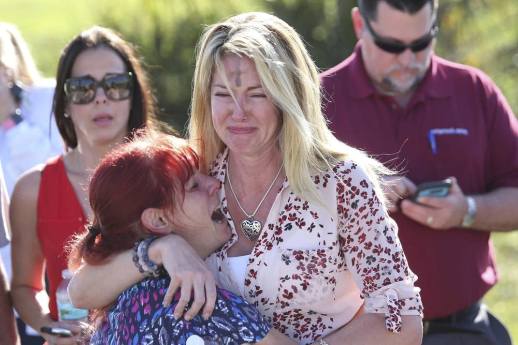
It was a cruel twist that one of the latest in a long line of school massacres took place on Ash Wednesday—a fact painfully pressed home by the gray cross smudged across the forehead of a grieving mother.

Parkland Mother
Joel Auerbach, AP

In such moments, “Eloi, Eloi” comes to mind.

And as with Jesus’ cry upon the cross, the question hangs unanswered.

In the end, I don’t know how to solve all school shootings. They have many causes, and I suspect they will require many nuanced solutions—all of which will cost us something.

But I do know this: We’ll continue getting nowhere so long as we fall into our partisan talking-points of “gun issue” vs. “sin issue.”

It’s time to stop being “ones” and “zeros” and start being people.


Interested in understanding the Big Story of the Bible? Check out my new book: “Long Story Short: the Bible in Six Simple Movements,” available with Video teachings to help church small groups.

Signup here to receive bonus content through my email Newsletter (“Serpents and Doves”).

I will not clog your inbox, and I will not share your email address.

What Seven Thunders Spoke: Why some revelations ought to go unpublished

What Seven Thunders Spoke: Why some revelations ought to go unpublished

The most anxious moment for a blogger is the second just before one hits the button labeled “Publish.”

It is a point of no return.

And it can raise nervous questions:

Will someone try to get me fired for saying this?

Will it be misunderstood?

Could I have phrased this better?

Come to think of it: Is the very exercise of “blogging” only slightly less narcissistic than a suggestive teenage selfie, emblazoned with an out-of-context Bible verse?

(Shut up inner voice! I rebuke you in the name of #Jeremiah_29.11!)

ON PRIVACY SETTINGS

Of course, such questions are not entirely unique to bloggers.

We all wrestle with our “privacy settings.”

And we all hit “Publish” in one way or another.

Hast thou a mouth that thou canst speak?

Hast thou a camera on thy smartphone?

Despite the mild anxiety, the wrestling match can be helpful. Because strange as it may sound in our age of TMI, some “revelations” ought to go unpublished.

Here’s what I mean:

THE SEVEN THUNDERS

In the trippy tell-all book of Revelation, John of Patmos says this about the so-called Seven Thunders:

And when the seven thunders spoke, I was about to write; but I heard a voice from heaven say, “Seal up what the seven thunders have said and do not write it down” (Revelation 10.4).

The command seems somewhat odd, since John is elsewhere ordered to “Write” what he has seen, regardless of its strange or controversial content. Yet in this one instance, just as he is about to click the button labeled “Publish,” the voice of God chimes in–“Don’t do it!!!”

“Do not write this thing that is simultaneously TRUE and NOT FOR PUBLIC CONSUMPTION.”

Did John bristle at the prohibition?

After all, he is not even told the reason for the divine censorship.  He simply gets a very pressing prompt: “Do not write it down.”

Whatever could this have to do with us?

WHY THUNDERS SPEAK TODAY

As most people acknowledge, we badly need a better ethic when it comes to use of social media these days—whether in The White House or the hands of certain mal-adjusted Junior-Highers (*tries hard to ignore the irony in that sentence).

None of us do this perfectly, including me.

Yet as I’ve thought about the button labeled “Publish” in my own life, there are some obvious reasons why certain “Thunders” might deserve to go unpublished.

Here are just a few:

  1. When the point is expressed in a way that is un-necessarily hurtful or sensational. 

In Romans 14, Paul delivers an interesting command with regard to a first-century squabble over food and drink. While agreeing with those (“the strong”) who saw nothing wrong with eating meat and drinking wine in moderation, he also gave this warning to those who were theologically correct:

20 Do not destroy the work of God for the sake of food. All food is clean, but … 21 It is better not to eat meat or drink wine or to do anything else that will cause your brother or sister to fall.

In essence, it’s possible to be “Right” in your view, and yet “Wrong” as you press them to the point of harm.

And while this is not a blanket condemnation of all sharp rhetoric (see Jesus, Paul, and pretty much any other biblical prophet), it is a caution against words that are intended merely to get a rise out of others.

  1. When the motive for the telling has been twisted.

Another danger of the Internet is our ability to track how much attention we receive for any given action.

It is the pathology of analytics, and it breeds “tricks for clicks.”

There is thus a constant pressure to say things that will maximize “exposure.” And in some cases, exposure is precisely the right word: as in a cause of death for mountain climbers, and a misdemeanor involving the “indecent.”

In truth, our motives are almost always mixed.

And our aims are often hidden from us.

Is there not a certain irony in this very blog post!? (Inner voice, I warned you!)

As a one of my old professors used to say: “We are a bundle of contradictions”—wanting simultaneously to be seen and to stay hidden. Thus we lock ourselves in the Panopticons of Instagram and Facebook, while grasping feverishly for fig leaves.

Come to think of it: How do I turn off notifications for the Seven Thunders…?

  1. When the “Publishing” may do more harm than good.

I joked in a prior post that the Hebrew word blogger translates roughly to “Not helping.”

And like all humor, it’s only funny if there is truth to it.

On that point, I often wonder if some Christian attempts (including my own…) to “speak prophetically” do not actually make the situation worse (See here for more along those lines).

In such moments, we end up as the theological equivalent of those trying to ban books. The result is always a bestseller, even when the book is lame.

On the other hand, this so-called “Hippocratic worry” can lead to dangers of its own. It may mean cowardly silence in the face of injustice or a dangerous equation of positions that are actually quite different (See here on how this happened with white pastors in the Civil Rights era).

The fear of offending may also lead to a weak-kneed, boring style of writing that lacks punch, humor, and engagement with issues that actually matter.

“I never discuss anything but politics and religion,” remarked Chesterton, “There is nothing else to discuss.”

While that’s not quite true, it is certainly true enough to discourage the politico-religious equivalent of spaying or neutering our public discourse.

Sometimes we should speak up (as the saying goes) even if our voice shakes.

CONCLUSION

Despite such qualifiers, the reminder of Revelation 10 is both simple and profound: Some points are not (yet) meant for public consumption, despite their honesty or truth-value.

And so we end as we began: in that moment just before the “Publish.”

Listening for revelation, and for the quiet voice that might say “Do not write it.”

Is social media eroding our humanity?

Is social media eroding our humanity?

By all means, read this–and then contemplate a flip phone.

Since I’m on the road this week for a conference, I wanted a share some excerpts from an article by Andrew Sullivan (“I Used to Be a Human Being”).

While I differ with Sullivan on other issues, this piece is prophetic in detailing the perils of our addiction to technology and social media.

And after a week in which Facebook nearly drove some of us insane, it seems particularly timely.

Read the whole thing here.

Personally, while I continue to use social media (i.e., to share this post), I’ve recently instituted some boundaries after noticing some unhealthy tendencies.

Perhaps we all should.

Below are a few of my favorite quotes from Sullivan’s article in New York Magazine.

May they crush you in the best way possible:


mountain-selfie
Kim Dong-kyu, based on Wanderer Above the Sea of Fog, Caspar David Friedrich


If the internet killed you, I used to joke, then I would be the first to find out. Years later, the joke was running thin.

I was … a very early adopter of what we might now call living-in-the-web. And as the years went by, I realized I was no longer alone. …[T]he rewards were many: an audience of up to 100,000 people a day … a constant stream of things to annoy, enlighten, or infuriate me … and a way to measure success — in big and beautiful data — that was a constant dopamine bath for the writerly ego. If you had to reinvent yourself as a writer in the internet age, I reassured myself, then I was ahead of the curve. The problem was that I hadn’t been able to reinvent myself as a human being.

CONTACTS INSTEAD OF FRIENDS:

By rapidly substituting virtual reality for reality, we are diminishing the scope of this interaction even as we multiply the number of people with whom we interact. We remove or drastically filter all the information we might get by being with another person. We reduce them to some outlines — a Facebook “friend,” an Instagram photo, a text message — in a controlled and sequestered world that exists largely free of the sudden eruptions or encumbrances of actual human interaction. We become each other’s “contacts,” efficient shadows of ourselves.

ON DOPAMINE AND LONELINESS:

Has our enslavement to dopamine — to the instant hits of validation that come with a well-crafted tweet or Snapchat streak — made us happier? I suspect it has simply made us less unhappy, or rather less aware of our unhappiness, and that our phones are merely new and powerful antidepressants of a non-pharmaceutical variety. In an essay on contemplation, the Christian writer Alan Jacobs recently commended the comedian Louis C.K. for withholding smartphones from his children. On the Conan O’Brien show, C.K. explained why: “You need to build an ability to just be yourself and not be doing something. That’s what the phones are taking away,” he said. “Underneath in your life there’s that thing … that forever empty … that knowledge that it’s all for nothing and you’re alone … That’s why we text and drive … because we don’t want to be alone for a second.”

THE LINK TO SPIRITUALITY:

And so modernity slowly weakened spirituality, by design and accident, in favor of commerce; it downplayed silence and mere being in favor of noise and constant action. The reason we live in a culture increasingly without faith is not because science has somehow disproved the unprovable, but because the white noise of secularism has removed the very stillness in which it might endure or be reborn. …And yet our need for quiet has never fully gone away, because our practical achievements, however spectacular, never quite fulfill us. They are always giving way to new wants and needs, always requiring updating or repairing, always falling short. The mania of our online lives reveals this: We keep swiping and swiping because we are never fully satisfied.

That Judeo-Christian tradition recognized a critical distinction — and tension — between noise and silence, between getting through the day and getting a grip on one’s whole life. The Sabbath — the Jewish institution co-opted by Christianity — was a collective imposition of relative silence, a moment of calm to reflect on our lives under the light of eternity. It helped define much of Western public life once a week for centuries — only to dissipate, with scarcely a passing regret, into the commercial cacophony of the past couple of decades. It reflected a now-battered belief that a sustained spiritual life is simply unfeasible for most mortals without these refuges from noise and work to buffer us and remind us who we really are. But just as modern street lighting has slowly blotted the stars from the visible skies, so too have cars and planes and factories and flickering digital screens combined to rob us of a silence that was previously regarded as integral to the health of the human imagination.

If the churches came to understand that the greatest threat to faith today is not hedonism but distraction, perhaps they might begin to appeal anew to a frazzled digital generation. Christian leaders seem to think that they need more distraction to counter the distraction. Their services have degenerated into emotional spasms, their spaces drowned with light and noise and locked shut throughout the day, when their darkness and silence might actually draw those whose minds and souls have grown web-weary.

Then there were the other snares: the allure of online porn, now blasting through the defenses of every teenager; the ease of replacing every conversation with a texting stream; the escape of living for a while in an online game where all the hazards of real human interaction are banished.

WHAT TECH-GURUS KNOW:

When you enter the temporary Temple at Burning Man, the annual Labor Day retreat for the tech elite in the Nevada desert, there is hardly any speaking. … They come here, these architects of our internet world, to escape the thing they unleashed on the rest of us. 

CONCLUSION:

I haven’t given up, even as, each day, at various moments, I find myself giving in. There are books to be read; landscapes to be walked; friends to be with; life to be fully lived. And I realize that this is, in some ways, just another tale in the vast book of human frailty. But this new epidemic of distraction is our civilization’s specific weakness. And its threat is not so much to our minds, even as they shape-shift under the pressure. The threat is to our souls. At this rate, if the noise does not relent, we might even forget we have any.


First, say their names: A response to “the response” to Orlando

First, say their names: A response to “the response” to Orlando

“I think it’s important that you hear their names.”

Somehow, that was the line that finally broke me in the wake of the Orlando massacre. While others were discussing ISIS, weapons used, and the political implications, a reporter was slowly reading through a list of nearly fifty names, voice faltering, while adding information about each one.

  • Jean Carlos Mendez Perez (aged 35). He is remembered by his sister as a doting uncle, who loved to buy her children ice cream.
  • Brenda Lee Marquez McCool (aged 49). She loved to go dancing with her son. He survived.
  • Rodolfo Ayala-Ayala (aged 33). He worked at a blood donation center. “He’s alive in the lives that he saved,” said a co-worker.

For some of us,  hearing the names reminded us that this is about real people, not just politics.

A RESPONSE TO THE RESPONSE

So while there have been many responses to the shooting, this is not one of them.

It is not a response to what happened because I have no good response to that. It is a response to the response—and especially that on social media.

As Russell Moore notes (here), we used to be able to grieve together as a nation: Pearl Harbor, JFK’s assassination, and 9/11 were examples. We wept with those who wept (Rom. 12.15). And while there was some of that after Orlando, Moore is also right to say that

“the aftermath quickly turned into an excuse for social media wars.”

And as so often with such missive missiles, the minds of all combatants seemed made up so far in advance that the MEMEs had already been written. Indeed, in some cases, the bodies of the slain formed only minor speed bumps to be driven over on the way to making one’s point.

Whatever the debate, each side seemed clear on what this “proved”:

  • Guns: For some gun-lovers, the real problem was that victims themselves were unarmed. More guns in nightclubs; that’s how you fix mass-shootings. While for others, this showed that America’s firearm fixation is literally killing us.
  • Islam: For the new nationalists, this revealed that Trump was right in trying to ban all Muslim immigrants (never mind that the shooter was born here). While for the new atheists, this proved that religion itself is what “poisons everything.”
  • Homosexuality: For a handful of “Christians” (word used loosely), the problem seemed not so much the lives lost, but the ensuing support for the LGBT community. While for ardent secularists, this showed that all fervent “believers” (whatever the stripe) hate gays.

To be clear, I do not think that every point being made was invalid.

I even agree with several proposals on how to begin preventing the kind of shootings that happen in no other civilized country with this kind of stupid frequency.

But that is not what I want to talk about here.

WHAT WE’VE LOST

My observation is this: We seem to have lost the national ability to mourn PEOPLE, before making POLITICAL POINTS. And while some points matter, it is the people who are priceless.

In this case, bodies were still being pulled out Pulse nightclub when the pixeled pronouncements started flying. Donald Trump, for one, “mourned” as he does all things—by Tweeting—“I called it!” he crowed: “Appreciate the congrats for being right.”

You know, just like F.D.R. after Pearl Harbor.

Others were more thoughtful (which isn’t hard). Still, in many cases, as I went online last week, I couldn’t help but feel like there was something wrong with the insta-battles that broke out even before family members had been notified.

It was not always like this. Social media has changed things. And in this regard, for the worse.

FIRST, SAY THEIR NAMES

What then is my suggestion?

Hear this: I am not saying that those passionate about solutions should just stay silent. Not at all.

But I do think that before we venture into polemics, we should first do what a few thoughtful mourners did, and say their names. Weep with those who weep. Reach out to gay friends and family. Grieve with the grieving. Many people did this, and God bless them. (I especially appreciated this from the new Wesleyan General Superintendent Wayne Schmidt [here]; in fact, it was not a statement at all, but a prayer.)

To recount the names and faces of the fallen reminds us that they were real people, with real dreams, parents, siblings, friends, and children. They are not mere dead weight to be leveraged in the catapults that launch our online arguments.

Biblically speaking, the call to love and serve and grieve is not dependent (even one iota!) on whether the victims were gay or straight, liberal or conservative, Christian or atheist.

The imago Dei is the lone prerequisite.

So while we must seek solutions to such reckless acts of hatred, let’s not forget to weep with those who weep.

First, hear their names.  And perhaps that empathy may, in the end, lead us to work together to prevent such acts in the future.

Requiescat in pace.


Edward Sotomayor Jr., Stanley Almodovar III, Luis Omar Ocasio-Capo, Juan Ramon Guerrero, Eric Ivan Ortiz-Rivera, Peter O. Gonzalez-Cruz, Luis S. Vielma, Kimberly Morris, Eddie Jamoldroy Justice, Darryl Roman Burt II, Deonka Deidra Drayton, Alejandro Barrios Martinez, Anthony Luis Laureanodisla, Jean Carlos Mendez Perez, Franky Jimmy Dejesus Velazquez, Amanda Alvear, Martin Benitez Torres, Luis Daniel Wilson-Leon, Mercedez Marisol Flores, Xavier Emmanuel Serrano Rosado, Gilberto Ramon Silva Menendez, Simon Adrian Carrillo Fernandez, Oscar A Aracena-Montero, Enrique L. Rios, Jr., Miguel Angel Honorato, Javier Jorge-Reyes, Joel Rayon Paniagua, Jason Benjamin Josaphat, Cory James Connell, Juan P. Rivera Velazquez, Luis Daniel Conde, Shane Evan Tomlinson, Juan Chevez-Martinez, Jerald Arthur Wright, Leroy Valentin Fernandez, Tevin Eugene Crosby, Jonathan Antonio Camuy Vega, Jean C. Nives Rodriguez, Rodolfo Ayala-Ayala, Brenda Lee Marquez McCoo, Yilmary Rodriguez Solivan, Christopher Andrew Leinonen, Angel L. Candelario-Padro, Frank Hernandez, Paul Terrell Henry, Antonio Davon Brown, Christopher Joseph Sanfeliz, and Akyra Monet Murray.