
“I’ve found it an effective rule of therapy to accept . . . that most people nowadays are possessed.”
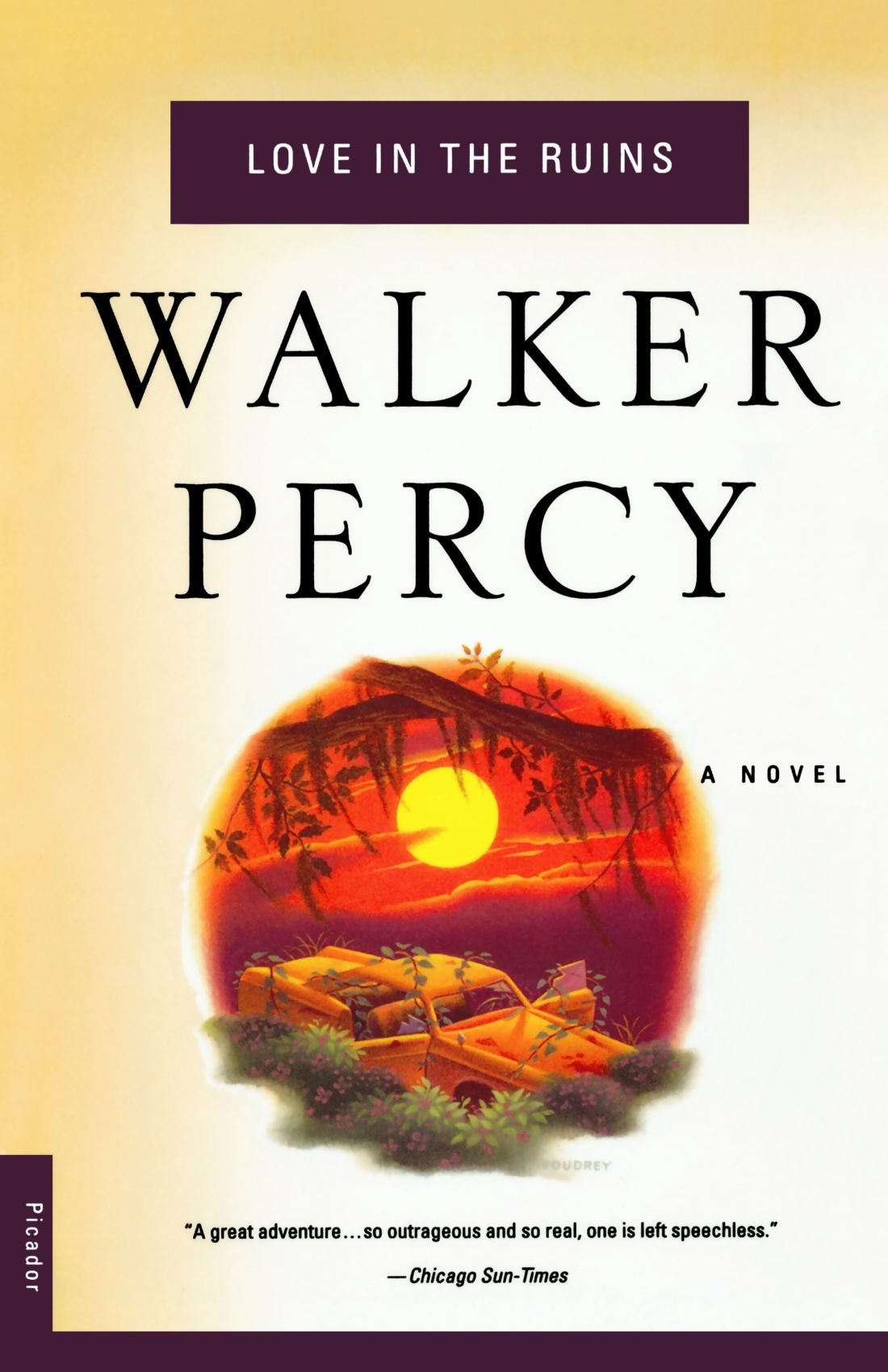
So says the psychiatrist Dr. Thomas More in Walker Percy’s darkly funny dystopian novel, Love in the Ruins. The subtitle describes it as “The Adventures of a Bad Catholic at a time near the End of the World.”

I was carrying the novel through a Tulsa coffeeshop recently when a stranger stopped me to remark, “That book changed my life.” (What a gift it to hear such words in an age where many of us spend our free time staring into 3-inch screens that are the self-authorized equivalent of Fahrenheit 451.)
Percy was a Southern writer and a practicing Catholic whose works engage themes of alienation, faith, and the decline of American culture. Though written in 1971, Love in the Ruins reads as more relevant than ever in its focus on cultural unraveling, partisan factions descending toward violence, unchecked technological power, and, well . . . demonic possession.
After all, how else can you describe some of the mind viruses that have taken root in segments of American cultural and political life?
The book is also funny. All sides are skewered, but my favorite barb involves a group of (clearly) evangelicals who partner with an evangelistic organization to hold Pro Am golf tournament that includes a massive banner which reads, “Jesus Christ: Greatest Pro of them All!”
But back to Satan.
A WHIFF OF SULFUR
It can be a dangerous to speak of demons and possession loosely.
Richard Beck rightly observes that we too often smell “a whiff of sulfur” around our enemies. Hence, allegations of satanic interference have been (and still are) used to excuse acts of violence. (They were used that way against Jesus.) And in the words of a more recent writer, “They’re burning all the witches, even if you aren’t one.”
Still, I’ve been struck recently by passages like 1 John 5:19:
“…the whole world is under the control of the evil one.”
What does that sound like? (And believe me, I am not speaking only of non-religious folks when considering the afflicted.)
I was at an conference years ago where a roomful of academics (the technical term is a “balding of professors”) were debating the difference between being “filled with the Spirit” and being “possessed.” One of which we normally assume to be more common than the other.
At this point, the distinguished scholar Ephraim Radner spoke up to say something like the line from Percy: “Well, maybe the whole world is possessed.” It carried weight since he’s about the farthest thing imaginable from a wild-eyed witch-burner, or an exorcist for hire.
My goal here is not to exhaustively develop this idea.
Partly because I do not know what to make of it.
So let’s turn to two quotes from authors smarter than myself.
C. S. LEWIS
First, C. S. Lewis, in The Abolition of Man:
“We are born into a world where magic and miracles are seen as fairy tales, but in truth, we are under a spell ourselves—the spell of modernity. To break this enchantment, we need the strongest enchantment of all.”
He’s wrong to call it modernity.
Or at least that label no longer seems right. Perhaps Nietzsche was closer when writing of the “old strong gods” returning to the stage after mistakenly being assumed dead somewhere in a prior Act of the drama.
L. M. SACASAS
Second, here is L. M. Sacasas, in his argument (borrowed from Robin Sloan) on the need for “verbal amulets”—a metaphor for short quotations that have the power to guard our hearts and minds against the “spirits of our age.”
Such phrases or fragments [are] charged with a certain power. Like an amulet worn around the neck, these words might somehow shield or guide or console or sustain the one who [holds] them close to mind and heart.
In this way, these words may function like prayers of blessing and protection against a kind of “groupthink” that could almost be termed, corporate possession.
Sacasas suggests the following as examples holding exorcistic promise:
“Ideologies are never interested in the miracle of being.” ~Hannah Arendt
“We do not obtain the most precious gifts by going in search of them but by waiting for them.” ~Simone Weil
“We live the given life, and not the planned.” ~Wendell Berry
“Attention has moral implications.” ~L. M. Sacasas
AN AMULET OF MY OWN
I’ve been pondering all of this as I work on my next book, which offers what I hope will be a “spell breaking” look at a single verse of Scripture (a verbal amulet from the Old Testament). More on that some other time.
The working dedication reads as follows:
For Teddy Brian McNall
Here is an amulet.
Put it on. It is made not of precious metal, gems, or bone—
But of ancient words in foreign tongue.
Keep it close to ward off the evil spirits of our age.
And here’s to you this week, dear reader:
May you receive the gift of exorcism.
Hello friends, thanks for reading. Please subscribe to receive future ones by email. This is especially valuable to me since I’ve decided not to promote the blog much on social media these days. I’m grateful for you. ~JM

 joshuamcnall.com