[Indistinct chatter]

[Indistinct chatter]

“If I ever write a book about technology and modern life, that will be the title.”

I said that to my wife recently as we were watching Netflix. We were using closed captions since the kids had just been banished to their rooms. And during the course of the episode, I was struck by how one caption appeared more than any other, entombed in brackets: [Indistinct chatter].

And now that I’ve mentioned it, perhaps it will stand out to you as well.

It appears everywhere on the shows we consume: In crowded restaurants, on bustling streets, inside Dunder Mifflin, in Ted Lasso’s locker room, and virtually everywhere else.

You might “indistinct chatter” is the soundtrack of our lives.

In a literal sense, and especially for the hearing impaired, the caption alerts viewers to a constant buzz of unintelligible and unimportant speech, humming somewhere in the background. But the more you think about it, the more it starts to feel like a kind of oracle or prophetic diagnosis of what ails us in our age of noise and news and social media. Who’s speaking? We can’t say. What language? IDK. What makes this wave of jumbled words more consequential than, say, the noise made by my neighbor’s lawn mower? Nothing, really.

Still, the caption-generating gods of Netflix feel compelled to include them in a font that is just as large and bold as actual dialogue, lest we miss this apparently important detail. And in a weird way, that’s basically my goal here. Have you noticed how much of modern life can be summarized by what’s in those brackets?

You could take that observation in a dozen different directions.

But here are two quick attempts at showing why it matters.

When words become white noise

First, we become so accustomed to indistinct chatter—unintelligible and unimportant words that wash over us almost constantly—that we find it hard to function without it. The chatter soothes us. Silence is unsettling. And we cannot bear to be alone with our thoughts. Eventually, washing dishes, driving a car, or even using the restroom become unthinkable without a verbal (or visual) security blanket of incessant, often vacuous, noise. Air pods, tik tok, twitter. You hear it now.

I’ve seen the effects of this especially in college students who say they cannot read, focus, or do homework without various forms of media running constantly in the background. This too is indistinct chatter. Though “Background TV” is another for it. And despite some obvious benefits—dampening the noise across the hall, or making one feel less alone within an empty apartment—psychologists also caution that our addiction to such electronic noise carries costs: We use it to drown out inner monologues that need attention, and we may eventually find ourselves unable to follow more complex arguments, conversations, or plot-lines since our word-diet is now filled with empty calories. Reflection becomes difficult. And idiocracy encroaches further.

Only the shrillest are heard

Second, to be noticed in a world (or news cycle) of constant chatter requires one to shout–or perhaps to make a scene. Subtlety is lost. And eventually, poets, preachers, and reasonable politicians are replaced by demagogues and provocateurs.

Before we know it, our cultural Caps Lock remains constantly illumined like the faulty tire pressure light upon your dashboard. After awhile, you don’t even notice it. We are seeing the cost of this now in our shared political lives especially, where (to quote Yeats), “the worst are full of passionate intensity,” while the rest are just really, really tired.

So what’s the solution?

As usual, the way forward begins by noticing the way that caption has come (metaphorically) to dominate our lives. In the words of Andy Kennedy,

Every great solution starts with someone noticing a problem. Noticing is underrated. Notice more. Good things will follow.

But noticing is not enough. We must also make decisions, at least periodically, and for sustained intervals to unplug from machines and environments that threaten to drown us in indistinct chatter.

Here though is an irony. As I write this, I am seated outside by the fire while robins and bluejays and large group of black crows are performing their own bit of background noise. It too is unintelligible. Yet it hits differently than a steady stream social media alerts, breaking news, doom-scrolling, calendar reminders, and the targeted ads that constantly assault us. Is it chatter? Of a sort. And yet.

As the Psalmist writes:

There is no speech nor language, where their voice is not heard.
Their line is gone out through all the earth, and their words to the end of the world. In them hath he set a tabernacle for the sun,
Which is as a bridegroom coming out of his chamber, and rejoiceth as a strong man to run a race” (19:3-5 KJV).

Which is to say, go touch some grass. And for just an hour, disable captions.


Hello friends. Please subscribe to these posts via the button on the home page to receive future posts by email. This is helpful since I’ve decided (mostly) to uncouple the blog from social media. I’m grateful for you. ~JM

Reading is Rereading

Reading is Rereading

After my sermon last Sunday, a friend asked, “How many books do you read per week?”

Surprisingly, the answer is usually “less than one.” To be sure, I read daily: Scripture and academic works in the morning; and something outside my field at night—fiction, history, or biography. (I’m currently near the end of Simon Schama’s fantastic but entirely-too-long history of the French Revolution.)

Still, I suspect I read slower than most people.

My friend’s question emerged because I had referenced several books in the sermon (probably too many books, if I’m honest). These authors included A. J. Swoboda, Joshua Jipp, Will Guidara, Ingrid Faro, and Wendell Berry. And, you know, Luke’s Gospel.

I was able to draw on these books, not because I had read them last week. (Only one fell into that category, and I didn’t finish it.) Instead, I could retrieve them because of the way I read and annotate books. (And I do mean physical books—with pages, spines, and a total lack of pixels.)

I mark them up like a graffiti artist tagging a boxcar and I dog-ear pages with content I want to retrieve, usually with a one- or two-word annotation: “Blog post,” “Article,” “Micah 6:8 book,” “Sermon Illustration,” “Atonement doctrine,” “No!”

When it’s time to write a message, a lecture, or a book of my own, I’ll consider what previously-read works in my library might add something; then I’ll flip through the dog-eared pages quickly to see what fits. It might take 30 seconds per book.

The massive benefit, however, is that I’m able to retrieve things that I no longer remember.

Perhaps that habit can help you too.

Of course, some caveats apply:

  1. You can’t dog-ear every page. If you highlight each word, you might as well not do it. I aim for less than ten dog-ears per book (four or five is best), otherwise you’re just doing entry-level origami.
  2. Slow down. Reading is about growth, not “finishing.” Studies suggest slower readers—that is, those who read at the pace of speaking rather than the pace of word-recognition–retain and remember far better than others. Hear this: In a world of distracted digital rabbits, be the turtle.
  3. Read broadly. No one wants to listen to someone who only reads business books (welcome to the late 90s and early 2000s in many evangelical denominations), or sports, or academic tomes, or jingoistic histories, or partisan political opinions disguised as “a Christian worldview.” The best writers, preachers, and thinkers read broadly. After all, I can only speak to all of life if I read intentionally in ways that touch upon the diversity of human experience. Otherwise, we become like the old man on the Simpsons who proclaims loudly that he hates everything but Matlock and Metamucil.
  4. Man cannot live (or preach) on books alone. As much as I want to champion reading actual books over the brain-rot of cable news, TikTok, smartphones, and the temptation (even in academia…) to say “AI” over and over as if it’s a magic spell that substitutes for thought and work and expertise—the fact remains that we live increasingly in a post-literate age. Hence, I’ve been inspired by authors and preachers who can draw not only on books, but on other sources too. I recall several moving illustrations in Jake Meador’s recent work that came from the world of streaming television—since, let’s be real, his audience is more likely to recognize those illustrations than they are a reference to Charles Dickens. Thus, when Jesus preached, he told more stories about seeds than Stoic philosophers.

CONCLUSION

In the end, take this as an encouragement that slower readers can still be deeply formed by books—and then pass that blessing on to others. In fact, formation may be more substantial precisely because of its slowness. Likewise, one need not have a photographic memory to retrieve wisdom and beauty from texts that no longer occupy one’s short-term memory.

Reading is rereading.

And marking.

And dog-earing.

And pulling off the shelf when the time is right.

Hear then, the word of the Lord: Be the turtle. Make reading great again. Practice selective, recollective origami.


In fact, if you’re looking for some books to practice on, see here.


Hello friends, and thanks for reading. Please subscribe via the button on the home page to receive future posts by email. This is especially valuable to me since I’ve decided (mostly) to uncouple the blog from social media. I’m grateful for you. ~JM

When (not) to use AI: a Venn diagram

When (not) to use AI: a Venn diagram

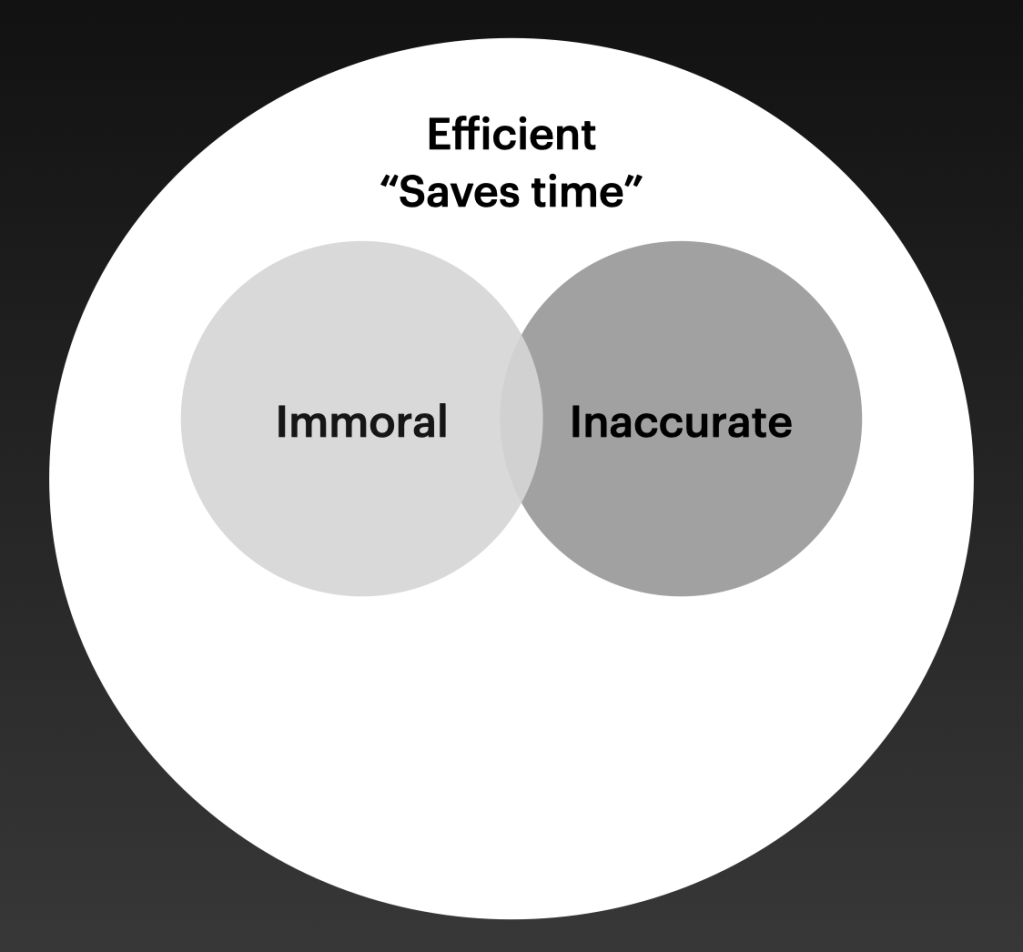
I created a Venn diagram recently to articulate when I think use of AI is ethical and when it’s not.

The smaller circles represent ways in which use of AI is problematic, while the remaining white space illustrates helpful ways in which one may utilize it to save time or accomplish meaningful tasks.

I want to be clear on two points: First, I do use programs like Chat GPT for some things. So I am not proposing a blanket rejection. And second, my focus here is almost exclusively on LLMs (Large Language Models) used to generate text and language. Thus, I am not interested in other ways that AI may be helpful, say, in coding, accounting, or other areas of life. My focus is on words.

My question is a simple one: When do programs like ChatGPT contribute to the good life, and when do they make me dumber, less personal, and less capable of being formed into a thoughtful and connected human being?

Let’s start with efficiency. As Jacques Ellul famously warned, the modern pull of “technique” tempts us to reduce every aspect of life—including relationships and spirituality—to a question of efficiency. In essence, if it saves time, do it.

Of course, efficiency may be a good thing. I do not ride a donkey to the office. I own a dishwasher. And I do not etch my writing on wax tablets. Broken, inefficient processes can be both frustrating and blameworthy. However, there are times when the modern idolatry of efficiency causes harm to others and ourselves.

Allow me to explain:

Circle #1: Efficient but Immoral: The most obvious way AI-use becomes unethical is when our drive to save time leads to immoral choices. Case in point: When I ask students not to use ChatGPT for a particular assignment (because I want them to think and grow by wrestling with ideas and words), to do it anyway is cheating. True, they may not get caught. But it is wrong nonetheless. Likewise, if my church expects me to write my own sermons (as they ought to… ), if I outsource an undo amount of that reflection to a robot, I am in the realm of immorality.

Frankly, many immoral decisions (whether robbing a bank or visiting a prostitute) are driven partly by our thirst for efficiency, which is to say, the drive to get something as fast as possible with the least amount of effort. And in these cases, the fact that it “saves time,” is hardly an excuse.

Circle #2: Efficient but inaccurate: A second problem with AI is the proliferation of falsehoods, inaccuracies, and other bogus depictions of reality. That’s because while programs like ChatGPT do a great job of producing grammatically correct sentences, they do not necessarily prioritize truth.

Hallucinations abound. And evidence is not hard to find: Sites like Google now prioritize bogus AI images of real animals, even when they look nothing like the actual creatures being searched.

LLMs invent sources that don’t exist, as attested by a friend of mine who was surprised to find his own name in footnotes, listed as the author of numerous academic works that don’t exist. And by some accounts, it’s going to get worse.

As Ted Gioia argues,

“Even OpenAI admits that users will notice ‘tasks where the performance gets worse’ in its latest generation chatbot. …

This isn’t a flaw in AI, but a limitation in the training materials. The highest quality training sources have already been exhausted—so AI is now learning from the worst possible inputs: Reddit posts, 4Chan, tweets, emails, and other garbage.

It’s going to get worse. Experts believe that AI will have used up all human-made training inputs by 2026. At that point, AI can learn from other bots, but this leads to a massive degradation in output quality.

In other words, AI will soon hit a brick wall—and face a dumbness crisis of epic proportions. That will happen around the same time that AI will have pervaded every sphere of society.

Are you worried? You should be.”

I can’t say whether all of this is accurate. But it further raises the specter of “the bogus” at a time when we are already drowning in it.

Circle #3: Efficient but impersonal: Now for the saddest (and weirdest) one.

As I watched the 2024 Olympics on Peacock with my kids, one of the commercials that ran on maddening repeat was the now infamous “Dear Sydney” ad for Google Gemini. The premise is bizarre. A dad asks AI to write a fan letter on behalf of his daughter to the American sprinter, Sydney McLaughlin-Levrone: “I’m pretty good with words,” he intones, “but this has to be just right.”

Responses to the ad were a mix of confusion coupled with a collective gag reflex. WHO IN THEIR RIGHT MIND WANTS AN AI-WRITTEN FAN LETTER!?? pretty much summed it up. Or in the words of Alexander Petri, that ad “makes me want to throw a sledgehammer into the television every time I see it.” After all, how do you possibly ruin the universally endearing act of a child authoring an imperfect but adorable note to her hero? Hey Gemini, can you help with that?

Google isn’t alone. I heard recently of a dad who asked ChatGPT to write the speech for his daughter’s wedding. And I personally received an 10-page email from a stranger, asking me to answer a list of questions about one of my books, The Mosaic of Atonement. For a small-time author, letters from readers can be encouraging (and sometimes not). But this one ended with an admission saying that it had been composed by AI. To be clear, the sender hadn’t bought the book. He hadn’t read the book. And he hadn’t even taken time to WRITE THE EMAIL he had sent me. Still, he wanted me to write a long response. (A friend suggested that I plug his 10-page email into ChatGPT and ask for a 10,000 word reply in Klingon.)

My claim for this third circle is simple: We should reject AI in instances where more genuine human interaction and personal attention is reasonably expected. That’s not every use of words (as when I asked ChatGPT to help me smooth out the legal jargon in an insurance claim after my car was totaled… [I repent of nothing!]), but it does require us to discern what parts of life cannot be delegated without a loss of love and human care. As L. M. Sacasas writes, “attention has moral implications.” (And that includes fan letters, sermons, and your daughter’s wedding speech.)

The potential cost is high: In addition to someone wanting to throw a sledgehammer at you, our epidemic of loneliness will continue to creep into domains normally immune to it. After all, as C. S. Lewis wrote, “We read to know that we are not alone.”

Circle #4: Efficient but infantilizing: For those who care about education and formation, this may be the most important circle. Admittedly, “infantilizing” is probably not the best word for it, but it speaks to the fact that education and discipleship are meant to move us toward maturity. And on that point, L. M. Sacasas seems right to note that the most important question to be asked of any technology is, “What kind of person will this make me?”

That is, how will this use of AI shape me?

In the humanities especially, to labor slowly over words, sources, and ideas is—without question—the best way to grow as a thinker and communicator. Believe me, the work is slow and often frustrating. But it changes you in ways that cannot be accomplished otherwise. Somewhere in his five million published words, Saint Augustine remarks that “people will never know how much I changed my mind by writing.” That sentiment resonates for me—in part, because I read and wrestled with it as I wrote a PhD on Augustine’s theology. That work changed me, tedious though it was.

In at least some cases, when we outsource the labor of thought and articulation, we move backward on the scale from Idiocracy to Augustine—which is a pretty fair diagnosis of many ills that currently afflict our cultural, political, and spiritual lives. (Let the reader understand.) The grammatically correct sentence is not the goal of writing. The goal is a well-formed and mature person.

In the words of Alan Noble, teachers must attempt to convey that

“the process of writing, when done well, is working magic in their minds, making them into better thinkers, better readers, better neighbors, better citizens. That writing will help them know themselves and others around them. But that writing will also take hard work, just as all good things take hard work. And to use AI to help with that hard work will rob their minds of all those good things. It would be like going to the gym to lift weights only to have someone come along and lift them for you. You’ll never grow stronger. You’ll never grow. You’ll only waste your time.”

Perhaps this case feels like a losing proposition. So be it. A final lie from the idol of efficiency is that only “successful” tasks are worth undertaking.

But for teachers and pastors especially, when it comes to the case for wisdom in our use of technology, the words of T. S. Eliot (in “East Coker”) still echo over the wasteland of soulless bureaucratic prose:

“For us, there is only the trying. The rest is not our business.”


For further reading on this topic, the folks cited in this post are excellent: Alan Noble, Ted Gioia, Alan Jacobs, and L. M. Sacasas.

Hello friends, thanks for reading. Please subscribe to receive future ones by email. This is especially valuable to me since I’ve decided not to promote the blog much on social media these days. I’m grateful for you. ~JM

Which book should I write next? (take 2)

Which book should I write next? (take 2)

Alright… let’s try this again. Apologies that the poll wasn’t showing up when I tried to post this yesterday. I’m trying SurveyMonkey instead of the “quick and easy” option in WordPress.

I’m wondering if readers of this blog (Both of you? Mom?) might help me decide which book I should write next.

I’ve been busy early this summer with academic writing, but I’m shifting gears now to work on a book that would be for anyone: pastors, plumbers, parents. Here are the options. All titles are tentative. And I don’t promise to follow your advice. But I do appreciate it.

Vote via the poll at the end (that is, if it works this time. If not, just post a comment).

Walk Humbly: Micah 6:8 as a Guide to Faithful Living
As I have returned to Micah 6:8 over the years, I have come to see it as a much-needed means of recalibrating my misguided priorities, reminding me of what God has “shown,” and providing a prophetic alternative to the cultural and political extremes that threaten to squeeze the church into their misshapen molds. But what does it mean to act justly, love mercy, and walk humbly with your God?

Jesus Preaching: Sermons and the Son of God
Jesus preached. But his sermons are unlike ours. As a companion text for preaching classes, or a guide to pastors, the book explores how we can better proclaim the gospel of King Jesus by learning from his sermons and his unique approach to preaching.

Food God: Meals as means of Grace
In Scripture, meals are often how God displays his love and truth, even as their misuse marks key moments of human sinfulness. Designed to be discussed around a table, this book explores how breaking bread can still point us to Christ and his uncommon flesh-and-blood community.

Thanks for the help. (Survey Monkey link below.)

Which book should I write next?

(Thanks for the comments as well. It’s great to hear your feedback!)


Click the green “Follow” button to never miss a post.

And see here for my own books.

Life in a “case”

Life in a “case”

I’ve just finished Anton Chekhov’s excellent short story, “The Man in a Case” (1898).

It chronicles the life of a rigid and anxious man named Belikov, who teaches Greek in a provincial Russian town. As Chekhov describes him,

“the man displayed a constant and insurmountable impulse to wrap himself in a covering, to make himself, so to speak, a case which would isolate and protect him from external influences.”

For Chekhov, a “case” is a way to insulate ourselves from the world’s messiness, but also from its grandeur, pathos, and joy. Cases prevent discomfort, but they also wall us off from life and from transformative experience.

Through a series of unexpected twists, Belikov nearly gets married (driven partly by the townspeople who hope to rid themselves of him), but he pulls back at the last minute, refusing now to even leave his bed, until his final encasement: death.

Then comes Chekhov’s most memorable line:

“Now when he was lying in his coffin his expression was mild, agreeable, even cheerful, as though he were glad that he had at last been put into a case which he would never leave again. Yes, he had attained his ideal!”

In our day, we might say that Belikov lives with a form of OCD. And that likely makes him a more sympathetic character.

Chekhov’s genius, however, is to show how there is a bit of Belikov in all of us. After the narrator (whose thoughts are not necessarily Chekhov’s) has smeared Belikov for the entirety of the story, another character experiences a moment of apparent revelation, staring up at a moonlit and melancholy sky. After reflecting on his safe but stuffy life, filled with frivolous pursuits, ” he remarks: “isn’t that all a sort of case for us, too?”

And the question hangs unanswered.

CASE STUDIES

Chekhov’s encasement sounds a bit like what Jonathan Haidt calls “safety-ism”— the worship of safety above all else, which leads to an attempt to “nerf” the world to prevent all possibility for distress, anxiety, or risk.

But safety-ism has ironic consequences: It serves as an “experience blocker,” which fuels anxiety, instead of quelling it. It also often leads to an enforced adherence from others. “You know, he crushed us all,” a townsperson remarks of Belikov, “and we gave way.”

Case-dwellers become case-enforcers.

And case-enforcers rob not only themselves, but also their loved ones of life.

MY CASE

I’ve thought about my own tendencies to be a bit like Belikov.

Like anyone, I have reasons: A few years back we almost lost our eldest son to a freakish rip current while on a family vacation in Florida. It happened on my watch, and ever since I’ve turned into much less of a “fun dad” at the beach (but also elsewhere)—causing my children to complain as I hover nearby telling them to “stay close!”

Is my safety-ism bad?

Not always. Sometimes it’s needed. But it can go too far so that I find myself saying “Be careful” when what I really mean is “I love you, and I’m scared you’ll die.” The thing is, both ends of that sentence are inalterable. So the only question is, what now?

A theme in Chekhov’s masterpiece is the need to examine how we insulate ourselves not merely from danger or discomfort—but from life. This happens not just in anxious attempts to avoid suffering or death, but more frequently through the malaise of distraction, productivity, and the tyranny of tiny tasks which confuses “getting things done” with actually living.

In other words, as Chekhov might say, don’t crawl into a casket because it’s “safe.”


Click the green “Follow” button to never miss a post.

And see here for my own books.

The Death of Crazy Horse

The Death of Crazy Horse

This passage on the death of Crazy Horse from Ian Frazier’s book on the Great Plains is just fantastic.

It describes how, after being bayonetted in the back , the great Lakota warrior refused the U.S. Army cot toward which he had been led to die.

Ian Frazier:

“What I return to most often when I think of Crazy Horse is the fact that in the adjutant’s office he refused to lie on the cot. Mortally wounded, frothing at the mouth, grinding his teeth in pain, he chose the floor instead. What a distance there is between that cot and the floor! On the cot, he would have been, in some sense, “ours”: an object of pity, an accident victim, “the noble red man, the last of his race, etc. etc.”

But on the floor Crazy Horse was Crazy Horse still. On the floor, he began to hurt as the morphine wore off. On the floor, he remembered Agent Lee, summoned him, forgave him. On the floor, unable to rise, he was guarded by soldiers even then. On the floor, he said goodbye to his father […]. And on the floor, still as far from white men as the limitless continent they once dreamed of, he died.

With his body, he demonstrated that the floor of an Army office was part of the land, and that the land was still his.”

It’s a soaring passage.

And it’s made more moving by the fact that I listened to it while driving across the American plains as part an eleven-part series on Custer, Sitting Bull, and Crazy Horse—done masterfully by Tom Holland and Dominic Sandbrook.

THE LESSON

What I want to focus on is Frazier’s ability to condense the character of a lifetime into a single, pregnant image: the space between the cot and floor.

“On the cot, he would have been, in some sense, ‘ours’.”

“But on the floor Crazy Horse was Crazy Horse still.”

Some might say he reads too much into it. And, of course, there is a danger of imbuing tiny details with an excess of significance.

But I don’t care. I love it.

And there is a lesson here for those, like me, who want to use words well.

Now more than ever, our audience is drowning in a sea of white noise: emails, calendar invites, unbidden incursions of all kinds.

What they need is an arresting image on which to hang the point we want them to remember: “What a distance there is between that cot and the floor!” That’s it. That’s the brilliance of Frazier’s passage.

If we can give them that—in a way that elucidates rather than distorts the truth—then we will breathe life into the cold, dead words that often sit corpse-like and content upon the “cot” of our narration.


Click the green “Follow” button to never miss a post.

And see here for my own books.

What is walking?

What is walking?

“The world reveals itself to those who walk.” So said Werner Herzog.

I’m flying back now from Budapest, where I had the privilege to speak to a group of European church leaders. I was lucky enough to bring my eldest daughter with me. And we had two days prior to the conference to explore one of Europe’s great cities. (It’s been special and I’m grateful for the invitation.)

In Budapest, we walked a lot.

As always, I conceived of things while moving slowly on foot that would not have pressed themselves upon me otherwise. Like: Hmm…, Hungarians are thinner. I bet it’s partly the walking.

Then this gem from L. M. Sacasas hit my inbox (here).

Sacasas writes thoughtfully on the crossroads of technology and culture on his Substack, The Convivial Society. (You should subscribe to it.) In his words,

“To walk, then, is to inhabit a fitting scale and speed. It is the scale and speed at which our bodies are able to find their fit in the world, and the world rewards us by spurring our thinking and disclosing itself to us.”

I’m pondering that wisdom as I lament the fact that my next book (or rather, books) don’t seem to be revealing themselves as readily as prior ones. Reasons are numerous. I have more jobs and “hats” than five or ten years ago. More kids. More soccer games. More emails and calendar invites. But I wonder if it isn’t also that I’m just not walking and thinking enough to have worthwhile things to say. (I suspect most preachers and teachers can relate to that.)

Sacasas wonders if the reason walking and writing pair so well is that both require a kind of deliberate slowness. Because, “Past a certain speed, we simply cannot perceive the world in depth.”

Both writing and walking . . . seem to calibrate the tempo of our minds to the rhythm of thought.

Yes, cars and jets and computers and smartphones are useful—I’m boarding a transatlantic flight in a few minutes and typing on my MacBook. But as always with technology, there is a cost to our sedentary connectivity.

Namely, “the tool we think enhances our capacity may also diminish it” (…a note to all incautious evangelists for the gospel of AI).

To this end, Sacasas then quotes Rebecca Solnit, who observes,

The mind, like the feet, works at about three miles an hour. If this is so, then modern life is moving faster than the speed of thought.

Of course, not all sidewalks are created equal—the trash-strewn footpath by the Casey’s is not the Danube promenade by the Hungarian Parliament. Nor are all motives for our ambulation equally transformative. The tourist and the pilgrim differ in subtle and important ways. As Sacasas puts it,

The tourist bends the place to the shape of the self while the pilgrim is bent to the shape of the journey.

Those differences aside, mt overarching takeaway—and one I hope to embody more this summer—is as follows:

There is a scale of activity and experience appropriate to the human animal and things tend to go well for us when we mind it.

I’d say more, of course, but it’s time to strap myself to a metal tube that moves around 500 mph. No time for irony (or editing).

But here’s to more walking when the jet-lag wears off.


Click the green “Follow” button to never miss a post.

And see here for my own books.

and still it is not full: on epigraphs

and still it is not full: on epigraphs

As a reader, I’m a sucker for intruiging epigraphs.

These are the short quotations, usually from another writer, placed at the start of a book or chapter. Since I’m working on a new writing project now, I’ve already started a Word doc with a list of possibilities.

For my last book, the overarching epigraph was a single line from N. T. Wright:

“Sometimes, believing in providence means learning to say perhaps.”

N. T. Wright

Here are a few of my favorites from books other than mine.

EAST OF EDEN

Though it’s more a dedication than an epigraph, I’ve always loved the inscription that precedes my all-time favorite novel, East of Eden. According to legend, when John Steinbeck finished the 250,000-word manuscript, he placed it into a mahogany box that he had carved. Then he sent it to his friend, Pascal “Pat” Covici. When you open East of Eden, these words greet you:

Dear Pat,

You came upon me carving some kind of little figure out of wood and you said, “Why don’t you make something for me?”
I asked you what you wanted, and you said, “A box.”
“What for?”
“To put things in.”
“What things?”
“Whatever you have,” you said.
Well, here’s your box. Nearly everything I have is in it, and it is not full. Pain and excitement are in it, and feeling good or bad and evil thoughts and good thoughts—the pleasure of design and some despair and the indescribable joy of creation.
And on top of these are all the gratitude and love I have for you.

And still, the box is not full.
~John

East of Eden

OF BOLDNESS AND REQUESTED BODIES
Then there is this thought-provoking verse from Mark’s Gospel that James K. A. Smith chose as the epigraph for his book on Christian public witness and political philosophy (Awaiting the King):

“Joseph of Arimathea, a prominent member of the Council, who was himself waiting for the kingdom of God, went boldly to Pilate and asked for Jesus’ body”

Mark 15:43

I love it because it seems so purposeful and yet so unexpected. It made me stop and ask, Now why the heck did he choose that!? Is this a Christian attitude toward cynical leaders and corrupt governments? …to ask not for prayer in public schools or Ten Commandments on a courthouse lawn, but for a corpse to bury in strange anticipation of a kingdom still to come? …and to do so “boldly”?

It’s perfect—precisely because it raises questions more than answers them. You’ve got to keep read on. And in this case, you should.

CUTTING POPPIES
Then there’s this from Søren Kierkegaard’s masterpiece Fear and Trembling—a book that probes the nature of faith in the frightening story of Abraham being willing to sacrifice his son. Kierkegaard chooses this:

“What Tarquinius Superbus said in the garden by means of the poppies, the son understood but the messenger did not.”

Fear and Trembling

Who’s Tarquinius? And why the cryptic message sent by way of flowers? Once again, the quotation is just strange enough to make me care. It plays upon the universal human impulse that drives attention to ancient oracles, true crime podcasts, and ridiculous Q-drops—a mystery to be figured out.

THE PAST AS PROLOGUE
Finally, I’ve long loved the epigraph that opens Zadie Smith’s debut novel, White Teeth:

“What is past is prologue”
–Inscription in Washington, D.C., museum

The phrase is a well-worn line from Shakespeare’s The Tempest. Yet Smith messes with it. Shakespeare’s “What’s” is changed to the rather clunky “What is”; and the origin of the phrase is deliberately mis-cited: “–Inscription in Washington, D.C., museum.”

For careful readers—and it took me auditing a college Brit Lit class to have it pointed out—these small but deliberate changes illustrate the theme of Smith’s sprawling, multi-generational epic on what it’s like to be an immigrant, or the child of one, in modern Britain. Her novel plays upon the complex ways in which the past influences the present, even while the present tweaks and misremembers the received tradition. It’s brilliant. And on the novel’s final page, Smith gives one last nod to the lesson from her epigraph:

“To tell these tall tales and others like them would be to speed the myth, the wicked lie, that the past is always tense and the future, perfect. … It’s never been like that.”

Zadie Smith, White Teeth

LESSONS LEARNED

Over time, I’ve formed opinions on what makes for an arresting epigraph: (1) Short beats long; (2) one beats many; (3) cryptic beats obvious or preachy. But like most writing rules, these may be broken under the right circumstances.

The true constant, and the real magic of a perfect epigraph is that it functions exactly like Steinbeck’s little hand-carved box: As the writer, all you have is there—the whole book–though the words are not your own:

—the pleasure of design and some despair and the indescribable joy of creation.

and still it is not full.

***If you have a favorite epigraph, post it in the comments. I’d love to see it.


Click the green “Follow” button to never miss a post.

See here to purchase a copy of Perhaps: Reclaiming the Space between Doubt and Dogmatism.

Signup here to receive bonus content through my email Newsletter, “Serpents and Doves.”

“Old so-and-so”–A post on peculiarity and affection

“Old so-and-so”–A post on peculiarity and affection

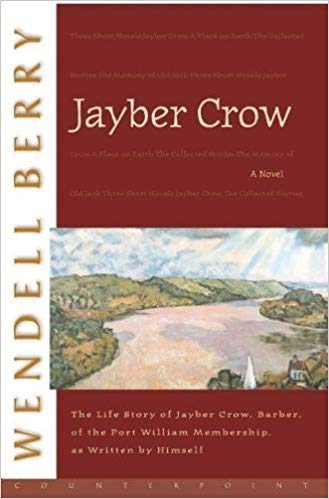
Lately, I’ve been reading Wendell Berry’s novel, Jayber Crow, after Brianna and I put the kids to bed.

It’s a story about the “unique” people one comes to know during a lifetime in a small community.

Jayber

A key takeaway is this: When no one is a “stranger” we see more clearly that everyone is strange.

But far from being merely a cause for mockery or bullying, peculiarity can spark affection.

Case in point: ‘Ol Ab Rowanberry, with his rifle and his chamber pot.

Yet another sight I used to see [around town] was uncle Ab Rowanberry shuffling by, carrying a rifle, a lantern, and a sack containing a chamber pot, a cowbell, a corn knife and a long leather purse tied with a rag string. He would be on his way between daughters.

The paragraph is random and ridiculous—and delightful.

The scene continues:

Ab carried with him all his worldly possessions, the terms of his independence and self-respect: the rifle with which he provided a little meat for the table and with which he could defend himself if attacked, the corn knife in case he needed it, the lantern and the chamber pot to preserve his dignity when he had to get up at night, the cowbell to ring if he fell down and couldn’t get up. […] I observed him carefully and have remembered him always.

The last line is vintage Berry.

EXAGGERATED?

Some would allege that such colorful depictions of human beings amount to “tall tales” that exaggerate the strangeness.

I disagree.

As a case in point, I recall a similar critique as it was levelled at the southern gothic stories of Flannery O’Conner. In defense of Flannery, the poet Elizabeth Bishop wrote the following:

Critics who accuse her of exaggeration are quite wrong, I think. I lived in Florida for several years next to [a church like those described in O’Conner’s fiction].

After those Wednesday nights, nothing Flannery O’Conner ever wrote could seem at all exaggerated to me.

CONCLUSION

What’s the point of these forays into human idiosyncrasy?

Since I’m in the middle of a fiction-writing project myself (MS due in about a month!), one reminder is to “Include a rifle and a chamber pot” in my own way (i.e., Don’t be afraid to highlight the peculiar features that make people interesting people).

But there is also a spiritual lesson to be learned.

For Berry (and for O’Conner), the goal is not to mock our strangeness, but to weave a spell around it so that even oddity can become a mark of beauty and belovedness.

As C. S. Lewis writes in The Four Loves:

The especial glory of Affection is that it can unite those who most emphatically, even comically, are not [alike]. Growing fond of “old-so-and-so,” at first simply because he happens to be there—[rifle and chamber pot in tow!]—I presently begin to see that there is “something in him.”

This realization also connects with another theme from Lewis’ most famous essay (The Weight of Glory): There are no ordinary people. No mere mortals.

We are all odder and more broken than we look; yet more beloved than we dared imagine.


Thanks for stopping by.

Click the green “Follow” button to never miss a post.

Signup here to receive bonus content through my email Newsletter, “Serpents and Doves.”


Adorning the dark: A post on the creative process

Adorning the dark: A post on the creative process

“I’m convinced,” writes Andrew Peterson, “that poets are toddlers in a cathedral, slobbering on wooden blocks and piling them up in the light of the stained glass.”

The colorful description comes in a book on the beauty and the pain of making things—whether one is a poet, a preacher, a musician, or an artist of some other stripe.

ADORNING THE DARK

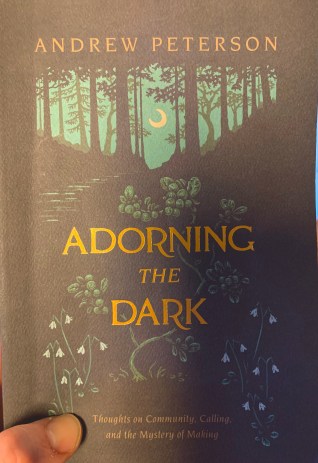
I just finished Peterson’s new book, Adorning the Dark: Thoughts on Community, Calling, and the Mystery of Making.

adorning.jpg

I’ve appreciated his work for years.

Despite a voice that (allegedly) sounds a bit like Kermit the frog with a sinus infection, his music has always moved me.

  • Brianna and I chose “Canaan Bound” to be sung at our wedding.
  • My kids loved Peterson’s fantasy novels (The Wingfeather Saga), with Lucy proclaiming them to be even better than Harry Potter. (Not true. But still.)
  • And his entirely original, Behold the Lamb of God, is my favorite Christmas album of all time.

Adorning the Dark is different from these other works. But there are still some helpful lessons for those involved in the creative process.

Here are four:

1. Write the bad ones too

Peterson tells sheepishly how a fan once approached him after a concert with a request for him to write down some songwriting advice on the inside of a CD case. Being a bit tired, Peterson wrote, “Don’t write bad songs.”

Seeing the somewhat snarky inscription, Peterson’s bandmate Andy Gullahorn wrote his own advice: “Write the bad ones too.”

Gullahorn’s insight was not just that one should be kind to fans, but that “quality control” is not the chief skill an artist must cultivate: Output matters too.

The two pre-requisites for getting published are (wait for it…) writing and finishing.

So make something, even if it isn’t great.

Excellence is for editing (and re-writing).

2. Artists need “resonators”

A second take-away is that art nurtures community and community nurtures art.

After being dropped by his record label and nearly bankrupted by the post-Napster death of album sales, Peterson founded a collective called “The Rabbit Room” with a ragamuffin group of Nashville artists.

These friendships not only allowed for cross-promotion between artists; they also provided encouragement, community, and feedback.

I’ve been blessed with fantastic “resonators.”

  • My colleague, Dr. Jerome Van Kuiken, is the smartest person I know, and he provides invaluable critique on everything I write for publication.
  • My wife Brianna reads my blog posts, and she often weeds out the lines that could get me fired and/or tarred and feathered.
  • I also have friendships with folks like the up-and-coming novelist K. M. West, who provides not only encouragement but also a (silent) reminder that there are people out there busier than me who still write consistently—and at a high level.

Art nurtures community. Community nurtures art.

Artists need resonators.

3. Boil it down

After reading Wendel Berry, Peterson tells how he and his wife sold their comfortable suburban home and bought a small, ramshackle cottage on several tree-lined acres near Nashville.

If artists need resonators, they frequently need nature too.

Since the property had maple trees, Peterson Googled “How to make maple syrup.” He was stunned to learn that a person gets one gallon of syrup for every forty (!) gallons of sap.

If you were to taste the maple sap before you boiled it down, which I did, you’d find it hard to believe there’s any sweetness hiding in there at all.

Writing is like that too.

The sweetness often comes in “boiling it down.”

I was reminded of this yesterday when I picked up a copy of my book, Long Story Short: The Bible in Six Simple Movements. For the most part, I am proud of the writing—which is significant since I first hammered it out over a decade ago.

That said, upon re-reading what I’ve published, my overriding critique is that I could have cut a few more words from certain sentences and paragraphs.

I could have lost some empty calories and gained some “sweetness.”

Boil it down.

4. Plant the berries

The most moving story in Adorning the Dark involves a trip to Sweden that Peterson’s family took in 2016 after a season of busyness, burnout, and depression (another commonality of artists).

While abroad, he sought to locate the old stone cottage of his great-grandfather.

After much research, the general location of the ruined house was found, and an ancient local Swede agreed to take the Petersons by bicycle into the dark, thick forest to find it.

[The Swede] explained [through a translator] that he was looking for a certain kind of berry that would tell him where the old foundation stones would be.

A hundred years ago, he said, the berries were planted outside the cottage for food, and long after the house fell into ruin, the berry bushes lived on. If you want to find the remains of a dwelling in a Swedish forest, [he] told us, look for berries.

Lo and behold, they found the berries—along with the home.

The story forms a parable for the kind of art that matters.

As Peterson concludes:

“One day, perhaps, when I’m dead and gone, and my songs and stories lie in the ruins of some old forest and no one remembers my name, whatever good and beautiful and human thing that the King of Creation called forth from me will fall to the earth and grow brambly and wild, and some homesick and hungry soul will leave the well-worn path and say, ‘Look! Someone lived here.

Praise God, there are berries everywhere.’”

Good art is the “berry” that adorns the darkness.

And homesickness leads home.


I’m going to open the comments on this one.

Fellow writers, preachers, musicians (etc.): What’s the most helpful advice you’ve found about the creative process?


Click the green “Follow” button to never miss a post.

Signup here to receive bonus content through my email Newsletter, “Serpents and Doves.”