Can Satire Sanctify? The Babylon Bee takes the Internet by Storm

Move over Comedy Central, there’s now a sacred source for stinging satire:

The Babylon Bee.

cce21xtwiaawe6g

Here’s a sampling of the latest faux headlines:

  • “Local High Schooler Pretty Sure Sixth Camp Rededication Did the Trick”
  • “Archaeologists Discover Prophet Daniel’s Weight Loss Diary”
  • “Redditor Takes Ten-Minute Break From Browsing Porn To Lecture Christians On Morality”
  • “Everything Local Man Feels Led To Do He Coincidentally Really Likes”
  • “Rescue Attempt Mounted For Couple Trapped In Post-Church Small Talk”
  • “Steven Furtick Cancels Book Tour After Getting Lost in his Mansion”
  • “Benny Hinn Miraculously Removes Lump From Woman’s Purse”

BACKGROUND

The Bee is the creation of 32-year-old Adam Ford, a dad from Detroit. According to The Washington Post—yeah, that’s right, The Washington Post did a story on this (here)—Ford launched the Bee in March, and it attracted more than 1 million visitors(!) within three weeks. Not bad. The stories are provided by unpaid freelancers (acceptable translation of the Greek phrase “Seminary Students”).

Prior to launching the site, Ford hoped to be a pastor. Then debilitating panic attacks and clinical depression caused him to turn away from crowds and toward writing. He found his niche:

“Most of the articles serve to hold up the truth and let it do the work,” he states. “I hope people leave the site with a spring in their step, or limping.” (Washington Post)

Both possibilities present themselves.

Take, for instance, the recent story about the time Joel Osteen’s happy thoughts made him able to fly (here).

As “Osteen” notes:

“I just decided one day I wasn’t going to let the enemy hold me back anymore, and I started boldly declaring before God each and every day that I was going to fly.”

The report ends with the smiley televangelist soaring high above the one-time NBA arena where his church meets.

And then there is the bulletin about a “Wild at Heart” Men’s Group that got hopelessly lost in a lightly wooded field behind their local church:

“Medics were immediately called to the scene to treat the brave, but traumatized, group of men.”

“After all this, [one member] says he’s not giving up on the Wild At Heart study. ‘There’s something primal, risky, and wild in God’s heart. While we may have come uncomfortably close to death in this harrowing experience, we’re that much closer to finding out what it means to be a real man of God.’”

A SERIOUS QUESTION

I find these stories hilarious.

And perhaps that’s unsurprising.  I have been a longtime fan of Stephen Colbert, Jon Stewart, and John Oliver.

But here’s a serious question: Can satire be a sanctifying agent for the church?

In other words, can it serve a purpose other than just making us smile? Or is it more likely to be detrimental as Christians make fun of each other, or the church at large?

POTENTIAL DANGERS

As someone who loves satire, I must admit that it has pitfalls.

For some of us, cynicism lurks behind the laughs.

Such cynicism is negativity with a smirk. It is a pervasive pessimism marked by punch-lines rather than overt anger. If you’re really angry, you can slap a Trump sticker on your car and fantasize about a giant golden wall in ways that make even characters on the Walking Dead feel uncomfortable.

But if you’re prone to cynicism, perhaps you turn on John Oliver’s Last Week Tonight.

Personally, I’m predisposed to the latter more than the former. But neither is good.

I’ve noticed this danger as I enjoy offerings like The Daily Show, and comedians like Jon Stewart. At their best, they shine the light of truth through humor, but for some of us (read: me), too much satire can reinforce the sense that everyone in politics and media is either a hypocrite, a moron, or both.

For me, cynicism is something I must guard against.

A second danger in satire is a kind of self-righteous meanness (or at least pride) that emerges as we tear down others in the name of comedy .

Sometimes this is done by those who have few accomplishments of their own, as highlighted in this story from the Bee: “First-Year Seminarian Ready To Take Over For Senior Pastor If Necessary.”

DES PLAINES, IL—First-year seminarian, George Turner, 23, confirmed Friday that—if necessary—he could easily step in to take over Rev. Gary Price as Senior Pastor at Covenant Presbyterian. […]

Gesturing to his pack of Greek flashcards, Turner added, “And I suppose it’s time to talk to him about that Bible translation we’re using. Ugh.”

Out on a hospital visit, Rev. Price was unavailable for comment.

If you have ears to hear, then hear.

In sum, there are pitfalls to reveling in too much satire or cultural critique. But as I will argue now, I hardly see such dangers as damning to all satire.

POSSIBILITIES

Personally, few (if any) Babylon Bee stories strike me as either mean-spirited or cynical.

They’re funny. And in most cases, there appears to be a light-hearted twinkle in the author’s unseen eye.

As contributor Michael Coughlin remarks in the story from the Washington Post:

“You can be satirical without being cruel.”

And as Jon Acuff states:

“Sometimes the best satire is tempered by love.”

In fact, the Bible itself employs examples of humor, satire, irony, and even sarcasm (see 1 Cor. 4.8-13; Isa. 40.19-20; Jer. 46.11; 1 Kgs. 18.27; Mt. 7.5).

As Walter Kaiser, one of my old Seminary Profs, once said: Humor can help the message go down, like a parent who makes faces at a child in a high chair as a way of getting them to smile, open their mouth, and insert the food or medicine.

Along these lines, Terry Lindvall, author of God Mocks: A History of Religious Satire from the Hebrew Prophets to Stephen Colbert, claims that satirists often act like prophets, helping believers see where they’ve gone astray.

You can be a prophet with solemn pronouncement. Or you can be prophet with comic pronouncements.

This is true.  But I also think that “speaking prophetically” can be a euphemism–at least as I have used it–for “being a self-righteous jerk.”

Real prophets are more likely to be sawn in two than retweeted.

CONCLUSION

So what’s the big idea?

By my judgment, satire cannot sanctify us. Only God can. And he does it by his word and Spirit.

Yet perhaps God sometimes uses well-placed satire as a way of opening our eyes to realities that need attention. Or perhaps he uses it to keep us from taking ourselves too seriously. As Martin Luther liked to say:

“Mock the devil, and he will flee from you.”

There are dangers, of course, like cynicism and self-righteous meanness. But in my view, such problems need not be inherent.

So now for the important question:

What’s your favorite Bee headline?
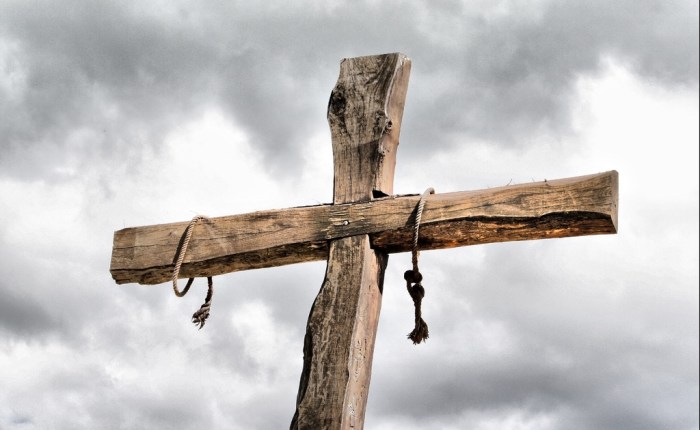
The Naked God: The Cross and Body Shame

The Naked God: The Cross and Body Shame

The Romans crucified their victims naked.

Indeed, the Gospels may even imply this when noting that soldiers cast lots for Christ’s clothing. Still, the thought of a naked Jesus splayed out before the world is uncomfortable to us. And rightly so. You will not find this painting in your Christian bookstore.

Along these lines, I recall (years ago) a fellow student asking a professor about the possibility that Christ hung naked on the cross. The teacher was incensed. “Of course not! To even think so is offensive!”

While I appreciated the concern for modesty, I remember thinking that the whole nailing-an-innocent-man-to-a-cross part was pretty offensive too. Yet it happened.

To reflect on this nakedness, however, does seem crass, unless there is some insight to be gained. And I think there is.

It has to do with bodies, shame, and those who have been made to feel less than human.[1]

5661613189_65be533432_b
P: Claudio Ungari

DEFINING SHAME

According to psychologists, we feel guilt for wrongs we have done. Yet we feel shame for who we are at some deep level. The concepts are related, but distinct.

Unfortunately, while guilt can be atoned for by punishment or making amends, shame clings to us more tenaciously. It lodges in our minds and in our marrow. It is the difference between “I have done wrong” and “I am wrong.”[2]

For Gershen Kaufman:

To feel shame is to feel seen in a painfully diminished sense. The self feels exposed both to itself and to anyone present. [It] is the piercing awareness of ourselves as fundamentally deficient in some vital way as a human being.[3]

While certain forms of shame may be warranted, this pervasive kind is deadly.

SHAME AND NAKEDNESS

In the Bible, shame is linked to nakedness. It didn’t start this way (Gen. 2.25), but when Adam eats the fruit he feels exposed. He was never clothed, of course, but now he feels it. So he seeks to cover himself. Enter fig leaves. In fact, the stated fear is not punishment, but being seen undressed.

“I heard you in the garden, and I was afraid because I was naked; so I hid” (Gen. 3.10).

The problem is shame, but the feeling is a body that we want to hide.

BODY SHAME

Today, the trend continues. In our culture, a common cause of shame is the body itself, especially as it fails to conform to rigid standards of perfection: models, magazines, ubiquitous pornography, and the crucible of comparison. These days, not even the perfect people are perfect enough, as evidenced by the need to airbrush them.

So while the apostle Paul once assumed that “no one ever hated his own body” (Eph. 5.29), our culture shouts back: “Speak for yourself!”

It is unsurprising then that so many of our shame words relate to the body.

  • fat,
  • weak,
  • pudgy,
  • plain,
  • pock-marked,
  • bald,
  • scarred,
  • flat,
  • freak,
  • repulsive,
  • and many racial slurs I will not write.

Whatever postmodernity is, it is definitely post-Eden.

SEXUAL SHAME

Then there is the realm of sexual shame.

The statistics are staggering: Twenty-five percent of girls will be sexually abused before they turn eighteen. One in five women will be raped, and 325,000 children will be victims of sex trafficking this year.

For many of us, the numbers include faces that we recognize. Indeed, the pain becomes more personal when listening, as I have, to a student say the following: “I was raped by my first boyfriend. We met at church. No one believed me.”

Shame.

Increasingly, the “Hunting Ground” for sexual assaults are college campuses (see here), where a mix of alcohol, partying, and attempts to hush or blame the victims often combine to add one shame upon another. Over such campuses, the question tolls like a funeral bell: “Where can I go to be rid of my disgrace?”

And that is not to mention the myriad of consensual encounters that leave one or both persons feeling objectified, used, and cast aside.

It is not called the “walk of shame” for nothing.

CHRISTUS NUDUS

But what does this have to do with the shameful nudity of Christ upon the cross?

Everything.

8307135748_44fe6af8f7_z
Ancient graffito, mocking Christians. Note the naked buttocks of the Christ-figure, with the head of a donkey. P: Jason M. Kelly

As one scholar writes:

The whole point of Roman crucifixion was to reduce the victim to the status of a thing, stripping him of every vestige of human dignity, in order to discourage any challenging of the might of Rome.[4] 

The key idea is this: We do not have a Jesus who merely bears our guilt and sin. Nor merely one who conquers death and devils. Nor merely one who loves without exceptions.

In addition to all this, Christ also enters into our deepest experience of shame and nakedness. He was mocked and laid bare not only before tormenters, but before his weeping mother! It does not get more shameful.

So hear this: To the bullied teen who cowers in the bathroom stall, to the victim of sexual assault who feels blamed for someone else’s crime, and to all others made to feel the weight of heaped-on shame, Christ says: “I KNOW.” I have been there.

I am Christus nudus (“the naked Christ”), not merely Christus victor (“Christ the victor”).

The cross is “God’s shame-bearing symbol for the world.”[5]

Upon it, the second Adam assumed the nakedness of the first, for as Gregory of Nazianzen wrote: “The unassumed is the unhealed.” We need a God who bears our shame. And we have one in the naked Christ.

CLOTHED WITH CHRIST 

But it does not end there.

After the resurrection, the New Testament pictures salvation as being clothed. Yet the clothing is not of earthly garments, but “with Christ” (Rom. 13.14). Paul saw this as taking place at baptism (Gal. 3.27).

Thus the early church even began what may seem like a strange practice.

Converts were baptized naked in imitation of a Christ who hung naked on the cross. In response to this, Saint Jerome’s (347–420 AD) oft-repeated motto for the Christian lifestyle read as follows:

nudus nudum Jesum Sequi” (naked to follow a naked Christ).

Because of Jesus, the metaphor of nakedness was transformed from a mark of shame to a metaphor of purity, innocence, and life-giving vulnerability (on that last bit, see here).

This is so because, on the cross, Christ not only bore our shame, he “scorned” it (Heb. 12.2).

This is indeed good news.

Christus nudus; Christus victor.


———–

[1] For a mountain of research on this topic, see the published doctoral dissertation of Dan Lé, The Naked Christ: An Atonement Model for a Body Obsessed Culture (Eugene, OR: Pickwick, 2012).

[2] See T. Mark McConnell, “From ‘I Have Done Wrong’ to ‘I am Wrong’,” in Locating Atonement: Explorations in Constructive Dogmatics, eds. Oliver Crisp and Fred Sanders (Grand Rapids: Zondervan, 2015).

[3] Gershen Kaufman, Shame: The Power of Caring (Cambridge, MA: Schenkman, 1985), ix–x.

[4] Philip Cunningham, Jesus and the Evangelists (New York: Paulist, 1988), 187.

[5] Robert Albers, “The Shame Factor: Theological and Pastoral Reflections Relating to Forgiveness,” Word & World 16:3 (June 1, 1996), 352.

Love thy transgender neighbor. And thy other neighbors also.

Love thy transgender neighbor. And thy other neighbors also.

Who knew that in 2016 the most disputed space in America would be a public toilet?

Whereas previously we would have been thrilled if someone merely cleaned such bathrooms, in recent weeks a number of policies have emerged to manage access to these sacred stalls.

1024px-bathroom-gender-sign

From progressives (and most notably Target), there was a move to allow essentially anyone to use the bathroom of their choice, provided that they claim to be transgender. This was done in the name of tolerance, while occasioning concerns for public safety. After all, some say, what is to prevent a deviant person from claiming to be trans in order to occupy the women’s restroom? Cries of “boycott!” soon followed.

Likewise, from social conservatives, there were a series of “bathroom bills” requiring that a person use the restroom corresponding to the gender on their birth certificate, or face penalties. This was done in the name of safety, while occasioning charges of transphobia. After all, many asked, is it really necessary to force the trans woman in a long dress, makeup, and high heels to use the male restroom or face fines? Who will enforce this? Shouts of “bigotry!” ensued.

What do I think?

MY OWN CONVICTIONS

As a Christian, I have deeply held beliefs about God’s design for gender and sexuality. I do not force these views on others, of course, but neither am I ashamed of them. Therefore it perplexes me that our culture increasingly sees gender as something detached from physical reality. (In the case of intersex births, the situation is more complex, but I am not talking about that here.) For both biological and theological reasons, my view is plain: physicality, not feelings, determines gender.

Yet at the same time, at the core of the Christian gospel is a call to LOVE thy neighbor. And that includes transgender persons too.

A few points here:

  • We can love while disagreeing.
  • Disagreement isn’t hate.
  • True tolerance is not synonymous with approval.
  • And love is always more than tolerance.

Indeed, one can tolerate others while despising them, but love requires more. Love reaches out, listens, protects, and serves. And love may also reason and disagree, for love refuses to be apathetic toward the beloved.

So back to the question:

THE QUESTION

Which side am I on in the great bathroom war of 2016?

Am I with those shouting “boycott!” or those claiming “bigotry!”?

As some might ask: “Are you for us or for our enemies?” (Joshua 5.13)

In response, I would quote the next line from the above passage: “Neither” (vs.14).

My reason has to do with the fact that neither stated concern is entirely groundless, even while I find the methodology of some on both sides troubling.

With regard to the progressive concern (not the policy), it does not seem unreasonable, in public spaces, for us to calmly allow the trans woman, who in many cases has gone to great lengths to appear as female, to use the women’s toilets in peace. After all, where do you think she has been going? It’s not a marriage proposal. It’s a bathroom stall. So love thy transgender neighbor.

Likewise, with regard to the conservative concern, it isn’t hateful to have qualms about a blanket policy that makes all bathrooms open to all persons. To have such safety or privacy worries does not make one a bigot. Nor does it make one transphobic, since the object of anxiety (in the best cases) is not the average trans person, but those others who might abuse the policy. In fact, to hold this position may simply be an effort to love thy other neighbors also, especially women and children. (Hence the title of this post.)

In sum, neither of these basic concerns seems plainly wrong.

So what is problematic?

THE PROBLEM

In my view, the trouble magnifies when both sides adopt heavy-handed policies (or laws) that cause more problems than they solve.

One side creates potential loopholes for sexual deviants, while whipping up the religious right into a boycott-happy frenzy. And the other places rigid requirements and penalties on a population that, for the most part, just wants to live in peace. Both results are bad. And when this furor erupts, it provides yet more fuel to the (absurd) progressive meme that traditional morality is the new Jim Crow.

Everyone loses, except those who use such controversies to their own ends.

So what would be a more responsible solution?

A PROPOSAL

In a more civil society, neither side would feel the need to legislate (or policy-push) this issue in a heavy-handed manner.

In a more civil society, people who have transitioned to a particular gender identity would be loved and respected enough to use the public bathrooms in peace, without a birth certificate, without fear, and without the need for sweeping legislation.

I find this reasonable, not because I agree that gender is socially constructed, but because we should also be concerned for the safety of the trans person, who may be harassed (or worse) if they use the bathroom of their birth sex. Many of these people have been violently bullied, and Christians should stand against this violence as strongly we stand for our own convictions. We can do both.

Likewise, in a more civil society, the privacy and safety of other citizens (i.e. thy other neighbors) would be respected enough to halt the official abolition of our gender binaries. Such blanket policies do cause safety and privacy concerns, and they should not be adopted.

CONCLUSION 

So, am I naïve to think that we could handle this public bathroom issue without sweeping legislation from either side?

Probably.

My approach shows no signs of being adopted.

Still, whatever happens, the way of Jesus calls us to be people of grace and truth. And that means loving our transgendered neighbors as well as seeking to protect our other neighbors also.

A civil society could do both. And as Christians, we should strive for that.


NB: If you comment, be respectful.

Christian, learn to say “perhaps”

Christian, learn to say “perhaps”

Tucked away on page 1,351 of N.T. Wright’s Paul and the Faithfulness of God, there is this gem of statement:

            “To believe in providence often means saying ‘perhaps’.”

In context, Wright is speaking of the fact that for Paul, moments of unambiguous divine revelation were rarer than we might guess. They happened, but not constantly. Whereas pagans believed in divination, consulting the entrails of animals, and any number of other techniques for receiving certitude, for Paul it was different:

“As often as not, Paul sees the divine hand only in retrospect. For the present, the attempt to discern divine intent carries a ‘maybe’ about with it. Maybe, he writes to Philemon about Onesimus, this is the reason he was separated from you. To believe in providence often means saying ‘perhaps’.”

For me, “perhaps” is intriguing for a slightly different reason.

It seems to occupy a kind of sacred middle ground between the two extremes of doubt and false certainty.

widest

THE ALTERNATIVES

On one extreme, we face the arrogant temptation of claiming to know more than we do. This can lead to dogmatic pronouncements on things that should probably held more tentatively. After all, in theology especially, we are talking about a mysterious and unseen God, not plotting the schematics for a circuit breaker. As Neil Plantinga writes, “besides reliability, God’s other name is Surprise.” And as Paul proclaimed, “we see now as through a glass, darkly” – we know “in part” (1 Cor. 13.12).

Yet the opposite extreme is equally unsavory. Across from false certainty is the sinkhole of pervasive skepticism. After the Enlightenment, empiricism demanded quantifiable data for every aspect of one’s worldview, and many were swallowed in an ocean of unbelief. In my view, this is not appealing either. Nor does it succeed in meeting its own criteria for verifiability. Here, the words of Shakespeare’s Hamlet still have force: “There are more things in heaven and earth [O Richard Dawkins] than are dreamt of in your philosophy.”

But the irony is this: Both certainty and skepticism have something in common: both bow before the idol of “proof” and make their sacrifices.

And in the middle, sitting quietly, is “perhaps.”

DEFINITION

What exactly do I mean by this? In truth, one could easily locate faith or trust as the midpoint between doubt and certainty. This makes sense. Yet for my purposes, I take trust to be an act of the will (or heart), whereas perhaps is more an exercise of the imagination. Faith says “yes” to core convictions of the creed, while perhaps stands upon this platform in order to peer into more uncharted territory: the blank spaces on our maps.

In doing so, it offers a hopeful, humble, and biblically-informed “what if?” Yet unlike the proof-obsessed alternatives of doubt and dogmatism, perhaps does so with the proviso that “this could very well be wrong.”

It is a kind of sacred speculation, on the basis of more firm convictions.

THE DANGERS 

In fairness, there are times when perhaps is not a helpful word. It can be used to indulge absurdity or unbridled speculation. “Perhaps, as some say, the earth actually sits on the back of a giant (unseen) turtle,” and if asked what this turtle stands on, the answer is straightforward: “it’s turtles man, all the way down.” Yeah… I doubt it.

Likewise, as a Christian, I choose not to endlessly mull over the “perhaps” of questions that have already been decided in my own mind. Thus I do not agonize continually over the possibility that “Perhaps God is not Love,” “Perhaps Christ did not conquer death,” or “Perhaps ‘morality’ is just an evolutionary adaptation.” While such questions are quite real for many, the anchor of my own faith keeps me from endlessly rehearsing them.

WHY IT MATTERS

Yet in other instances, the ability to entertain unlikely possibilities can be crucial.

Imagine, for instance, that you are a first century Jew who has been taught (from the Bible) that Yahweh is “One” (Deut. 6), that only God can forgive sins, and that no human should be worshipped. Then a traveling Rabbi visits your town, and starts saying things that seem to rub against all this.

“Before Abraham was, I am” (Jn. 8.58);

“I and the Father are one” (Jn. 10.30); and

“[I have] authority on earth to forgive sins” (Mk. 2.10).

What do you do?

Apart from God’s Spirit, and a profound ability to say “perhaps,” the answer is clear: You reject the strange Rabbi, you join the throng of confident doubters, and you cite Bible verses to show that it is justified.

Simply put, none of the earliest Christ-followers could hold on to both monotheism and the worship of the risen Jesus without the ability to do some fairly thorough reimagining. At some point, they had to say something like the following: “Well…this doesn’t seem to fit at all with what we’ve been taught, but perhaps God is doing something we had not expected. Perhaps we shouldn’t just reject it.”

For my own part, this thought experiment is particularly convicting. I am a theology professor, which means that if I had lived in the first century, I might have been one of the “teachers of the Law” who frequently interrogated Jesus. Given this, I sometimes wonder what my response would have been to this strange Rabbi saying strange things.

I know myself. I am not optimistic.

I too have trouble remembering that God’s other name is “Surprise.”

CONCLUSION

So while sacred speculation is not without pitfalls, there is justification for Wright’s pregnant sentence:

Sometimes, to believe in providence, means learning how to say “perhaps.”


Someone Reviewed my Book! (And Some Thoughts on Good Criticism)

Someone Reviewed my Book! (And Some Thoughts on Good Criticism)

Well, it happened.

Last week, I learned that my recently published doctoral thesis had been reviewed in an academic journal (Augustinian Studies). For seasoned scholars, such things are hardly news. You write a book. It gets reviewed. That’s how it works. But this is my first academic book, so for me the news was met with two equal and opposite emotions:

  • “Sweet!  Someone actually read it!” And:

  • “No!  I bet they torched it!”

Actually, the review was fantastic (full text below; reposted with the Journal’s permission):

Lincoln Harvey, of London, was both thorough in his treatment of my book, and incredibly complementary toward it, calling it “something of a manifesto against all-or-nothing readings of both Augustine and Gunton.” Mission accomplished.

But that’s not the only reason for this post. If it were, I’d feel an uncomfortable proximity to this story from the Babylon Bee: “Christian Author Models Humility by Retweeting only 75% of Compliments.” (To be clear, that’s not me. I’ve reposted 100% of my positive reviews.)

Here’s the serious point: All of us who make things—whether art, or websites, or handcrafted Amish furniture—crave honest feedback on our work. We need it. Yet the process of being critiqued is scary. Indeed, at the popular level, this is truer than ever, especially in the age of that dreaded invention: the “internet comment box” (acceptable literal translation of the Greek word “Gehenna”).

Sadly, in our culture, the thoughtful summation and evaluation of ideas is increasingly replaced by bombastic rhetoric, and a desire to distort others in exchange for points in a game that doesn’t actually exist. Of course, this also happens in academia (just with better grammar), but perhaps there are some lessons that the internet, or the world at large, could learn from the more cordial world of academic journal book reviews.

None of these are creative, but they are important:

  1. Before responding, try to understand.

This should be a no-brainer, but alas it is not. To understand takes time. And we feel dangerously short on that. After all, there are viral videos to watch. No need to read the article; just post a comment. It avoids the hassle of actually thinking.

  1. Don’t distort.

When interacting, we should be able to summarize another’s argument so accurately that they will at least know that they’ve been heard. One thing I appreciated about Harvey’s review, apart from the positive comments, is that he had obviously read my book, and then accurately represented it. The alternative is called “bearing false witness,” and it is a sin regardless of how many “likes” you get for doing it.

  1. Affirm something.

Almost every academic review finds something to affirm. I even read one that praised the quality of the pages and book binding. (Not a joke.) Some of this is mere politeness, but imagine how different our political or social discussions would be if we implemented this approach. Maybe I can’t agree with the economic policies of, say, Bernie Sanders, but I can at least affirm that he believes them, and that he feels a moral obligation to follow through on them. That’s more than I suspect of many candidates. (FYI: Don’t take that as an endorsement.)

  1. Critique the idea, not the person.

Some ideas deserve to get hammered. And there is even a place for satire and sharp retort. Just read the Hebrew Prophets. Moreover, when someone’s rhetoric has become dangerous or abusive, they deserve to be lambasted and even lampooned (see here).

Yet a further point that book reviews tend to model well is the general rule that we ought to critique ideas, and not people. To thoughtful observers, ad hominems reflect more poorly on the speaker than the target. And when the Bible calls us to “Judge not” it is often speaking of the unseen motives of another heart. We can’t know those. So we shouldn’t presume. Colin Gunton called this “the disgraceful Freudianizing of one’s opponents.” And he was right.

  1. Recognize that flawed ideas are sometimes the most interesting, and the most needed.

Boredom is a form of evil. And when arguments persist in hugging the shallows of conventional wisdom, that’s what they are—boring. In my own field, some of the most needed and interesting works have been deeply flawed. Gustaf Aulen’s Christus Victor is a prime example. The history is reductionistic, and the theological implications are dubious at certain points. Yet it was sorely needed. Despite weaknesses, it awakened scholars to a neglected theme of the atonement (Christ’s victory over the forces of evil), and that was what mattered.

A work can be manifestly flawed in certain ways, and yet profoundly helpful in others. Thus we must move beyond the gladiatorial options of “thumbs up” (winner!) or “thumbs down” (kill him!). Caesar did that. And he’s not Lord.

Conclusion:

In the end, I’m glad for a positive review. But I’m even more thankful that someone took the time to model the above points. May we do likewise.

Does God “forgive” if Jesus pays our penalty (Part 2 of 2)

In part one of this post, we highlighted a claim by Greg Boyd about divine forgiveness.

As Boyd argued, the idea that God forgives our sins, and the idea that Jesus paid the penalty for them cannot both be true.  They are incompatible, at least as he sees it.

His argument involved the following analogy:

“If you owe me a hundred dollars and I hold you to it unless someone or other pays me the owed sum, did I really forgive your debt? Yes, you got off the hook. But forgiveness is about releasing a debt — not collecting it from someone else.”

For starters, there are several things that I appreciate about Boyd’s work. We both have disagreements with aspects of Reformed theology (though I am not an Open Theist), and his book The Myth of a Christian Nation has great points about how (according to the subtitle) “the Quest for Political Power is Destroying the Church.” In addition, Boyd does a fantastic job of communicating theology in ways that are understandable to the average person, and his emphasis on the Christus Victor model of atonement is often very helpful. I like him.

Yet on the present subject, I think there is good reason why this is not a particularly common argument (are there others who make it?).

The main problem, in my view, centers on a false assumption about what forgiveness entails.

The crucial question is thus: Does the forgiveness necessitate that no punishment may be handed down for the offense? Boyd assumes so, but this seems obviously wrong.

Consider, for example, the parents who (incredibly) choose to forgive the murderer of their child. While this is an amazing act of grace, it by no means implies (as Boyd seems to assume) that all penalties must be waived for the crime. Indeed, no thoughtful person would respond to the parents’ action by proclaiming: “Well, it’s very nice that you did that, but it is not forgiveness, because the criminal is still in jail.”

In this regard, Boyd is simply wrong about what forgiveness means. It need not be antithetical to all legal consequences.

Moving back to the many biblical examples, it is telling that Israel’s absolution often comes after (or alongside) the enactment of certain covenantal penalties—things like exile, or a defeat at the hands of enemies. Here too forgiveness need not imply a total lack of punishment. Often, as with Christ, it comes through the shedding of blood (Eph. 1.7). And in the case of penal substitution, the assumption is that divine faithfulness to the covenant means that our forgiveness comes because God himself decides to bear the curse of the Law.

In the end, Boyd’s claim seems to misunderstand both the meaning of forgiveness in our contemporary culture (e.g., the example of the forgiving parents), and its meaning within the biblical and covenantal narrative. Of course, this does not prove that penal substitution is correct—it could well be wrong for many other reasons—but it does show that this particular claim has some false assumptions.

On a related note, one thing I have appreciated in the recent growth of analytic theology—as exemplified by folks like Tom McCall and Oliver Crisp—is a concern to be a bit more careful about such issues of terminological precision and argumentative rigor.

While this concern is not unique to analytic theology, it is sometimes stunning (as in the above example from Boyd) how quickly theologians make sweeping conclusions without ever clarifying or mounting an argument for what a given concept actually means. In fairness, most all of us have been guilty of this.

Thankfully, though, there is one thing that Boyd’s argument get’s right: with God there is forgiveness.

—-

On a related note, if you are interested in an introduction to analytic theology, Tom McCall’s new book (An Introduction to Analytic Christian Theology) is a great read.

Does God “forgive” if Jesus pays our penalty? (Part 1 of 2)

Does God “forgive” if Jesus pays our penalty? (Part 1 of 2)

For those who are interested in theology, here is another atonement post with a question to consider:

In the Bible, God is a forgiver.

As Psalm 130 states:

If you, LORD, kept a record of sins,

Lord, who could stand?

But with you there is forgiveness (vss. 3-4a).

Dozens of passages could be added to this, but as Alexander Pope wrote: “To err is human; to forgive is divine.”

So here is what may seem like a strange question:

  • Can we really say that God “forgave” sins if Jesus paid the price for them?

For many Christians, one meaning of the cross is that Christ willingly bore the penalty that we deserved. Therefore, there is “no condemnation” for us (Rom. 8.1), because Jesus was condemned in our place. This is referred to as “penal substitution,” and it sometimes focuses on the idea that sin’s price was paid in full.

Yet for the contemporary theologian Greg Boyd, this runs counter to the Bible’s claim that God “forgives.”

As Boyd argues, forgiveness is “the release of a debt.” Yet:

“If God must always get what is coming to him in order to forgive (namely, “a kill”), does God ever really forgive?”[1]

Boyd thinks not. And for him, this is yet another reason to abandon penal substitution for more coherent understandings of atonement (see more here ). As he explains:

“If you owe me a hundred dollars and I hold you to it unless someone or other pays me the owed sum, did I really forgive your debt? Yes, you got off the hook. But forgiveness is about releasing a debt — not collecting it from someone else.”[2]

So what do you think? Does Boyd’s point resonate with you? Why or why not?

While I would not claim that penal substitution is somehow the “most important” model of atonement, I am currently looking at some objections to it for a chapter in a larger book. Hence the repetition of the penal substitution questions.

This question builds on two previous posts (here and here), which examined a related objection  involving the parable of the Prodigal Son. If you are new, see those prior posts for further context.


———————

[1] Gregory Boyd, “Christus Victor Response,” in The Nature of the Atonement: Four Views, eds. James Beilby and Paul R. Eddy (Downers Grove, IL: IVP Academic, 2006), 104.

[2] Gregory Boyd, “The Danger of the Penal Substitution View of Atonement.” Re|knew. November 20, 2014. Accessed April 2, 2016. http://reknew.org/2014/11/the-danger-of-the-penal-substitution-view-of-atonement/.

Burn your silo; find a home

As Walter Lippmann said:

“When everybody thinks the same, nobody thinks very much.”

I love that statement, but it’s also convicting.

The gist is simple: There is profound danger in surrounding yourself with voices that sound strangely like your own. It’s called the “echo chamber,” and the result is the assisted suicide of critical thinking.

As I heard a wise man say:

“If you only read the books you write, your ‘truth’ will always be slanted.”

These days, the slant goes by many names:

  • confirmation bias,
  • the herd mentality,
  • tribalism, and
  • a silo culture.


In a silo culture, homogenous items are kept safely together, and safely separate from all else. There is little meaningful communication between silos, and few doors or windows. And as the Cold War taught us, “silos” now have a further purpose. They are for launching missiles in the direction of opposing silos.

bwsilos
Photo by Patrick Feller

Both meanings are fitting. Silos are symbols of separation, and of mutually assured destruction.

And whatever your position on particular social or political issues, you have to admit one thing: Our culture has embraced its silos.

Take, for instance, the way we get our “news”:

In prior eras, there were a few respected voices: Cronkite, Murrow, Brokaw. They were biased, of course (for everyone is biased), but we mostly drank from the same wells.

Not today. Now, we have our “silo-sources.” They have been carefully designed by market research to suit our preferences and our prejudices. Not too hot. Not too cold. They’re “just right”—with a steaming side of confirmation bias.

Are you a raging liberal who thinks George W. Bush would have been a Bond villain if only his IQ was higher than a Texas hunting dog? Enjoy the echo chamber of MSNBC.

Or maybe you think Obama is a secret Muslim who simultaneously loves gays and beer and Sharia law (think about that…). Good news. You too have Cable News corroboration. It’s fair and balanced. No tribalism here.

Unfortunately, we are now discovering where silo-sources leave us (see the current presidential frontrunners).

My point, however, is not about our news or politics.

It’s about community, friendship, and the kind of relationships that actually help us think.

Here’s my big idea:

While tribalism can be deadly, there is great value in belonging to a tribe.

While silos separate us, we still need homes.

Humans need community, and some of that community should be like-minded. That’s not a bad thing. To accomplish anything, we need shared vision. We need spouses and friends who see the same truth we do, just as we need voices to challenge our assumptions. To deny the value of all like-minded groupings is to cast oneself adrift on a sea of loneliness and isolation. That way lies cynical inaction.

There is value in belonging to a tribe, and I certainly have mine.

As a follower of Jesus from a particular segment of the Christian family, I am part of an admittedly peculiar (and imperfect) people. It is a bounded set, which means that it has fences, unique problems, and beliefs that we hold in common. That is as it should be.

In one sense, to have a tribe is to have a home, and homes are good.

Homes have doors and windows, and perhaps a welcome mat. In good homes, outsiders are welcomed with hospitality, and family members are bound together by more than shared opinions. In homes, there are lines of communication with the outside world, and not just the “Red Phone” for launching missile strikes! In a home, insiders leave and return, preferably on a daily basis, in order to embrace the outside world.

Because while we should have homes, we were never meant to hole-up there. Agoraphobia is a disorder—and a fear-based way of living.

Here’s my point: When tribes become tribal, homes become silos, and fences become unwelcoming walls (“y-uge beautiful walls”…perhaps paid for by Mexico). And that is bad for everyone.

It is killing civil discourse, and it is the assisted suicide of critical thought.

“When everybody thinks alike, nobody thinks very much.”

It’s time to burn our silos, while also finding homes.

In defense of piggyback rides


This week, my wife and I got a touching note from a former student. Amongst other things, it said this:

“I feel beyond thankful for your loyal friendship… I think my faith took a ‘piggyback ride’ on yours for awhile there, and it made all the difference.”

As a dad, I am something of an expert on piggyback rides.

But that line has me thinking of the concept in the realm of friendship.

Can tired faith climb aboard the shoulders of another person? 

I hope so.

getting_children_out_of_the_fields_and_into_school_8424375496

In opposition to this notion, some think of faith as a completely individual possession.

It’s like underwear and toothbrushes. You don’t share.

After all, you can’t believe for someone else. Thus, preachers often (and rightly) emphasize the importance of each person deciding what they will do with Christ. And I don’t disagree with that. Yet the Scriptures also say things that call into question our culture’s rampant individualism, even when it comes to faith.

I could cite lots of examples, but I’ll stick with one.

Consider this passage about a paralyzed man who is “piggybacked” (er… carried) to a house where Jesus is. After his friends dig a massive whole in the building’s roof, the lame man is then lowered down to be with Jesus.

Mark’s version, says it this way:

“When Jesus saw their faith [that is, the faith of the men who had just ripped open the roof and lowered down the mat], he said to the paralyzed man, ‘Son, your sins are forgiven’” (Mk. 2.5).

Reread that. When Jesus saw the faith of the man’s friends—the ones who had carried him to Jesus—he forgave (and healed) the paralytic. The commentators are unanimous.

Now, I don’t doubt that the lame man also believed in Christ. Especially when he started walking.

But the passage doesn’t emphasize that. The passage emphasizes the faith of the man’s friends.

So what’s the takeaway?

I don’t know the exact distance or extent that faith can be “piggybacked.”

I’ll leave that to God.

But I do know this:

I’m grateful to have some friends who would–beyond a shadow of a doubt–rip off the roof, risk felony charges, and rain down drywall on the Son of God if they thought that it would help me.

That’s friendship.

Piggyback on.

“Greater love has no one than this,that one lay down his life for his friends” (Jn. 15.13).