The Eclipse of Evangelicalism?

The Eclipse of Evangelicalism?

Just in time for today’s solar eclipse, David Drury (of Wesleyan HQ) has written a pointed piece on what he terms “The Eclipse of Evangelicalism.”

His claim is that, as a movement, evangelicals have seen their core convictions eclipsed by other aims and ends; hence he even argues that, as a movement, evangelicalism is “dead.”

While I don’t have time for a full critique here, I appreciate the call to repentance and a reclaiming of our core-convictions.

While “dead” may seem too-strong a word to many; I’m glad that Resurrection is even stronger.

Here it is.


The Eclipse of Evangelicalism

Repentance Upon the Death of a Movement 

By David Drury

As of this day, August 21, 2017, I believe that the evangelical movement is dead. At least, it appears to be dead. As a movement, evangelicalism is no longer effective in its original aims in the West. The movement has shirked its persistent values, and has quit practicing the core convictions that made it relevant and necessary. Even if evangelicals still claim to believe the core values, they do not practice them. Evangelicalism still exists as a category of people today—but it no longer is an actual movement in the kingdom of God.

Today Americans gather to watch one of the most unique sights the skies produce: a total eclipse. The moon is passing directly between the earth and the sun, blocking its rays, but for a corona of subtle light exuding from the dark circle, a faint reminder that the sun is still there, obscured for a time. Visible from coast to coast, the eclipse shown on a map looks like an arcing brush stroke swept from Oregon to South Carolina. The last time the sun was eclipsed like this (what they call a “totality”) in America was June 8, 1918. Much has changed in the 99 years since the last total eclipse, particularly for evangelicals.

In the last century, but particularly in the last decade or two, the core of what it means to be evangelical has been eclipsed by other priorities. The shining truths have been obscured by other moons, which have come between evangelicals and their core identity. In the process of this eclipse, a darkness has come across the land of evangelicalism, and even though it happened slowly, it has happened surely to this day, where a near totality has been reached.

Evangelicalism has a long history that can be told in a variety of ways. Finding its source in revivals and awakenings as well as Methodism and pietism. Whitefield and Wesley, Ockenga and Graham, Finney and Stott, Edwards and von Zinzendorf: they all could be seen, in their own way, as founders from different eras of the evangelical movement. Most agree that evangelicalism, as a movement, reflected a core set of values, which were…

  1. Conversion-oriented
  2. Bible-following
  3. Cross-focused
  4. Culture-transforming

These are the classic four core values affirmed by many in evangelicalism, including the National Association of Evangelicals.

Let’s examine each of these characteristics of evangelicalism and how they have been eclipsed:

Conversion-oriented                                                                                      

Evangelicals not only believed but behaved in a way that being “born-again by the transforming work of Jesus Christ” was critical. They shared their love of Christ to others and people “came to Jesus.” Was it messy? Yes. Did it all add up like a theology text-book? No. But because of this passion for conversion millions entered into a life-long process of following Jesus in fits and starts. This meant that disciples were called out to “follow me” and enter discipleship.

Today the conversion-oriented activity of evangelicals has now been eclipsed by the love of entertainment.

Bible-following – More than merely Bible-believing, evangelicals were a Bible-living sort of people. They followed the Bible and obeyed its teachings. They gave scripture a higher authority over any other source. Some might have valued reason, tradition, and experience, but even those critical elements were subject to the witness of the Gospel of Jesus Christ found in the Bible. The pietistic, revivalist, and holiness streams of evangelicalism ensured that the people called evangelical were not just evangelistic, but also discipled to live differently by obedience to this gospel.

Today the Bible-following lifestyle of evangelicals has been eclipsed by the love of self.

Cross-focused – Core to being an evangelical was a cross-focused way of life. The evangelical was living by the mantra: Christ has done it on the cross. The evangelical was all about the forgiveness attainable by the sacrifice of the perfect God-man on the cross, making possible the redemption of all humanity. Evangelicalism believed in the incarnation, the teaching of Jesus, the miracles, the resurrection, and the ascension, and return of Christ—but central to it all was the crucifixion as the event and doorway into the rest of its three values. This brought the movement a potency and clarity in focus where all things began and ended with Jesus.

Today the cross-focused nature of evangelicals has been eclipsed by the love of power.

Culture-transforming – Evangelicalism was missionary and activist in an inter-dependent manner. Evangelicals cared about the souls living down the street and around the world, so they sought to share the gospel with them in innovative ways, and advocated for changes in the economy and government in a way that would help those who were voiceless or oppressed. Abolitionists, suffragists, and pro-lifers all found a home in this paradigm. To a lesser extent, the civil rights movement found a home in this paradigm as well (although largely in the Black Evangelical church, more on that later). They all sought to see people come to Christ worldwide and to, as a result, transform entire societies as the holy witness of Jesus spread across the land.

Today the culture-transforming mission of evangelicals has been eclipsed by the love of money.

You might see the a theme evident in the phrasing above, but one of the things that has had a frog-in-the-kettle effect for this change in evangelicalism is that long ago we stopped actively measuring the actual activity attached to these values, and instead merely treated them as beliefs one would check off like a creed. Evangelicals were decidedly not a creed-oriented people, so this is out of character, but these four values became something to help us discover the answer to the question: “who is an evangelical?”

Surveys began to ask questions discerning how much someone believed statements like: “the Bible is the highest authority for what I believe,” or: “only those who trust in Jesus Christ alone as their Savior receive God’s free gift of eternal salvation.” It is quite difficult to measure the actual behavior of people, and easier to do a survey of what they say they believe. Further, it may be important for younger readers who have come of age during a partial eclipse of evangelicalism, that evangelicals of days gone by didn’t just say they believed these things, they actually lived differently than their non-evangelical neighbors because of them.

Some have attempted to redefine evangelicals or categorize them to make a distinction for those who actually go to church, or engage in other practices. These attempts are noble, but have for the most part shown disappointing trends all the same.

I say “we” in the next sections because I am part of the problem I will outline. I repent of each of these choices, for I have my part in them, particularly since I am a leader in a denomination, and have responsibility for not only my own actions but for the behavior of my people. I am convicted in each of these areas, and write them through tears, grieving for the eclipse of one of the most important and Christ-honoring movements in the history of Christianity.

The Eclipse of Conversion by Entertainment

We choose entertainment over evangelism every day of our lives. We evangelicals care more deeply about the characters on our favorite Netflix show than the neighbors in the homes next to us. We value news as entertaining commentary and conflict more than the world full of those who need Jesus. We choose to value attendance at our churches far more than conversions in our services, much less in our conversations. We have even ceded the worship of God over to an entertainment-driven cycle, one where our Church teams and staffs are continually required to top what they did last week to continue to attract us and entertain us as the “audience.” Our churches accidentally become a part of the menu of Sunday entertainment choices the suburbs have before them, where people wonder: “should I exercise, watch news shows or football, sleep in, take the kids to soccer practice, mow the lawn, or go to Church today?” This is all propagated by an evangelical culture that chooses to feed off the entertaining rush that comes through mostly socio-political conflict with strangers, and even our friends, in comment sections and social media. We care little for the souls of these people we interact with—we demonstrate that we only care that our ideas win the argument, and that we look smarter than our opponents while doing so. We need lessons in civility at a 101 level, to say nothing for the lack of holiness displayed. We no longer love our enemies for the sake of the gospel, we don’t even build bridges our friends if they disagree with us. Evangelicals have “un-friended” the world in the process, as if the gospel of Jesus Christ and possible conversion of these acquaintances is worth nothing to us.

But, before I depress us overmuch, I need to say that I think we post-evangelicals know deep down that conversion of the lost is more important than all the entertainment of this world. Everything will change when we engage more devoutly in our own converted discipleship journey—updating the simple, millennia-old practices of our faith, by meeting as handfuls of believers in living rooms and coffee shops, reading the Bible and praying for each other, interceding over names of lost people, and serving together in our communities. We must repent of our idolization of comfort over conversion, knowing that only Jesus saves us.

Regardless of what others do, I commit to conversion-orientation, because it starts with me, or my vibrant faith dies along with evangelicalism. I repent that I have allowed entertainment to eclipse the importance of conversion, and will make concrete steps before the end of the year to engage with fresh focus in this area, and reject the idolatry of entertainment and comfort which evangelicalism has embraced.

I will…

  • Pray for the lost
  • Share my faith
  • Eliminate excessive entertainment & consumption
  • Engage in uncomfortable conversations
  • Converse with civility and redemption in mind online and in person

The Eclipse of the Bible by Self

We choose ourselves over the core convictions of the Bible routinely, so we are bereft of anything resembling the fruit of the Spirit. It has gotten so bad that mainline liberals who we think don’t even believe in the authority of scripture in their lives are better at actually obeying most of the commands of Jesus than we are. This is a profound indictment for us who purportedly have the blood of Jesus covering our sin. Jesus has called out a holy people, a royal priesthood of all believers, and instead we choose whatever our own selfish desires want. Instead of contextualizing the gospel, we rationalize our behavior. We think less of what the world needs to next hear, or what the gospel claims for our actions, and we think more of what backs up our actions in scripture. When we are challenged by anyone we do a google search of scriptures that might somehow be negotiated into backing up our behavior, rather than engaging in the word in such a way that it actually challenges us and our obedience to it any longer. We attack the world primarily over matters of sex, while being no more holy than we were a decade ago ourselves. We are stuck in our sins and believe in the authority of the Bible only in as much as it gives us the authority of self-expression of our evangelical political concepts over others. We don’t actually give the Bible authority over our own daily walk, we use it as a pseudo-authority over others, thus turning the living word of God into an idolatry of selfish aims.

But, I think we post-evangelicals know deep down that the Word of God is more important than any one of us in this world. If we return to the beautiful life-giving way of scripture-living people the movement may rebirth in us. If our neighbors see us actually living differently than them, instead of just putting a different political sign in our yards than them, we will have begun to change this trend. May we repent of our sins and go back to Scripture in our quiet moments each week, worshipping God in our every step, confessing and repenting when we err, and becoming a people that are admired for our devotion to living as Christ taught, rather than as hypocrites who always point out the sins of others, never taking care to confess our own.

Regardless of what others do, I commit to Bible-following, because it starts with me, or my vibrant faith dies along with evangelicalism. I repent that I have allowed authority of the self to eclipse the authority of the Bible, and will make concrete steps before the end of the year to engage with fresh focus in this area, and reject the idolatry of self which evangelicalism has embraced.

I will…

  • Read my Bible in a way that it convicts me about my behavior and attitude
  • Allow others to truly keep me accountable to live in a holy way
  • Live with conviction under the authority of Scripture
  • Eliminate hypocrisy from my life
  • Selflessly admit I could be wrong

The Eclipse of the Cross by Power

We choose the power of the world over the power of the cross, preferring to chase the halls of power in Washington D.C. through political machinations rather than to rely on the work of Jesu Christ. We would prefer to put a picture of ourselves with our favorite politician on our wall than the cross of Jesus Christ. We leaders point to our likes and shares and platform, all symbols of our powerful status, rather than point to the cross of Jesus, boasting only in him. We would rather invite a politician into our pulpit, literally between the congregation and the cross in our buildings, to curry favor and let fame rub off on us than to call people to the forgiveness of Jesus Christ at the cross. All too often this power we desire has actually had overtones of white power with a strident denial of any white privilege. We have allowed those with vaguely white supremacist views to not only take refuge in our churches and go unchallenged from the pulpit, but also to allow a neo-supremacist view of race to cultivate even among our educated and influential leaders. As this has happened, the idea of a Black Evangelical and a White Evangelical has become even more distinct, and the already deep divisions and darkest days of evangelical separatism have re-emerged, threatening the unity that God commanded of us in a more direct way than at any time since the Civil Rights era, when we likewise largely failed at the challenge set before us by God. Some have hoped that revival would come and then magically end our problems of race, providing unity. It could be that God is waiting upon our true repentance from the lust for power and the subtly supportive practices of racism to allow revival to come. We may have his priorities out of order, since confession often precedes and sparks revival, rather than coming after it.

But, I think we post-evangelicals know deep down that the cross is more powerful than the powers of this world. If we begin to see how the Holy Spirit might bring us together, across race and ethnicity, and to truly listen to the concerns of our brothers and sisters of color, we can reverse this trend. If we repent of our chasing after the power of the world, and begin to chase after the power of God, we will find a greater statesmanship, and a credibility to actually speak into the public square that we have somewhere along the way lost. When we think of our identity, we can regain a sense of movement only by pointing to the cross of Christ, by pointing to the party of the lamb, rather than advocating for the party of the donkey or the elephant, chasing after the permanent power of heaven, rather than temporary power of this earth.

Regardless of what others do, I commit to cross-focus because it starts with me, or my vibrant faith dies along with evangelicalism. I repent that I have allowed power to eclipse the cross of Christ, and will make concrete steps before the end of the year to engage with fresh focus in this area, and reject the idolatry of power which evangelicalism has embraced.

I will…

  • Fix my eyes on Jesus and his cross
  • Ask others to question ways in which I seek power
  • Eliminate partisanship from my faith convictions, demoting party affiliation to a preference
  • Ask open ended questions of people of color, receiving and follow their counsel
  • Doing the hard work of reconciliation that actually costs me something more than words

The Eclipse of Transformation by Money

We choose money over missions and over the transformation of cultures and societies. We calculate the cost of every move so we never say anything that might too sharply challenge anyone, we have ceded the prophetic high ground of biblical justice in our churches to ensure the steady flow of resources to make sure we meet budget and build buildings. We have lost the urgency to send anyone to reach the billions and billions who are lost worldwide, and evangelicalism is no longer the mission sending movement it was designed to be. Evangelicals from the global south now send droves of missionaries to North America to reach those we miss in our back yard, and nine other countries now send a higher percentage of their members as missionaries than we do. Church boards act more like money managers of missionary funds than the classical evangelicals who gathered in days gone by, shedding tears, praying prayers, and paying the way for those to reach entire countries dying without Christ. They sent their own sons and daughters for the cause, while we obsess about a rate of return on our investment like bankers instead of believers. Likewise, we care not for the actual transformation of our neighborhoods and cities at home. Evangelicals largely see immigrants and refugees as only a threat to our fiscal security, rather than people that we might reach for the sake of the gospel, or when they are Christians (as is often the case) seeing them as partners we can learn from and work with. This erosion of transformative motive has made tapping into the xenophobia of evangelicals a sure-fire election issue for politicians. We choose where to live and where to have our children educated with only a concern for our financial well-being and protection. Propagating our financial security and growth is the unspoken but constant aim of our decisions, and we cannot transform the souls and systems of society when the goal is our own greed.

But, I think we post-evangelicals know deep down that the transformation of our culture is more valuable than all the money in this world. We can restore what we once were by fostering a zeal for the world’s salvation, a sense of loving the whole world like our Father does, sending his own Son to save it and offer his transformative way of life to all. We can regain what God wants for us if we look at our culture as a whole, and find cross-cultural ways to bring the kingdom of God on earth as it is in Heaven, whether that means a loving connection to the immigrant new to our neighborhood, or the lost land in another hemisphere that needs us to rekindle the fires of missionary impulse.

Regardless of what others do, I commit to this kind of missionary culture-transformation, because it starts with me, or my vibrant faith dies along with evangelicalism. I repent that I have allowed money to eclipse the transformation of culture, and will make concrete steps before the end of the year to engage with fresh focus in this area, and reject the idolatry of money which evangelicalism has embraced.

I will…

  • Live on dramatically less and spend more wisely
  • Give a greater amount of my income to supporting missionaries
  • Pray for worldwide evangelism daily
  • Consider which areas of systemic injustice require my sacrificial investment
  • Eliminate ways I contribute to injustice and risks my white privilege to defend the oppressed

Four out of Five White Evangelicals

Now we need to talk about the elephant in the room. Much has been made of the data showing that White Evangelicals in the US voted for Donald Trump at a rate of 4 out of 5. You may not like me bringing this up in the context of this treatise which is more about the state of the church and theological matters, but like or not, as evangelicalism reaches total eclipse, it comes at a moment when we are associated quite directly with the President we largely helped achieve power. It is notable that many prominent evangelicals were silent about politics in the past few years, but many supported and continue to support Trump vocally. As a full disclosure on my part, two of the most notable public evangelical detractors of Trump include two great leaders I worked for directly in the last decade, Jo Anne Lyon and Max Lucado.

So as we consider evangelical identity in its age of eclipse it is pertinent to ask ourselves: is Trump an evangelical? I am tempted to say no, based on the above classical components of evangelical belief and life, Trump is not a classic evangelical. However, he may in fact roughly match the reality of evangelicalism in eclipse. He juggles these four factors like a court jester of Washington DC, giving little if any respect or attention to the values evangelicals have said they care about for hundreds of years.

He has experienced no personal conversion personally, claiming to have never even asked God for forgiveness and defending his faith as an entirely private matter, but he values entertainment over most anything, devoting most of his business life to it. Even those that cannot stand our president must admit that he is a highly entertaining sort. No one has ever accused the man of being boring. He is not Bible-following, in belief or practice, as is patently evident in his behavior and words. He is not cross-focused, never bringing to bear the concepts of redemption or the reconciling grace made possible by the death of Jesus on the cross. Nor is he culture-transforming, as his isolationist values make no room for the longstanding moral and Christian influence of our nation worldwide, something that evangelicals have perhaps even over-stated in the past, in their drive to be a witness to the world.

Some hoping to gain through his candidacy have written these things off as the beliefs and practices of a “baby Christian,” or a “man with flaws but a good heart.” I am not here to talk about politics. My aim is not to convince you to object to Trump as I and my mentors have, or to support him. Instead, my claim is that Donald Trump may in fact be a mirror to hold up to show evangelicals what they actually look like now. Whether you have a politically calculated toleration for Trump, or a revulsion to his policies and behavior, he is us, reflecting in the mirror all our lost glory as evangelicals.

Donald Trump is what we evangelicals already are, or at least are becoming. It explains why he is so supported among us. Even after a cavalcade of circus-like activity coming from the White House since his inauguration, he still retains his support. Why? Why not, I say, if he matches what we actual value. We love entertainment, ourselves, power, and money. Trump gives us those things. We need to admit it. We love these values even more than the Son of God they obscure behind them. We might fill out surveys and claim differently, but we don’t live that way.

Next Evangelicalism

In this treatise I have claimed that like the eclipse of the sun by the moon, evangelicalism has been eclipsed internally by other priorities and idolatry. Repentance is needed by we evangelicals, and a return to the core values that made evangelicalism purposeful for God in the first place. Evangelicalism was never perfect, but it was used by God, and perhaps this eclipse will pass if we each as individuals recommit to do our part to the core tenants that made evangelicalism work for Jesus. We may need to throw out the term. We may need to join a Christian identity that will emerge and be created by young people tomorrow that we cannot clearly see today. But whatever the case, may we again become those who value:

  1. Individual lives converted by Christ and made new…
  2. The Bible as the true guide for actually living differently than we used to live…
  3. The cross of Christ as the actual crux of history, which provides the only persistent power worth aligning ourselves with, and…
  4. The missionary transformation of cultures and communities, found here and nearby, and in the hard and faraway places likewise.

May all this be made possible by the Him who can do immeasurably more than all we ask or even dream of, Jesus Christ.


David Drury is author of ten books, including God is for Real, Transforming Presence, Being Dad, and SoulShift. He serves at the chief of staff for The Wesleyan Church headquarters. The Eclipse of Evangelicalism may be re-published in any format provided these lines are included. © 2017 by David Drury




I’m glad they carried tiki torches

I’m  glad they carried tiki torches

“In a way, I’m glad they carried tiki torches and wore well-pressed polo shirts.”

That was one of my (admittedly strange) thoughts while grieving the vile scene from Charlottesville this weekend.

The citronella made the barbarity feel suburban–and that matters.

White Supremacists March with Torches in Charlottesville
P: Zach Roberts/NurPhoto

The stereotype for white supremacy (as set forth by Jerry Springer) usually involves a two-toothed yokel in bib overalls, catfish bait beneath the fingernails, and married to a cousin.

That’s unfair.

Not to white supremacy, but to the many decent folks who wear bib overalls.

That picture of racism is dangerous because it’s easy to dismiss as distant and defunct.

“I don’t know anyone like that.”

But the young millennials marching in Charlottesville looked (well…) a lot like me:

  • sensibly dressed,
  • semi-literate, and
  • unacquainted with cousinly matrimony.

That’s important too.

Because as long as I view white nationalism as just a backwoods problem, I will never note the subtle ways it grows untended in my own backyard.

Now a word on that.

A DANGEROUS QUESTION

Shortly after Saturday’s bloodshed, a pastor-friend of mine posed this question to me.

How long could a polo-shirt wearing, tiki-torch bearing white nationalist attend your evangelical church before hearing something from the pulpit that would contradict his worldview?

One month?

One year?

One lifetime?

What would be your response?

I’m thankful to be part of a tribe that has tried to change the answer to such questions (see here). Yet we have some work to do.

SOME HONEST HISTORY

For the past few weeks, I’ve been reading the latest history of American evangelicalism (The Evangelicals) penned by Pulitzer Prize winner, Francis Fitzgerald.

It has been a painful but important read.

A stark reminder has been the extent to which many evangelical leaders found themselves on the wrong side of civil rights.

And by that, I do not just mean “the wrong side of history” (see here), but more importantly: “the wrong side of God.”

The reason?

White nationalism. And a desire not to run afoul of their “constituency.”

To take a famous example: Jerry Falwell, the founder of the Moral Majority (and Liberty University) preached and published passionately for segregation; he called racial integration “the work of the devil”; and he denounced civil rights legislation with the claim that “it should be considered ‘civil wrongs’.”

He eventually disavowed these viewpoints. Yet his mature ministry was still marked by staunch support for the white supremacist government of South Africa, which he visited, while denouncing Bishop Desmond Tutu as “a phony.”

Billy Graham was (normally) light-years ahead of Falwell on this subject.

Yet even he struggled to stand up to his constituency. While MLK languished in a Birmingham jail in 1963, Graham chided his “good personal friend” with the claim that he needed to “put the brakes on a bit” in the quest for justice. Likewise, Graham often insinuated at the time that whites and blacks were equally culpable, even in instances when violence against nonviolent black marchers was at its height.  (If you have ears to hear, then hear.)

A HOPE

The reason for bringing up this history is not to look down our collective nose at those who were, like all of us, people of their time.

The motive actually is just the opposite.

Evangelicals must be honest about our past so as not to repeat it.

Because the real danger of white nationalism (or hatred of any kind) is not the Jerry Springer stereotype.

It is the subtle form that will kill us, without ever climbing behind the wheel of a Dodge Charger.

Christians and Climate Change

Christians and Climate Change

My Interview with a real-life Climate Scientist

Jim Norwine is a unicorn.

A few years ago I met Jim as he audited my university New Testament class.

For the unfamiliar, auditing means attending my lectures simply for the fun of it, rather than for college credit. (Needless to say, some of my traditional students find this very odd.)

Nevertheless, Jim and I became friends.  And I then learned that he is a PhD scientist, specializing in Climate Change, and having taught for years in the Geosciences at Texas A&M.

Jim is a scholar.

Yet he is also an evangelical Christian, living in the Bible-belt — which brings us to the opening line about his almost “mythical” status. As he admits, evangelical climate scientists (with actual PhDs in the field) are somewhat rare.

EVANGELICALS AND CLIMATE SCIENCE

Manmade global warming, while accepted as an empirical fact in many places, is often controversial in the Bible-belt (though not for theological reasons).

And like everything else, it is highly politicized.

Even so, the command to be good stewards of our earth is a mandate for all Christians. And the need to listen to actual experts on such subjects (rather than unqualified bloggers like myself!) seems wise.

So whether you “believe” in manmade climate change or not, I hope you’ll enjoy the interview I did with Jim.

THE GIST

In it, he attempts to explain:

  1. How warming happens;
  2. Why he can be quite certain it is both real and human-caused; and
  3. How his treatment of the topic differs from some others as it comes from a Christian concern for the “least of these,” and an acknowledgement of the imago Dei.

You can access the conversation, in two formats.

First, there is an audio conversation shown below, and secondly (further down) there is an email response from Jim in which he responds to some questions on Christians and climate change.

Enjoy!

EMAIL Q&A WITH JIM NORWINE

Q: How do we know that man made global warming is real?

Oh boy. How to answer that in a few sentences….?

First, we know nothing with absolute certainty other than our selves, and even that could be a projection by some external whatever. (The latter is the ancient philosophy of solipsism, “I am the only reality,” which is impossible to refute…but which most of us choose to ignore in order to get on with “our”—we hope–lives.)

Seems obvious when you think about it but in fact even very educated folks often seem to think we are eating into the corpus of ignorance and soon will have digested the whole enchilada. Nothing could be further from the truth. Knowledge is by its nature finite. Ignorance is infinite.

Think of the former as standing on a new and still-rising volcanic mountain on an island in the middle of the sea. Every day you are higher and higher, see (know) more and more.   So easy to think, what a smart boy am I! And true up to a point. But: every day the horizon recedes further and further. This is the point of the folk, and scholar’s, wisdom, “the more I know the greater my ignorance.”

So I suppose one could say there is one kind of “certain” knowledge, that of apprehending the limits inherent in being embodied createds.

Second, as to knowing in a scientific sense, there are levels. One may know in the sense of a law, like that of gravity. Near-“certain” because of so many repeated demonstrations and observations. (Still never really certain because a law, like that of gravity, is not the reality, just the best description one has at the moment.   And in fact the law of gravity has been overturned: Aristotle to Galileo to Newton to Einstein and so on.)

The next level of knowledge in science is that of theory. You might think of a successful theory as a sort of baby or not-quite-yet law. High confidence again due to verification by testing and testing and still more testing. The theory of evolution is a good example. When folks hear the phrase they often confuse theory with hypothesis. The latter is the educated guess with which one begins the practice of the scientific method. Hypothesis is merely square one on the Monopoly board of science; theory is at the very opposite end of the practice, one half-step short of law.

Anthropogenic warming is in, or at least close to, the latter category, in terms of the broad relation between CO2 levels (and those of other greenhouse gases) and planetary temperature. Our studies of Earth’s climate history provide robust evidence of CO2 level as one of the 4 principal causes of climate change over many thousands, even millions, of years, along with the astronomical cycle (3 cycles in Earth’s orbital geometry), volcanic activity, and solar output.

To wit, warm epochs in the past were periods of high CO2 and vice versa.   It is true that important details remain open to question, such as the rate of future warming. Our mathematical models are impressive but again they are only simulations of the vastly more complex real deal so always open to improvement.

Backing up a bit, I should have mentioned that speculation about the thermal effect of emissions from fossil fuels dates to the late 1900s. This “educated guess” was based on a by-then clear understanding that Earth is only inhabitable because of the greenhouse effect.

Quickie short course: the sun is so hot it emits extremely short-wave radiation, energy which zips through our atmosphere like the proverbial knife through butter. However, the Earth is much, much cooler, so that it re-radiates the energy outward in the form of long-wave length “heat” that CO2, methane, ozone and other gases are able to trap in the lower atmosphere with great efficiency. (This “extra” leaks out to space at night so over time Earth usually remains in heat balance.) Consider Mars and Venus by comparison. Both have mostly CO2 atmospheres, but Mars has such a thin atmosphere it lacks the “blanket” needed to trap the outgoing energy near the surface and hence is cold, while Venus has a thick atmosphere with a super9efficient greenhouse effect, hence mean temps of 800-900F.

Q: How do you, as a Christian (and, I think, as a fairly conservative guy) think about this issue differently than some of your colleagues in climate science.

Another toughie to answer briefly.

First, they are right to be skeptical. Just as there was some core of truth about Hilary’s famous “vast right wing conspiracy,” I am confident that there is a strong undercurrent among advocates and progressives in general to place, and enforce using state power, ever-greater limits on personal freedom. (And like the right-wing conspirators, not out of some dark impulse but because of a sort of true-belief faith, in the case of the progressives in “positive”—rules, regs and laws designed to maximize equality of condition–as opposed to the “negative”—“don’t tread on me”—freedom conservatives favor.)

But finally, it don’t make no nevermind, as we say in TX. Or: just because you are paranoid don’t mean there ain’t a bad’un behind you. See answer above: Earth is habitable only because of a wonderful (for us) process that we are overdoing. Liberal plotting and conspiracy notwithstanding, enough extra CO2 is like enough extra jelly donuts: warmer/fatter. Trads of all folks should be first to remember that we are not and never will be “as gods.”

Another reason for conservative dubiety is they intuit, correctly, that they have been lied to by advocates. I.e., “leaving fossil fuels behind won’t be that hard.” Complete and profoundly disingenuous nonsense. (Sort of like “you can keep your doctor, it won’t cost more, etc.” with health care.) Elites think that ordinary folks are so stupid and selfish that they can’t be told the truth about sacrifice.

Fossil fuels were the most transformation discovery in human history since fire itself. The challenge of moving away from their use even done gradually will be immense, something on the order of the Great Depression, WWII, and Europe’s Black Death plagues.

Another common theme from advocates: “we are all in this together.” Yeah, right. Folks see Al Gore and Bill Gates in their vast estates gobbling up energy, and elites with few if any kids living in huge homes, taking jetliner flights to climate conferences–each of which has a greater environmental footprint that a redneck family for a year—all smug in their confidence that by a. recycling and driving hybrids—behaviors that don’t inconvenience them one iota–, and b. preaching to nobodies about how awful they are to drive gas guzzlers, they are sorting with the angels.

And of course they also almost universally support policies like “cap and trade,” which will double or treble energy cost. Again, no big problem, merely some modest tweaking of lifestyle (fewer trips to Cabo, etc.)…but try to imagine the impact of a summertime monthly electricity bill of $800 or $1,000 for someone of modest means living in an older home or trailer.

All the above have unfortunately contributed to many traditional losing sight of our No. 2 marching order: the well-being of the least of these. Opting out of the conversation is consequential, because by participating they could hugely influence new policies and regs, which are surely coming one way or the other. For instance, to lobby for James Hansen’s “fee and dividend” plan, which would raise energy costs enough to cut back emissions but would all be rebated to individuals/families at year’s end. (Progs mostly hate fee and dividend because all the taxes in cap and trade go to the state. As in California now, and Australia earlier, neither of which effectively cut CO2.)

Q: What would you say to those who think manmade climate change is basically a ploy driven by some other political or ideological agenda?

Guess I sort of answered this above: “First, they are right to be skeptical. Just as there was some core of truth about Hilary’s famous “vast right wing conspiracy,” I am confident that there is a strong undercurrent among advocates and progressives in general to place, and enforce using state power, ever-greater limits on personal freedom. (And like the right-wing conspirators, not out of some dark impulse but because of a sort of true-belief faith, in the case of the progressives in “positive”—rules, regs and laws designed to maximize equality of condition–as opposed to the “negative”—“don’t tread on me”—freedom conservatives favor.) But finally, it don’t make no nevermind, as we say in TX. Or: just because you are paranoid don’t mean there ain’t a bad’un behind you. See answer above: Earth is habitable only because of a wonderful (for us) process that we are overdoing. Liberal plotting and conspiracy notwithstanding, enough extra CO2 is like enough extra jelly donuts: warmer/fatter. Trads of all folks should be first to remember that we are not and never will be “as gods.”

But Let me know if you want further clarification.

To recognize that there is a problem with climate change is one thing… but what can the global community actually do about it at this point?

I should have already stressed this point: we can do nothing about the warming from the emissions already done. And frankly not much in terms of actually “fixing” the problem anytime soon. We are going to have to adapt to a warmer world. The key question is how much warmer. The toughest aspect of doing that is that those who sacrifice now will not live to experience any of the benefits.

James Hansen leads the so-called 350 movement, That is, to get CO2 back to 350 ppm from the current 410 or so. (~275 at the start of the Industrial Rev.) Very unlikely methinks, at least without massive economic disruption, with most disastrous impacts on the world’s nobodies. I believe that a doable objective (doable, anything but easy) is to get the level stabilized at or below 450 and then by ~2100 with luck, hard work and sacrificeback down to around where it is currently. That means something like a 5F rise by century’s end. A big challenge, but nothing like the 10F or more which could well present an existential threat if we if we don’t begin to flatten the rate of increase.

Returning to your question, if we could go back in time 20 years I would say that candor would have made a big difference. A forthright message of the need for shared sacrifice like ML King Jr.’s Christian-morality based movement. Recall his own personal example of sacrifice writing from the jailhouse, etc. Maybe too late for that now.   In a self-referential age like the one we now inhabit, post-modernity, evidence along no longer persuades many unless it bolsters what they already believed. (And new studies make it clear that is as true of liberals as conservatives.)

Maybe if a Francis Collins led a movement of traditional evangelicals….? Perhaps somehow combined with Ron Dreher’s “Benedict Option”…in which we do retreat in some manner to spiritual “sanctuaries”—living as we do in an alien and ever more hostile post-theistic world—but reach out from them to that world, kind of ala Jeremiah’s concern for the pagans.


Should a Christian ever say “America First”?

Should a Christian ever say “America First”?

In the second century Letter to Diognetus, there is this description of the early church:

They live in their own countries, but only as foreigners. They have a share in everything as citizens, and endure everything as aliens. Every foreign land is their fatherland, and yet for them every fatherland is a foreign land. They marry, like everyone else, and they beget children, but they do not cast out their offspring. They share their board with each other, but not their marriage bed.

The point of the passage—aside from the bit on marriage beds—is that while the first Christians were good citizens, they saw themselves as “foreigners” within their “fatherlands.”

They rejected nationalism, because they believed that they belonged to a Kingdom that transcended earthly borders.

I’ve written about this topic elsewhere (“When patriotism goes too far”).

Yet here I want to ask a more specific question:

Is it ever okay for a Christian to utter the now-resurgent slogan “America First”?

AN INITIAL ANSWER

In pondering the question, my initial answer was a quick and solid “Nope.”

America, despite my gratitude for her, is not first.

God is.

And Christ’s Kingdom knows no borders, tribes, or nationalities.

Beyond this, Christ’s Kingdom will endure long after America is a forgotten footnote in the dusty book of human history–alongside Rome, Byzantium, and others.

As Isaiah states:

Surely the nations are like a drop in a bucket

they are regarded as dust on the scales (Isa. 40.15).

All this is true.

Unfortunately, “Nope” is not a very lengthy blog post.

And, to be honest, I have considered one qualified(!) sense in which it might be okay for a Christian to put “America First”—though I will not be saying it.

Still, I’ll start with the massive problem with the phrase.

A “NOPE” TO NATIONALISM

If the expression “America First!” carries even a hint of nationalism (as opposed to gracious patriotism), it is quite obvious that a Christian should not say it.

As Ryan Hamm defines it:

  • Patriotism is a love of one’s country (which may be good).
  • Nationalism is a love of country at the expense, or disrespect, of other nations.

As I’ve argued elsewhere, the very notion of a “Christian nationalist” is an oxymoron.

It is a form of syncretism that verges on idolatry as much as stacking plastic Baals and Buddhas on the altar at one’s local church.

A less academic term for syncretism (the mixing of gods) is what I call a “Ricky Bobby religion”—as evidenced by his heartfelt plea from inside an imaginary fire in the movie, Talladega Nights:

Help me Jesus! Help me Jewish God! Help me Allah! AAAAAHHH! Help me Tom Cruise! Tom Cruise, use your witchcraft on me to get the fire off me!

giphy

On a more serious note, it was a plea for national allegiance (from religious leaders) that led finally to Christ’s murder, which may make nationalism the first heresy.

“If you let this man go, you are no friend of Caesar” (Jn. 19.12).

Hence the twinge of pain emitted by the satirical July 4th headline on the Babylon Bee:

  • “Dozens Accept America As Lord And Savior At First Baptist Dallas Service” (here).

The exaggeration only drives home the danger of a more subtle syncretism.

In sum: Nationalism is a cancer to the Kingdom, and one often senses it—like a poorly hidden accent—beneath the chanting of “America First!”

“YES” TO STEWARDSHIP 

Even so, I am trying lately to read the claims of others (and especially those I disagree with) in the most charitable way possible. We need that discipline these days especially.

As I’ve said before, I’m thankful for America; and I think a gracious patriotism may be rooted in gratitude instead of nationalism.

So while things like “charity” and “nuance” are Kryptonite to “blog-clicks,” here goes…

Perhaps, in some cases, it is possible to view the words merely as a call to take responsibility for one’s own “household” before moving on to others.

After all, as a father, if I claim to put my family “first,” I need not be implying that others don’t matter, or that my family is more important than my faith. In this case, the words may simply function as a reminder of, say, my duty to parent my own kids before trying to parent everybody else’s.

And if one works within a particular government, there is a clear duty to give priority to one’s own “house” before venturing off to mow all other “yards” and trim other “hedges.”

This need not be nationalism and it need not be sacrilegious.

It might be a form of stewardship, and the priority might be a “first among equals.”

Maybe.

CONCLUSION

Still, the question is not just what intention lies behind such slogans (for indeed “chants” are rarely the most measured or coherent statements), but what the words connote within the hearts of hearers.

Thus while the catchphrase may not always entail a conscious endorsement of nationalistic syncretism, I still much prefer the attitude described in the age-old Letter to Diognetus.

They live in their own countries, but only as foreigners. They have a share in everything as citizens, and endure everything as aliens. Every foreign land is their fatherland, and yet for them every fatherland is a foreign land. They marry, like everyone else, and they beget children, but they do not cast out their offspring. They share their board with each other, but not their marriage bed

Minimalism and the Sermon on the Mount

Minimalism and the Sermon on the Mount

“You can never get enough of what you don’t really want.”

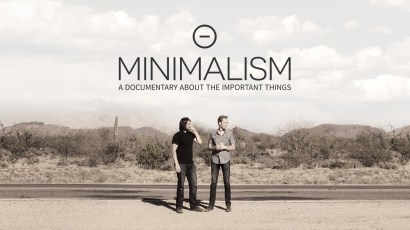
That was the line that zinged me from the documentary entitled Minimalism (available on Netflix).

maxresdefault

For those not familiar:

Minimalism is a lifestyle that helps people question what things add value to their lives. By clearing the clutter from life’s path, we can all make room for the most important aspects of life: health, relationships, passion, growth, and contribution.

(“The Minimalists,” Joshua Fields Millburn & Ryan Nicodemus – see here)

The documentary introduces a wide variety of people, who, despite great “success” in the corporate world, grew dissatisfied with their lives of compulsive consumption.

“We’ve been told that more stuff will make us happy,” they all say, “but that wasn’t the case for me.”

The solution was to shrink their human footprint (often radically), in order to find more time, more money, more freedom, and more meaning.

It worked, allegedly, and each one proudly preached the gospel of minimalism with the zeal of a hemp-shoed televangelist.

JUST ANOTHER FORM OF EXCESS?

From my perspective, there’s much to love about the movement.

Yet I was also struck (occasionally) with the sense that, for some, “minimalism” seemed like just another species of excess and one-upsmanship.

Instead of merely downsizing the McMansion, “true believers” were shown luxuriating in their Derek Zoolander-inspired center-for-ants-sized “tiny homes” (which often retail for more than my last actual house), and gushing about how their lives are so much better now that they have one pair of pants.

“I woke up really SAD one day… And then I realized, it was that second pair of slacks.” ~Fake quote.

This is, of course, an exaggeration—and Joshua and Ryan (“The Minimalists”) are quite keen on tempering such impressions.  Minimalism will mean different things to different people. And as they say, it’s not about what you get rid of, it’s about “Everything that Remains” (see here).

Perhaps, then, the extremes are just more interesting to us.

After all, no one watches an A&E show called “Not really a Hoarder, but still kind-of lazy with regard to housework.” No. We want the hardcore stashers—boring mole-like mineshafts through discarded USA Todays.

And so too with the minimalist who makes toothpaste pull triple duty as hair product and underarm deodorant.

Minty fresh, from nave to chops.

We like extremes.

So whether it’s the meta comparison of “Who’s got the bigger boat?” or the micro one-upsmanship of “I live in a van down by the river (for the planet!)”—both poles can represent the same pathology.

JESUS-STYLE MINIMALISM

But having said all this….

Much of the minimalist mojo fits quite well with Jesus, and especially with his Sermon on the Mount.

“Watch out!” Christ said: “Be on your guard against all kinds of greed; life does not consist in an abundance of possessions” (Lk. 12.15). In fact:

23 life is more than food, and the body more than clothes.

24 Consider the ravens: They do not sow or reap, they have no storeroom or barn; yet God feeds them. And how much more valuable you are than birds!

27 “Consider how the wild flowers grow. They do not labor or spin. Yet I tell you, not even Solomon in all his splendor was dressed like one of these. 28 If that is how God clothes the grass of the field, which is here today, and tomorrow is thrown into the fire, how much more will he clothe you—you of little faith! 29 And do not set your heart on what you will eat or drink; do not worry about it. 30 For the pagan world runs after all such things, and your Father knows that you need them. 31 But seek his kingdom, and these things will be given to you as well

32 “Do not be afraid, little flock, for your Father has been pleased to give you the kingdom. 33 Sell your possessions and give to the poor. Provide purses for yourselves that will not wear out, a treasure in heaven that will never fail, where no thief comes near and no moth destroys. 34 For where your treasure is, there your heart will be also (Lk. 12).

CONCLUSION 

So while I will be keeping that second pair of pants, and forgoing the $400 per-square-foot tiny house, I do recommend the documentary for those of us trying to whittle down our excess in service of the Kingdom, and in pursuit of peace.

I needed it.

After all, as Jesus taught the woman at the well (Jn. 4):

You can never get enough of what won’t really satisfy you.

What’s your Bay of Pigs?

What’s your Bay of Pigs?

The Importance of Failing Hard and Learning.

Is it possible that the greatest failure of JFK’s presidency saved the world from nuclear apocalypse?

In recent months I’ve been binge-listening to Dan Carlin’s Hardcore History podcast (check it out here), and in his most recent offering, he delves (for six hours!) into the background of the Cuban missile crisis.

The episode is breezily entitled “Destroyer of Worlds,” and it gives a frightening look at how close we actually came to an atomic Armageddon.

One suggestion for why this didn’t happen, however, has to do with what was undoubtedly the biggest and most public embarrassment of JFK’s young presidency: the Bay of Pigs.

As Carlin points out, Kennedy largely inherited the proxy invasion of Cuba from his predecessor, Dwight D. Eisenhower. Yet the previous administration had run out of time to carry out the attack. So while JFK reportedly had misgivings (hindsight is always 20/20 isn’t it…), he chose to go along with the Generals and CIA officials who assured him that the Bay of Pigs would be a huge success.

It wasn’t.

The invaders were slaughtered and the ensuing controversy mired the president in a flaming pile of “covfefe” from the early days of his administration.

Even so, Kennedy reportedly learned a lesson from his epic failure: Don’t simply go along with what the experts are telling you. Sometimes the “experts” are wrong.

THIRTEEN DAYS IN OCTOBER

According to some historians, this painful lesson proved invaluable in October 1962.

With word that the Soviets were installing nuclear warheads just 90 miles from the U.S. coast, the president and his advisers began a thirteen-day game of atomic poker.

What we now know from these marathon meetings (because of Kennedy’s secret taping system) is that several generals were urging the president to push the big red button, just as they had previously advised Truman to do the same (even after WW2 was over).

“If you wait, we’re dead” was the logic employed. Thus the “only option” was to launch hundreds of nuclear warheads toward dozens of Russian cities.

While I can’t imagine the pressure of that decision, some historians trace Kennedy’s pursuit of a more diplomatic solution to his early error at the Bay of Pigs.

His prior decision to “shoot first, and ask questions later” had blown up in his face. And that same advice was now coming again, but with greater consequences.

It’s possible then that the memory of Bay of Pigs kept the Cuban crisis from becoming Armageddon.

WHAT’S YOUR BAY OF PIGS?

Of course, not everyone reads the story quite like this (See Garry Wills’ scathing critique of Kennedy’s Cuban policy [here]).

Still, the principle holds true even if the history is complicated.

Early failures can be invaluable if we learn from them.

And in one way or another we all have our “Bay of Pigs.”

Each of us can look back at past decisions that were embarrassing and painful.

There was the choice to flunk out of college freshman year, because beer was more interesting than biology.

There was the decision to turn an ill-advised relationship into an ill-advised marriage.

Or the early and repeated conflation of “cash” with “credit.”

While none of this is quite on par with nuclear holocaust, even smaller embarrassments can serve as sacrifices on the altar of wisdom.

If we recognize them.

So what’s your bay of pigs?

And what did you learn from it?

We don’t have a theodicy, yet.

We don’t have a theodicy, yet.

This last weekend brought the first in a four-week class I’m teaching at our church on “Critiques of Christianity.”

This session was on: “The Problem of Evil.”

And sadly, but appropriately, it came after yet another terrorist attack in England.

THE DANGER WITH APOLOGETICS

Terrorism aside, my worry with some “apologetics” is that Christians often approach objections to the faith with “girded loins” and “sword in hand.”

Indeed, one popular (and quite good) apologetics text even features a sword-fighter on the cover, slashing away at an unseen opponent.

To be fair, the illustration is rooted in a biblical call to “contend for the faith” (Jude 1.3) and “give a defense” for “the hope that is in you” (1 Peter 3.15). And the Bible itself can speak of being armed with the “the sword of the Spirit” (Eph. 6.17).

Still, the optics of “stab-n-slash” apologetics are (shall we say) not the best for winsome dialogue.

After all, few people change their minds because they lost an argument.

Which brings us to the problem of evil.

THEODICIES 

For some, the very fact that evil exists is seen as disproving an “all-good” and “all-powerful” God. The claim is quite familiar: If God were all-good, he would not want evil. And if God were all-powerful, he could prevent it.

In response, theists have crafted various “theodicies”—which give answers as to why an all-good and powerful God might nonetheless permit evil.

The most common theodicy is termed the “Greater Good Defense.”

In short, this argument says that perhaps some worthy goods can only be achieved with the presence, or at least the possibility, of evil.

Of course, this all sounds quite rational until one is blindsided—experientially—with a form of evil that is hardly academic:

A child facedown in a backyard pool.

A pedophilic camp counselor.

A cheating spouse.

Or perhaps even harder are those things that we (unfortunately) call “acts of God.” My colleague’s son was killed by a lightning strike.

And to amend the words of Ta-Nihisi Coates: “The [storm cloud] cannot be subpoenaed.” Just ask Job.

TWO ATTEMPTED ANSWERS

Nonetheless, the so-called “Greater Good defense” comes in two major forms: Appeals to divine glory, and appeals to human freedom.

  1. Glory Theodicies. 

In so-called “glory theodicies,” the greater good is the glory God receives as he contrasts, judges, and ultimately conquers evil.

From this perspective, God is seen as even more exalted, gracious, and holy when set against the dark backdrop of sin and death.

Unfortunately, in some forms (namely: divine determinism), this view also can impugn God’s good character.

After all, a determinist deity seems willing to ordain all manner of atrocities in pursuit of his renown. And what kind of god is that?

Hence, a second and more popular theodicy is called “The free will defense.”

  1. Free Will Theodicies.

The greater good here is not “free will,” but something more significant: the possibility of a genuine love relationships between God and humans.

As the story goes, “Love” requires freedom, and for creatures freedom means the possibility of pain.

In the view of C.S. Lewis:

To love at all is to be vulnerable. Love anything and your heart will be wrung and possibly broken.

And more extensively:

Some people think they can imagine a creature which was free but had no possibility of going wrong, but I can’t. If a thing is free to be good it’s also free to be bad. And free will is what has made evil possible. Why, then, did God give them free will? Because free will, though it makes evil possible, is also the only thing that makes possible any love or goodness or joy worth having. A world of automata -of creatures that worked like machines- would hardly be worth creating. The happiness which God designs for His higher creatures is the happiness of being freely, voluntarily united to Him and to each other in an ecstasy of love and delight compared with which the most rapturous love between a man and a woman on this earth is mere milk and water. And for that they’ve got to be free.

But there are issues here as well.

One objection is that the human will seems hardly “free” in many instances. Hence Scripture (e.g., Rom. 7) sometimes paints a picture of the will as being bound apart from God’s grace, and the work of the Holy Spirit

(Incidentally, both Calvin and Wesley agreed on this.).

Our liberty is limited in a thousand ways—by genetics, environment, and other actors.

Hence absolute freedom is a pipe dream. You’d have to be high to believe in it.

The options, then, are that humans either had free will and lost it. Or we retain some measure of it only by God’s grace and Spirit.

Either way, the free will defense (which I actually find quite helpful) still presents us with unanswered questions.

And that brings us to the title of this post.

WE DON’T HAVE A THEODICY, YET

The name of the class I’m teaching (“Critiques of Christianity”) is proudly stolen from one taught by one of my old seminary professors: Dr. Rick Lints.

And as I looked over my old handwritten notes, I found scribbled there this phrase:

“We don’t have a theodicy, yet.”

The point here is not that appeals to glory and freedom are useless, but that they do not fully crack the code of monstrous evil.

They too stand silent before Auschwitz.

And they too fall short when we encounter evil personally. As proof, even C.S. Lewis famously repudiated (if only briefly) his earlier theodicies when his wife Joy died of cancer.

Even he—the greatest “apologist” of the last two centuries—did not yet have an adequate theodicy.

As the Scottish theologian T.F. Torrance argued, evil cannot be rationally explained, because evil is not rational.  It exists contra ratio and contra Deum. 

After all, what is rational about the recent terror attacks in Manchester and London?

What is rational about the repeated decisions of, say, Anthony Weiner?

Come to think of it: What is rational about some my decisions?

For these and many other reasons, we don’t have an adequate theodicy.

“YET”

But the next word is important also—“Yet.”

The hope of Christians is not that we will explain evil—but that we will “outlast it.”

Hence the Scriptures (and famously, the book of Job) offer no full answer to “Why bad things happen to good people.”

That’s a modern question, not a biblical one.

In Scripture, we learn only that God opposes evil, that he will one-day end it, and that he invites us to be part of the campaign—frail and faulty though we are.

Sword-less but well armed.

13 Reasons Why Not

13 Reasons Why Not

There is a danger in decrying certain elements of pop culture.

In many cases, the very breath that’s used in criticism serves only to fan the flame you’re trying to extinguish.

Boycotts build bestsellers.

And the best way to ensure the popularity of a book or movie is to try and ban it.

So this is not a move to ban or boycott; but it is a note of quiet resistance to what is now the most controversial show on television: 13 Reasons Why.

THE STORY

The series is an adaptation of Jay Asher’s 2007 novel chronicling the tragic life of Hannah Baker, a high schooler who kills herself after leaving behind 13 tapes to explain why she did it.

Each tape is devoted to a different person in Hannah’s life, and together they plot a path of bullying, betrayal, and most horrifically–a brutal rape.

At points, the series is poignant and heartbreaking.

The characters of Hannah and Clay (her love interest) are well cast and well acted. The soundtrack is fantastic, and the buzz around the show proves what has been obvious for some time: network television has long-ceased to tell stories that folks under fifty even remotely care about. (This too was a suicide of sorts – but less lamented.)

At other points, however, the show is badly broken.

And not just for moral reasons.

ONLY THE CLICHÉS EMERGE UNSCATHED 

With all the talk of death in 13 Reasons, one thing that lives eternal are the wooden stereotypes.

Indeed, most episodes could have come with a disclaimer that despite appearances, “No clichés were harmed in the making of this mixtape.”

“The popular kids are always mean,” says Hannah. “That’s how they get popular.” No lack of nuance there.

The assessment is fairly simple:

  • Athletes are dumb and despicable.
  • Rebels are kind, though misunderstood.
  • And if you own a letter jacket, you’re half Nazi, half Neanderthal.

While acknowledging that there is some truth to the Darwinian dictum that “the strong eat the weak” within the wild of high school, these sorts of oversimplified clichés are enough to make Saved by the Bell seem complex by comparison.

The real problem, though, runs deeper.

THE BACKLASH

While the show’s intent is (ostensibly) to shine a light on the terrible effects of bullying behavior, many experts say that it will have another consequence: more suicides, not less.

In the view of Trevin Wax (here):

In trying to fight bullying, this show lifts up suicide. It gives the main character a noble way out, a martyrdom of sorts, a tragic but glamorous finale (displayed in graphic detail) that goes against virtually every best practice for addressing suicide responsibly.

For Hannah, suicide is a weapon to be wielded against a culture of shame and brutal violence.

Yet what may escape the audience is that this selfish act merely perpetuates the problem. It continues the graceless cycle of violent shaming. And it ends up valorizing the very beast that devoured Hannah in the first place.

To be sure, Hannah’s predators deserve to be punished—severely. Yet the road she chooses merely reiterates the rapist’s verdict: Some lives are expendable; some bodies are mere means to a vindictive end.

In Wax’s even harsher judgment:

Most people think that 13 Reasons Why is about a group of teenagers, who in their selfish actions and inaction, are responsible for killing a fragile young girl. No. This is a show about how a girl, beyond the grave, kills her classmates.

And I’d add: her parents.

While suicide is complex—with contributing factors like mental illness, clinical depression, and even chronic brain injury—13 Reasons gives little hint that such forces account for Hannah’s choice. She’s just a happy girl who was driven to this end by bullies. What choice did she have?

And that’s a dangerous depiction.

THE OTHER HANNAHS

If there is a silver lining to the show, it is the conversation that it may spark (in places like this) regarding how we ought to deal with bullying, sexual assault, and suicide prevention.

And we must.

The very title of this post was stolen from a message by my friend Aaron Stroman as he preached hope to the high school students in his own youth group.

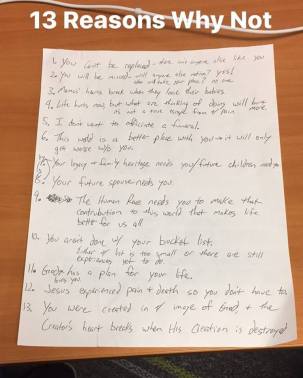
Instead of 13 Reasons Why, he gave “13 Reasons Why Not.”

Because the Gospel claims that even the darkest moments can be made new.

13whynot

As a ministry professor, one thing I never expected was the number of students—even from Christian families—who would eventually recount for me a tale that sounds a bit like Hannah’s.

“I was bullied terribly.”

“I was raped in high school.”

“I thought no one would believe me.”

Or worse yet: “No one did.”

Yet unlike Hannah, these women did not take the violent way out. They pursued help and hope and healing.

For such reasons, they are the far more interesting case studies.

They are the ones who deserve an audience.

And I’ve learned far more from them than Hannah Baker.

“Ocupado”

“Ocupado”

On Catholic Crosses, Welcoming a Son, and “Being Gangsta”

When I was five or six, I remember being allowed to visit the local Dollar General Store to spend “my very own money” on whatever I liked.

I selected a massive golden crucifix on a gaudy golden chain.

I was (and am) a Gangsta.

Upon showing the purchase to my parents, I was informed that I had made a slight mistake. This was a “Catholic” cross, as evidenced by the gold-plated Jesus hanging from it.

While we were cool with the Catholics, I was told that “Our crosses are empty.”

The point, for Protestants, is that Jesus is no longer on the cross—he’s risen—so we prefer our sacred death-devices to be unoccupied. Or for my Spanish readers: desocupado.

El Jesús del hospital

Fast-forward thirty years and I sit now inside a Catholic hospital where I will also be allowed to spend some of my “very own money”—but it’s been worth every penny.

Yesterday, we unexpectedly welcomed our fourth child (Theodore Brian) three weeks early.

Teddy

And right above my head, as I now type, there is another Catholic crucifix.

And somehow it seems fitting.

Yesterday, when Teddy was born, he was having some trouble breathing. While the doctors weren’t too worried, his respiration was far more rapid (that’s: rapido) than desirable. And to make matters worse, he could not go to Brianna’s room to in such a state.

So there I sat in the nursery—stripped to the waist so he could feel my skin—singing “Hush little baby” in front of a plate-glass window through which onlookers watched a topless professor who probably looked like a pasty primate trying to “nurse” a baby (*despite some gender confusion).

Mire mamá, un chimpancé blanco

Thankfully, Teddy is fine – but as I sit now under a suspended Christ, I am thankful for the Catholic crucifix. It is not necessarily better than its more triumphant counterpart, and in some ways it may occasionally be prone to fetished misconstrual.

But in some settings—like the hospital—it also seems more helpful.

By it I was vividly reminded that mine was not the only Son to struggle for breath in a world that is harsh and cruel compared to that from whence he came. And unlike mine, this other Son could not feel his Father’s presence, much less his skin.

Eloi, Eloi…, he screamed, and was not comforted. 

Señor Grünewald

Rewind five hundred years and a man named Matthias Grünewald sits painting an altarpiece for a monastery that doubled as a hospital.

891px-matthias_grc3bcnewald_-_the_crucifixion_-_wga10723
M. Grunewald: The Isenheim Altarpiece

The location, Isenheim, in France, had been afflicted by a terrible plague that manifested in festering sores upon the skin.

Like Jesus, its survivors were forever scarred.matthias_grc3bcnewald_-_the_crucifixion_28detail29_-_wga10790

Famously, Grünewald infected Christ. He chose to paint the sores upon the Savior.

The message was clear. As the Book of Hebrews states: We do not have a High Priest [Jesus] who is unable to sympathize with our travails (Heb. 4.15). He knows. He’s been there.

He knows what it’s like to gasp for breath, to have a prayer go unanswered, to feel betrayed by friends, belittled by cynics, and beaten up by bullies. He was murdered naked in front of his own mother. And while the good news is that the cross is no longer ocupado, sometimes it helps to see—yes, actually see—the Catholic version.

Because while language is a gift, some images transcend translation.